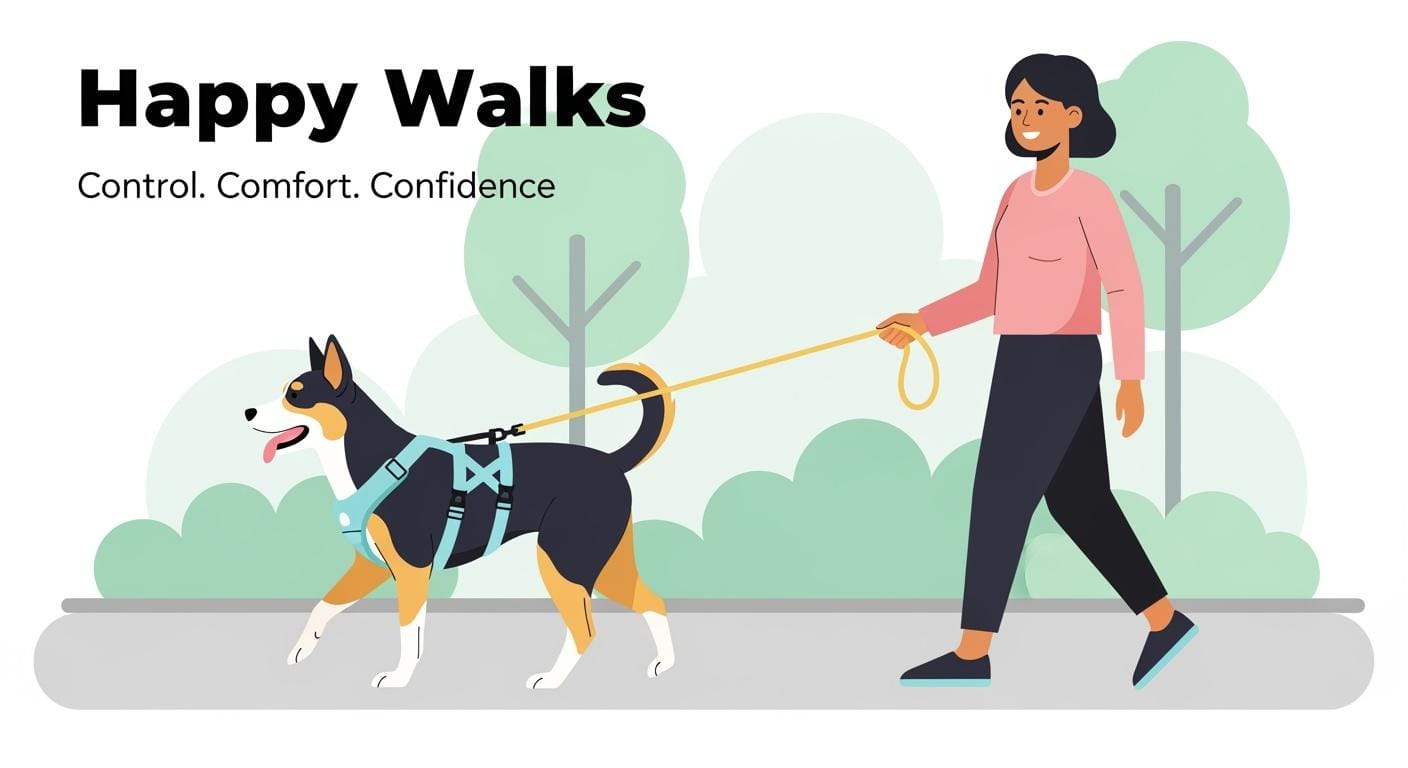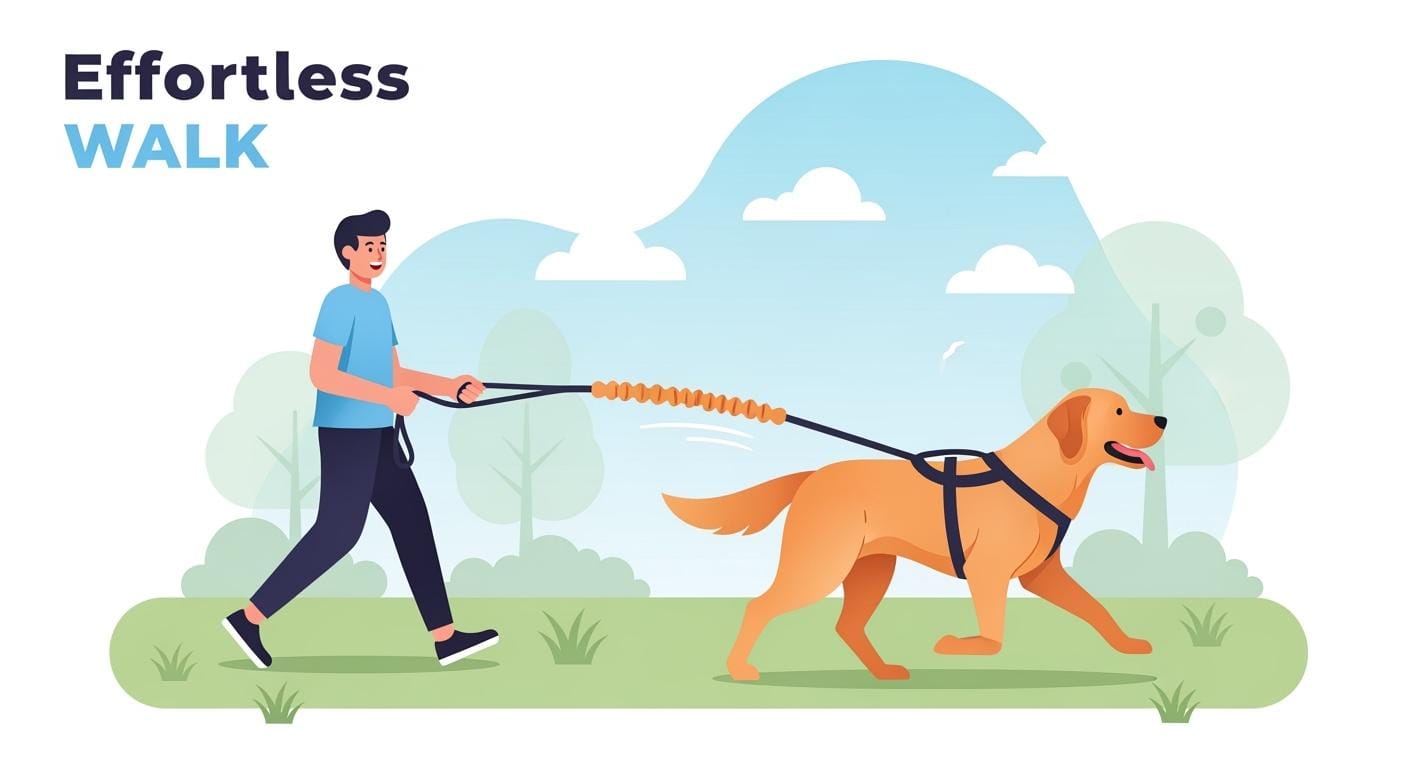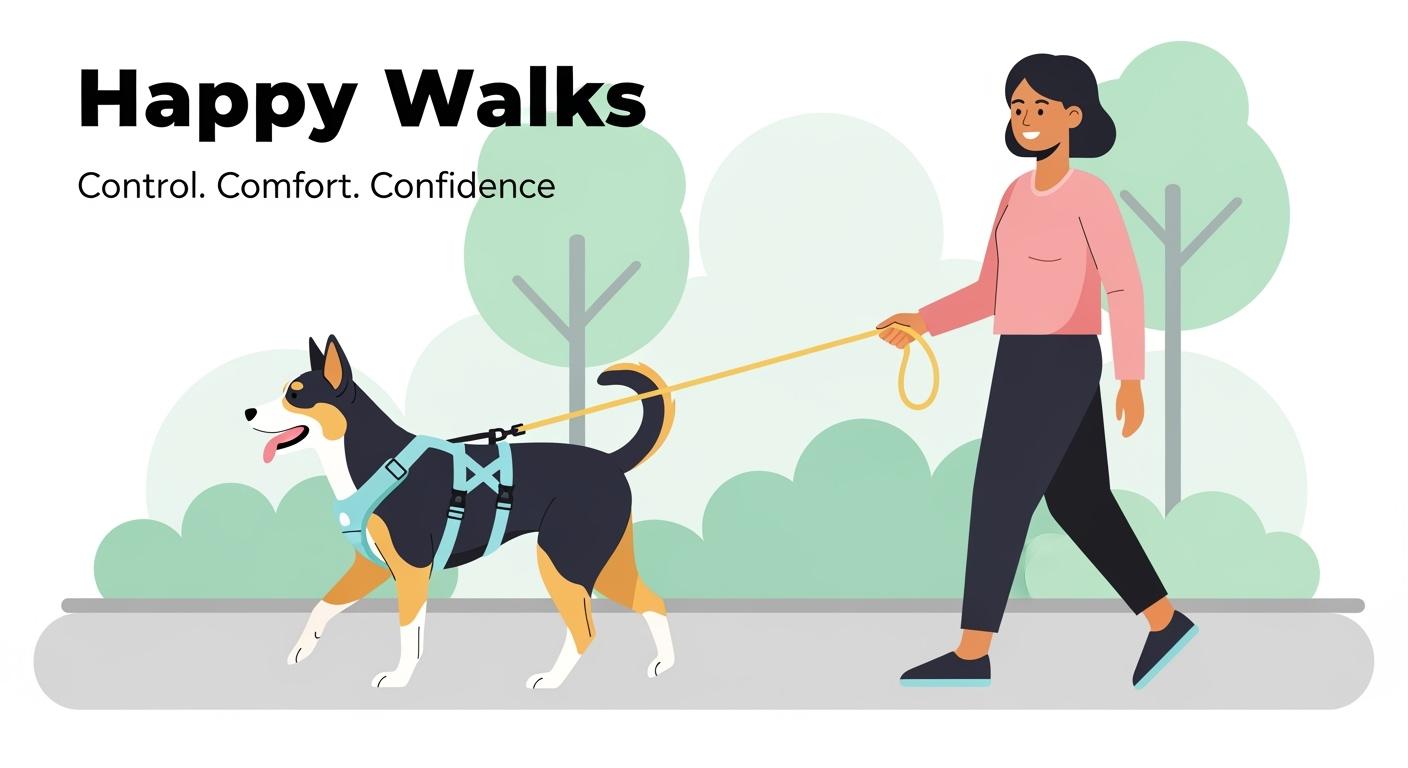
A medium size dog harness no pull works by redirecting forward momentum through the front clip. But redirection only holds if the chest panel stays centered. When the panel twists sideways — the front ring drifts toward the shoulder, a strap creeps toward the armpit, and the dog resumes pulling straight ahead — the no-pull mechanism has already failed. The problem is rarely the dog. It is the panel’s resistance to rotational torque.
Why the Chest Panel Twists Under Load
The Mechanical Chain of Chest Twist
When a medium dog pulls forward against a front-clip harness, leash tension enters at the front ring and creates a moment arm that wants to rotate the chest panel around the dog’s torso. The force travels through the panel fabric and meets the girth strap at the side of the ribcage. If the chest panel is narrow — under roughly two inches at its widest point — it has almost no resistance to this torque. The panel folds against its short axis, the front ring follows the direction of pull, and within a few strides the clip migrates toward the dog’s shoulder. At that point the redirective mechanism is gone: the dog pulls straight forward, and the harness functions like a back-clip setup with extra hardware that no longer does its job.
This is not a fit problem first. It is a structural problem — the panel lacks the width and rigidity to create a counter-moment against the pull force. A wider panel spreads the load across more fabric area and gives the girth strap a longer lever arm to resist rotation. That is the physical reason a stable chest panel matters more than strap tightness.
How to Spot Twist Before the Walk Falls Apart
You can check whether twist is happening mid-walk. After ten minutes of forward walking on a standard 4-to-6-foot leash, stop and look at the front ring. It should still sit on the centerline of the dog’s chest, not drifted more than an inch toward either shoulder. Run your hand along the inside face of the chest panel — if the panel stayed flat, the inner surface feels uniformly warm and slightly damp from contact. Dry patches surrounded by damp fabric mean the panel lifted or rotated during movement and lost full chest contact. That is your signal: the no-pull mechanism is degrading, and the harness needs a different structural approach, not tighter straps.
| Failure Sign | Structural Cause | Better Design Direction |
|---|---|---|
| Front ring slides sideways | Chest panel too narrow to resist torque | Wide, firm chest panel with centered ring |
| Chest panel rotates off center | Girth strap positioned too close to elbow | Girth strap placed behind front legs, Y-front shape |
| Strap migrates toward armpit | Panel folds under load, shifting strap path | Adjustable neck and chest sections, structured panel |
Why Medium Dogs Magnify the Problem
Medium-sized dogs produce a specific combination of force and mobility that stresses no-pull harnesses differently than small or large dogs. They generate enough pull force — typically from a body mass in the 30-to-70-pound range combined with an active, direction-changing gait — to overcome a narrow chest panel’s rotational resistance. But they are also compact enough that a small shift in panel position represents a larger percentage of their chest width. A half-inch drift on a Labrador looks minor; the same drift on a Border Collie puts the front ring well off center. The result: harnesses that hold steady on large dogs can fail systematically on medium frames. The panel needs proportionally more width relative to the dog’s chest circumference, not just a scaled-down version of a big-dog design.
Design Features That Keep the Panel Stable

Centered Front-Clip Geometry
The front ring must sit on the sternum centerline — not slightly high, not slightly off to one side. When the ring is centered, leash tension pulls equally against both sides of the chest panel. That symmetry is what converts forward pull into a gentle turn rather than a sideways panel rotation. Offset rings create an immediate torque bias; the panel rotates toward whichever side the ring favors. This is why a measured center placement — not just “centered-looking” — matters. On a well-designed no-pull harness, the ring position is set by the panel’s cut pattern, not by after-the-fact adjustment. If you can shift the ring’s position by tightening one strap more than the other, the geometry is already compromised.
Chest Panel Width and Structural Rigidity
A chest panel that folds under load cannot redirect. The panel needs enough width to create a meaningful lever arm against rotational torque — on a medium dog, that typically means a panel that spans at least a third of the chest width at its narrowest point. But width alone is not enough. The panel fabric must resist folding along its vertical axis. Soft, single-layer fabrics collapse under tension; they fold like a napkin and carry the front ring with them. A panel built from a stiffer-faced fabric with edge binding or internal reinforcement resists that fold. The difference is visible mid-walk: the panel stays flat and follows the dog’s chest contour rather than puckering into a ridge along the line of pull.
This same structural logic applies across pulling styles. Steady pullers and sudden lungers load the panel differently — sustained tension versus impact spikes — but both demand the same resistance to folding. A panel that stays flat under steady load may still buckle under a lunge if the fabric lacks enough bending stiffness.
Girth Strap Position and Y-Front Shoulder Clearance
The girth strap anchors the chest panel against the dog’s ribcage. If it sits too far forward — crowding the elbow — the panel loses its rear anchor point and rotates freely. If it sits too far back, the panel rides up toward the throat when the dog pulls. The correct position places the girth strap directly behind the front legs, over the ribcage where the chest is structurally firmest. A Y-front shape that splits around the neck and rejoins at the chest bone leaves the shoulder joint unobstructed. The dog’s foreleg can swing forward without pushing against strap material, which means the panel stays planted during stride extension — one of the most common moments for twist to begin.
Training harness fit checks that verify shoulder clearance and girth strap placement tend to catch twist problems before they become habits. A quick stride test — watch the dog take three full walking strides and check whether the panel stays centered — reveals more about stability than any static measurement.
Material Choices That Resist Folding
Edge binding, laminated face fabrics, and moderate-density padding all contribute to a panel’s resistance to folding. Soft neoprene alone, without a structural face layer, compresses under tension and loses its shape. Breathable mesh backed by a stiffer woven face gives the panel enough rigidity to hold its form while still passing air. The hardware also plays a role: metal D-rings and adjusters add negligible weight but hold strap position under load far better than plastic equivalents that can flex open slightly under sustained tension — a small deformation that, over minutes of walking, lets the panel creep off center.
Disclaimer: The twist checks and panel-width guidelines described here assume a smooth-coated medium dog where harness position is visually clear. Double-coated breeds may show subtler strap movement that requires hand-checking along the fabric edge rather than visual inspection alone. Dogs with a pronounced barrel chest or very deep keel may experience different pressure distribution patterns — the panel can stay centered while still creating localized pressure points that these checks cannot capture.
Fit Verification That Catches Twist Early
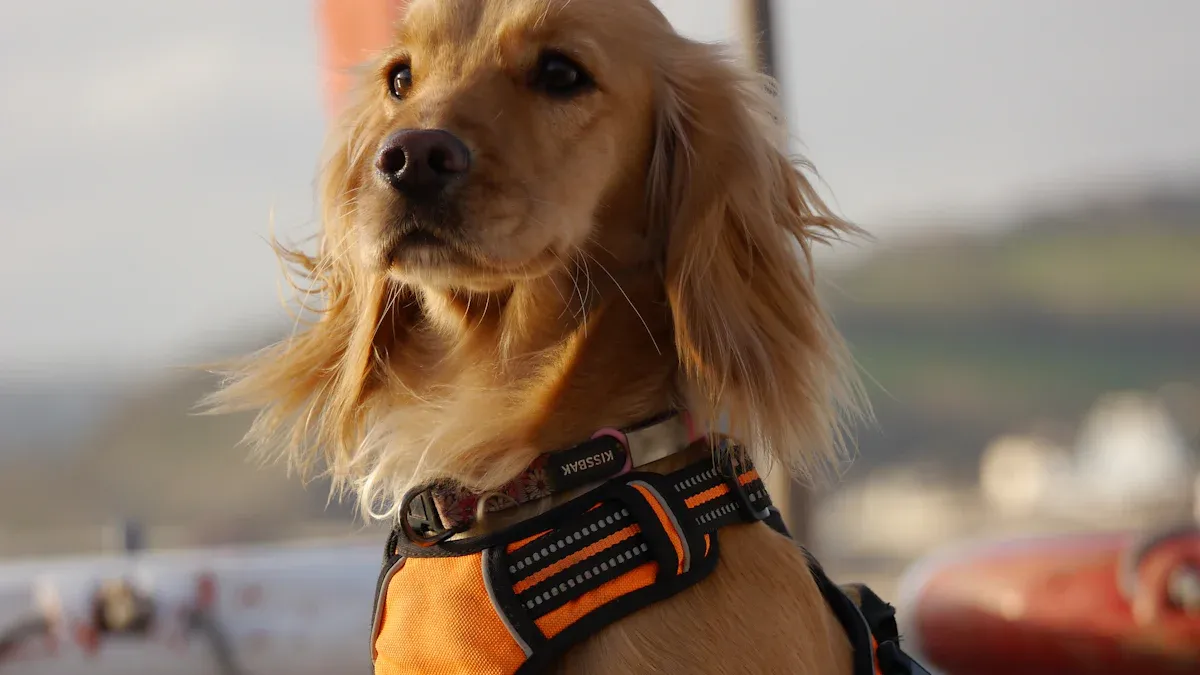
A harness that fits at a standstill can still twist under movement. Fit verification needs to happen under load. After strapping the harness on — neck and chest sections adjusted so two fingers slide under each strap with resistance but not ease — walk the dog at its normal pace for five to ten minutes. Then stop and check three things: the front ring position relative to the sternum centerline, the girth strap position behind the elbows, and the inner panel contact described earlier. If any of the three has shifted, the harness structure is losing against the dog’s pull mechanics.
Overtightening does not fix this. Tight straps do not create structural rigidity — they only compress soft tissue and restrict stride. A harness that twists under moderate tension will still twist under overtightened straps. The fix is a different panel structure, not a different strap setting. Medium dog harnesses that drift toward the shoulder during walks almost always trace back to panel width or girth strap geometry, not strap tightness.
Strap creep is a separate signal. If the buckles hold position during the walk — meaning the strap length you set at the start stays put ten minutes later — the hardware and strap material are doing their job. Slipping adjusters compound twist problems by introducing slack where the panel needs tension to stay planted. Training harnesses with locking adjusters and low-stretch webbing tend to hold their settings across an entire walk, which keeps the panel anchored at the dimensions you set.
When a No-Pull Harness Is the Wrong Tool
A centered-panel no-pull harness works best when the dog pulls steadily forward — the load path is predictable, and the panel can create a consistent counter-moment. It is less effective when the dog pulls in unpredictable directions or lunges sideways. Sudden lateral loads can overcome even a well-designed panel because the force enters from an angle the structure was not built to counter. In those cases, pulling harness fit and control strategies may need to shift toward a dual-clip setup or a different handling approach altogether.
| Situation | Why the Design Fights Back | What to Try Instead |
|---|---|---|
| Deep-chested breeds (Dobermans, sight-hounds) | Chest panel may not sit flat against the sternum | Harness patterned for deep-keel chest shapes |
| Dogs with thick double coats | Padding traps heat, panel contact is harder to verify | Minimal-padding harness with hand-check routine |
| Sudden lateral lunges (reactive dogs) | Panel counters forward force, not side-load torque | Dual-clip harness or head collar for directional control |
| Dogs that freeze or back out of gear | Forward-pull redirection is irrelevant to backing out | Martingale-style harness or escape-resistant design |
The design works. But no design works for every dog. The question is whether the failure mode you are seeing — twist, drift, fold — matches what this structure was built to solve. If the answer is yes, the fix is a better panel, not more tension. If the answer is no, the fix is a different category of tool.
Disclaimer: If the dog’s chest shape falls well outside the breed norms this harness design was patterned for — particularly dogs with a pronounced barrel chest, very deep keel, or unusually narrow sternum — the centered-panel geometry described here may not distribute pressure as intended. In those cases, pressure mapping is best done by hand: after a walk, run fingers along the full strap path and check for localized heat, dampness, or indentations that persist more than a minute after removing the harness.
Häufig gestellte Fragen
How can you tell if the chest panel is wide enough for your medium dog?
After a ten-minute walk at normal pace, check the front ring position relative to the sternum centerline. If the ring has drifted more than roughly an inch toward either shoulder, the panel lacks the width or stiffness to resist the rotational torque your dog generates.
Does a dual-clip harness prevent twist better than a front-clip-only design?
A dual-clip harness gives you a second attachment point — typically at the back — which can act as a secondary anchor and reduce the rotational load on the front panel. But the chest panel still needs its own structural stability. Two clips cannot fix a panel that folds under single-clip tension.
Why does the harness stay centered on my large dog but twist on my medium dog?
Medium dogs produce a different ratio of pull force to chest width. A narrow panel may resist torque adequately on a broad-chested large dog but fail on a medium dog where the same absolute panel width represents a smaller proportion of the dog’s chest. The panel must scale to the dog’s chest geometry, not just its weight.
Does padding thickness help prevent twist?
Padding adds comfort, not structural rigidity. Thick padding without a stiff face fabric can actually make twist worse — the padding compresses unevenly under load, creating a wedge shape that encourages the panel to roll toward the compressed side. The panel’s resistance to folding comes from its face material, edge construction, and width, not from padding depth.