Slide a pet travel carrier under an airline seat and the outside dimensions check out. That does not mean the inside stays breathable. Compression changes everything. A mesh panel that looked wide open on the kitchen floor can end up pressed flat against a seat bracket or a bulkhead, cutting off the only path for fresh air. The design problem is not whether the carrier fits the tape-measure rules. It is whether the ventilation survives the squeeze. Two features decide that: where the mesh sits, and whether the carrier has enough internal structure to stop the walls from folding inward and covering it.
Why a Carrier That Fits Can Still Fail on Ventilation
What Happens When Mesh Meets a Hard Surface
When you push a soft-sided carrier into a tight under-seat cavity, the force does not distribute evenly. The tallest point — usually the roof — takes the downward pressure first. That force travels through the roof panel into the sidewalls. If the sidewalls are just fabric with no internal frame, they buckle. The mesh window, now folded at an angle, presses against the seat frame or the carpeted bulkhead.
Here is the causal chain: compression transfers through the roof → sidewalls buckle inward → mesh surface area is lost against a hard surface → cross-ventilation stalls → interior temperature rises → the pet shows heat stress. A single blocked mesh panel can turn a carrier into a still-air pocket within minutes. The air needs both an entry and an exit path. Block one, and convection stops. The carrier holds heat instead of shedding it.
You can verify this without waiting for your pet to pant. After stowing the carrier in the actual travel position, run your hand along each mesh panel from the outside. If the mesh touches a hard surface with no finger-width gap, that panel is functionally closed. Check at least two panels — one on each side of the carrier. A carrier with mesh on only one or two sides risks losing all airflow if those specific panels end up against a seat or wall.
In practice: The carriers that fail fastest in tight spaces are the ones with a single large mesh panel on the front and nothing else. That panel looks generous on a product page. Under a seat, it is the first surface to press against the seat frame in front of it.
Outside Fit Versus Usable Ventilation
A carrier that slides into the allotted space passes the outside-fit test. That tells you nothing about whether air moves through it. The two measures are independent, and confusing them is the most common mistake in carrier selection.
| Design Check | Outside Fit | Usable Ventilation |
|---|---|---|
| Carrier dimensions within airline limits | Pass | Unknown |
| At least one mesh panel stays exposed after stowing | Unknown | Pass |
| Pet can turn around inside | Pass | Unknown |
| Air moves through carrier from two or more sides | Unknown | Pass |
Checking outside fit is the first step — not the last. The real test happens after you place the carrier in the actual travel position with your pet inside. This is why a carrier that passes a living-room fit check can fail the moment it meets an irregular under-seat cavity.
Design Features That Keep Air Moving After Compression

Semi-Structured Sides That Flex Without Folding
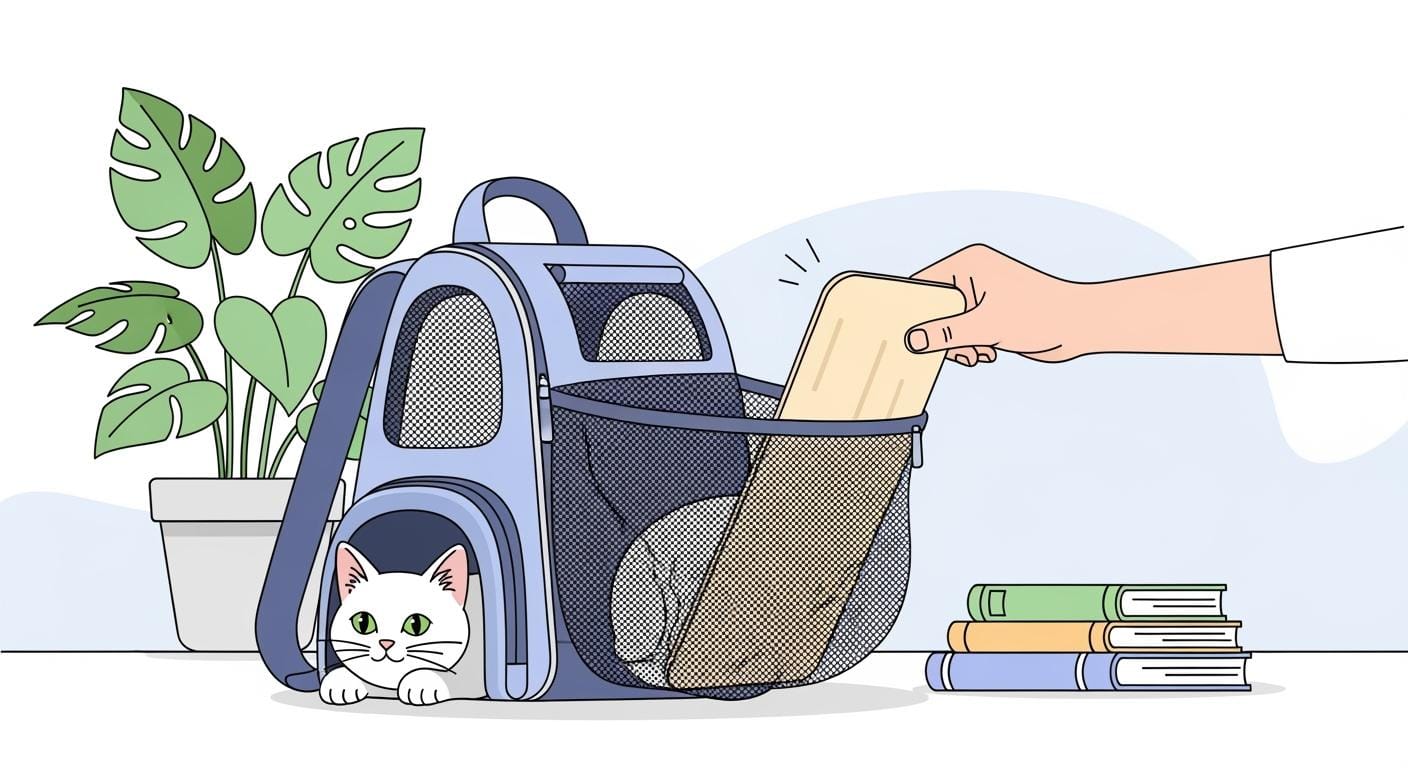
The carriers that hold up best in tight spaces share one design choice: the sidewalls give a little but refuse to collapse. They use a lightweight internal frame — often a thin fiberglass or plastic rod sewn into the perimeter seams — or semi-rigid panels sandwiched between fabric layers. The goal is controlled flex. The roof compresses enough to clear a low seat overhang. But the sidewalls stay upright.
Why this works mechanically: a vertical panel under compression has two failure modes. It can buckle — folding at a crease. Or it can bend — curving while staying intact. An unstructured fabric wall buckles. A semi-rigid panel bends, and bending preserves far more interior volume. The mesh stays oriented toward open air instead of collapsing against itself.
After loading your pet and travel gear, push down gently on the roof with one hand. Watch the sidewalls. Do they bow outward and stay upright, or do they crease inward immediately? An inward crease under light hand pressure predicts failure once the carrier slides under a seat and the weight of the cushion rests on top. Carrier fit for air travel depends more on this structural behavior than on labeled dimensions because the under-seat cavity rarely matches the shape of an unloaded bag.
Mesh Placement Across Multiple Sides
A carrier with mesh on only the front or only the top is gambling that one particular panel stays exposed. In a packed car or under a seat with a center support bracket, that panel can be the first one blocked.
Multi-sided mesh — panels on the front, top, and at least one side — builds in redundancy. Even if one panel presses against a surface, another remains open. Cross-ventilation requires at least two exposed panels: one for intake, one for exhaust. Without it, the carrier becomes a one-way pocket where warm air pools and fresh air cannot circulate. This principle matters most for small soft-sided carriers that ride under airline seats, where seat supports, life vest pouches, and footwell contours create irregular dead zones that pin mesh against hard points.
To check cross-ventilation at home: place the carrier in the spot it will ride, unzip the top, and hold a tissue near the interior back wall. Fan air toward an exposed side mesh. If the tissue moves, air is crossing through. If it stays still, the carrier has a dead-air problem — regardless of how many mesh windows the product page lists. Mesh panel count and placement are among the first features to verify on any carrier meant for under-seat use.
A Flat Base and a Roofline That Holds
Two structural failures compound the ventilation problem.
The first: a sagging base. When the floor panel is too soft — just a piece of fabric with a thin foam insert — it dips under the pet’s weight. The pet slides toward the low point. Its body presses against one sidewall, and that body contact blocks the nearest mesh panel from the inside, even if the outside is clear. The second: a roofline that collapses. If the roof sags onto the pet’s back, the top vents close and the interior height shrinks. A pet that could sit upright now has its head against fabric. The only remaining airflow path runs along the floor — the narrowest and most easily blocked path in the carrier.
A well-designed travel carrier pairs a firm, flat base insert with a roof structure that resists downward pressure. Some designs use a removable rigid floor panel; others integrate a lightweight frame into the perimeter seams. The key is that the base does not dish under load and the roof does not dome inward. An airline-approved pet carrier with a structured floor and reinforced roof keeps vent paths open even after it is compressed into an under-seat position.
When This Design Works — and When It Does Not

A carrier with semi-structured sides, multi-sided mesh, and a flat base works best for small to medium pets traveling in-cabin on commercial flights or in the back seat of a car. The design handles the specific stress of being wedged into a confined space where at least one side remains open to cabin air. A carrier bag built for airport travel needs this balance of compressibility and structural hold because the under-seat cavity demands both.
The design hits its limit in two situations. First, if the pet fills the carrier from wall to wall — chest against the front panel, hindquarters against the back — there is no air channel left inside. The carrier’s own structure cannot fix an over-packed bag. Second, if every single side presses against a hard surface — an overstuffed cargo hold, a footwell crammed with luggage — no mesh placement strategy can keep air moving. The design needs at least one face exposed to open air. For a 30 lb dog, carrier sizing must leave enough internal clearance that the pet’s body itself does not become the vent blockage.
| Design Choice | Where It Works | Where It Falls Short |
|---|---|---|
| Semi-structured sides | Under-seat compression with one side open to cabin air | Fully enclosed cavities where all sides contact hard surfaces |
| Multi-sided mesh (3+ panels) | Irregular spaces where panel blockage varies by position | When every panel presses against luggage or cargo |
| Flat rigid base | Pets under roughly 20 lb on smooth floors | Heavier pets that can deform thin floor inserts over time |
| Controlled-flex roofline | Airline seats with standard overhang clearance | Seats with unusually low clearance under roughly 9 inches |
Disclaimer: These ventilation checks assume a short-coated or smooth-coated dog or cat whose body heat dissipates readily through exposed skin. Double-coated breeds — huskies, malamutes, most shepherd types — run warmer in enclosed spaces, and the hand-check method described here may understate their heat load. For brachycephalic breeds such as pugs, Persians, and bulldogs, airflow requirements are higher in absolute terms; a carrier that passes the tissue test for a smooth-coated cat may still be marginal for a flat-faced breed under the same conditions. If your pet pants at rest in a room-temperature house, assume it needs cross-ventilation through at least three exposed mesh panels during travel.
Häufig gestellte Fragen
How do I know if my pet carrier has enough ventilation before a flight?
Place the packed carrier in the actual under-seat position at home — under a low table or a chair that mimics seat clearance. Wait five minutes, then check two things: whether you can feel a finger-width gap between each mesh panel and the nearest surface, and whether a tissue held inside moves when you fan air from an exposed side. If either check fails, the stowing position or the carrier itself needs to change.
What carrier design features matter most for airflow in tight spaces?
Three features carry the load: mesh panels on at least three sides so no single blocked panel kills all ventilation, semi-structured sidewalls that bend but do not buckle under compression, and a flat firm base that prevents the pet from sliding and blocking the remaining vent from the inside. If a carrier lacks any one of these three, tight-space performance tends to degrade fast.
Does a hard-sided carrier solve the ventilation problem?
A hard-sided carrier holds its shape, which keeps vents from collapsing. But its rigid shell often cannot compress enough to fit under airline seats with low clearance, and it leaves fewer options for stowing angles. Most hard-sided carriers also concentrate ventilation on fewer faces — typically a wire door and small side slits — so they can still end up with blocked airflow if positioned against a wall. The trade-off is shape retention versus fit flexibility, and for in-cabin air travel, the soft-sided semi-structured design usually wins on both counts.