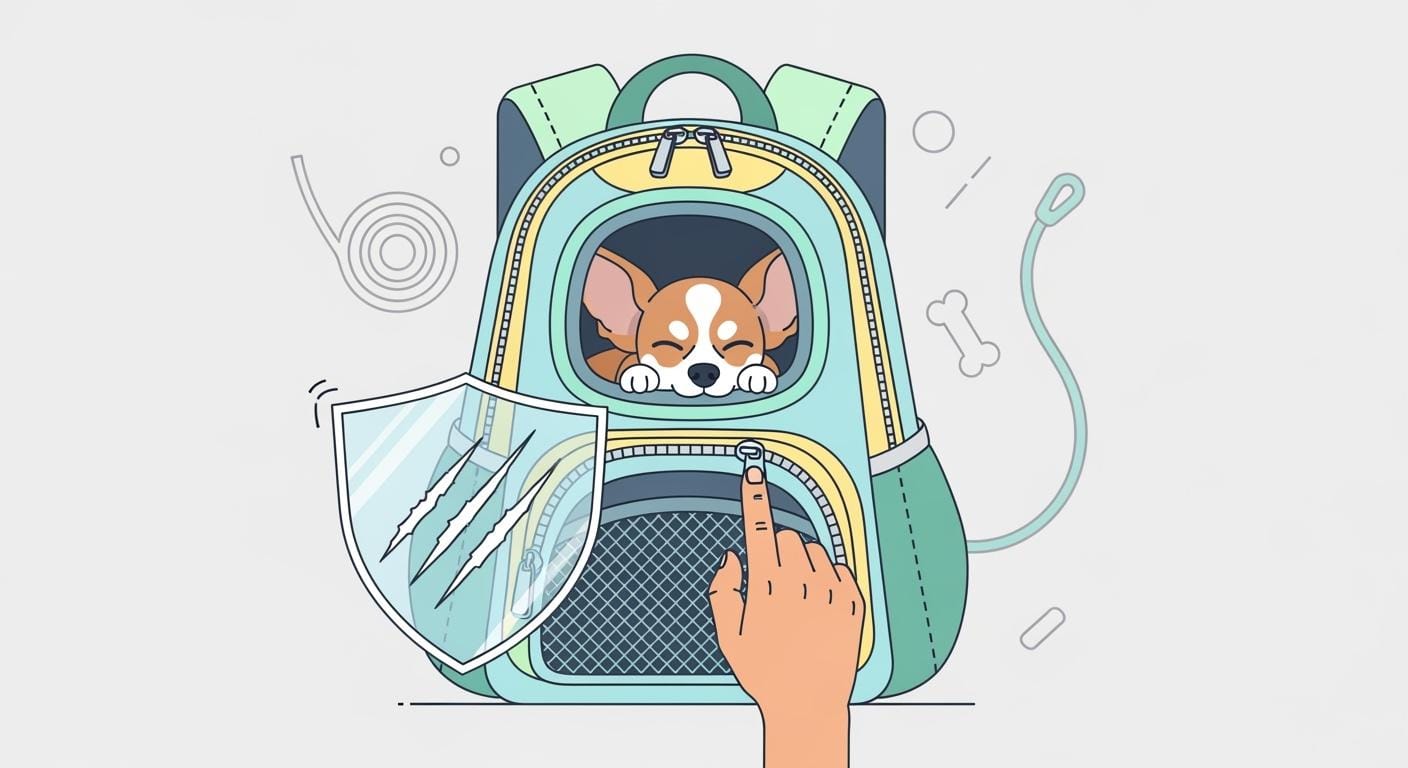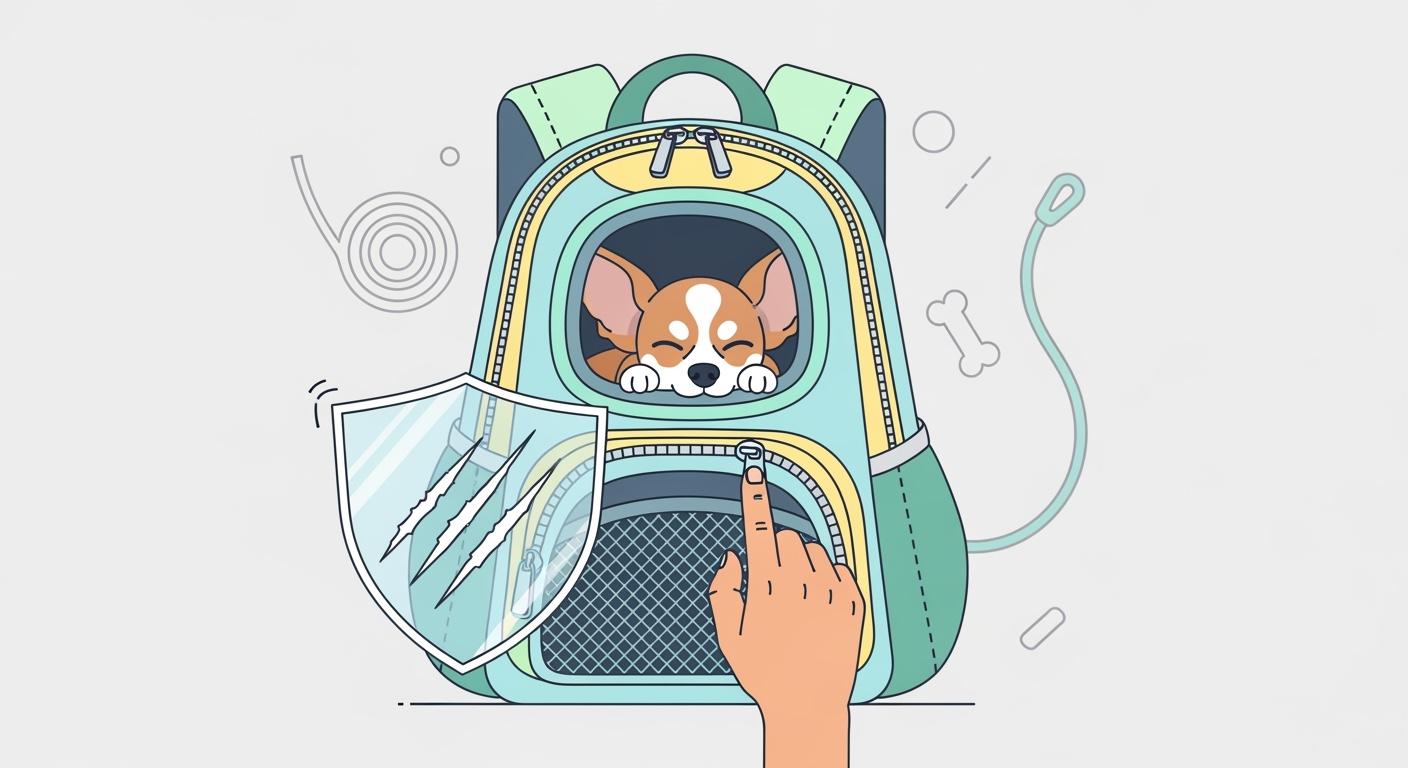
A dog carrier backpack zipper takes abuse no other zipper on your gear does. It gets pushed from inside by a moving animal. Scratched at. Pressed outward at odd angles when the carrier shifts against your back or a car seat. Most zippers are designed to keep things in against gravity and casual contact, not against a determined dog working a weak point from the inside. That difference in load direction changes everything about whether a closure holds.
Where Zippers Fail First — and Why “Closed” Does Not Mean Secure
The Physics of a Zipper Under Internal Pressure
A zipper is strongest against forces pulling parallel to its teeth — the direction a slider travels. But a dog inside a carrier rarely pushes that way. A paw or muzzle pressing outward at an angle splits the force into two components: one pulling the zipper tape apart laterally, the other sliding along the track. The lateral component is what defeats a single coil zipper. Each tooth interlocks with its neighbor across a small contact surface. When the outward push exceeds that interlock friction, the teeth cam apart from the inside — the zipper unzips itself without the puller ever moving. This is not a defect. It is the expected failure mode of any unreinforced continuous coil closure loaded perpendicular to its travel axis. The dog does not need to be strong. It just needs to push at the right angle long enough for the teeth to walk apart.
What makes this worse inside a carrier is confinement. The dog cannot get away from the zipper. Every shift, turn, or stretch puts pressure somewhere along the track. A carrier that fits too loosely amplifies this — the dog braces against one side and drives force into the opposite zipper line with more leverage than a snugger compartment would allow.
What a Fully Closed Zipper Hides
A zipper puller seated at the end of its track looks secure. It is not the same as a zipper that will stay closed under load. Run a fingernail between the closed teeth at the midpoint of the track after a 10-minute carry. A gap wider than the edge of a dime means the coil has already deformed under pressure. The teeth have spread. The next time your dog pushes at that same spot, the gap opens faster — the interlock surface is already degraded. This is an early warning that the track, not the puller, is the weak link.
The Four Stress Points — Puller, Track, Mesh Edge, Seam
Escape risk rarely starts at one isolated point. It starts where two or three of these intersect — where the zipper track meets the mesh edge at a corner, where the puller sits against a stretched seam. Each stress point has its own failure signature.
The puller. A loose zipper puller dangles. A dog notices it. Nudging, pawing, or mouthing a loose puller can slide it open — slowly at first, then in one sudden run if the dog catches it at the right angle. Auto-locking sliders resist this by engaging a small pin that drops into the track when the puller tab lies flat. Without that pin, gravity and vibration alone can migrate an unlocked puller during a hike.
The track. Coil zippers skip teeth when pulled diagonally. A single skipped tooth breaks the continuous interlock. The track then separates under lower force because the remaining teeth carry a higher share of the load — a cascading failure. Molded tooth zippers resist diagonal separation better but are stiffer and harder to operate one-handed. That trade-off matters when you are closing the carrier on a restless dog.
The mesh edge. Standard polyester mesh unravels at stress concentrations, especially where it is stitched to the zipper tape. A dog clawing at the mesh near the zipper line creates pulls and runs that spread laterally into the fabric. Once a run reaches the stitch line, the mesh begins tearing away from the zipper — a new opening forms adjacent to a still-closed track.
The seam. Tape-backed seams peel from the substrate fabric under sustained diagonal tension. The peeling starts at corners, where the zipper tape makes a 90-degree turn and the stitch density changes. Run a fingertip along the mesh-to-zipper seam after each trip. Pilling, fuzz, or loose thread ends at the corner junction mean the seam binding is beginning to separate from the base fabric — tear-out has started even if no hole is visible yet.
These four points do not fail independently. A stretched seam changes the angle at which the zipper track sits, which makes the puller easier to slide, which a dog can reach because the mesh edge has frayed just enough to expose it. The failures compound. A carrier’s sizing and panel tension directly affect how these stress points interact — a panel that is too loose lets the dog reposition against whichever point is weakest.
What Makes a Closure System Genuinely More Escape-Resistant
No single feature makes a carrier escape-resistant. The closure is a system — track, puller, mesh, seam, and panel tension each contribute, and a weakness in any one undercuts the others.
Reinforced zipper tracks and lockable pullers. A double-row stitch along the zipper tape distributes lateral load across a wider fabric area, reducing the peel force at any single point. Auto-locking sliders prevent the puller from migrating under vibration or casual contact — the lock pin engages automatically when the tab is released, so the dog cannot walk the zipper open incrementally. On a carrier with these closure features, the zipper area handles multidirectional pressure without the teeth camming apart.
Seam binding and durable mesh. Bound seams — where a separate strip of fabric wraps the raw edge of the mesh-to-zipper junction — create a load path that does not rely on a single stitch line. The binding strip carries tension along its length before transferring it to the stitch, spreading the force. Nylon mesh with a tighter weave resists run propagation better than open-weave polyester; a claw snag stays local instead of spreading into a tear. That difference is not about material thickness. It is about how the weave structure arrests a propagating failure.
The internal tether as secondary restraint. An internal tether clips to the dog’s harness and limits how far forward the dog can move inside the carrier. It does not strengthen the zipper. But it keeps the dog from reaching the zipper in the first place — the tether sets a forward limit shorter than the distance to the closure. If a gap forms, the dog is physically prevented from working it. This is the backup that matters when the primary closure takes damage mid-trip and you do not know it yet.
Panel tension. A carrier with loose side panels lets the dog shift its weight against the zipper from multiple angles, hunting for the weak spot. Properly tensioned panels limit the dog’s ability to reposition, which limits the number of angles from which force can be applied to the closure. This is why a carrier sized and tensioned for the specific dog outperforms a generic approach — the panels act as part of the closure system, not just the container.
These features work together or not at all. A lockable puller on a single-stitch track still fails at the seam. Reinforced mesh that meets a poorly bound corner still tears out. The system is only as escape-resistant as its weakest intersection.
When Design Alone Is Not Enough
A well-designed closure system has limits. A dog over roughly 30 pounds can generate enough sudden force to overwhelm even a reinforced zipper track if it panics or lunges. Dogs with anxiety-driven scratching behaviors can work a single spot for hours — no mesh weave resists that indefinitely. A carrier that is oversized for the dog gives the animal too much leverage inside, which amplifies the force on every stress point regardless of how well each is built. A carrier sized correctly for the dog’s measurements keeps the closure system within its design envelope.
Inspection catches what design cannot prevent. Before each trip, pull the zipper closed and run a thumbnail between the teeth along the full track — any spot that opens under light pressure has begun to deform. Check the four corner seams for thread lifting. Clip the internal tether and pull firmly — if the attachment point shifts or the webbing shows abrasion, replace it before the next use. Regular fit and hardware checks turn slow degradation into something you catch before it becomes an escape.
Disclaimer: These fit and inspection checks assume a dog under roughly 30 pounds in a carrier whose panel dimensions match the dog’s standing height and length. Larger dogs, dogs with pronounced anxiety-driven scratching or chewing behaviors, or carriers used in high-vibration environments such as off-trail hiking can produce forces beyond what reinforced closures are designed to withstand. No carrier closure design eliminates escape risk for every dog in every condition — a carrier is a restraint aid, not a guarantee. If the dog’s behavior includes persistent directed attacks on the zipper area, a closure alone is unlikely to be sufficient regardless of its reinforcement level.
FAQ
Can a dog escape if the zipper is pulled fully closed?
Yes. A closed zipper with unreinforced teeth can separate under lateral pressure from inside — the dog pushes outward at an angle, the teeth cam apart, and a gap forms without the puller ever moving. The closure looks intact but the interlock has failed. Lockable pullers prevent puller migration but do not reinforce the track itself; both features are needed.
What is the first place to check for zipper wear on a carrier backpack?
The corners. Zipper tape makes a 90-degree turn at each corner, and stitch density changes — this is where seam binding peels first and where mesh runs most often start. Run a finger along each corner seam after every trip; pilling or thread fuzz at the corner junction is the earliest visible sign of structural degradation.
Does an internal tether replace the need for a reinforced zipper?
No. The tether limits the dog’s forward reach — it keeps the dog from accessing the zipper area if a gap forms. But if the mesh tears adjacent to the zipper track or a seam separates at the corner, the dog may not need to reach the zipper to get out. Tether and reinforced closure address different failure modes and work as complementary restraints.