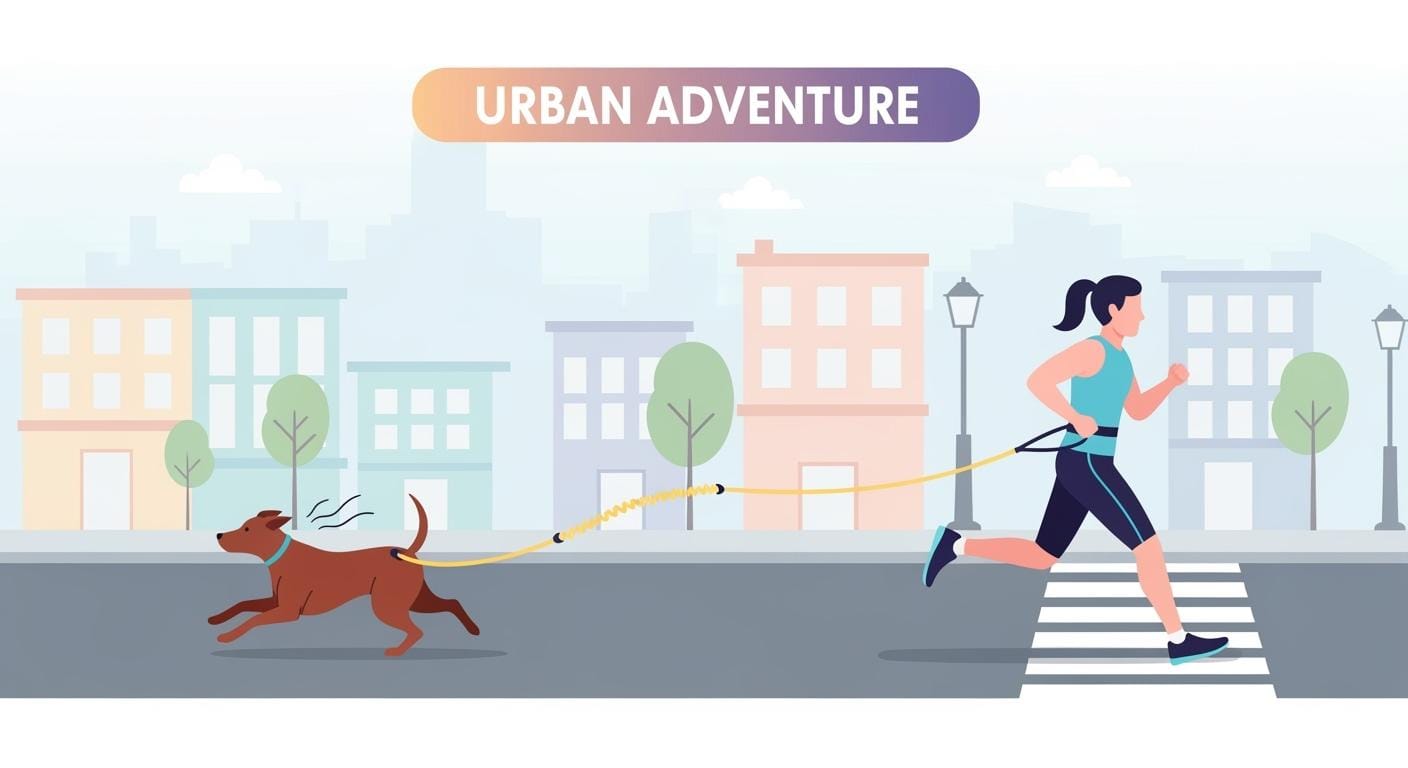
A bungee leash looks like a simple fix: add an elastic section, soften the tug. The problem is that stretch length is not a comfort dial you turn up freely. Every extra inch of elastic that absorbs a jerk also delays the moment you feel your dog change direction. In a quiet park, that delay is harmless. On a sidewalk next to moving traffic, it is the difference between a one-step correction and a lunge that puts your dog in the street.
This is why the design question is not “how much stretch” but “where and how the stretch is controlled.” A well-designed bungee running leash does two things at once: it takes the spike off sudden pulls, and it keeps the feedback loop between you and your dog tight enough that you can react before distance becomes danger. Getting both requires decisions about elastic length, webbing stiffness, handle placement, and attachment stability — not just one feature in isolation. How those pieces interact, and the conditions under which the tradeoff tips the wrong way, is what shapes whether a run feels smooth or unsafe. The way a bungee leash is built determines whether the elastic helps or hinders once you leave the park and hit the street.
Why a Bungee Section Changes the Feel of a Running Leash
How Shock Absorption Works in a Running Context
At a steady jog, the force between you and your dog is mostly constant. The leash stays under light tension, and the elastic sits partially stretched — doing nothing visible. The moment it matters is when tension spikes: a squirrel, a sudden stop, a dog cutting across your path. That spike sends a force impulse through the leash. In a non-elastic leash, the impulse transfers almost instantly — your arm or waist absorbs the full load in a fraction of a second. In a bungee leash, the elastic section stretches, converting some of that impulse into displacement over time. The peak force reaching your body drops. That is the comfort everyone talks about.
But here is the part most discussions skip: the time it takes for that elastic to stretch is also the time it takes for the tug to travel from the dog’s harness to your hand or waist. The longer the elastic section, the longer that travel time. At three feet of elastic, a dog can move two body lengths before you feel the full pull. That gap is the hidden cost. Bungee leash design lives in this tension — comfort on one side, reaction speed on the other.
The Causal Chain From Stretch Length to Control Loss
The mechanism is straightforward once you trace it step by step. A dog accelerates sideways → the elastic begins to stretch → during the stretch phase, the handler feels only partial tension → the handler’s reaction is delayed because the brain registers a gentle pull rather than a sharp direction change → the dog gains distance and momentum → by the time full tension arrives, the dog is farther off course and moving faster → the correction requires more force, more time, and more space. Each link in that chain tightens when elastic length shortens and loosens when it lengthens. This is why, when running in a space with no hazards, longer elastic feels liberating, and when running next to a four-lane road, the same elastic feels like a liability.
What changes between those two scenarios is not the leash — it is the consequence of the delay. The leash performs the same physics either way. The question is whether the environment can absorb the margin of error that the elastic creates. In open space, it usually can. In traffic, it often cannot.
When Stretch Length Works Against You
How to Tell If Your Leash Stretches Too Far
You do not need a measurement to spot the problem. After ten minutes of running on a mixed route — sidewalks, crossings, stretches of park — check one thing: when your dog surges ahead, do you feel the pull before or after your dog’s shoulders pass your knee? If before, the feedback delay is short enough for most urban routes. If after, your dog has already committed to a direction change by the time your body registers it.
A second check: after the run, note how many times you had to shorten the leash with your hand to pass a crosswalk or a group of people. If the answer is zero because the leash kept the dog close on its own, the stretch level matches the route. If you grabbed the handle at every intersection, the elastic length is working against the environment. This gap between the leash’s natural working length and the distance the route demands is the practical measure of whether the elastic section is too long. Running leashes with different elastic designs handle these mixed-route demands differently — a bungee built for open trail runs may struggle on a stop-and-go city route.
Three Situations Where Stretch Delay Becomes Dangerous
The conditions that magnify the risk are predictable. First, sidewalk running alongside traffic: the consequence of a three-foot surge is a dog in the road, not just an awkward stride. Second, passing other dogs on narrow paths: a sideways lunge into another dog’s space happens in under a second — if the elastic delays your correction by even half a second, the interaction has already started before you can steer. Third, sudden stops at intersections: a dog that halts to sniff while you are still moving forward creates slack, then a snap-back. With long elastic, the snap-back arrives late and hard, pulling your center of mass sideways.
| Design Difference | Why it matters | Main limitation |
|---|---|---|
| Short elastic section (under roughly 12 inches of stretch) | Feedback arrives fast — handler feels direction changes nearly in real time. Safer near traffic and in crowds. | Less shock absorption on steady runs. The handler feels more of every small pace change. |
| Long elastic section (roughly 18+ inches of stretch) | Maximum comfort during long, uninterrupted stretches. Absorbs nearly all minor tugs. | Feedback delay grows. Dog can gain significant distance before handler registers the pull. Risky near roads. |
| Moderate elastic section with low-stretch main webbing | Splits the difference: the elastic handles sharp spikes while the stiff webbing carries steady tension. Handler gets both shock reduction and quick feedback. | Less specialized — not the most comfortable for open-field runs, not the most precise for dense urban blocks. |
Design Features That Restore Control Without Losing Comfort
Low-Stretch Main Webbing
When the primary webbing does not stretch, the elastic section is the only part of the leash that gives. This creates a clear division of labor: the elastic absorbs shocks, the webbing transmits control. Materials like nylon hold their shape under load, which means the effective working length of the leash stays predictable. Polyester adds UV resistance and does not stiffen when it dries after a wet run. The feel through the hand or waist changes from mushy to crisp — you sense the dog’s next move as it starts, not after it is already underway. This distinction between bungee-only stretch and full-elastic stretch matters more on runs than on walks because the forces are higher and the pace leaves less room for correction.
A leash built with low-stretch webbing and a moderate elastic buffer tends to hold up better across repeated high-load cycles, since the webbing bears most of the sustained tension while the elastic only activates during spikes. The elastic retains its recovery behavior longer when it is not under constant load. The same principle applies to harness fit — how a harness fits and distributes pressure determines whether the bungee’s force reaches the dog’s frame evenly or concentrates on a narrow band.
Close-Control Handle and Waist Connection
A handle placed within arm’s reach of the dog’s harness lets you shorten the effective leash length in under a second. This is useful when approaching crosswalks, passing cyclists, or threading through a crowded block. The handle position matters: higher on the leash, closer to the dog, requires less arm movement to engage. A handle placed near the midpoint of the leash gives you a half-length option without adjusting any hardware.
Hands-free waist attachment changes how force enters your body. When the leash pulls from waist height rather than hand height, the force vector runs closer to your center of mass. You are harder to rotate off balance. The tradeoff is that waist attachment removes the fine steering you get from hand-held wrist movements. In practice, that means waist belts work well for dogs that hold a consistent line and pace — the leash does the work of following — and less well for dogs that weave or change sides frequently. Maintaining control during walks and runs depends as much on how force enters your body as on what the leash itself does. For routes that mix open stretches with tight sections, a leash design that pairs a waist belt with a close-control handle gives both modes without swapping gear.
Clips, Stitching, and What Fails First
The most common failure point on a running leash is not the elastic wearing out — it is the clip gate or the stitching where the elastic meets the webbing. When a dog lunges, the elastic stretches and the clip bears a shock load. Cheap clips with stamped metal gates can deform under repeated impact, leaving a gap the harness ring can slip through. Check the clip gate before each run: press it open and let it snap shut. If it does not close clean with an audible click, replace the leash. Reinforced stitching at the elastic-to-webbing junction should show no pulled threads or uneven tension. Run your thumb along the stitch line — any raised or separated thread means the seam is starting to unzip from the inside. A running leash built for frequent use shows these stress points early — catching them before a run is cheaper than chasing a loose dog.
When This Leash Design Is Not the Right Match
A bungee running leash with controlled stretch works best for dogs that already run in a roughly consistent direction and pace. The elastic section handles minor speed changes and occasional surges — it does not train a dog to stop pulling, and it does not replace leash manners. For a dog that lunges at every passing bike or darts unpredictably from side to side, the stretch delay works against you. In those cases, the design that helps — moderate elastic — is not the problem, but the behavior demands a level of feedback precision that any elastic, even a short section, will soften.
The leash also performs differently across dog sizes. A 60-pound dog accelerating from a standstill loads the elastic faster and farther than a 25-pound dog at the same speed. The same elastic section that gives the smaller dog comfortable feedback may let the larger dog build more momentum before the handler feels the full load. The design does not fail — the forces scale, and what counts as moderate stretch for one dog is undersprung for another.
Disclaimer: the fit and feedback checks described here assume a dog that runs on a consistent side and holds a mostly steady pace. For dogs that switch sides frequently or weave across the running path, the close-control handle becomes the primary safety feature — the elastic section can introduce lag in side-to-side corrections. If your dog has a barrel chest or a very deep keel that falls outside typical breed proportions, the waist attachment’s force vector may not stay centered, and you may need to test balance on a short, low-speed run before committing to a longer route.
FAQ
Does a bungee leash train a dog to stop pulling?
No. A bungee section absorbs force — it does not teach a dog anything about leash pressure. If the dog pulls, the elastic stretches instead of delivering a clear pressure signal. This can slow down loose-leash training because the dog never feels a consistent consequence. A bungee leash is a comfort and safety tool, not a training tool. Training for loose-leash running typically works better with a fixed-length leash first, then transitioning to bungee once the dog understands the running pace and position.
What leash length works for running in a city?
Most runners find that a total leash length between four and five feet, with the elastic section accounting for roughly a third of that, keeps the dog close enough to steer through intersections without tripping the handler. Shorter than four feet tends to crowd the dog into the runner’s stride on faster paces. Longer than five feet creates enough slack for the dog to reach the road edge before the handler can react, especially when running against the curb side.
Can a bungee leash be used with a collar instead of a harness?
It can, but the physics argue against it. A bungee section stores and releases energy — when the dog hits the end of the elastic, that energy returns through the attachment point. On a collar, that attachment point is the neck. On a harness, the force distributes across the chest and shoulders. Over the course of a run with pace changes and stops, the accumulated load on a collar-attached bungee can create neck pressure that a harness avoids entirely. For running specifically, harness attachment lets the bungee do its job without concentrating force on one vulnerable point.
How often should the elastic section be checked for wear?
Every few weeks of regular running, or sooner if the leash gets wet frequently. Stretch the elastic by hand and watch for uneven recovery — if one section stays stretched longer than the rest, the elastic core is starting to fatigue unevenly. Check where the elastic meets the webbing for any separation in the outer sheath, since moisture entry at that junction accelerates internal deterioration. A bungee leash used daily on wet or sandy routes may need replacement every six to twelve months depending on how fast the elastic loses its snap-back.
| Design Strength | Where It Works | Where It Falls Short |
|---|---|---|
| Shock absorption via moderate elastic section | Steady-pace runs on mixed terrain. Smooths pace changes without removing handler awareness of the dog’s position. | Dense urban blocks with frequent stops and direction changes. The elastic recovery time adds up across many short corrections. |
| Low-stretch main webbing for feedback precision | Routes that alternate between open stretches and tight sections. The webbing keeps the working length predictable when the elastic is not engaged. | Dogs that pull continuously rather than surging occasionally. The constant tension bypasses the elastic entirely and the webbing transmits every ounce of that pull. |
| Close-control handle near the dog | Passing crosswalks, cyclists, children, and other dogs. Instant half-length without stopping or adjusting hardware. | Runners who need both hands free for balance on technical trail terrain. Grabbing the handle takes one hand out of the running rhythm. |
A running leash works when its design matches the demands of the route. Moderate elastic cushions the spikes. Low-stretch webbing keeps the feedback loop short. A close-control handle gives an instant half-length option when the environment tightens. The design question is never whether one leash feature solves everything — it is whether the combination of elastic length, webbing stiffness, handle placement, and attachment point matches the specific mix of open road and tight corner on the route you actually run.