
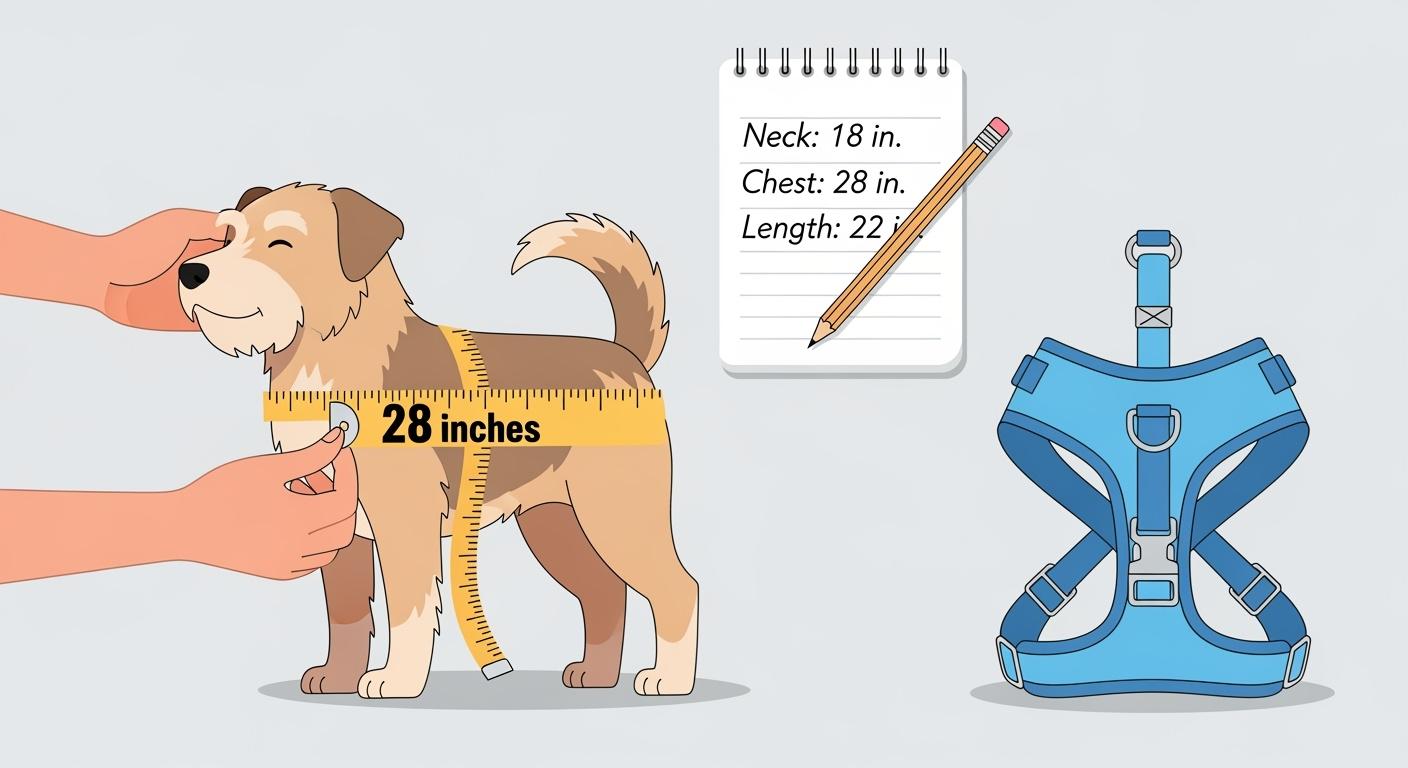
To measure a dog for a harness, start with the lower neck and the widest part of the chest behind the front legs, then compare those numbers with the harness size chart. But the right size is not proven by the chart alone. A harness still has to stay centered, keep pressure away from the throat and underarms, and remain secure when the dog starts walking.
That is why sizing should move from real measurements to a short fit check. A harness that looks correct at home can still ride up, twist to one side, rub behind the front legs, or give a dog enough room to back out. The best result comes from measuring first, choosing the closest size range, and then checking how the harness behaves during movement.
Real sizing starts with your dog’s measurements and ends with movement. A harness that looks correct at home can still ride up, drift off center, crowd the shoulders, or feel too loose once your dog starts walking. That is why the best fit check happens after the tape measure, during a short and careful walk test.
Note: This article is not medical advice. If your dog coughs, limps, shows skin irritation, or seems distressed in a harness, stop using it and speak with your veterinarian.
Key Takeaways
- Start with neck and chest measurements, but do not stop there.
- A size chart is only a starting point. Walking fit tells you whether the harness really works.
- Shoulder freedom, chest centering, throat clearance, and escape risk matter more than a tidy first impression.
Start with measurements, then check movement
Use the numbers as a starting point
You need the right tools to measure a dog for a harness. But on this page, the key question is what happens after you already have the numbers. Use a soft tape while your dog stands naturally, then treat those measurements as the starting point for choosing a size range, not as proof that the harness will work in motion.
Check the neck base and chest range without turning this into a tape-only decision
The two measurements that usually matter most are the lower neck, where the harness opening will sit, and the widest part of the chest, just behind the front legs. When you measure a dog for a harness, keep the tape flat but not tight, and check the dog while standing naturally. These numbers are more useful than breed guesses, weight alone, or a generic small/medium/large label. Still, they do not show whether the front section will stay low, whether the strap path clears the shoulders, or whether the harness will stay centered during movement.
| Area | Good practice | Common mistake | Why it matters |
|---|---|---|---|
| Neck | Use the lower neck area where the harness opening sits | Judge the fit from a high collar-like position | The harness opening should not ride up toward the throat |
| Chest | Use the widest part behind the front legs | Choose by weight or breed before checking the chest range | Chest size usually decides how stable the body section will feel |
| Back length | Use it only if the size chart asks for it | Treat it as the main sizing number every time | Not every harness uses back length as a key fit point |
| Coat | Smooth thick fur down before checking the fit again | Assume a fluffy coat gives the same fit in every season | Heavy fur can make a harness end up looser than expected |
Use the size chart as a starting point, not the answer
Breed and weight can point you in the wrong direction
Dogs of the same breed can still have very different chests, necks, and shoulder shapes. Weight can help you sanity-check a harness size, but it should not replace real neck and chest measurements. A size chart works best when you compare your dog’s numbers to the maker’s adjustment range, then confirm whether the harness shape still works once the dog moves.
If your dog is between sizes, compare shape and adjustment range
When your dog falls between sizes, do not jump straight to the label that sounds safer. Compare the chest range, the neck opening, and the remaining adjustment room after your dog’s real measurements are inside the chart. If one size only fits at the very edge, the harness may buckle but still shift, rub, or ride up during a walk. Some size problems are not really size problems at all. They are design problems.
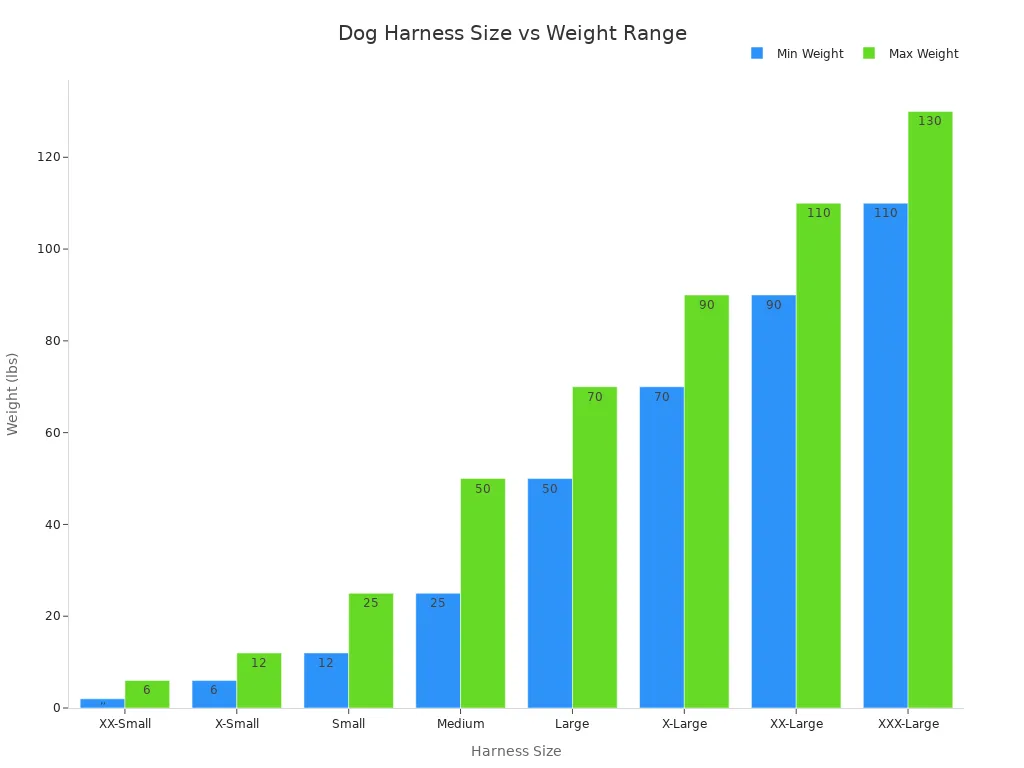
How to Read the Chart More Carefully
Illustration only. Actual harness size ranges vary by maker and should not replace the brand’s own size chart.
| Question | Pass signal | Red flag | Better response |
|---|---|---|---|
| Does the chest range really fit? | Your dog sits comfortably within the range | Your dog is right at the edge with little adjustment room | Check the next size and compare the overall shape |
| Does the neck opening match the body? | The lower neck looks supported, not crowded | The opening looks high or narrow before walking | Consider a different harness cut |
| Are you choosing by breed alone? | You use breed only as background | You skip real measurements | Check the actual body numbers, then compare labels |
| Are you choosing by weight alone? | Weight is only a rough cross-check | Weight decides the whole purchase | Go back to neck, chest, and movement behavior |
Check the fit on a real walk
The two-finger rule only starts the check
Being able to slide one or two fingers under the straps can help you avoid an obviously tight or loose fit. It is useful, but it is not the final answer. A harness can pass that quick test and still fail once your dog starts walking.
Watch the shoulders, throat, chest, and underarms
The first short walk usually tells you what the size chart could not. You want the harness to stay centered on the chest, leave the throat clear, and let the front legs move normally. If the harness starts riding up, rolling to one side, rubbing behind the front legs, or giving your dog room to back out, the measurement was only the starting point. The fit is not solved until the harness stays secure during real movement.
| Check point | Pass signal | Fail signal | What to do |
|---|---|---|---|
| Chest position | Harness stays centered on the chest | Harness twists or drifts to one side | Reset the fit and reassess the harness shape |
| Throat room | Neck opening stays low and clear | Top edge creeps upward toward the throat | Stop treating the size as correct just because it buckles |
| Shoulder movement | Dog walks and turns naturally | Shortened stride or stiff turning | Try a less restrictive harness cut |
| Underarm area | No scratching, rubbing, or hot spots | Dog licks, scratches, or shows fresh rub marks | Change fit or switch design before regular use |
| Escape risk | Harness stays secure in normal movement | Dog can back out or loosen the fit under pressure | Do not trust that setup unchanged |
Tip: If the harness only looks right while your dog is standing still, the sizing process is not finished yet.
Signs you need another size or another harness shape
Growth, coat changes, and body changes matter
Puppies grow, adult dogs gain or lose weight, and thick coats can change how the straps sit. A harness that worked well a month ago may not feel the same now. If the fit starts changing with no obvious reason, recheck the body numbers before assuming the harness itself suddenly became bad.
Some repeated problems are really design problems
If the same issue keeps coming back after careful adjustment, you may not need one more strap change. You may need a different harness shape. Repeated throat creep, shoulder crowding, or constant twisting often means the overall layout is wrong for your dog’s body, even if the label size looks close.
| Symptom | Likely cause | Quick check | Best next move |
|---|---|---|---|
| Harness looked fine at home but twists outside | Walking fit reveals a balance problem | Watch chest position after a few turns | Adjust once, then reassess the harness shape |
| Dog seems hotter or more reluctant in the harness | Too much coverage or bulk | Check comfort after a short walk | Use a lighter design if the problem repeats |
| Dog can back out under pressure | Neck opening or overall geometry is too loose | Test carefully in a safe space | Choose a more secure fit or different style |
| Harness keeps rubbing behind the front legs | Strap path or size is wrong | Inspect skin and fur after use | Stop using that fit unchanged |
| Dog outgrew the fit after coat or weight change | Body measurements changed | Recheck neck and chest | Resize before the next regular walk |
The right harness size should stop feeling like a question once your dog starts walking. If the harness stays centered, leaves the throat clear, allows normal movement, and does not keep asking for corrections, the fit is working. If the same problems keep showing up, the label is not the answer.
FAQ
What if my dog falls between two sizes?
Start by comparing the chest range, adjustment room, and harness shape, not just the label name. If one size barely covers the chest measurement, it often makes more sense to compare the next size and see which design sits better.
Should I size a harness by breed or weight?
No. Breed and weight can help you sanity-check a choice, but real neck and chest measurements are much more useful. Dogs with the same weight can still need very different fits.
Why does the harness fit indoors but twist outside?
Because standing fit and walking fit are not the same. Turning, leash tension, speed changes, and coat movement often reveal problems that a static check misses.
How often should I check the harness size again?
Check again whenever your dog grows, gains or loses weight, changes coat substantially, or starts showing new fit problems. If the body changes, the old numbers stop being enough.






