
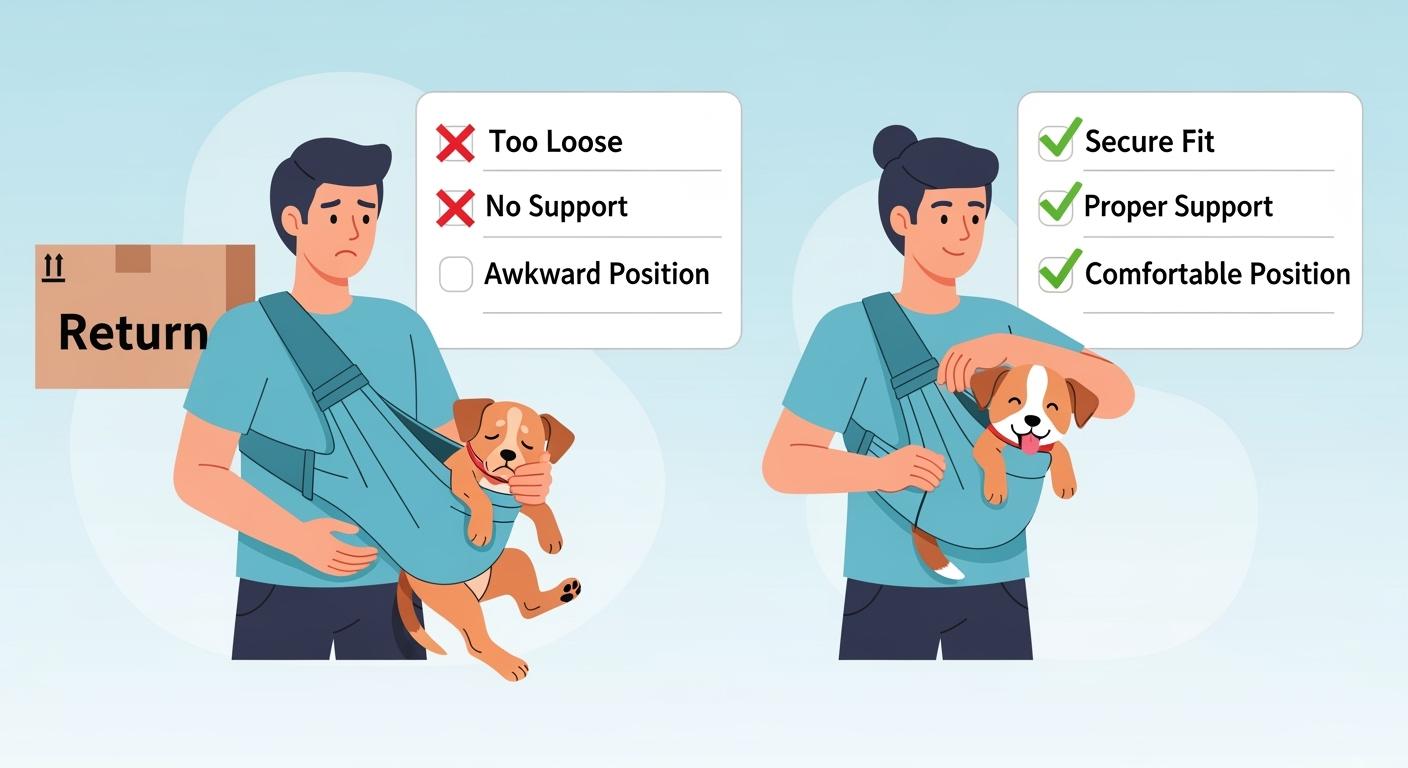
A dog pet sling carrier looks simple on a product page, but small fit and material problems can turn into visible use failure after the product reaches customers. The most common issues are not only size mistakes. They include sagging support, side swing, weak opening control, trapped odor, slow drying, and pockets or seams that collect dirt.
For B2B buyers, these problems matter because a sling carrier is often judged during the first few uses. If the dog slumps, the strap pulls, the carrier swings, or cleaning feels difficult, the product can quickly lose buyer confidence. A good sling carrier should make short-distance carrying feel stable, controlled, breathable, and easy to maintain. This guide focuses on the checks that help buyers judge whether a sling carrier is suitable before sourcing, sampling, or adding it to a travel carrier range.
Key Takeaways
- A dog pet sling carrier should be judged by supported posture, strap balance, opening control, airflow, and cleaning access, not by weight limit alone.
- Most sling carrier complaints come from sagging, swing, poor ventilation, odor buildup, hard-to-clean seams, and unclear stop-use instructions.
- Sling carriers are best for short trips, errands, and travel transitions. Longer carry time usually needs stronger structure or a different carrier type.
- For B2B product pages, clear sizing, material, cleaning, and safety wording helps buyers understand the product’s real use boundary.
Dog Pet Sling Carrier Buyer Checks Before Sourcing
Match the Sling Carrier to the Real Use Case
A sling carrier is not the same as a backpack carrier, handbag carrier, or structured airline carrier. Its strength is close, hands-free carrying for short trips, quick errands, store visits, short outdoor movement, and travel transitions. Its weakness is that soft construction can sag or swing if the dog is too heavy, too long-bodied, nervous, or poorly supported.
Before selecting a sling carrier for a product line, buyers should define the use case clearly. Is the carrier meant for quick city movement, a short walk from car to store, indoor-to-outdoor transitions, or occasional travel support? If the product copy promises long-distance carrying, full travel replacement, or broad breed compatibility, customer expectations may become too high for a soft sling design.
When the carrier is connected to travel use, the product information should also separate sling use from airline-cabin carrier requirements. For flight-related carrier decisions, buyers should check airline or transit rules, because a sling carrier does not replace a fully enclosed, under-seat travel carrier.
Check the Failure Points Customers Notice First
Many sling carrier problems appear during the first handling test. The dog may sit too low, the base may fold inward, the strap may pull to one side, or the opening may feel loose when the dog shifts position. These early problems are easy for customers to see, which makes them important for product selection.
| Failure Point | What It Looks Like | Why It Matters for Buyers |
|---|---|---|
| Sagging base | The dog sinks into the sling instead of staying supported. | Creates discomfort, poor posture, and a low-quality first impression. |
| Side swing | The carrier moves away from the body during walking. | Makes the dog feel unstable and makes the handler adjust constantly. |
| Weak opening control | The dog can push upward, twist, or climb toward the edge. | Raises escape concern and makes the carrier feel unsafe. |
| Poor ventilation | Thick fabric, blocked mesh, or limited airflow around the dog. | Increases heat and comfort complaints during warmer use. |
| Hard cleanup | Hair, dirt, moisture, and odor collect in seams or liners. | Makes repeat use less attractive, especially for travel and daily carry. |
Set a Clear Size and Weight Boundary
Weight limit is useful, but it is not enough. A dog may fall within the weight limit and still be too long, too tall, too wide-chested, or too active for a soft sling. Buyers should check body length, chest girth, leg position, and whether the base can hold the dog in a natural sitting position.
The table below keeps the original sizing logic but should be treated as a product-development reference, not a universal promise. Final size ranges should always be adjusted against the actual pattern, base structure, strap length, fabric stretch, and intended market.
| Dog Weight | Recommended Length | Recommended Height | Chest Girth | Common Breed Examples |
|---|---|---|---|---|
| 4-7 lbs | 14-16 in | 10-11 in | 12-14 in | Chihuahua, Pomeranian |
| 8-12 lbs | 17-19 in | 12-13 in | 15-17 in | Toy Poodle, Yorkshire Terrier |
| 13-18 lbs | 20-22 in | 14-15 in | 18-20 in | Miniature Schnauzer, Cavalier King Charles Spaniel |
| 19-25 lbs | 23-25 in | 16-18 in | 21-24 in | Beagle, smaller Cocker Spaniel variants |
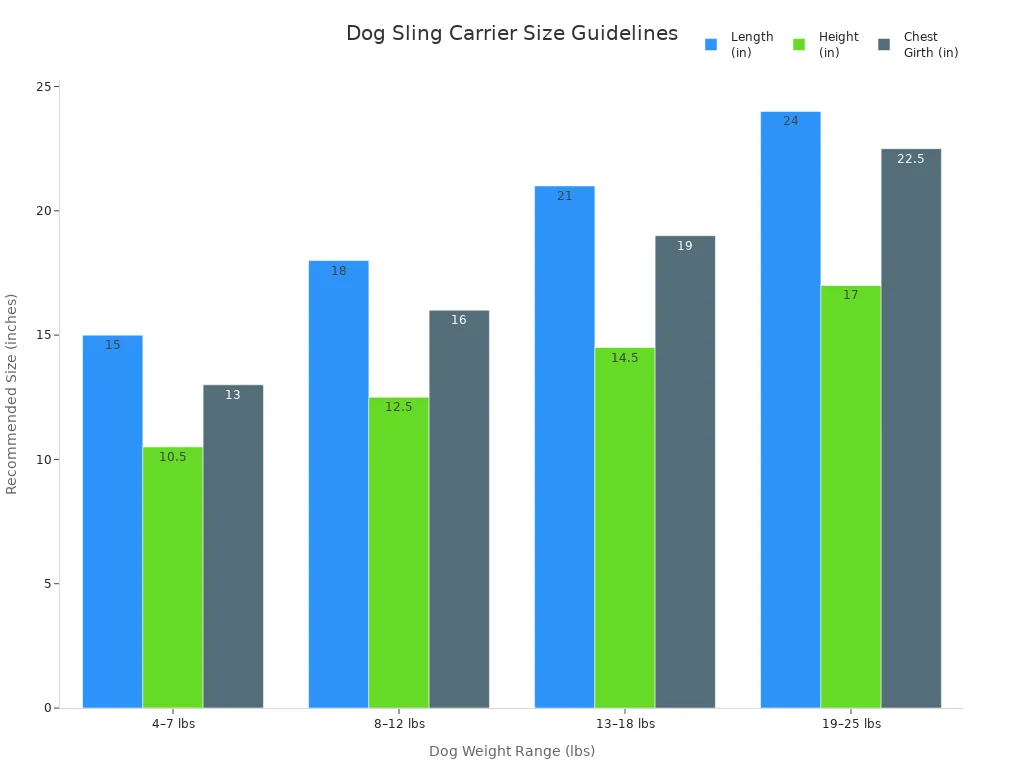
For sampling, buyers should not only check the label weight. A better sample review includes seam inspection near stress points, a light pull test on the closure, a weighted carry test, a strap-balance check, and a short supervised fitting session with a suitable dog size. These checks show whether the product performs as a sling carrier, not just whether the size chart looks complete.
Fit and Stability Checks for Sling Carrier Design
Dog Support: Posture, Base, and Body Position
A stable sling carrier should hold the dog close to the body without letting the torso collapse into the bottom. The base should support the dog’s body enough to reduce twisting and deep sagging. If the dog slumps, rotates, tries to climb out, or cannot settle into a supported position, the design may be too soft, too large, or not shaped well for that body type.
This is especially important for small, older, nervous, or long-bodied dogs. A sling that works for a compact dog may not work for a longer dog with a different center of gravity. Product pages should avoid implying that one size fits all small breeds. A more accurate product message explains the suitable weight range, body-length range, base support, opening control, and short-carry use case.
Stop-use wording matters: if the dog slumps, twists, overheats, panics, or repeatedly tries to escape, the sling should be adjusted or replaced with a more structured carrier.
Handler Fit: Strap Balance and Carry Control
The carrier must also fit the handler. A one-shoulder sling places load on one side of the body, so strap width, strap adjustability, anti-slip feel, and body position all affect comfort. If the sling hangs too low, swings outward, or pulls sharply on the shoulder, customers may feel the carrier is unstable even when the dog fits the size chart.
B2B buyers should check whether the strap can fit different handler heights and clothing layers. The bottom of the sling should remain close enough to the body to reduce swing, but not so tight that the dog is compressed. A good sling design should also keep pockets and accessories from pressing into the dog when loaded.
| Feature | Dog Backpack Carrier | Sling Carrier |
|---|---|---|
| Weight Distribution | More evenly across both shoulders and the back | Mostly on one shoulder or across one side |
| Postural Support | Usually firmer and more structured | Softer, easier to sag if sizing or base support is poor |
| Best Use Case | Longer walking, travel transitions, and structured carry | Short trips, errands, and close everyday carry |
| Common Risk | Bulk, heat, and incorrect size selection | Swing, slumping, and one-side shoulder fatigue |
Safety Details Buyers Should Not Treat as Extras
Small safety details often decide whether a sling carrier feels trustworthy. The internal tether should attach to a harness, not a collar. The opening should control movement without trapping the dog or reducing airflow. The carrier should not rely on decoration or soft fabric alone to create a feeling of security.
| Check Area | What to Verify | Why It Matters | Safer Customer-Facing Wording |
|---|---|---|---|
| Support and posture | Dog sits upright without deep sagging | Reduces discomfort and escape attempts | Designed to support a more stable carry position. |
| Strap control | Strap adjusts and holds position | Reduces swing and handler fatigue | Adjustable strap helps keep the carrier close and balanced. |
| Opening security | Entry and exit feel controlled | Reduces climbing and sudden escape risk | Secure opening helps keep small pets safely inside during carry. |
| Ventilation | Air can move around the dog | Helps manage heat and comfort | Breathable panels support airflow during short trips. |
| Cleaning access | Liner and seams are easy to wipe or remove | Reduces trapped dirt and odor | Easy-clean surfaces help simplify daily maintenance. |
| Tether attachment | Tether connects to harness, not collar | Improves control during movement | Use the internal tether with a harness for safer carrying. |
Easy Cleanup and Odor Control for Carrier Materials

What Easy Cleanup Should Mean in a Sling Carrier
Easy cleanup should not be treated as a vague selling point. For a sling carrier, it means hair, drool, dirt, and light outdoor residue can be removed without complicated washing. A removable liner, wipeable inner surface, fast-dry fabric, and smooth seam layout all make the product easier to maintain.
Slow-drying materials can hold odor, especially if the carrier is used after outdoor walks, store visits, or warm-weather travel. Very plush linings may feel comfortable at first, but they can trap hair and moisture. Buyers should balance softness with drying speed, lint resistance, and realistic cleaning behavior.
| Feature | Buyer Check | Risk If Ignored |
|---|---|---|
| Removable liner | Can the liner be removed, washed, or replaced easily? | Odor and dirt remain trapped inside the carrier. |
| Fast-dry fabric | Does the material dry quickly after wiping or washing? | Moisture creates smell and lowers repeat-use comfort. |
| Seam design | Are there hidden folds that collect hair and dirt? | Cleaning feels harder than the product copy suggests. |
| Pocket placement | Do loaded pockets press against the dog? | Storage features create pressure points or imbalance. |
Where Mess Collects First
The messiest areas are usually not the center of the fabric. Dirt and odor often collect in seam folds, corner stitching, removable liners, pockets, and the bottom panel. A sling carrier that looks clean from the outside can still hold odor if these areas do not dry well.
- Seams: hair and fine dirt collect where fabric layers overlap.
- Liners: moisture, odor, and stains build up if the liner is fixed or slow to dry.
- Pockets: treats, waste bags, crumbs, and small items can leave residue.
- Bottom panel: the area under the dog carries the most pressure and moisture risk.
For product instructions, simple care wording works best: remove loose hair, empty pockets, wipe the inner surface, wash the liner when needed, and dry fully before storage.
Ventilation Is Also a Cleaning Issue
Ventilation is usually discussed as a comfort feature, but it also affects odor control. A carrier with better airflow dries faster and holds less trapped smell. A carrier with blocked mesh, heavy padding, or poor opening design can feel warmer and become harder to keep fresh.
Ventilation should not be described as cooling beyond the surrounding conditions. A safer claim is that breathable panels support airflow and help reduce trapped heat during short carry use. Product copy should also warn customers not to block mesh with thick blankets, extra pads, or overfilled pockets.
Common Sling Carrier Mistakes and Fixes
Mistake 1: Choosing by Weight Limit Only
A customer may choose the correct weight range and still get a poor fit. Body length, chest width, leg position, and posture all matter. This is why B2B product pages should include more than a weight limit. Clear body measurement guidance helps buyers understand which dogs are suitable and which dogs may need a different carrier style.
Mistake 2: Oversizing the Carrier
Oversizing can make the carrier look more comfortable, but it often creates slumping and swing. Extra space may allow the dog to twist, lean, or climb toward the opening. A sling carrier should fit close enough to keep the dog supported while still allowing natural breathing and a relaxed body position.
Mistake 3: Overfilling the Sling
Blankets, toys, and thick pads can block airflow and change the way the dog sits inside the sling. They can also add bulk that makes the opening less secure. Product instructions should explain that the carrier should not be overfilled and that vents should remain clear during use.
Mistake 4: Treating Cleaning as an Afterthought
Cleaning affects repeat use. A carrier that is hard to clean may be used less often, even if the fit is acceptable. Buyers should check liner access, drying speed, stain visibility, seam folds, pocket design, and whether the care instructions are realistic for everyday users.
| Issue | Likely Cause | Immediate Fix | Product Selection Check |
|---|---|---|---|
| Dog slumps or twists | Carrier is too large or base is too soft | Adjust fit and reduce slack | Check size chart, base support, and body-length fit |
| Sling swings while walking | Strap is too loose or load is unbalanced | Shorten strap and keep carrier closer to the body | Test strap range and anti-slip control |
| Dog overheats | Blocked mesh or overfilled carrier | Remove extra items and move to a cooler area | Check breathable panels and stop-use instructions |
| Odor builds up | Slow drying, trapped hair, or fixed liner | Clean liner and dry fully | Choose fast-dry fabric and no-trap seam design |
| Dog tries to escape | Opening is loose or tether is not used correctly | Secure the opening and attach tether to harness | Check opening control and harness-tether guidance |
FAQ
How do you check if a dog pet sling carrier fits well?
The dog should sit in a supported position without deep sagging, twisting, or repeated attempts to climb out. The bottom should stay stable, the opening should feel controlled, and the strap should keep the carrier close to the handler’s body.
Is a sling carrier suitable for long travel?
A sling carrier is usually better for short trips and transitions. Longer carry time, airport travel, or heavier dogs may require a more structured carrier type with stronger base support and fuller containment.
What causes a dog to slump in a sling carrier?
Slumping is usually caused by oversizing, a soft base, poor body-length fit, or too much slack. It can also happen when the dog is too long-bodied or too heavy for the sling structure.
What is the best way to reduce odor in a sling carrier?
Choose fast-dry materials, removable liners, wipeable surfaces, and seam designs that do not trap hair and moisture. After use, remove loose hair, clean the inner surface, and let the carrier dry fully before storage.
Should the internal tether attach to a collar or harness?
The internal tether should attach to a harness, not a collar. This gives better control during movement and avoids unsafe pressure on the dog’s neck.
A dog pet sling carrier can work well when its limits are clear. For B2B buyers, the best product decision is not only about choosing a soft carrier with an attractive look. It is about checking whether the sling keeps the dog supported, stays balanced on the handler, allows enough airflow, cleans easily, and gives customers clear stop-use guidance. Those details decide whether the product feels stable, practical, and trustworthy after purchase.






