
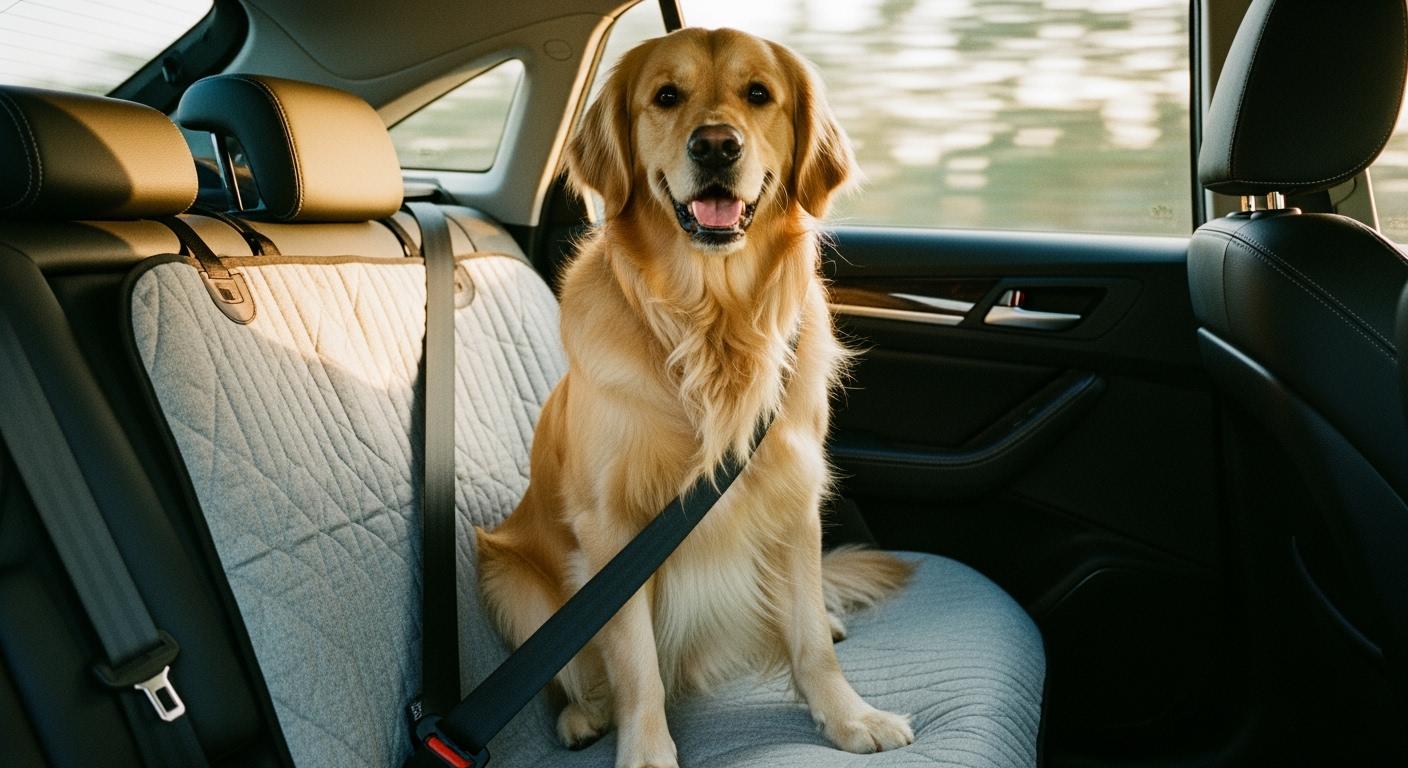
A dog scrambling for footing mid-turn is not a training problem. It is a surface problem. When the car turns, lateral force pushes the dog sideways. The paws need something to bite into. If the cover is slick, the cover shifts, or there is nothing to brace against, the dog slides. Three failures. Each has its own fix.
Most seat covers solve one of these. Maybe the top has grip but the cover itself drifts on the seat. Maybe it stays put but offers no side support. The cover design that actually works treats paw stability as a three-layer stack: surface-to-paw grip, cover-to-seat anchoring, and lateral bracing. Remove any layer and the other two cannot compensate.
Why Paws Lose Grip Mid-Turn — the Physics of Lateral Weight Shift
Cornering generates lateral acceleration. The dog’s body wants to keep going straight while the car arcs. The result is a sideways force vector that pushes the dog toward the outside of the turn. The paws reflexively splay and press down to counter it.
Here is where the cover surface decides the outcome. A textured surface lets the paw pads deform into the texture, creating mechanical interlock. The claws catch in the weave or raised pattern. That interlock converts lateral force into shear at the surface rather than full-body slide. A smooth waterproof coating removes that mechanism entirely — the paws skate across it like a wet shoe on tile. Sudden turns. Hard braking. Even a lane change at moderate speed can trigger a slip if the surface-to-paw friction coefficient drops too low.
Walk this test after your next drive with the dog in back. Park on level ground and look at where the dog ended up relative to the seating position they started in. If the dog has drifted more than a few inches toward the door side, the cover surface is not holding.
Weight matters here too. A 60-pound dog generates roughly twice the lateral force of a 30-pound dog through the same turn at the same speed. The same slick surface that a small dog barely notices can send a larger dog sliding. More mass, same friction coefficient, bigger slide. The cover surface texture needs enough mechanical grip to handle the largest dog that will use it, not the average one.
How a Shifting Cover Makes Traction Irrelevant
Even a grippy top surface fails if the cover itself moves. Here is the chain: the dog braces during a turn, paws dig into the textured top, and that force transfers through the cover to the seat beneath. If the cover is not anchored, the entire assembly — dog, cover, everything — slides as one unit. The dog’s paws never actually slipped on the surface. They lost footing because the surface moved under them.
Two separate mechanisms. Same result.
Seat anchors that tuck between the backrest and seat cushion create a mechanical stop. Headrest straps pulled tight put the cover under tension, which increases friction between the cover backing and the seat upholstery. A non-slip backing material — typically a rubberized or silicone-dot pattern — raises the static friction threshold so the cover resists movement up to a higher lateral load. The combination of tension from straps plus friction from backing plus mechanical stops from anchors is what keeps the cover stationary. One without the others is weak.
After a drive, check whether the seat anchors are still fully seated in the gap between the backrest and cushion. If they have pulled partway out, the cover shifted during the trip. The dog’s footing was compromised even if you did not see an obvious slide.
In practice: a cover with excellent surface grip but loose anchors fails the same way a slick cover does. The dog ends up off-balance either way. The failure just happens at a different layer of the stability stack.
| Failure Signal | Which Layer Failed | Quick Check After a Drive |
|---|---|---|
| Dog drifts toward door | Surface grip or side support | Is the dog displaced from starting position? |
| Cover bunched or shifted | Cover-to-seat anchoring | Have seat anchors pulled out of position? |
| Dog ends up against door or footwell | Side bracing | Are side flaps still in place or curled inward? |
Side Support — the Layer Most Covers Skip
Surface grip stops the paw from sliding on the cover. Anchors stop the cover from sliding on the seat. But neither stops the whole dog from sliding off the cover. For that, you need a vertical plane — something for the dog to push against laterally.
Side flaps that extend up the door panel create that plane. When the car turns and the dog shifts toward the door, the flap catches the dog’s shoulder or hip and provides a reaction surface. Without it, the dog’s body keeps moving until something else stops it — the door panel, the seatbelt housing, the gap between the seat and the door.
Hammock-style covers add a second bracing mechanism. By suspending the cover between the front and rear seat headrests, they create a sling that cradles the dog. Forward braking pushes the dog into the front seat back rather than the footwell. Lateral force pushes the dog into the side of the hammock rather than over the edge. It is not that the hammock eliminates movement — it redirects it into surfaces the dog can brace against. The difference between a bench cover and a hammock design is most visible during a sequence of turns: left-right-left on a winding road. A dog on a flat bench cover drifts progressively further with each turn. A dog in a hammock recenters between turns because the sling shape naturally returns them to the low point.
Side flaps do have a failure mode worth watching. If the flap is too short or the seat is unusually tall, the flap curls inward under lateral pressure instead of bracing. Tucking the flap firmly between the seat and the door frame — rather than letting it drape — creates a stiffer bracing surface. Check this before the drive. After the drive, if the flap has pulled free, it was not seated deep enough to hold.
Disclaimer: this bracing assessment assumes a typical bench seat geometry. Bucket-style rear seats, split-folding seats with uneven surfaces, and seats with prominent side bolsters change how side flaps engage. On highly contoured seats, a side flap may not reach the door panel at all — in that case, a hammock design provides the lateral containment that the flap cannot.
When a High-Traction Cover Is Not the Right Fix
A textured, anchored, side-braced cover solves paw slip for most dogs on most drives. But not all. Here is where the design logic meets its limits.
Dogs with balance or mobility issues — senior dogs with joint instability, dogs recovering from orthopedic procedures, dogs with vestibular conditions — may still struggle even on a perfectly stable surface. The cover stops the surface from moving, but it does not stabilize the dog. For these dogs, the missing layer is not traction. It is restraint. A car-specific dog seat or booster with integrated harness tethering limits the dog’s range of motion enough that they cannot reach the point where traction becomes the deciding factor. The cover keeps the seat clean; the tether keeps the dog in a zone where footing matters less.
Very anxious dogs present a different case. An anxious dog that paces, spins, or claws at the cover will defeat any surface texture over a long enough drive. The mechanical interlock between paw and surface relies on the paw pressing down and staying relatively still. A pacing dog applies force in every direction, and with enough cycles, even a textured surface can wear smooth or the cover can work loose from its anchors. For these dogs, the problem is not the cover design. The problem is that the dog is trying to exit the stability system entirely. Addressing the anxiety — through conditioning, shorter trips, or a crate — changes the equation more than switching covers.
Temperature amplifies the limits too. On a hot day, a dog’s paw pads can sweat. Sweat on a waterproof surface reduces the friction coefficient. This is not a design defect. It is a material reality — water is a lubricant between two surfaces. A cover can be waterproof and textured, but the texture channels can fill with moisture, reducing effective grip. After a hot-weather drive with the windows down, run a hand over the cover surface where the dog was sitting. If it feels damp, that moisture layer reduced paw grip during the trip. Drying the surface between drives — even just wiping it with a towel — restores the baseline friction.
Disclaimer: sweat-reduced grip is most pronounced on non-porous waterproof coatings. Porous textured surfaces like quilted cotton or Oxford-weave polyester allow moisture to wick into the material rather than pooling on top. If the cover stays wet between drives, a porous surface or a removable washable top layer will recover faster than a sealed waterproof finish. Double-coated breeds and dogs that pant heavily in the car produce more ambient moisture, which can settle on the cover surface regardless of the dog’s paw sweat.
The three-layer stability stack — surface grip, cover anchoring, side bracing — handles the vast majority of paw-slip cases. Understanding which layer is actually failing in a given situation, rather than guessing, tells you whether the fix is a different cover, a design with better side flaps, or something outside the cover entirely. The seat cover stability that keeps a dog steady on a winding road is not magic. It is just three design decisions that either all work together or all fail together.
FAQ
Why does my dog only slip on some turns but not others?
Turn radius and speed together determine lateral force. A sharp turn at 15 mph can generate more sideways push than a gentle curve at 40 mph. If the cover is right at the edge of its grip threshold, the dog holds steady through mild turns and slips only on the tight ones. That is the cover surface working at its friction limit, not an intermittent defect.
Does a waterproof layer always make the cover more slippery?
Not if the waterproofing is built into a mid-layer rather than applied as a surface coating. A three-layer construction — textured fabric top, waterproof membrane middle, non-slip backing bottom — keeps water out of the seat without putting a slick film under the dog’s paws.
Can a hammock cover work with a single passenger in the back?
Most hammocks allow one side to be unclipped and folded down, creating a split configuration — hammock on one side, open seat on the other. The dog retains the hammock’s lateral bracing on their side while a passenger uses the other seat normally.






