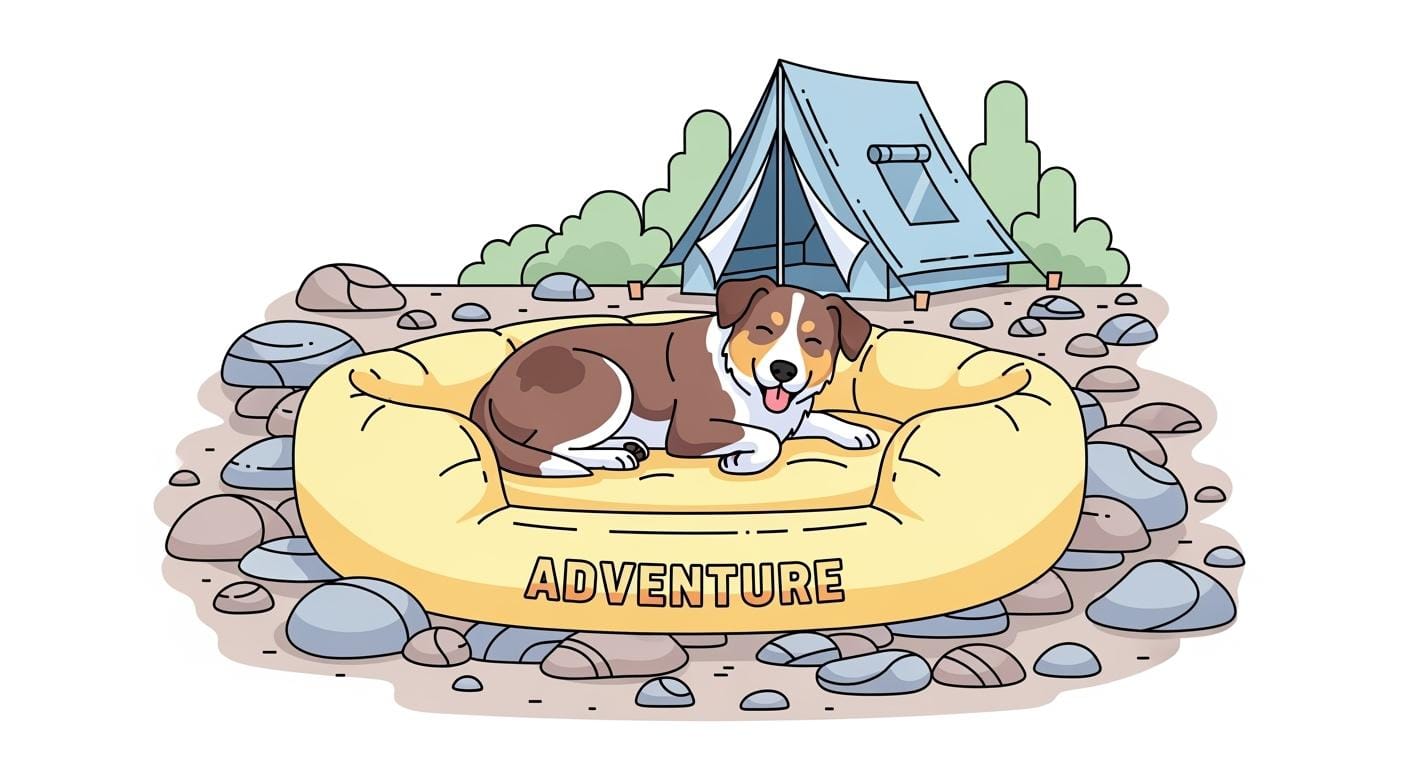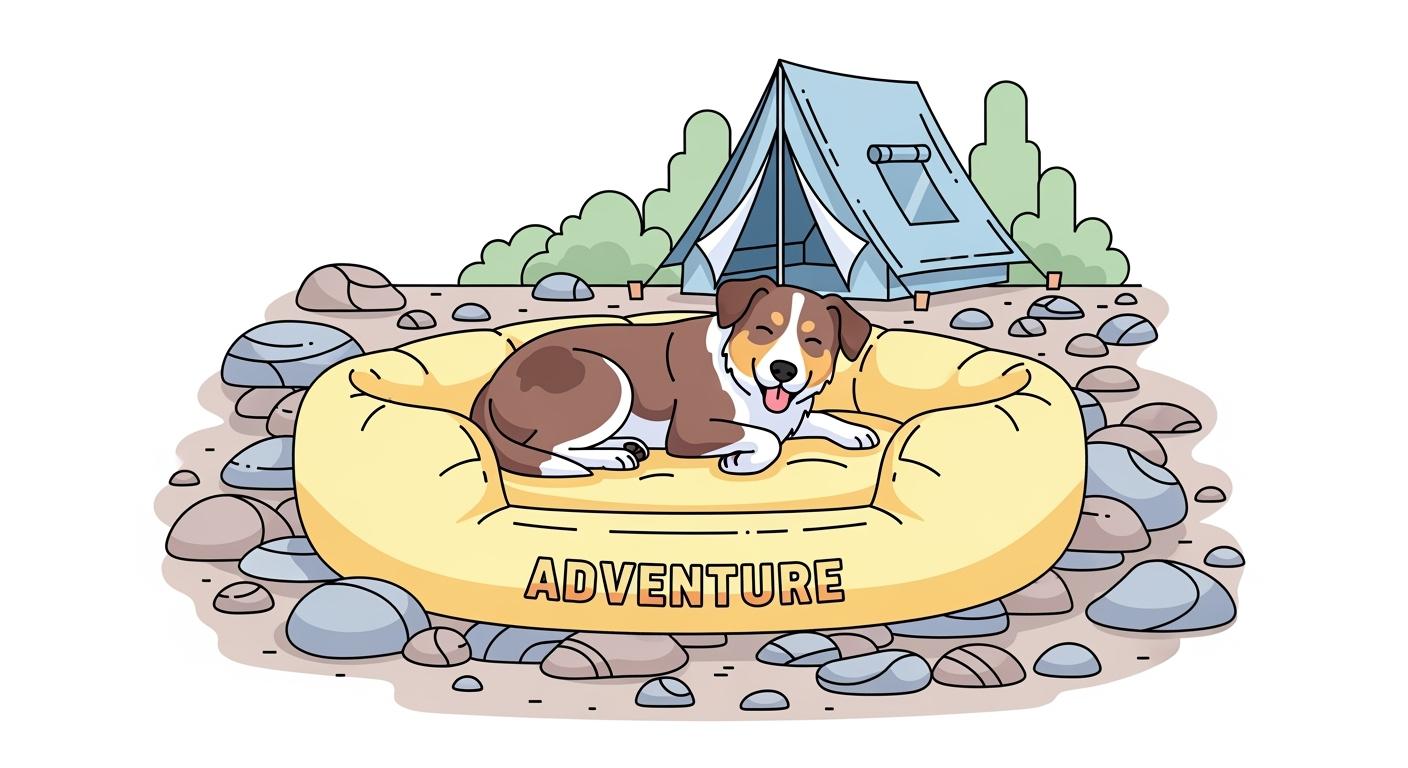
A camping dog bed that bottoms out on hard ground is worse than no bed at all. The fill compresses, the base folds, and within minutes the dog is lying on rock through a thin layer of fabric. Most beds sold as “camping” beds fail this test. The problem is not that they are cheap. Plenty of expensive beds collapse just as fast. The problem is that softness gets prioritized over structure, and on packed dirt or gravel, softness alone disappears under body weight.
This is not about comfort rankings. It is about what physically happens between the ground and the dog when a bed cannot hold its shape.
Why Soft Beds Collapse on Hard Campsite Ground
What Happens When Fill Bottoms Out
Hard ground does not give. Packed dirt, gravel, and rock ledges push back against the bed from below. A bed with weak fill has no way to resist that pressure. The padding shifts, thins out, and stops doing its job. The dog ends up with hips and elbows pressing directly into the ground — the bed is just a thin fabric layer in between.
Loose-fill beds are the worst offenders. Polyester stuffing shifts under repeated pressure. It clumps at the edges and leaves a near-zero fill zone in the center. That is where the dog lies. Memory foam fares a little better indoors, but on cold ground it stiffens and loses its ability to contour. The fill needs two things: enough density to resist body weight and enough structure to recover its shape after use. Most camping beds fail on both.
This is the same reason a sleeping bag feels fine on a tent floor with a pad underneath and miserable without one. Ground-level support is not about the top layer. It is about what sits between the dog and the hard surface below.
How to Tell the Bed Is Not Holding Up
Dogs tell you when a bed fails. They just do not use words. Restlessness is the first signal — shifting positions every few minutes, circling, trying to find a spot that does not hurt. A bed that slides or bunches under movement is another. The dog steps on it, the whole thing shifts, and the dog gives up and moves to bare ground.
| Failure Sign | Likely Cause | Better Design Detail | Why It Matters |
|---|---|---|---|
| Bed flattens in the center after minutes of use | Weak fill, no base structure | Compression-resistant fill with dense base layer | Prevents hips and elbows from bottoming to ground |
| Dog avoids the bed or chooses bare ground instead | Pressure transfer from hard surface below | Stable, flat sleep platform that stays level | Dog trusts the bed only when it actually supports |
| Bed slides, bunches, or curls at edges | Slick underside, no grip, thin fabric | Reinforced underside with grip texture | Movement breaks the sleep surface; grip holds it flat |
Dogs with joint sensitivity show failure first. A bed that feels “fine” to a young, healthy dog may be unusable for an older one. The test is simple: press your palm into the bed on hard ground and hold for ten seconds. If you feel the ground through the fill, the bed fails.
Indoor Beds Do Not Translate Outdoors
Indoor dog beds are built for carpet and hardwood. Those surfaces have some give, and they are flat and predictable. The bed only needs to be softer than the floor. Outdoors, the ground is the problem. It is hard, cold, uneven, and often damp. An indoor bed moved to a campsite compresses completely. What felt plush in the living room becomes useless on gravel.
Outdoor beds need a different architecture. The base must be firmer than the top layer. The fill must resist compression rather than just feeling fluffy. Fabrics need to handle moisture without losing structure. When evaluating a bed, the material differences between outdoor and indoor designs are not cosmetic — they determine whether the bed works at all once the dog lies down outside.
What Keeps a Camping Bed From Bottoming Out
Compression-Resistant Fill and a Structured Base
Not all fill is the same. Open-cell foam, shredded memory foam, and loose polyester fiber all behave differently under sustained pressure. For camping use, the fill needs to push back. That means higher-density foam rather than pillowy loft. Density is measured in pounds per cubic foot — a camping bed below 2.5 lb/ft³ will typically flatten within weeks of regular outdoor use. Above 3.5 lb/ft³, the fill holds shape far longer.
A layered approach works better than a single thick slab. A firmer base layer provides the structural floor. A softer top layer adds comfort without compromising ground separation. When these layers are bonded or contained in separate chambers, they do not shift under use. Single-layer beds cannot do both jobs. If the whole bed is soft, it bottoms out. If the whole bed is firm, it feels like a mat. The combination is what makes the difference — one material cannot solve both problems.
Flat Sleep Surface and Why Shape Matters
A bed that curls at the edges or develops a center crater stops being a bed. Bolsters and raised edges can help dogs feel secure indoors. Outdoors, they reduce the usable flat area and create pressure points of their own. What matters on hard ground is a flat, uninterrupted rectangle of support. The dog needs to be able to stretch, turn, and shift without hitting a seam or a bolster that changes the support profile.
Flatness also affects stability. If the bed has high sides or uneven fill distribution, the dog’s weight concentrates on a smaller contact patch. That increases the pressure per square inch and accelerates fill failure. A level surface spreads weight evenly. It sounds simple. Most camping beds get this wrong by adding design features that look like comfort but function as failure points. For a look at which outdoor bed features hold up after repeated trips and which are just design noise, the breakdown of camping bed warmth versus long-term cleanliness covers what actually separates beds that last from beds that look good on day one.
Bottom Fabric and Grip on Uneven Ground
The underside takes the most abuse. It sits directly on dirt, gravel, tent flooring, and damp grass. A thin polyester bottom wears through quickly. Once the bottom fabric fails, moisture gets in and the fill degrades. Reinforced fabrics — 600D or higher polyester, or coated nylon — resist abrasion far better than the 300D or unrated fabrics common on cheaper beds.
Grip is equally important. A bed that slides every time the dog moves creates constant micro-adjustments that prevent deep rest. Rubberized or textured undersides hold position on tent floors and smooth rock. Some beds use silicone dot patterns or PVC coatings. Without grip, a flat bed can still fail — not because it bottoms out, but because it will not stay where the dog needs it. On angled or uneven campsites, a slick underside means the bed migrates downhill overnight.
| Problem | Cause | Better Design Detail | Main Limitation |
|---|---|---|---|
| Bed slides on tent floor or gravel | Slick underside, insufficient texture | Rubberized or silicone-grip bottom panel | Grip coatings wear down over time on abrasive surfaces |
| Underside tears or abrades within a season | Thin fabric, no reinforcement | 600D+ reinforced fabric with sealed seams | Higher-denier fabric adds weight and bulk when packed |
| Moisture seeps into fill from below | No water-resistant barrier layer | Coated or laminated waterproof bottom | Fully waterproof bottoms trap internal condensation in humid conditions |
A strong underside also makes cleaning practical. Camping beds collect dirt, sand, and debris. A water-resistant bottom can be wiped down or hosed off without soaking the fill. If the underside absorbs water, drying takes days and the fill degrades with each wet-dry cycle. For a closer comparison of how waterproofing holds up across different bed constructions, the breakdown of waterproof dog beds for wet ground conditions covers which designs actually keep the core dry.
When Waterproofing Helps — and When It Does Not Fix the Real Problem
Waterproofing is useful. It is also the most overrated feature on camping dog beds. A waterproof bottom stops ground moisture from wicking into the fill. That matters. But it does nothing for compression resistance, nothing for grip, nothing for shape recovery. A waterproof bed that flattens on gravel is still a failed bed. The dog is dry and uncomfortable instead of wet and uncomfortable. That is not a win.
Water-resistant top fabric matters more than most buyers think. Dogs come back from swimming, walk through dew-soaked grass, and lie down wet. If the top fabric absorbs water, the surface stays damp for hours. That breeds odor and degrades the fill from above. Tight-weave synthetics with a DWR coating shed surface moisture faster than untreated cotton blends or plush fleeces.
Insulation adds another variable. In cold weather, a bed needs to block ground cold from below. But insulation layers add thickness, and thickness without structure just means more material to compress. A bed marketed as “insulated” with no compression resistance spec is giving you a thicker bottom layer that will still flatten. The insulation only works if the fill holds the dog far enough off the ground to create a thermal break. A bed with cold-weather camping in mind needs to balance insulation, waterproofing, and ground support — adding features without a structural base does not improve the bed, it just makes a more elaborate failure. For a side-by-side comparison of ground pads versus cot-style beds and which holds up better in wet conditions, the camping dog bed breakdown between ground pads and cots covers the key trade-offs.
| Feature | What It Actually Does | What to Watch | When It Fails |
|---|---|---|---|
| Waterproof bottom | Blocks ground moisture from below | Needs to stay flat and not slide; waterproofing adds zero compression resistance | On sharp gravel, coatings can scratch through within one trip |
| Water-resistant top fabric | Sheds surface moisture and speeds drying | Should not trap heat or feel plastic-like against the dog’s coat | DWR treatments degrade with washing; needs re-treatment after 15–20 washes |
| Insulated fill layer | Creates a thermal break from cold ground | Insulation must sit above a supportive base to hold the air gap; thickness alone does not insulate | Compressed insulation loses most of its thermal value; if the bed bottoms out, insulation is cosmetic |
Think of it as a stack. Ground-level moisture barrier at the bottom. Compression-resistant structural fill in the middle. Comfort layer and water-shedding fabric on top. Miss any layer and the bed has a failure mode waiting to surface.
Firm Ground Beds vs. Other Camping Bed Types
Where a Firm Supportive Bed Works Best
A dense, flat, compression-resistant bed is the right tool for specific conditions. Rocky campsites. Packed dirt. Gravel bars. Anywhere the ground is hard and uneven, a structured bed prevents pressure points that soft beds create. Dogs with joint issues or older dogs benefit most. The bed does not need to be thick. It needs to stay between the dog and the ground. That is a structural requirement, not a comfort preference.
Long stays amplify the difference. A soft bed that feels okay on night one may be compressed flat by night three. Fill fatigue is cumulative. A bed with real compression resistance recovers each morning. This matters more for multi-day trips than overnight stops. Cold-weather camping also favors a firm ground bed because consistent ground separation keeps the thermal break intact. When choosing a supportive outdoor bed, the sizing and support features covered in the outdoor dog bed sizing and weather-ready features breakdown walks through how to match bed dimensions to the actual sprawled-out dog, not just the labeled size.
When an Elevated or Inflatable Bed Makes More Sense
Firm ground beds are not the answer for every campsite. Wet ground changes the equation. If the site is marshy, or if heavy dew is a given, an elevated cot-style bed gets the dog above the moisture entirely. No amount of waterproofing on a ground pad competes with six inches of air gap. Inflatable beds offer adjustable firmness and pack down smaller — useful for backpacking where bulk matters more than long-term durability.
Hot-weather camping pushes toward mesh or elevated designs for airflow. A dense foam bed with a waterproof bottom can trap body heat underneath. If the dog runs hot or the campsite has zero shade, a raised mesh bed lets air circulate and cools better. The trade-off: elevated beds are heavier, bulkier to pack, and some dogs refuse the height or the unstable feel of a suspended surface.
| Bed Type | Decision Direction | Best Use Case | Main Limitation |
|---|---|---|---|
| Firm ground pad with compression-resistant fill | Choose when ground is hard, rocky, or cold; support and ground separation are the priority | Rocky campsites, packed dirt, cold-weather trips, dogs with joint issues | Less effective on wet ground; heavier and bulkier than inflatable options; can trap heat underneath |
| Elevated cot-style bed | Choose when moisture, airflow, or height from ground is the priority over cushioned support | Wet campsites, hot weather, dogs that run warm, sites with standing water risk | Some dogs refuse the height or unstable feel; heavier to pack; fabric tension can sag over time |
| Inflatable pad | Choose when packed size and adjustable firmness outweigh long-term durability | Backpacking, ultralight trips, short stays where bulk matters | Puncture risk on rocky ground; valve failure; air temperature changes alter firmness overnight |
Decision rule: match the bed type to the dominant campsite condition, not to the exception. A bed picked for the worst-case mud puddle that never arrives will be the wrong bed every other trip.
For longer adventures where packing a full camping bed kit makes sense, the outdoor adventure shelter and rest solutions cover includes bedding, shelter, and rest gear that work together for multi-day trips.
FAQ
How do you test whether a camping bed will hold up before the trip?
Set the bed on concrete or a hardwood floor — not carpet — and press your fist into the center with your body weight for 15 seconds. If you feel the hard surface through the fill, the bed will not hold up on gravel or rock. Check recovery too: the fill should return to full thickness within a few seconds of releasing pressure. Slow recovery or permanent indentation means the fill has no structural memory and will degrade with repeated use.
Does a thicker bed automatically work better on hard ground?
No. Thickness without density is just more material to compress. A 6-inch bed with low-density fill will bottom out faster than a 2-inch bed with high-density foam. What matters is how much resistance the fill puts up per inch of thickness. Unstructured loft collapses; dense structured foam resists. More inches of the wrong material make the failure more expensive, not less likely.
How do you keep a ground-level bed dry during multi-day trips?
Place a thin waterproof groundsheet under the bed that extends a few inches beyond the edges — this prevents wicking from damp soil without trapping condensation inside the bed itself. Shake the bed out each morning and flip it to let the underside air out. If the top fabric is not water-resistant, a lightweight fleece blanket on top absorbs dog moisture and can be dried separately. The bed itself should not be the only moisture barrier in the system.
Are firm camping beds suitable for small dogs or puppies?
Yes, but with a caveat about weight. A firm bed designed for a 70-pound dog may barely compress under a 10-pound dog, which means the smaller dog never gets the conforming comfort the top layer is supposed to provide. For dogs under 20 pounds, look for a bed where the top comfort layer compresses under lower weight while the base layer still provides ground separation. Some brands offer different firmness grades by size — that is worth paying for. For dogs that do better with a more contained sleep surface, the elevated outdoor dog bed with a steel frame and canopy design adds the option of raised support with shade.