
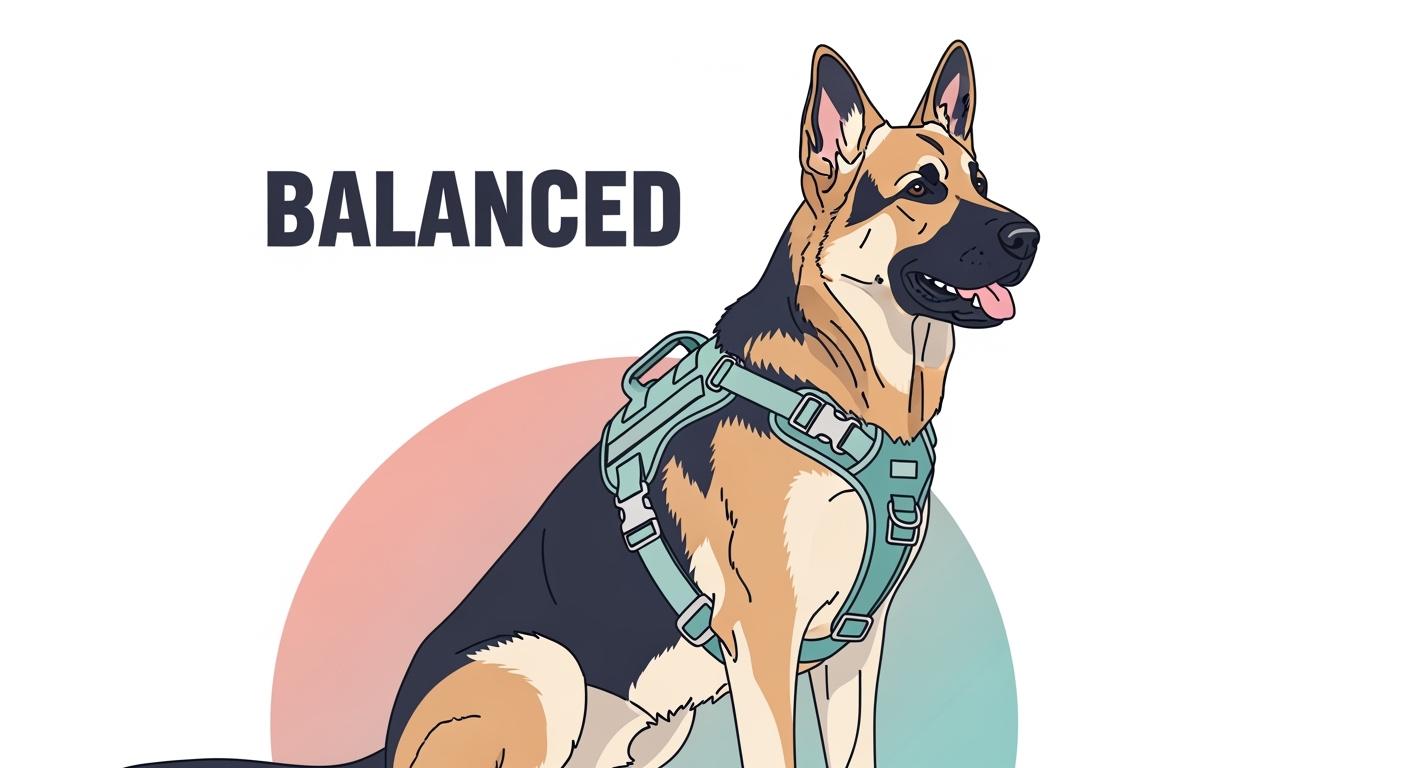
A tactical harness looks sturdy on the rack. Straps, buckles, MOLLE webbing — the visual language of control. But grab the handle and pull upward during a crowded street crossing, and a design flaw surfaces fast. The front edge lifts. The harness rides toward the throat. What looked like control on the shelf becomes neck pressure on the walk.
Two design details determine whether that happens: where the handle sits relative to the dog’s upper back, and how low the front chest panel rides. Everything else — strap count, material weight, buckle type — matters only after those two get solved. Most harnesses that fail the throat-lift test do not fail because they are flimsy. They fail because the handle and chest panel were placed for manufacturing convenience, not for force management on a moving dog.
Why close control can turn into neck pressure
What happens to the harness when you grab the handle
A dog pulls forward. You grab the top handle and pull upward. That creates a force couple: forward pull from the dog, upward lift from your hand. If the handle sits over the neck or shoulder blades, the upward component rotates the front panel. The bottom edge of the chest piece swings forward. The top edge swings backward — into the throat.
This is not about how tight the straps are or how strong the buckles test. It is about where the handle pivot sits relative to the dog’s center of chest mass. A handle placed over the upper-back load zone — behind the shoulder blades, roughly above where a lifting harness would attach — converts upward hand force into chest compression, not front-edge rotation. The pivot point sits behind the front edge, so lifting the handle presses the chest panel down and back, not up and forward. That is a single placement decision in the pattern-cutting stage, and it determines whether the harness works under real load.
Failure signals you can spot on a walk
You do not need a force gauge. Walk the dog for ten minutes on a route that includes one curb pause, one sharp turn, and one moment where you use the handle. Then check three things.
| Failure Sign | Likely Cause | Better Design Direction |
|---|---|---|
| Harness rides up toward neck | Handle too far forward | Handle over upper-back load zone |
| Front edge lifts when pulling | Chest panel sits too high | Lower front chest panel |
| One side gaps or tightens | Poor girth strap balance | Balanced girth adjustment |
| Dog shortens stride | Shoulder clearance too narrow | Open shoulder movement |
Stand behind your dog after the walk. The back panel’s center seam should still track the spine. If it has drifted more than an inch to either side, the girth straps are unbalanced under tension. The harness rotated during movement, and rotation is the step before lift. A stable harness returns to center on its own when the dog shakes off — no manual recentering needed. If you find yourself straightening the harness after every use, the strap geometry does not match the dog’s movement pattern. That is a design issue, not a tightening issue.
What harness design details cause or prevent throat lift
Handle position and back panel mechanics
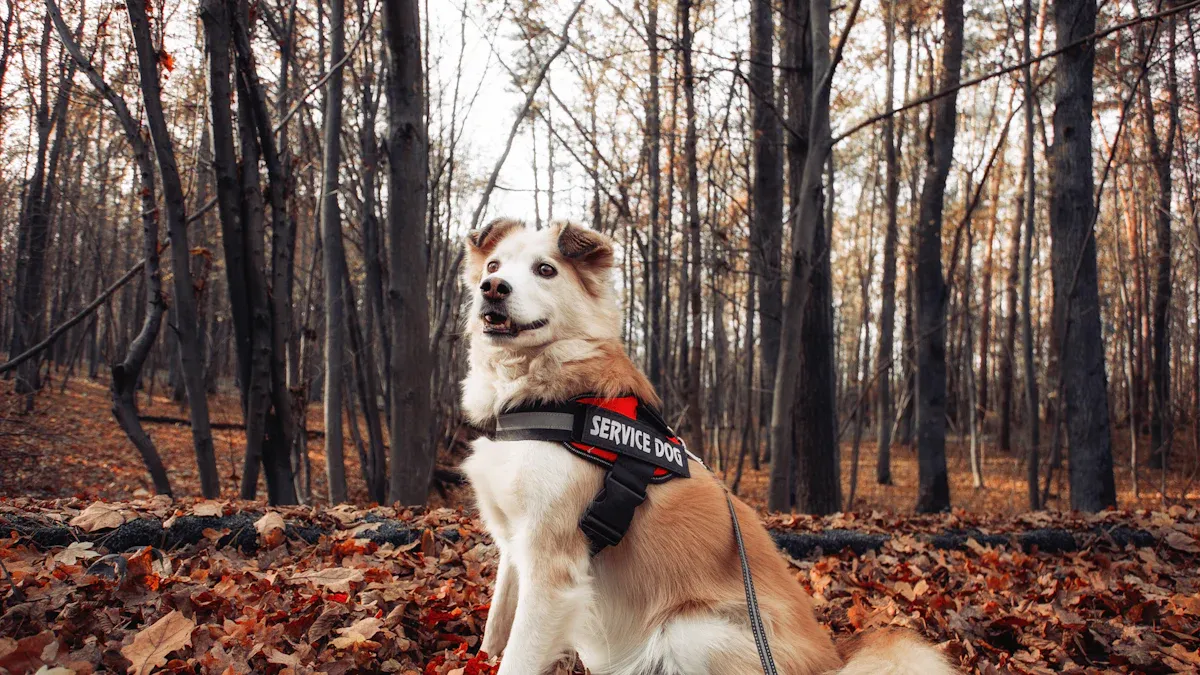
The handle is not an accessory. It is the primary force input point during close control, and its position determines where that force goes. A handle stitched too far forward — near the neck opening — acts as a short lever arm. When you pull up, the front of the harness lifts almost immediately because there is no counterbalancing panel length behind the pivot. The back panel, if it is stiff and unyielding, makes this worse: instead of conforming to the dog’s back and spreading the hand force across a wide contact patch, a rigid panel concentrates it at the forward stitch line. That stitch line becomes the hinge point, and the front edge becomes the load point — right at the throat.
A handle placed over the upper-back load zone, combined with a back panel that has enough flex to wrap the dog’s shape without collapsing, keeps the force traveling downward through the chest plate. The panel acts as a load spreader, not a lever. In production terms, this means the handle bar-tack must be placed aft of the shoulder gusset seam, and the back panel stiffener — if one is used — should extend past the handle attachment point so the panel does not kink at the stitch line under load. These are decisions made at the pattern and assembly level, and they show up immediately in how the harness behaves when you grab the handle on a moving dog.
Front chest height and neck opening shape
The front chest panel is the gatekeeper. If its top edge sits high on the sternum, every forward pull from the dog and every upward lift from the handle converges on the same half-inch of fabric crossing the lower neck. The neck opening should clear the throat by roughly two fingers’ width, but that static measurement only matters if the panel height is set correctly first. A panel that reaches too high will press into the neck even with a generous neck opening — the opening gapes but the panel still rides up into soft tissue.
A flat, low-sitting chest panel distributes force across the sternum and pectoral area. The panel should terminate below the point of the sternum, not above it. When a dog lunges forward, the chest panel takes the impact; if it sits below the sternal notch, the force vector pushes into the chest wall, not upward into the throat. This is why adjustment points matter less than the panel’s default position: five adjustable straps cannot fix a chest panel that was patterned to sit high. Choosing the right size and material starts with understanding where the panel lands on the dog’s chest, not just matching girth measurements to a chart.
Girth strap balance and shoulder clearance
Girth straps control rotation. When they sit at matched angles on both sides and their adjustment range is symmetric, the harness resists twisting under uneven load — a dog pulling diagonally toward a squirrel, for example. When one strap sits farther forward than the other, or when the adjustment slider favors one side, the harness develops a preferred rotation direction. Over a 20-minute walk, that preference compounds: each pull twists the harness slightly, and the twist never fully unwinds. Eventually the front edge drifts toward the throat on one side.
Shoulder clearance is the companion issue. Straps that cross the point of the shoulder restrict forward reach. A dog compensates by shortening its stride, which shifts weight backward, which changes the angle of pull on the harness, which can pull the front panel upward. A Y-shaped chest layout keeps the strap path outside the shoulder joint. On a large dog, that means roughly one inch of clearance between the strap inner edge and the bony point of the shoulder when the dog is standing square. When the dog extends into a full stride, that clearance should hold.
Leash ring placement and force travel
The leash ring position matters for the same reason the handle position matters: it is a force input point, and its location determines where that force goes. A back-mounted ring that sits forward of the upper-back load zone will lift the front panel when the leash is pulled upward. A ring placed at or behind the load zone keeps the pull vector parallel to the dog’s spine rather than perpendicular to it.
The front ring, if the harness has one, creates a different set of mechanics. A front ring positioned low on the chest panel redirects forward pulling into a sideways rotational force — the dog’s momentum is converted into a turn rather than resisted head-on. But if that ring sits too high, near the neck opening, the rotational force pivots around the neck instead of the chest. Walking control depends on where the leash ring directs force, not just on having a ring available.
| Design Difference | Why It Matters | Main Limitation |
|---|---|---|
| Handle over upper-back load zone | Upward hand force compresses chest, does not rotate front edge | Less effective if back panel is too stiff to wrap the dog’s shape |
| Low front chest panel | Force vector pushes into chest wall, not upward into throat | Requires accurate sizing — a panel cut too low for a deep-chested breed creates gapping |
| Balanced girth strap geometry | Resists progressive rotation under repeated uneven pulls | Adds adjustment steps; more setup time before first walk |
| Y-shaped chest layout | Keeps strap path outside shoulder joint through full stride | Narrower chest coverage — less surface area for load distribution than a full vest |
When a tactical harness design works — and when it does not
Suitable use cases
A tactical harness with anti-throat-lift geometry earns its keep in situations where you need brief, firm control over a strong dog. Hiking on uneven terrain where a sudden pull could throw your footing. Crowded urban crossings where a handle grab is faster than leash correction. Pausing at trail switchbacks to let other hikers pass. Working with a dog still learning not to lunge at distractions. In each of these, the handle is used for seconds at a time, not minutes. The harness does not need to be comfortable during extended handle-hold; it needs to stay in place and avoid lifting into the throat during those short, high-force moments.
A harness built for this kind of use prioritizes force management over constant-wear comfort. The materials tend to be heavier, the construction more reinforced, the adjustment range narrower because the fit must hold under load rather than accommodate casual sizing drift. That is the trade-off: a harness designed to stay put under tension is not the same as a harness designed to disappear on the dog during a calm stroll.
When a lighter design makes more sense
The same features that keep a tactical harness stable under load work against it in other contexts. The structured back panel that prevents kinking adds bulk. The wider straps that resist rotation trap more heat. The multi-point adjustment system that enables precise fit takes longer to set up and is less forgiving of a rushed owner.
For calm neighborhood walks on a loose leash, a dog that has never had a pulling problem does not need a handle positioned for emergency control. A heat-sensitive breed on a summer afternoon benefits more from minimal strap coverage and airflow than from anti-rotation geometry. A senior dog with limited shoulder mobility may find a structured harness restrictive rather than supportive — the tactical vest becomes overkill when the dog’s movement already matches the owner’s pace.
Disclaimer: The fit and movement checks described here assume a smooth-coated or short-coated dog where harness position is visible during movement. Double-coated breeds — huskies, malamutes, shepherds — may show subtler rub marks and strap drift that require hand-checking rather than visual inspection. If the dog’s chest shape falls outside typical breed proportions for which this harness was patterned — particularly dogs with a barrel chest or very deep keel — the two-finger neck-opening test may not catch every pressure point. In those cases, check for hot spots by running a hand under the chest panel and girth straps immediately after removing the harness, before the skin cools.
FAQ
How do you know if a harness is causing throat lift?
After a 10-minute walk that includes at least one handle-grab moment, check whether the front panel’s top edge has moved closer to the throat than where you set it. A harness that stays put will have the same finger gap at the neck opening as when you started. Also watch the dog’s stride in the last two minutes of the walk — a shortened stride often precedes visible harness shifting, because the dog compensates for restriction before the harness visibly rides up.
How tight should a tactical harness fit on a large dog?
Snug enough that you cannot slide more than two fingers flat between any strap and the dog’s body, but loose enough that those two fingers slide in without forcing. The chest panel should sit flat without gapping at the sides when the dog stands square. Check the fit again after the dog has walked for five minutes — body heat and movement can loosen some strap materials slightly, and the initial standing fit may not match the moving fit.
Can a tactical harness be used for everyday walks?
It can, but the question is whether it should. A tactical harness built for close control carries extra material weight and strap coverage that a calm, loose-leash walker does not need. If the dog walks without pulling on a standard harness, switching to a tactical design adds bulk without adding benefit. Reserve it for situations where you actually use the handle or need the anti-rotation stability.
What material differences affect throat lift prevention?
Back panel stiffness is the main one. A panel that is too rigid concentrates force at its forward stitch line when you lift the handle; a panel with controlled flex spreads that force across a wider contact area. The chest panel lining matters too — a slick inner surface allows the panel to slide upward more easily under tension, while a slightly textured or padded inner surface resists vertical drift. Strap edge finishing in the armpit and shoulder zones determines whether friction or comfort dominates during extended movement.






