
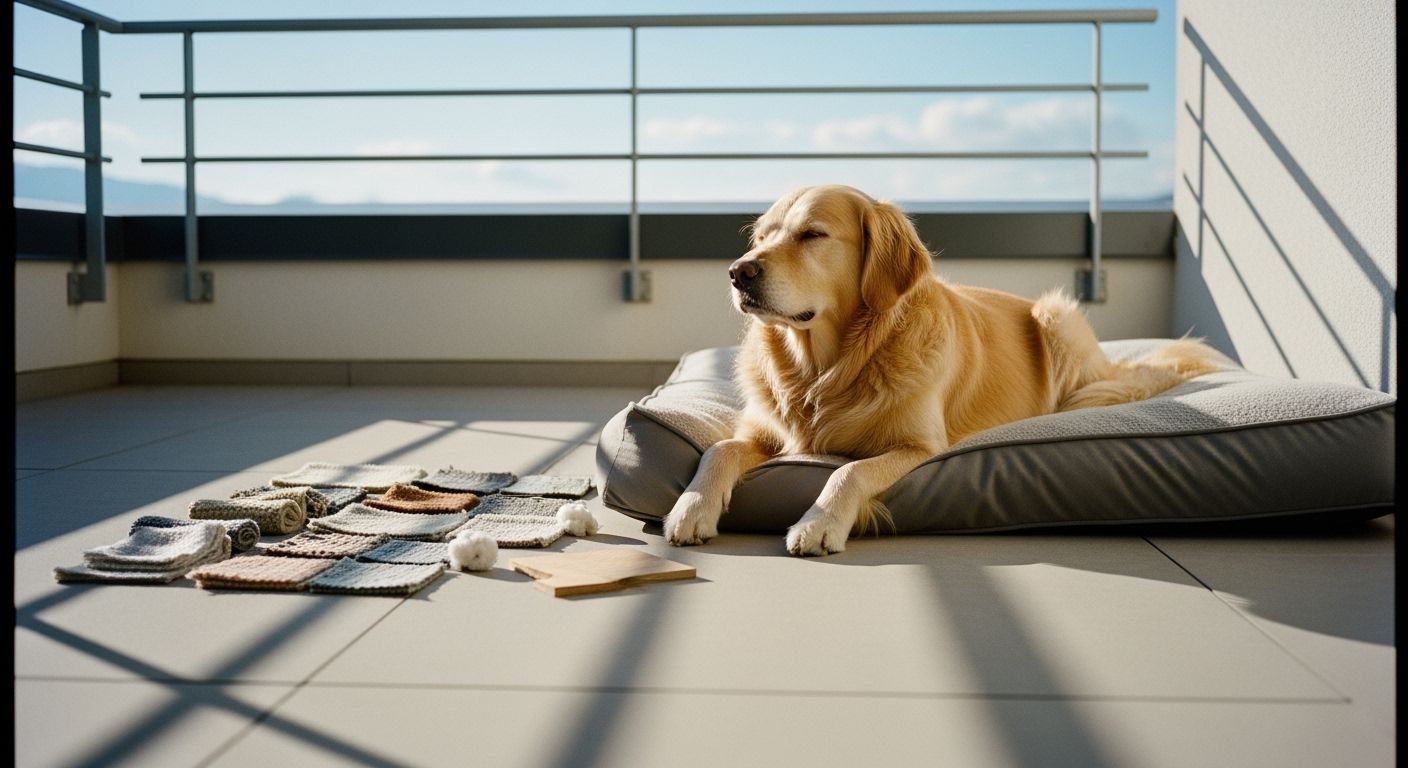
A dog bed sitting on a sunny balcony takes a beating that indoor beds never face. UV radiation, surface heat, and daily temperature swings attack every material layer — and they do not attack them equally. The outer cover might look nearly new while the stitching inside has lost half its strength. That gap between what you see and what is actually failing is what makes balcony sun exposure a distinct durability problem. The bed does not fail all at once. It fails one component at a time, starting with whichever material is least equipped for the conditions.
Outdoor beds engineered with UV-stabilized fabrics and breathable waterproof barriers tend to hold up where standard indoor beds collapse within weeks. The difference is not a single material spec — a fabric labeled “UV-resistant” tells you nothing about the threads holding it together. What matters is how the outer shell, the waterproof backing, the stitching, and the core fill are built to handle heat as one integrated system. A well-constructed outdoor dog bed treats each layer as a potential failure point, not an afterthought.
When Balcony Sun Starts Breaking Down the Bed
Direct sun on a balcony is more concentrated than sun in a yard. Balcony railings trap heat. Hard flooring radiates it back up. The bed surface can reach temperatures far above the ambient air, and that heat stays there for hours. Two things happen at once: UV photons break polymer chains inside synthetic fibers, and sustained heat accelerates every chemical degradation pathway already in motion.
The first visible sign is usually color fade. But fading is a surface story — it does not tell you what is happening deeper in the material.
Fading Is the Visible Signal, Not the Structural Problem
How a fabric is dyed determines whether it holds its color or washes out to a pale ghost within a season. Solution-dyed acrylic fibers have pigment mixed into the liquid polymer before extrusion — the color runs through the entire fiber cross-section, not just the outer skin. Sunlight has to erode the fiber itself to reach pigment-free material. Piece-dyed polyester works differently: the finished colorless yarn gets dipped in a dye bath, so color sits only on the surface. UV strips that thin outer layer fast. The fabric bleaches from the outside in.
But here is the trap: a bed with faded fabric might still be structurally sound. And a bed with bright, unfaded fabric might have threads snapping inside the seams. Color retention and mechanical strength degrade through different chemical mechanisms. Looking at the cover tells you nothing about the seam. If you run your thumb firmly along a seam line and the stitches separate or the thread feels brittle enough to crack rather than stretch, the bed is done regardless of how good the cover looks.
When the Structure Gives Before the Surface Fades
UV photons do not just bleach color. They cleave the long polymer chains that give synthetic fibers their tensile strength. Each chain break shortens the average molecular weight of the material — the fiber becomes more brittle, less elastic, and less able to distribute load. A fabric under the weight of a dog is under constant tension. As polymer chains snap, the remaining intact chains carry more load per chain. Eventually microfractures propagate into visible cracking, then into outright tearing.
This is why a dog bed on a sunny balcony can sag in the middle within months even if the color looks acceptable. The center support panel, which bears the dog’s full weight directly under the hottest sun, loses fiber strength faster than the side panels. Outdoor dog bed durability depends on whether the fabric was engineered for tensile retention under UV, not just for colorfastness. A textile can pass a fade test and fail a load test. They are separate metrics. They must be evaluated separately.
Why Threads, Coatings, and Fill Age at Different Speeds

A dog bed is a stack of materials with wildly different UV tolerances. The thick outer cover fabric might be solution-dyed acrylic with years of sun resistance. The sewing thread holding it together might be commodity polyester with no UV stabilizer at all. Threads have a much smaller cross-section than the fabrics they join — every square millimeter of thread surface receives the same photon dose as the cover, but the thread has far less material behind it to absorb cumulative damage before structural failure.
Thread Failure: The Weakest Link Rule
This is the mechanical reality: when force concentrates along a seam, each stitch point becomes a stress riser. A narrow thread under tension, exposed to the same UV as the broad fabric panels it connects, degrades faster simply because it has less depth to sacrifice. Once thread embrittlement sets in, daily weight loads that the bed handled easily when new become enough to snap individual stitches. A few broken stitches concentrate more load onto their neighbors. Cascade failure follows.
Bonded polyester threads — the kind rated V-92 or V-138 with UV-stabilized coatings — resist this degradation sequence far longer than untreated general-purpose thread. The bonding resin coats each filament and reduces the surface area exposed to direct radiation. PTFE-based threads take this further: the fluoropolymer backbone is inherently near-immune to UV photodegradation because the carbon-fluorine bond energy exceeds the photon energy of terrestrial UV. But these threads cost more, and many beds skip them. After a month on the balcony, pull gently on a visible seam. If the thread crackles or parts with hand pressure, the rest of the seams are not far behind.
| Thread Type | UV Resistance Mechanism | What to Watch For |
|---|---|---|
| Bonded Polyester (V-92/V-138) | Resin coating reduces exposed filament surface area | Still degrades eventually; check seam flexibility after 6 months |
| PTFE (fluoropolymer) | Carbon-fluorine bonds exceed terrestrial UV photon energy | Higher cost; confirm the entire seam uses it, not just top-stitching |
Waterproof Coatings: Heat Delamination vs. UV Breakdown
Waterproof backings on an outdoor bed face two separate threats. UV radiation attacks the coating’s polymer structure from above, through the cover fabric. At the same time, sustained heat from the balcony floor softens the coating from below, reducing its adhesion to the substrate fabric. These two mechanisms compound each other. A coating that has already softened from heat offers less resistance when UV begins breaking its polymer chains — the material fails faster than either stressor would cause alone.
A waterproof dog bed designed for outdoor use typically uses a breathable membrane layer rather than a solid impermeable sheet. The breathable structure releases trapped water vapor — which matters here because a sealed, non-breathable backing turns the bed into a solar oven. Heat builds between the cover and the waterproof layer with no escape path. Thermal degradation accelerates. The coating peels, cracks, or turns sticky. To check whether a coating is still intact, press firmly into the center of the bed on a hot afternoon and listen for crackling sounds. Cracking under pressure is the failure signal.
Fill Collapse: When the Core Cooks from the Inside
The fill inside a balcony dog bed sits in the hottest part of the system. Dark balcony surfaces absorb solar radiation and reradiate it as heat. The bed’s cover and waterproof backing trap that heat around the fill. Standard polyurethane foam cores undergo accelerated compression set under these conditions — the cell walls collapse, the foam loses rebound, and the bed develops a permanent dent where the dog lies.
Open-cell foam structures fare better than closed-cell in this scenario because they allow some air circulation through the core. Dense cotton-blend fills can also work if the bed includes mesh ventilation panels that create a chimney effect — hot air rises out through the sides, drawing cooler air in from below. Without this airflow path, even the best fill material degrades into a lumpy, unsupportive pad within a single summer. Choosing outdoor bed materials that work as a system — not one material in isolation — is what separates a bed that lasts from one that does not.
Design Choices That Slow the Clock
Three design features make a measurable difference on a sun-exposed balcony. None of them is complicated. Each addresses a specific degradation pathway.
A replaceable outer cover. The cover takes the worst of the UV and the dirt. When it is removable and replaceable, the most heavily stressed component becomes a consumable — swap it when it fades or stiffens, and the structural frame and fill underneath stay protected. This is the single highest-leverage design decision for balcony use, because the cover is always the first thing to go.
Mesh ventilation panels on the sides. Heat is the accelerator for every other failure mode. Ventilated side panels create a passive airflow path that dumps trapped heat before it can cook the waterproof backing and fill. The difference in internal temperature between a fully sealed bed and one with mesh gussets can be large enough to shift coating degradation from a single-season problem to a multi-year one.
Raised platform construction. An elevated dog bed with a steel frame separates the sleeping surface from the hot balcony floor. That air gap does two things: it blocks conducted heat from the floor from entering the bed structure, and it creates a cross-breeze underneath that pulls heat away from the fill. On a balcony where the floor surface can become too hot to touch, this gap is not a minor comfort detail — it changes the thermal environment the bed materials must survive in.
When a Balcony Bed Is Not the Answer
No outdoor bed design eliminates UV degradation. It slows it. A bed on a south-facing balcony in Phoenix endures a fundamentally different stress profile than one on a shaded east-facing balcony in Seattle. The material choices that work in one scenario may not work in the other.
Solution-dyed acrylic covers resist fading well but tend to feel rougher than soft polyester — a dog that already avoids textured surfaces may refuse to settle on it. Elevated frames solve the floor-heat problem but create a step-up that older dogs or short-legged breeds may struggle with. Raised beds also expose the dog to more direct airflow, which is good in summer heat but can be a comfort loss when the temperature drops.
Waterproof backings are essential if the balcony gets rain, but every waterproof layer reduces breathability by some degree. A truly waterproof, non-breathable bed creates the heat-trapping problem described earlier. The trade-off is real: you can have maximum waterproofing or maximum ventilation, but not both at their extremes.
Disclaimer: The seam-inspection check described above assumes a smooth-coated or short-haired dog whose body weight loads the bed evenly. Double-coated breeds with dense undercoat may distribute weight differently and produce subtler seam stress patterns that need hand-checking rather than visual inspection. Dogs with barrel chests or very deep keels that fall outside the breed norms a given bed was patterned for may create pressure points that the standard fit checks described here do not catch.
An outdoor bed for a balcony or backyard setup works best when the conditions are honestly assessed: hours of direct sun per day, whether rain reaches the spot, the dog’s weight and sleeping position, and whether the dog will use a raised surface. If the balcony gets eight-plus hours of direct summer sun with no shade option, no fabric bed will last indefinitely. In that case, a bed with a replaceable cover becomes a maintenance item — plan on swapping the cover every season or two, and consider it normal wear, not product failure.
FAQ
Does a faded cover mean the bed is structurally unsafe?
Not necessarily. Color fading and fiber strength loss are separate degradation processes. A noticeably faded solution-dyed acrylic cover may still retain most of its tensile strength. Conversely, an unfaded bed can have threads failing inside the seams. Check seam integrity independently of visual color — pull gently on exposed stitching and look for brittleness or separation.
Can sewing thread really fail before the cover fabric shows wear?
Yes, and it is common. Sewing thread has a fraction of the cross-sectional area of the cover fabric it joins. The same UV dose per square millimeter hits both materials, but the thread has far less material depth to sacrifice before reaching its failure threshold. Threads that are not UV-stabilized can lose enough strength to snap under normal use while the cover fabric still looks new.
How can I tell if the waterproof layer is still working?
Two quick checks. First, press firmly into the bed center on a hot afternoon and listen for crackling or crunching sounds — those signal coating delamination. Second, pour a small amount of water onto the bed surface and watch whether it beads up or sinks in. If water wets through to the fill within a minute, the waterproof barrier has failed. A functional coating should hold standing water on the surface for several minutes minimum.
Is a replaceable cover worth the extra cost for a balcony bed?
For a balcony with heavy sun exposure, a replaceable cover often pays for itself. The cover is the component that takes the brunt of UV, dirt, and surface wear. When you can swap only the cover instead of replacing the entire bed, the frame and fill stay in service for years longer. The economics tilt toward replaceable covers anywhere the cover is expected to degrade faster than the internal structure — which describes most sunny balconies.






