
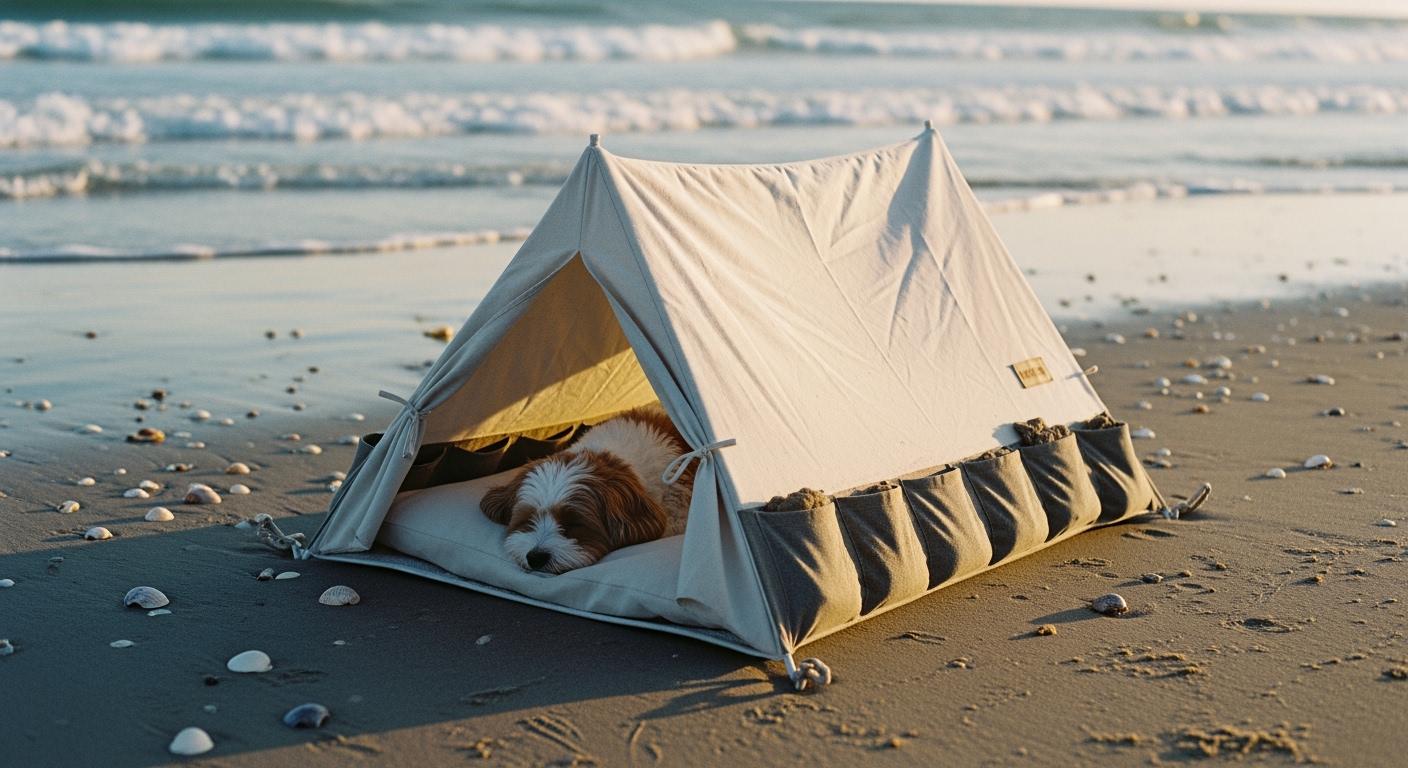
A pet tent on the beach faces two forces that backyard tents rarely see: gusting wind with no windbreak, and loose sand that refuses to hold a stake. Most lightweight tents fail here not because the fabric is weak. The anchoring strategy was designed for soil, not sand. Edge-weighted sand pockets and low ground-level anchors solve this differently — they redirect wind force through weight distribution and a shorter lever arm. That changes how the tent behaves the moment a gust hits.
Why Beach Wind Lifts Lightweight Pet Tents
How Beach Wind Behaves Differently
On a beach, wind does not arrive as a steady push. It comes in pulses. The temperature difference between sun-warmed sand and cooler water creates a sea breeze front — denser air sliding under lighter, rising air. That boundary behaves like a miniature cold front: gusty, turbulent, directionally unstable.
When one of these gusts hits the broad side of a pet tent, the fabric acts like a sail. Pressure builds on the windward face. But the real failure starts underneath. If the bottom edge lifts even half an inch, wind slips into the interior cavity. Now pressure builds from inside and outside simultaneously — and the inside pressure pushes upward. The tent becomes a wing. Worse, the higher the anchor point sits above the ground, the longer the lever arm wind can work against. A stake driven 12 inches up gives wind a 12-inch mechanical advantage to pry it loose. That is a losing geometry on sand.
The Problem with Loose Sand and Open Spaces
Standard tent stakes rely on soil cohesion — clay and loam grip the stake along its full length. Dry beach sand has almost none of that. Its particles are rounded and loosely packed. They flow around a stake rather than holding it. When wind tugs the tent fabric, a straight stake can pull free in seconds.
Open beach spaces compound the problem. No trees, no buildings, no terrain features slow the wind down. Gusts hit at full speed. The failure chain is consistent: wind catches fabric, stake loses grip in loose sand, edge lifts, more wind gets underneath, tent shifts or collapses. Break any link in that chain and the failure stops. The designs worth paying attention to break the first two links at once — which is where sand pockets and low anchors come in. Understanding which tent features handle real outdoor conditions starts with knowing what you are up against.
Real-World Effects on Dog Tent Stability
A tent that lifts or shifts exposes your dog to direct sun, blowing sand, and a shelter that may partially collapse. Three failure signals map to three specific design gaps:
| Beach failure signal | Likely tent design cause | Better design direction |
|---|---|---|
| Edges lifting | No sand pockets, loose corners | Edge-weighted sand pockets |
| Tent shifting | Weak anchors, narrow contact | Low anchors, wider ground contact |
| Sand blowing inside | Open sides, lifted bottom edge | Stable corners, edge coverage |
A tent built for soil camping tends to fail on all three counts at the beach. The design was never asked to solve these problems.
How Sand Pockets and Low Anchors Change the Physics
How Edge-Weighted Sand Pockets Work
A sand pocket is a fabric sleeve sewn along the tent’s bottom edge. Fill it with beach sand on site. That is the whole mechanism — no moving parts, no hardware to lose. But the physics of why it outperforms a stake is worth understanding.
When wind pushes against a tent wall, the force wants to rotate the entire structure around its anchor points. The higher those anchor points sit above the ground, the longer the torque arm — and torque equals force times distance. A sand pocket eliminates this geometry entirely. The weight sits at ground level. Zero lever arm. Wind cannot pry against it because there is no gap between the resisting mass and the surface it holds down.
Think of it as the difference between trying to tip over a sandbag versus pulling out a stake. The sandbag resists through pure mass acting at ground level. The stake resists through friction along its shaft — and on loose sand, that friction surface keeps failing as particles shift. Mass beats friction in this environment every time. A waterproof tent built with sand pockets also gains an edge at the beach: wet sand inside the pockets adds even more weight without leaking through the shell fabric.
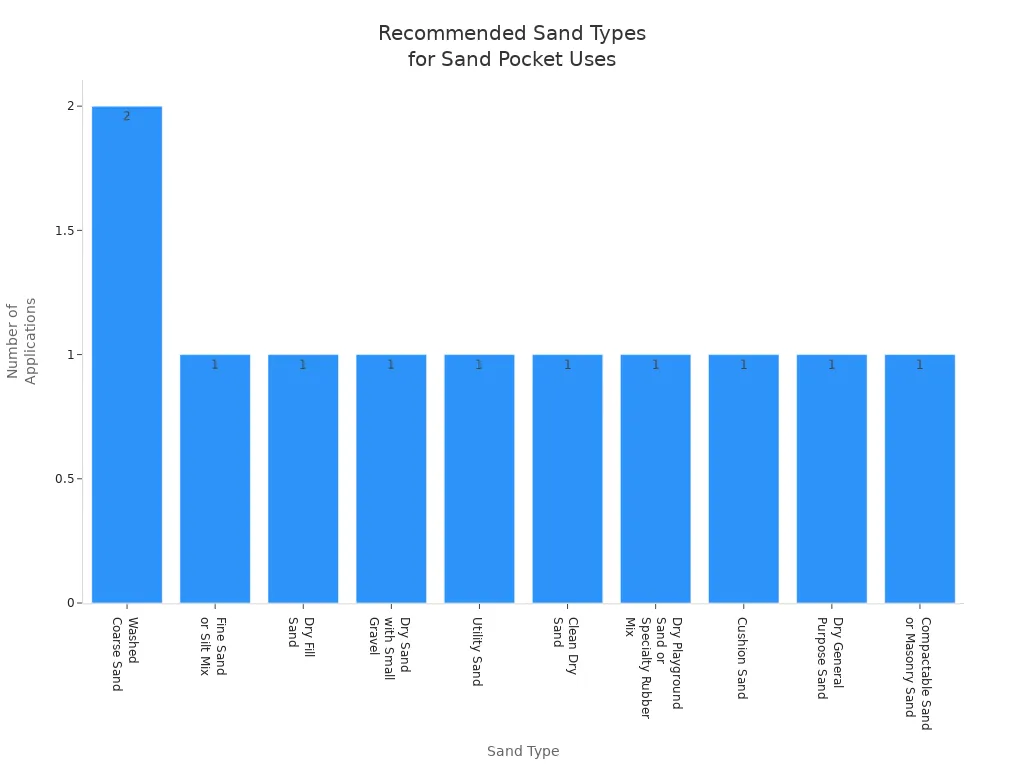
Dry, coarse sand fills these pockets best. Coarse grains interlock under their own weight, packing into a dense mass that resists internal shifting. Fine silt or damp sand can compact unevenly, leaving voids that let weight settle to one side over time. A quick field check: after filling, press down firmly on each pocket with your foot. It should feel solid, not spongy. If it gives way, redistribute the sand and pack it tighter.
Benefits of Low, Ground-Level Anchoring
Low anchors work on the same lever-arm principle. An anchor point set 2 inches above the sand gives wind almost no mechanical advantage. The force vector points nearly parallel to the ground instead of pulling upward. Compare that to a high tie-out on a standard tent pole — the wind gets a long handle to twist with.
Screw-type sand anchors outperform traditional straight stakes because their helical shape traps sand between the threads. Each rotation creates a small compressed-sand shelf that resists vertical pull. A straight stake offers one friction plane. A helical anchor offers a stack of them. The difference in holding power is not marginal — it is the difference between a single shear plane and multiple compressed layers.
The combination of sand pockets and low anchors creates a system that does not rely on any single point holding. The pockets provide passive, distributed weight. The anchors provide active mechanical grip. If one anchor loosens slightly in shifting sand, the pocket weight keeps that corner planted long enough to notice and retighten — instead of letting the tent go airborne before you can react.
In practice: Set up the tent, fill the pockets, secure the anchors. Walk 50 feet away and watch the edges for two minutes in steady wind. If any corner lifts even briefly, that anchor or pocket needs adjustment. A properly weighted edge stays flush against the sand without flapping.
Why Wider Ground Contact Keeps Corners Down
A tent with a narrow footprint concentrates its weight on a small area. On soft sand, that concentrated load can cause one side to sink while the other rides up — a slow tilt that loosens anchors on the high side while burying the low side deeper than intended.
Wider ground contact changes the math. The same tent weight, spread across a larger base, exerts less pressure per square inch. Less sinking. Less tilting. More consistent anchor tension across all corners. It also increases the total friction surface between the tent base and the sand — and friction scales with contact area, not just weight.
This becomes critical when your dog moves inside the tent. A camping outing with an active dog means constant weight shifts. A dog repositioning from one side to the other creates a moving point load. On a narrow-based tent, that point load can lift the opposite corner — the waterbed effect. A wider base reduces this by keeping more of the perimeter weighted and in contact with the sand regardless of where the dog settles.
When you combine edge-weighted sand pockets, low screw-type anchors, and a wide footprint, the three features cover three distinct failure modes. Sand pockets prevent edge lift through mass at ground level. Low anchors prevent pull-out through stacked friction planes. Wide contact prevents tilt and shift through distributed pressure. Each one addresses a problem the other two cannot fully solve alone. A tent that has only one or two of these features will hold in mild conditions — but on soft, shifting ground the gaps show quickly.
When These Designs Work Best — and Where They Fall Short
Edge-weighted sand pockets and low anchors deliver their biggest advantage in dry, loose beach sand with gusting onshore wind. That is the environment these features were explicitly designed around. They also perform well on other loose substrates — dry riverbeds, gravel bars, coarse dune sand.
The advantage narrows on hard-packed wet sand. When sand is dense and cohesive from moisture, traditional stakes can actually hold reasonably well. Sand pockets still add weight, but the relative benefit over a standard stake is smaller. On rocky shorelines with no sand to fill the pockets, the edge-weighting feature becomes irrelevant — you are back to relying solely on anchors, and screw-type anchors struggle in rock. A tent with a shade canopy design might work on a rocky beach, but the anchoring strategy needs to shift entirely.
The design also assumes you are willing to spend two minutes filling and packing the pockets properly. Rushed setup — half-filled pockets, anchors not fully twisted in — negates most of the advantage. The tent will perform closer to a basic stake-only model.
Disclaimer: These anchoring methods assume dry, coarse beach sand filling the pockets. Fine silt or wet compacted sand packs differently and may settle unevenly, requiring you to recheck pocket fill after the first 30 minutes of wind exposure. If your dog is large or highly active inside the tent, the waterbed effect can still lift lightly weighted corners — wider ground contact reduces this but does not eliminate it for dogs over roughly 80 pounds in tents with a footprint narrower than 48 inches.
For most beach days with moderate to strong wind, a tent built around sand pockets, low anchors, and a wide base will stay planted where a standard camping tent will not. The design advantage is not subtle — it is the difference between setting up once and spending the afternoon chasing a collapsing shelter. A portable shelter built for these conditions earns its footprint through physics, not through more stakes or heavier fabric.
FAQ
Can regular tent stakes work on the beach if buried deep enough?
Depth alone does not solve the problem. Loose sand flows around a stake regardless of how deep it goes — there is no cohesive grip along the shaft. A stake buried 18 inches deep in dry sand can still pull out with steady tension because the sand particles simply rearrange rather than locking. Screw-type anchors work differently: their threads create compressed shelves of sand that resist vertical movement.
Do sand pockets work if the sand is wet?
Wet sand is heavier, which helps. But it also packs unevenly and can form hard clumps that leave gaps inside the pocket. Fill wet-sand pockets gradually, packing each layer with your hand, and expect to recheck the fill after the sand dries — dried pockets can lose up to a third of their packed volume as moisture evaporates and the grains settle.
How many sand pockets does a tent need for real wind protection?
One pocket per corner is the minimum. Edge pockets along the full perimeter work better because they prevent wind from sneaking under the sides between corners. A tent with only corner pockets can still lift along the unsupported edges even if the corners stay put. The fabric bows upward between weight points, creating the same gap-wind-lift cycle at a smaller scale.






