
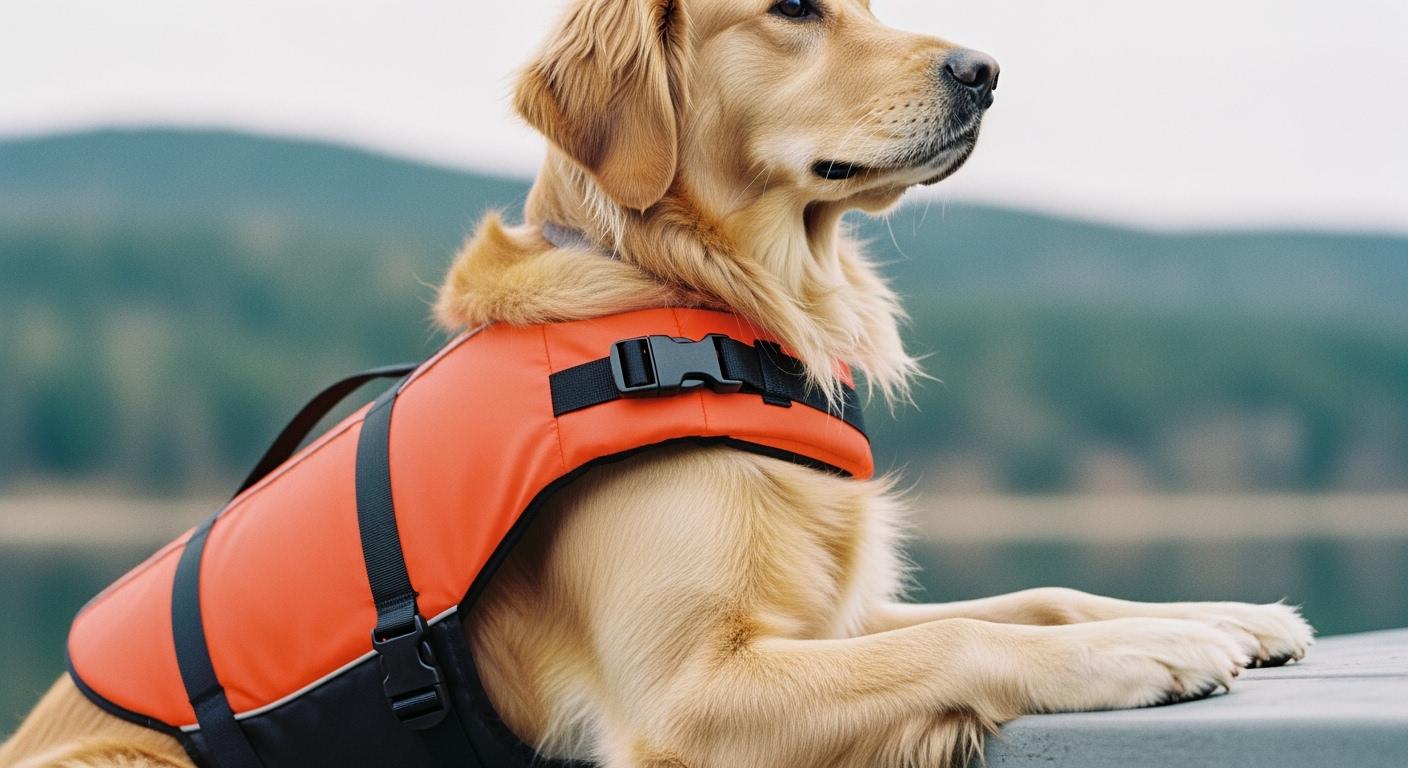
A dog life jacket chest strap ends up rubbing behind the front legs for one mechanical reason: too much force concentrated into too little contact area. When a dog paddles, the chest panel shifts with every stroke. A narrow strap translates that micro-movement into a focused friction line along the same strip of skin. Over a twenty-minute swim session, the dog’s foreleg cycles forward and back roughly six hundred times. Each cycle drags the strap edge across the same spot. The result is not instant. It builds.
What Makes a Chest Strap Rub Behind the Front Legs
A dog’s paddling stroke does two things to a life jacket at once. The foreleg drives forward, pulling the chest panel toward the shoulder. Then the leg sweeps back, dragging the panel rearward. Each direction shift transfers force into the strap that sits closest to the leg crease. A strap placed within an inch of that crease becomes the pivot point for the entire jacket’s movement. The strap itself does not need to be loose for this to happen. Even a snug strap rotates slightly under cyclic loading because the foam panel above it is buoyant and wants to float upward while the dog’s body drives downward with each stroke. That mismatch between buoyant lift and paddling motion creates a low-amplitude oscillation — small, repetitive, and concentrated along the strap’s contact line.
In practice: after ten minutes of swimming, lift the chest panel and look at the skin behind the front legs. A single defined red line running across the crease means the strap is sitting too close and too narrow. Diffuse pink spread across the chest panel area means pressure is distributing more evenly.
Why Narrow Straps Make It Worse
A narrow strap has no anti-rotation surface. When side force hits the strap from an angle during a turn or climb-out, the entire load stays in one thin band. The strap edge rolls inward, digging the binding into the skin. A wide chest panel changes this. The same side force hits a larger surface, so the panel shifts as a unit rather than rolling at the edge. The pressure per square inch drops because the load is shared across more fabric. This is not about padding thickness. It is about contact geometry. A half-inch strap under ten pounds of lateral force creates roughly twenty pounds per linear inch along the edge. A three-inch panel under the same force drops that below four pounds per inch. The skin tolerates the latter. It breaks down under the former after repeated cycles.
Design Choices That Change the Pressure Map
Wider Chest Panels Redirect Load Away from the Leg Crease
The chest panel on a life jacket does more than hold flotation foam. It sets the load path. A panel that spans from the sternum across to the ribcage transfers lifting force into the dog’s broadest surface — the chest wall — instead of funneling it into the narrow zone behind the front legs. This matters most during climb-out. When a dog hauls itself onto a dock or boat edge, the life jacket’s handle or rear panel gets pulled upward. On a narrow-strap design, that upward force runs straight into the strap behind the legs. On a wide-panel design, the same force disperses across the panel and into the chest. The dog gets lifted without the strap becoming a pressure hotspot.
This is why understanding the difference between segmented-foam and single-sheet chest panels matters before choosing a jacket. A single foam sheet transfers load more directly. Segmented panels can flex independently, which changes how force reaches the strap.
Strap Routing and Front-Leg Clearance
Strap routing is the difference between a strap that clears the leg crease by an inch and one that sits inside it. The ideal path runs the chest strap across the sternum at a slight downward angle, then routes the belly strap farther back, past the deepest point of the ribcage. This keeps both straps behind the leg’s forward arc. When the belly strap sits too far forward — a common cost-cutting pattern choice — it enters the leg-motion zone. Every paddle stroke pushes the strap backward into the armpit. Adjusting tightness cannot fix this. The anchor point on the jacket body determines the path. If the stitching places the strap exit too close to the front-leg opening, the geometry is locked in.
Sizing mistakes amplify routing problems because a jacket that runs large shifts all strap positions forward relative to the dog’s anatomy. A strap that was designed to sit mid-sternum ends up in the armpit.
Edge Binding and Wet-Webbing Stiffness
Run your thumb along the inside edge of a life jacket strap after it has been submerged for ten minutes. If the binding feels noticeably rougher or stiffer than when dry, that material is absorbing water and changing its surface texture mid-use. Nylon webbing can stiffen when saturated because the fibers swell and the weave tightens. A strap that felt pliable during a dry living-room fit test becomes a semi-rigid edge underwater. Polypropylene webbing absorbs less water and tends to stay closer to its dry texture. The edge binding material makes an equal difference. Fold-over polyester binding with a raw inner seam creates a hard ridge. Turned-edge binding or laser-cut sealed edges present a smoother face to the skin. The difference shows up after the dog has been moving — not during the first thirty seconds of wear.
On a paddle board, where the dog shifts weight constantly with board motion, the edge binding cycles against the skin even more frequently than during straight-line swimming. The strap material and binding choice compound under those conditions.
| Rubbing Signal | Likely Design or Fit Cause | Better Life Jacket Design Direction |
|---|---|---|
| Redness behind legs | Strap too close to leg crease, too narrow | Wider chest panel, better strap routing |
| Fur loss or chafing | Rough edge binding, stiff webbing | Smoother edges, soft contact zones |
| Shifting during swim | Loose fit, poor adjustment | Secure adjustment, proper front-leg clearance |
When a Good Design Still Causes Problems
Even a life jacket with wide panels, smart routing, and smooth binding can rub in the wrong conditions. The most common culprit is a size mismatch. If the chest girth measurement falls near the bottom of a size range, the jacket will sit slightly large. That extra fabric length shifts the chest panel forward, moving the strap closer to the leg crease than the pattern intended. A jacket at the top of its size range pulls the panel rearward, which can create bunching behind the shoulders. Both scenarios change the strap angle enough to reintroduce rubbing.
Breed conformation introduces a second variable. A dog with a very deep chest and pronounced tuck — think a Doberman or a sight hound — has less surface area behind the front legs for a panel to anchor against. The same wide panel that works on a Labrador can float slightly on a deeper-chested dog because the sternum sits further back relative to the leg crease. Short-legged breeds face the opposite challenge: the leg crease sits higher on the body, leaving less vertical clearance for the chest strap to route below it without dropping into the armpit zone.
A post-swim fit check catches these problems before they become skin damage. After the dog exits the water, run two fingers under the chest strap. If the strap sits more than a finger’s width from where you set it on dry land, the jacket shifted during activity and needs a tighter adjustment or a different panel shape. A life jacket that fits well for swimming stays within a half-inch of its starting position after a full session in the water.
Disclaimer: this fit assessment assumes a dog with a standard chest conformation — moderate depth with visible tuck behind the elbows. Barrel-chested breeds like Bulldogs or very deep-chested breeds like Greyhounds may need a different chest panel shape to achieve the same pressure distribution. For dogs with very short legs, the front-leg clearance described here can be harder to achieve because the leg crease sits higher relative to where the chest panel naturally falls. Hand-check the strap path rather than relying solely on visual alignment.
FAQ
How do I know if the chest strap is placed correctly behind the front legs?
After strapping the jacket on, slide your index finger between the chest strap and the front-leg crease. You should feel at least a full finger’s width of clearance — roughly three-quarters of an inch — between the strap edge and where the leg meets the body. If the strap touches the crease even at rest, it will press into it during paddling.
Does tightening the straps more fix rubbing?
Only if the rubbing comes from jacket shift, not from strap placement. Tightening reduces motion but does not change where the strap sits anatomically. If the strap crosses the leg crease, more tension concentrates more pressure into that same spot and can make it worse. Fix placement first, then adjust tension.
Does a life jacket with more buckles give a better fit?
Not necessarily. Additional adjustment points let you fine-tune fit if they are placed in useful positions — across the chest and belly, not in the leg-motion zone. Buckles that sit in or near the armpit add bulk in exactly the wrong place. Two well-placed adjustable straps with wide anchorage often outperform four narrow straps with limited contact area.
What material differences matter most for dogs with sensitive skin?
Edge binding material and webbing fiber type matter more than outer shell fabric. A smooth, turned-edge binding on the inner face of the chest strap prevents the hard seam ridge that folded binding creates. Polypropylene webbing tends to absorb less water than nylon, so it stays closer to its dry-state flexibility throughout a swim session. Life jackets built with sealed-edge construction remove the binding ridge entirely by fusing the edge rather than folding and stitching it.






