
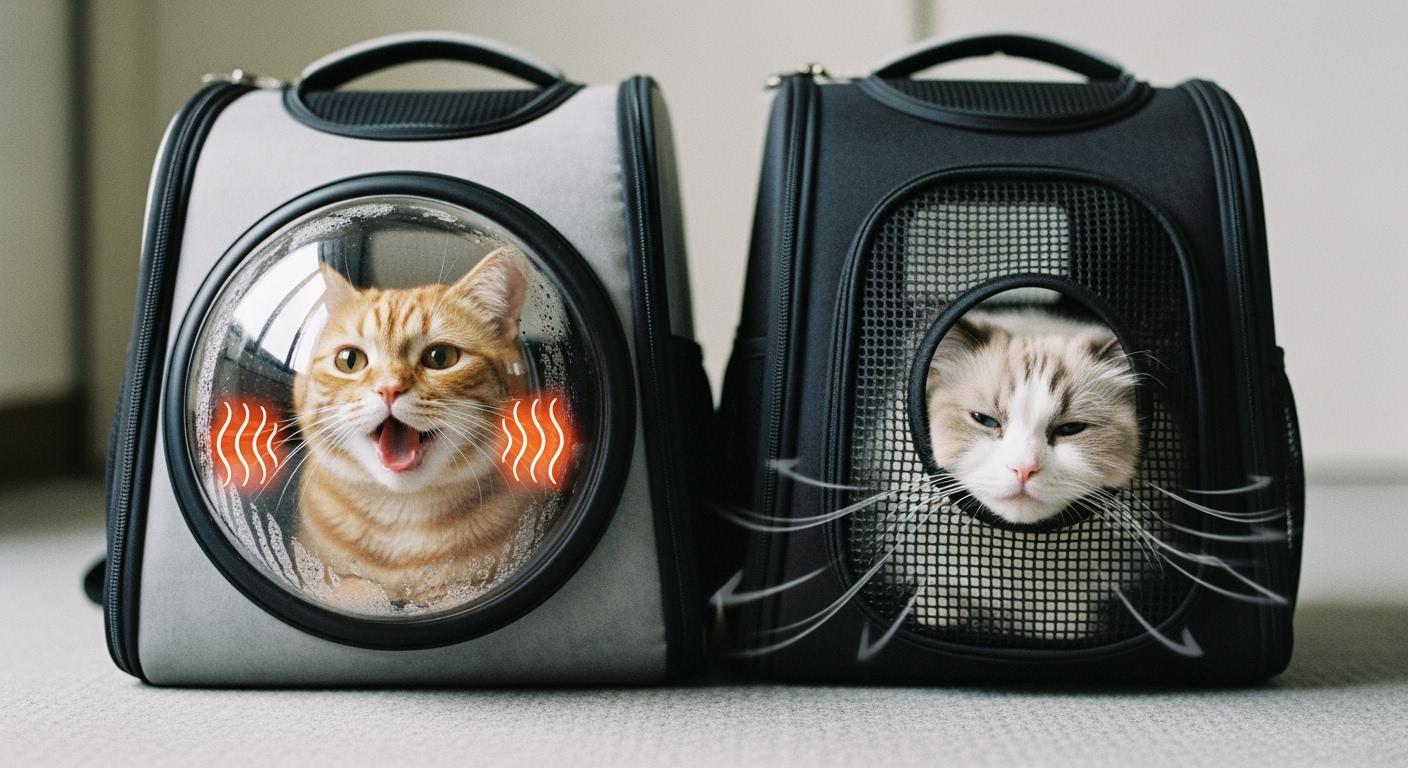
A bubble window gives a cat a view. It does not give it air. That distinction is the core of why some cats come out of a backpack carrier panting while others stay settled. When a cat who overheats easily is placed inside an enclosed shell with a sealed plastic window, the physics work against comfort from the first minute.
This is not about vent count. It is about whether the carrier structure creates an airflow path that passes across the cat’s body — or traps a pocket of warm, still air that gets progressively hotter. Mesh panel placement, internal air gap geometry, and shell material stiffness are the three design features that decide which scenario unfolds.
Why a Bubble Window Turns Into a Greenhouse Inside a Backpack Carrier
A bubble-style carrier surrounds the cat with a rigid plastic shell. The front window is sealed. The sides have a few small perforations. That is the entire ventilation strategy — and it breaks down the moment you understand how a cat dissipates heat.
Cats thermoregulate partly through their skin surface and partly through their respiratory tract. When ambient air around the body is still, the boundary layer of warm air next to the skin thickens. Heat transfer stalls. The cat’s core temperature drifts upward, and the panting threshold is reached sooner. In a bubble carrier, the sealed shell traps this boundary layer. The few side holes are not positioned to draw fresh air across the cat’s body — they vent outward, not across. The result is a warm, stagnant pocket that a cat cannot escape because the carrier walls prevent repositioning toward cooler zones.
This is the causal chain: sealed plastic window → no cross-ventilation pressure gradient → boundary layer of warm air thickens against the cat’s coat → evaporative cooling from the respiratory tract becomes the only remaining pathway → panting begins. A cat in a mesh-panel carrier, by contrast, has air moving across its flank and back. That airflow strips the boundary layer and restores convective heat loss. The difference is not subtle after 15 minutes on a warm sidewalk.
Note: Visibility and ventilation are unrelated design goals. A bubble window maximizes one at the expense of the other. A mesh panel trades some outward visibility for continuous airflow — and airflow is what keeps a cat’s body temperature from climbing.
Different carrier styles approach the airflow problem in fundamentally different ways:
| Design Difference | How It Affects Airflow | Main Limitation |
|---|---|---|
| Bubble window carrier | Sealed front, small side perforations; no cross-flow path | Boundary-layer heat builds up; cat cannot shift to a cooler zone |
| Mesh panel carrier | Open-weave front and side panels; air moves through along the cat’s flank | Snag risk from claws on lighter mesh grades; shade coverage depends on top panel design |
Body Heat, Back Contact, and the Missing Air Gap
A second heat source most carrier design discussions ignore: the wearer’s back. When a backpack carrier is worn, the rear panel presses against the person’s spine. Body heat conducts through the carrier wall. If that wall is solid plastic or dense fabric, the interior surface warms up. The cat, often leaning against or near that panel, absorbs this conducted heat on top of its own metabolic output.
The fix is not obvious because it is structural. A carrier frame that holds the back panel slightly off the wearer’s back — even by half an inch — creates a ventilated air gap behind the cat. This gap works on the same principle as a double-wall tent: the outer layer takes the thermal load while the inner layer stays closer to ambient. Mesh panels on the back face amplify this effect by allowing the gap air to refresh. Without that gap, the back panel essentially becomes a heating pad powered by the person wearing the pack.
Sunlight Through the Window — the Greenhouse Amplifier
Short-wavelength solar radiation passes through a clear plastic bubble window easily. It strikes the cat’s coat and the interior surfaces, where it converts to longer-wavelength thermal radiation. That thermal radiation cannot pass back out through the plastic as efficiently — the window is more opaque to infrared than to visible light. The trapped thermal energy raises the interior temperature. This is the same mechanism that makes a car interior climb 20 degrees above ambient in direct sun.
Mesh panels block this pathway differently. Sunlight that hits the mesh is partially reflected by the weave structure, partially diffused, and partially absorbed by the fiber. Less direct radiation reaches the cat. Heat that does accumulate escapes through the same open weave. A carrier with a covered or shaded top panel and mesh sides avoids the greenhouse loop entirely. This matters even on a mild day — direct sun through a clear window can push the interior temperature past the cat’s comfort threshold in under 10 minutes, especially for a cat who already runs warm.
Where Overheating Carrier Design Fails First
Small Side Vents vs. Full Mesh Panels — the Cross-Flow Difference
Vents are not the same as airflow. A carrier with six small holes in each side panel has six small points where air might move — but no pathway that draws air from one side to the other. Cross-flow requires an entry zone and an exit zone with a pressure differential between them. Walking forward creates slightly higher pressure at the front of the carrier and slightly lower pressure at the sides, but only if the carrier has openings large enough to let that gradient develop.
Three-millimeter perforations do not create cross-flow. They equalize pressure without moving a meaningful volume of air. A full mesh panel — with open-weave coverage across the entire side face — provides the large entry and exit zones that a pressure gradient can work across. The air moves from one side through to the other, carrying heat with it. This is not a marginal improvement. It is the difference between a carrier that ventilates and one that merely has holes.
In practice: After a 15-minute walk on a 75°F day, open the carrier and place your hand against the mesh panel nearest your cat’s flank. If the mesh feels noticeably warmer than the outside air, the ventilation pathway is undersized for the heat load — the cat’s body heat is accumulating, not clearing.
Thick Shell and Dark Fabric as Thermal Mass
Material density and color matter independently. A thick ABS plastic shell acts as thermal mass — it absorbs ambient heat slowly but releases it even more slowly. Once warm, it continues radiating heat into the carrier interior long after the external temperature drops. Dark fabrics compound this: they absorb more solar radiation across the visible spectrum, converting it to conducted heat that transfers into the carrier.
Lighter-colored mesh fabrics reject more solar radiation and hold less thermal mass. They cool down faster when shade returns. The design trade-off is real — darker fabrics hide dirt and wear better, and thicker shells feel more protective. But for a cat who overheats easily, the thermal penalty of those choices shows up within the first half-mile of a walk.
| Design Difference | Why It Overheats | Where It Works | Main Limitation |
|---|---|---|---|
| Thick ABS plastic shell | Absorbs heat slowly, releases it slower — becomes a radiant heater after warm-up | Cold-weather, short indoor transport where crush protection matters | Adds weight; thermal lag means it stays warm long after moving to shade |
| Dark exterior fabric | Absorbs more solar radiation; conducts heat through to the interior | Indoor or evening use where sun load is zero | Any direct sun turns dark fabric into a heat source within minutes |
| Light mesh shell with covered top | Rejects solar radiation, sheds heat quickly, maintains cross-flow | Warm-weather outdoor walks; cats who pant easily | Less crush resistance; may need an internal frame for structure |
Soft Padding as an Unintended Heat Reservoir
Plush liners and thick foam pads feel comforting to a human hand. To a cat already running warm, they act as insulation — trapping body heat against the cat’s underside instead of letting it dissipate through the carrier floor. The effect is worse in carriers with limited side ventilation because the padding absorbs moisture from the cat’s respiration and coat, then holds that humidity in a warm microclimate.
A thin, breathable base pad — enough for grip and modest cushioning, not enough to store heat — supports comfort without adding a thermal burden. The base should allow air to pass through, not seal the floor. If the pad feels warm to the touch after the cat has been inside for 20 minutes, it is acting as a thermal reservoir, not a comfort feature.
Carrier Architecture That Actually Keeps a Heat-Sensitive Cat Cooler
Multi-Side Mesh Coverage and the Internal Air Gap That Makes It Work
Mesh panels only ventilate if the carrier structure keeps them from collapsing against the cat. When a carrier lacks a rigid frame, the wearer’s movement causes the fabric walls to press inward. The mesh presses against the cat’s body. The air gap disappears. Ventilation stops — not because the mesh is inadequate, but because it cannot function without clearance.
A frame that holds the carrier walls in position — keeping mesh panels at least an inch and a half from the cat’s coat at rest — preserves the air gap that cross-flow depends on. This is the structural piece most carrier designs skip. Mesh without a frame is cosmetic. Mesh with a frame is functional. The frame does not need to be heavy; it needs to be stiff enough to resist compression under the shifting load of a moving cat and a walking wearer.
Mesh coverage on three or four sides provides entry and exit zones for air regardless of wind direction. Walking into still air still generates a pressure differential between the front and side panels. A cat who shifts position does not accidentally block the only ventilation source. The design philosophy is redundancy — no single blocked panel kills airflow — rather than optimization around one ideal scenario.
Interior Room to Shift Away From Warm Zones
A cat’s ability to self-regulate temperature depends partly on being able to move. If the carrier is too narrow for the cat to turn around, stretch out, or shift toward a cooler panel, the cat has no behavioral pathway to reduce heat stress. It is stuck in one position, and if that position happens to be against a warm back panel, it stays warm.
Interior space is not just about comfort in the abstract. It is about giving the cat access to the cooler zones the carrier design creates. A cat who can turn to face a mesh front panel after the back warms up is a cat who can manage its own temperature. Measure the cat from nose to tail base and from floor to ear tips. Add at least three inches to each dimension. That is the minimum interior floor length and height — not the exterior dimensions, which include frame thickness and pocket space. Exterior dimensions on a product page do not predict whether a cat can shift posture inside.
Disclaimer: This fit guidance assumes a typical domestic shorthair body shape. Cats with very long torsos, broad chests, or heavy builds may need more interior clearance than the standard three-inch adder provides. If the cat’s body shape falls outside common breed proportions, fit-check the carrier with the cat inside while stationary before attempting a walk — watch for the cat pressing against the sidewalls when it tries to turn.
Material Choices That Shed Heat Instead of Storing It
Fabric selection in a carrier is not just about durability. It is about thermal behavior. A lightweight oxford-weave mesh breathes not only through its openings but through the fiber structure itself — synthetic monofilament yarns do not absorb moisture and dry faster than natural fibers. This matters because a damp carrier interior amplifies the perceived heat and creates a humid environment that makes panting less effective as a cooling mechanism.
The trade-off is real: lighter mesh grades are less tear-resistant than heavy denier shells. For a cat who does not claw at carriers aggressively, the ventilation gain outweighs the durability loss. For a cat who scratches, a reinforced mesh with a tighter weave pattern can still pass air while resisting snags — but the airflow rate will be lower. That is the design balance: material weight and weave density directly trade breathability against tear strength, and for a heat-sensitive cat, breathability should win unless the cat specifically damages lighter mesh.
| Design Difference | Why It Overheats | Where It Works | Main Limitation |
|---|---|---|---|
| Dense 900D oxford shell, no mesh | Zero airflow through the fabric; heat and humidity trapped inside | Cold or wet conditions where insulation matters more than ventilation | Even on a mild day, interior humidity climbs fast once the cat’s respiration adds moisture |
| Light mesh body with reinforced edges | Air moves through the weave; humidity dissipates continuously | Warm-weather walks, cats who pant easily or drool when stressed | Tear resistance is lower — not suitable for cats who claw at carrier walls aggressively |
| Hybrid: mesh sides, solid top with shade panel | Mesh provides cross-flow; solid top blocks direct solar load | Sunny outdoor walks in moderate temperatures | In still, hot air, mesh alone may not be enough — see conditions below |
Shade-Ready Top Design and Quick-Access Openings
A carrier top that incorporates a shade panel or covered roof reduces the solar load directly. When combined with mesh sides, this configuration lets heat escape laterally while blocking radiation from above — the direction most solar energy comes from during midday walks. The top does not need to be fully opaque; a partial coverage that shades the cat’s head and shoulders is often enough to cut the heat load noticeably.
Easy-open side or front panels serve a second cooling function: they let the owner check the cat quickly without unloading. A carrier with multiple access points makes it practical to open a panel for 30 seconds mid-walk, flushing the interior with fresh air and letting the cat’s temperature reset. This is not a substitute for continuous ventilation — it is a supplement for conditions where even good mesh is working hard, like a sunny 80-degree afternoon with no breeze. The right carrier setup for warm conditions prioritizes airflow access points over sealed compartments.
When Even a Well-Ventilated Carrier Hits Its Limit
Mesh panels work because they let air move. But when the outside air itself is hot and still — above roughly 85°F with no breeze and high humidity — even the best-ventilated carrier cannot keep the interior at a comfortable temperature. The physics does not change. Convective cooling depends on a temperature gradient between the cat’s body and the moving air. When ambient air temperature approaches the cat’s body temperature, that gradient collapses. Airflow alone cannot remove enough heat.
Under these conditions, a carrier with structural features that support supplemental cooling — wide-opening panels for quick ventilation flushes, light-colored exterior fabrics, and enough internal room for the cat to stretch away from warm surfaces — still outperforms an enclosed bubble carrier, but the margin shrinks. The honest answer is that no passive-ventilation backpack carrier keeps a cat truly cool on a 90°F humid day with direct sun. Design differences that are decisive at 75°F become incremental at 90°F.
Disclaimer: If the ambient temperature exceeds 85°F or the humidity is high enough that sweat does not evaporate from your own skin, a backpack carrier — regardless of ventilation design — is not the right tool for transporting a cat who overheats easily. In those conditions, wait for cooler hours, limit carry time to under 10 minutes, or use an air-conditioned vehicle instead. The observation check is simple: if you feel uncomfortably warm standing still outside, the carrier interior is warmer than that.
Walk-time observation gives the most reliable read. After 10 minutes of carrying, open a side panel and feel the air just inside the mesh near the cat’s flank. If it is noticeably warmer than the outside air — more than a few degrees — the ventilation system is losing the battle against heat buildup. The cat’s body language tells the same story before temperature does: ears flattening, mouth opening slightly, or restless shifting that keeps returning to the same wall are all signs the thermal load is climbing past what the carrier can clear. A carrier sized correctly and chosen for its ventilation architecture gives the cat the widest safe operating window — but every design has a thermal ceiling, and respecting it is not a design failure. It is using the tool within its physics.
FAQ
Why does a bubble window carrier get hotter than a mesh carrier on the same walk?
A bubble window creates a sealed front face. Solar radiation enters through the clear plastic as short-wavelength light, converts to thermal radiation inside, and cannot exit efficiently through the same plastic. The few side perforations do not create cross-flow. Mesh panels, by contrast, let air move from one side to the other — carrying heat out and replacing it with cooler ambient air. The temperature difference between the two designs is measurable within 10 minutes of direct sun exposure.
How can I tell if my cat is getting too warm inside a backpack carrier?
Panting with an open mouth is the clearest early sign — cats rarely pant unless they are heat-stressed or extremely anxious. Drooling, restless shifting without settling, and pressing the face against a mesh panel or opening are also warning signals. After the walk, feel the cat’s ear tips and paw pads. If they feel noticeably warmer than usual, the carrier interior was running above the cat’s comfort threshold.
Do more vent holes always mean better cooling?
No. Vent hole count and ventilation performance are not the same thing. Six small holes cannot create cross-flow if they are all on the same side or too small to let a pressure gradient develop across the carrier. What matters is whether there is a continuous airflow path — entry on one side, exit on another — with openings large enough to let a meaningful volume of air move through. One large mesh panel can outperform a dozen small perforations.
What material difference actually affects carrier temperature?
Shell stiffness, fabric color, and mesh weave density all matter more than most product descriptions acknowledge. A stiff shell that holds mesh panels away from the cat preserves the air gap that ventilation depends on. Light-colored fabric absorbs less solar radiation than dark. A coarse mesh weave moves more air than a fine one but tears more easily. These three factors interact — a dark fine-mesh carrier with a soft frame is the worst thermal combination regardless of how many panels it has.






