
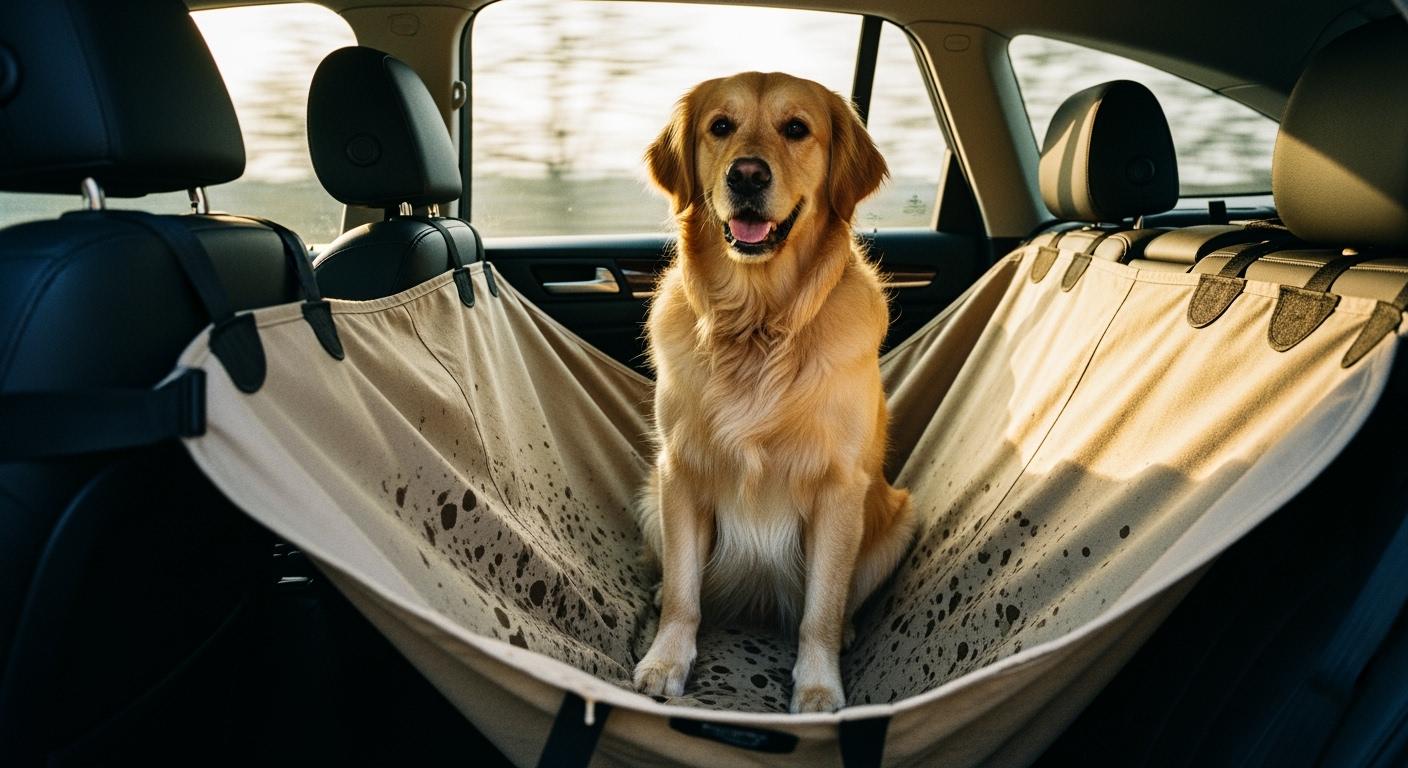
A dog jumps into the back seat after a hike. Paws are caked in mud. The leash drips. A towel is soaked through with drool. Within minutes, moisture has found its way past the edges of a flat seat cover and into the seat cracks — the exact places the cover was supposed to protect.
Most car seat covers solve the easy problem: keeping dry dirt off the seat surface. They fail at the harder one: stopping wet, mixed mess from traveling sideways, forward, and downward into gaps the cover does not reach. The difference between a flat cover and a hammock-style back seat cover is not just extra fabric. It is a fundamental change in coverage geometry — and that geometry determines whether drool and muddy gear stay contained or end up in the footwell.
Why Flat Covers Open Mess Pathways Around Gaps and Seams
A flat cover works like a blanket draped over the seat. It covers the horizontal surface. But nothing blocks the vertical plane — the space between the front edge of the rear seat and the back of the front seats. When the dog shifts weight, the fabric bunches. Corners lift. The cover that started flat is now a loose drape with exposed margins.
This is where the physics turns against the design. Drool is a low-viscosity fluid. It follows gravity to the lowest available point. On a flat cover, that point is the seat-front gap — a linear opening that runs the full width of the bench. Mud, being heavier and more viscous, travels slower but follows the same path. A wet leash or towel adds another vector: these items slide laterally as the car accelerates and brakes, carrying moisture off the cover edge and onto the door sill or floor.
| Design Difference | Why It Matters | Main Limitation |
|---|---|---|
| Flat cover: 2D surface protection only | Moisture runs to the lowest edge — the seat-front gap — with no barrier to stop it | Adequate for short trips with a dry, still dog |
| Buckle openings cut into flat covers | Each opening creates a penetration point where drool and mud can reach the seat below | Necessary for seat belt access; cannot be eliminated, only sealed or shielded |
| Stitched seams on non-sealed covers | Needle holes become capillary channels — moisture wicks along the thread line under tension | Not visible in product photos; only reveals itself after repeated wet use |
Attachment points compound the problem. A cover held in place only by elastic loops around the headrests has no lateral resistance. When a 50-pound dog leans against the cover during a turn, the fabric shifts. Each shift repositions the edges. Within a single drive, the cover can migrate several inches — enough to expose seat corners that were covered at the start. The difference between a cover that lays flat and one that bunches up often comes down to whether the anchoring system resists lateral load or just vertical pull.
The moisture path through untaped seams deserves a closer look. In a stitched waterproof layer, each needle penetration creates a hole roughly 0.5–1.0 mm in diameter — small, but multiplied across hundreds of stitches running the length of a seam. Under tension from a dog’s weight, these holes elongate. Drool, being water-based and low-viscosity, travels through them via capillary action. The seam effectively becomes a perforated line. Welded or heat-sealed seams avoid this entirely because no needle penetrates the waterproof membrane. The tradeoff is that welded seams require different production equipment and are less common in budget covers — a manufacturing constraint that directly shapes how the product performs after the first muddy trip.
Check this yourself after the next wet drive. Run a dry paper towel along the underside of the cover, directly beneath the main seam lines. Moisture on the towel means the seams are wicking. No moisture on the surface but dampness underneath means the waterproof layer has pinhole penetrations you cannot see from above.
How Hammock Geometry Blocks What Flat Covers Leave Exposed
A hammock cover changes the protection geometry from 2D to 3D. It anchors to the front headrests and the rear headrests, suspending a continuous fabric panel that forms a U-shaped trough across the entire rear seat area. The front wall — the vertical panel running from the seat surface up to the front headrests — is the element that flat covers lack entirely.
When drool lands on a hammock cover, gravity pulls it downward. On a flat cover, the lowest edge is the seat-front gap and the liquid falls through. On a hammock, the lowest point is the bottom of the trough — still on the cover surface. The front wall catches forward-traveling moisture and gear the way a bathtub wall contains water. A wet leash tossed onto the cover slides forward under braking, hits the front wall, and stays on the protected surface instead of dropping into the footwell.
The difference between bench and hammock covers shows up most clearly after a wet, muddy outing. A bench cover protects the seat you can see. A hammock protects the gaps you cannot see — the spaces where moisture and debris accumulate and cause the lingering smells that take weeks to fade.
| Design Difference | Why It Matters | Where It Falls Short |
|---|---|---|
| Front wall anchors to headrests, creating a raised barrier | Blocks the forward migration path that flat covers leave open; gear and liquid hit the wall instead of dropping into the footwell | Dogs over 80 lb may generate enough forward force during hard braking to pull slack into the front wall, reducing the barrier height |
| Non-slip backing with seat anchors wedged between cushions | Creates friction lock that resists lateral fabric shift; keeps the cover from bunching when the dog changes position | PVC dot backing wears smooth with daily friction; slip resistance declines gradually, not suddenly — the change is easy to miss until mess starts appearing underneath |
| Sealed or welded seams on waterproof layer | Eliminates the needle-hole capillary path; no perforation = no wicking along stitch lines | Welded seams are stiffer than stitched seams; the fabric drapes differently, which can affect how the cover conforms to contoured seat bolsters |
The non-slip system works through a straightforward mechanism: seat anchors — typically flat plastic discs or cylinders — are pushed between the seat cushion and the seat back. Friction holds them in place. When the dog shifts, lateral force transfers through the cover fabric to the anchor. If the anchor holds, the cover holds. If the anchor slips, the fabric follows. The full system only works when both front and rear anchors are under tension. A common failure mode: the rear anchors are seated firmly, but the front anchors have worked loose over time. The cover still looks installed, but the front wall loses tension and begins to sag — reopening the very gap it was meant to close.
In practice: After installing a hammock cover, mark each anchor insertion point with a piece of tape on the seat. After the next drive with the dog, check whether any anchor has moved more than an inch from the tape mark. Movement means the anchor is not holding under dynamic load, and the coverage geometry is degrading during use.
Side flaps and gap slip control matter because the cover-to-door-panel interface is where most side spillover occurs. A hammock with side flaps that tuck into the door seal creates a gutter-like edge that redirects liquid inward, toward the trough center, rather than letting it run off the side. Without flaps, any moisture that reaches the cover edge drains directly onto the door sill and into the cable channel beneath — one of the hardest areas in a car to clean thoroughly.
You can verify coverage integrity with a simple check. After a trip, slide your hand between the cover edge and the door sill. If you feel moisture on the sill plastic, the side seal failed during the drive — either the flap was not tucked correctly, or the cover shifted enough to break the seal. A dry sill after a visibly wet trip is the pass/fail signal that the coverage geometry held.
Where Hammock Coverage Reaches Its Limits
The hammock design solves the gap problem but introduces its own constraints. Split-fold rear seats are the most common pain point. When one side is folded down for cargo or a passenger, the hammock wall loses its anchor on that side. The fabric sags. The continuous barrier breaks. On vehicles with a 60/40 split, folding the 40 side leaves a partial wall; folding the 60 side opens a gap large enough for a medium-sized dog to reach the footwell.
Dogs that chew or dig at fabric present a different challenge. The front wall of a hammock sits within easy reach of a dog in the back seat. A dog that anxiously paws at barriers can tear the fabric or pull the front anchors loose from the headrests. No amount of in-car protection design fully compensates for a dog that treats the cover itself as something to attack. For these dogs, a hammock still provides better base coverage than a flat cover, but the front wall may need reinforcement or replacement more frequently.
Vehicle compatibility is another variable. Bench seats with integrated headrests — where the headrest does not extend on metal posts — offer no anchor point for the front straps. Some hammock covers include alternative anchoring methods like strap loops that wrap around the seat itself, but these tend to slip more than post-mounted anchors. The same fit verification principles that apply to car seats apply here: if the attachment points do not stay put under dynamic load, the geometry fails regardless of how well the cover is designed on paper.
Disclaimer: The coverage checks described here assume a standard bench rear seat with accessible headrest posts. Vehicles with non-standard rear seating — captain’s chairs, stadium-style folding seats, or integrated headrest designs — may not allow full hammock installation. In those configurations, even the best-designed hammock cover may leave gaps that require a supplemental flat mat underneath. For dogs with severe car anxiety that manifests as persistent digging or chewing at barriers, a hammock cover alone is unlikely to hold up; a combined approach with a crash-tested harness and a secondary restraint may reduce the behavior by limiting the dog’s range of motion.
FAQ
Does a hammock cover still work if only one half of a split rear seat is used for the dog?
It depends on which side folds. When the wider side stays up and anchors, the hammock retains partial coverage. When the narrow side stays up, the unsupported fabric sags and creates a gap large enough for a dog to slip through. Using a hammock on a split seat with one side folded compromises the front wall integrity — the barrier effect drops to roughly that of a flat cover with raised edges.
What material difference matters most for a dog that drools heavily versus one that tracks in mostly dry dirt?
Seam construction. For heavy droolers, the waterproof layer is only as good as its seams. A cover can use a fully waterproof membrane, but if the seams are stitched without taping or welding, drool wicks through the needle holes within the first few trips. For dry dirt, seam sealing matters far less — any intact fabric surface contains dry debris. The drool-heavy use case exposes construction shortcuts that the dry-dirt case never tests.
How does the cover affect access to seat belt buckles for human passengers?
Most hammock covers include zippered or Velcro access slits aligned with the seat belt buckle positions. The design tension is real: larger openings make buckling easier but create larger potential leak points. Covers that use a waterproof flap over the buckle opening rather than a simple slit tend to seal better when the opening is not in use, because the flap overlaps the cut rather than leaving a raw edge. If you regularly carry human passengers in the rear, check whether the buckle openings are positioned correctly for your vehicle’s buckle placement before buying — a misaligned slit means you have to lift the entire cover to access the buckle, which defeats the purpose of rapid installation and removal.






