
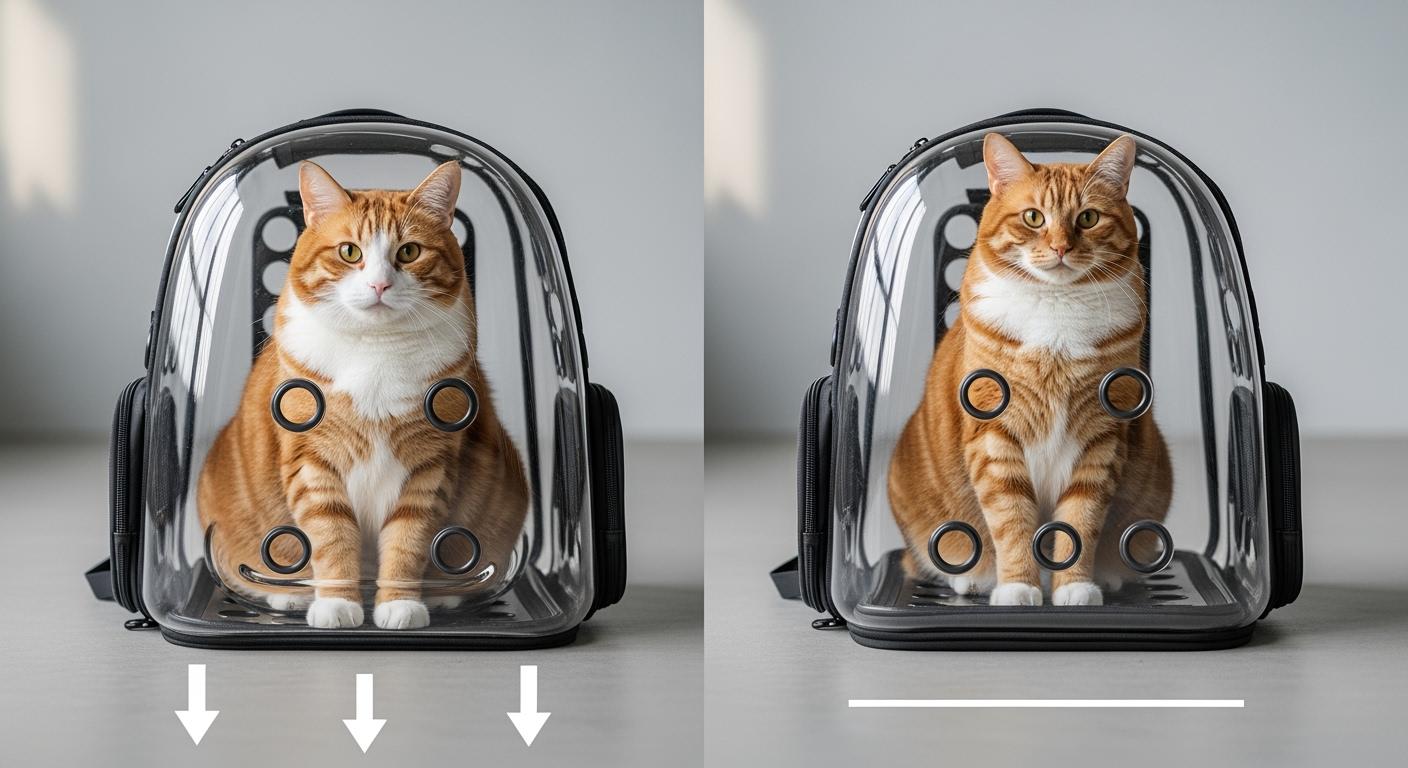
You lift the backpack, take three steps, and feel the carrier tilt. Your cat slides toward the low corner. The floor that looked flat on the shelf is now a hammock — dipping in the middle, pulling the sidewalls inward. A pet backpack carrier base bending with a heavy cat is not a rare defect. It is a structural mismatch between the floor panel and the load it was asked to carry.
The problem is not the cat’s weight. It is what the base is made of and how it connects to everything around it. Most carrier failures trace back to one of three decisions made during production: the choice of floor material, the stitch pattern anchoring that floor to the walls, and whether the sidewalls can stand on their own when the base deflects. Get any one wrong, and the carrier fails under load. Get all three right, and the floor stays flat whether the cat weighs 8 pounds or 18.
A sagging base does not fail alone. It triggers a cascade: the floor dips, sidewalls lose vertical tension and collapse inward, mesh contacts the cat, the cat curls tighter in response, more body surface presses against the mesh, and ventilation drops further. One weak panel starts a chain reaction that shrinks usable space by a third or more.
Why the Base Bends: The Structural Mismatch
A carrier floor has one job before comfort: it must spread a concentrated load across its full footprint. When a 14-pound cat sits, roughly two-thirds of that weight presses into an area no larger than a sheet of paper — the contact patch under the hips and hind legs. If the floor panel flexes under that pressure, weight rushes to the low point. The panel stops being a platform and becomes a funnel.
This is where material choice splits good carriers from the rest. Memory foam and PP cotton feel plush in the hand but compress under sustained load. Their internal structure — open-cell foam for memory foam, loose fiber fill for cotton — collapses vertically and offers almost no resistance to bending across the panel’s span. An EVA board or rigid plastic insert, by contrast, resists both compression and flexure. The material’s closed-cell structure or solid cross-section transfers the cat’s weight laterally to the sidewalls before the panel can dip.
You can trace the physics directly: the cat’s weight creates a downward force at the center of the panel. A soft insert converts that into a bending moment — the panel curves, the edges lift slightly, and the cat sinks. A rigid insert redirects the force along the panel plane into the sidewalls. The panel stays flat because it was never asked to absorb the load alone. It passes the work to the frame. That distinction — absorb versus transfer — is what separates a structural floor from a padded one.
In practice: Press your palm into the center of the carrier floor with about 10 pounds of force. If you feel the panel give more than a quarter-inch, the insert is already in the absorb regime. Under a living, shifting cat, that deflection will be larger — and the floor will not recover its shape between trips.
| Design Difference | Why It Matters | Where It Falls Short |
|---|---|---|
| Reinforced flat base (EVA board / rigid insert) | Transfers weight laterally to sidewalls; floor stays flat under concentrated loads | Adds weight; less compressible for tight under-seat storage on some aircraft |
| Firm removable support pad with structured core | Combines surface comfort with load resistance; removable for cleaning without losing shape | If the pad does not fit snugly, it can shift and create an uneven surface |
| Load-spreading bottom frame with three-point strap anchoring | Prevents pendulum swing; keeps floor level during movement | Adds production cost; requires accurate strap-attachment alignment in manufacturing |
What Happens When the Floor Gives Way
The Collapse Cascade: Space, Posture, and Airflow
A dipping floor does not just make the carrier less comfortable. It shrinks the interior. As the base sags, the sidewalls — no longer held apart by a flat bottom panel — lose tension and lean inward. A carrier that measured 16 inches wide on the product page can drop to 11 or 12 inches of usable width once the walls cave in.
The cat responds to this shrinking space the only way it can: it curls tighter. The spine rounds, the flanks press outward, and the largest body surfaces — the back and sides — come flush against the carrier mesh. That contact blocks the ventilation paths the mesh was designed to provide. What started as a structural problem is now a thermal one.
This is the cascade: base sags → walls cave → cat curls → body contacts mesh → ventilation drops → cat heats up → cat shifts more → base sags further. Each step feeds the next. The carrier that looked airy on the shelf becomes a warm, cramped tube within ten minutes of carrying.
Reading the Signs After a Walk
You do not need a lab to check whether a base is failing. The evidence appears in the first fifteen minutes of use.
After a short carry, set the backpack on a flat surface and open it. Look at the floor panel from the side. If it has taken a set — meaning it holds a slight curve even when empty — the insert material has permanently deformed. That carrier will only get worse with each use. Run your hand across the floor: if it slopes toward the center or toward one corner, the load-spreading structure has failed asymmetrically, likely because the stitching on one side stretched more than the other.
Then check the cat. If the fur along the flanks or hips lies flattened in a pattern that matches the mesh, the cat spent the trip pressed against the sidewall — a sign the base sagged enough to push the cat off-center. A cat that exits the carrier and immediately stretches its spine long and slow is telling you it could not extend inside.
Disclaimer: These checks assume a smooth-coated cat. Double-coated breeds may show subtler fur-compression patterns; hand-check the carrier floor for slope rather than relying on visual fur marks alone. Cats with very deep keels or barrel chests — body types that fall outside the typical proportions these carriers are patterned for — may experience pressure points that visual checks after a short walk will not catch.
Three Design Features That Keep the Floor Flat
Stitching That Anchors, Not Just Joins
The floor panel connects to the carrier walls along a seam. Under load, that seam carries tension — the floor wants to pull away from the walls as weight presses down. If the stitching is a single row of standard thread, it stretches. The floor sags even if the insert material itself is stiff. The best designs use double-row stitching with bonded nylon thread along the full perimeter, plus reinforced stitch clusters at the four corners where tension concentrates.
From a manufacturing standpoint, double-stitching a base perimeter adds roughly 30 seconds of machine time per unit. It is not expensive. But it requires the seam allowance to be cut wider and the panel alignment to be more precise — two variables that slip when production prioritizes speed over structural integrity. Stitching quality in backpack carriers often separates units that hold their shape for years from those that start sagging within months.
Sidewalls That Stand on Their Own
A base cannot stay flat if the walls collapse. Sidewalls provide the vertical reaction force that the floor transfers load into. When sidewalls are unstructured fabric, they fold under compression. A stiff wall insert — a wire frame, a plastic sheet, or a rigid fabric laminate — resists that inward collapse and keeps the floor’s edges at the correct spacing.
The interplay is direct: the base panel pushes outward against the bottom of the sidewalls. If the sidewalls are rigid enough to push back, the system holds. If the sidewalls buckle, the base edges lose their anchor points, and the panel is free to sag — no matter how stiff the insert is. Stable sidewall construction matters as much as floor material when selecting a cat carrier for any travel scenario.
| Failure Signal | Likely Structure Problem | Design Direction That Prevents It |
|---|---|---|
| Base sags in the middle | Floor panel too soft or too thin for the span | Rigid insert (EVA board or structured plastic) that transfers load to sidewalls |
| Carrier leans to one side when lifted | Uneven stitch tension or single anchor point on one wall | Double-stitched base perimeter with reinforced corner clusters |
| Cat curls tight against mesh, refuses to settle | Sidewalls collapsing inward after base deflection | Wire-framed or rigid-insert sidewalls with vertical compression resistance |
| Floor takes a permanent bend after one or two uses | Open-cell foam or fiber fill insert that deforms plastically | Closed-cell or solid-core insert that recovers shape elastically |
Strap Geometry That Keeps the Base Level
Shoulder straps do more than make the carrier wearable. Their attachment points determine whether the base stays horizontal or tilts. If both straps anchor to the top of the back panel, the bottom of the carrier hangs free — it swings like a pendulum with every step, and the cat’s weight amplifies the arc. A waist strap or sternum strap anchored near the base creates a second contact point lower on the carrier body, which constrains that swing.
The three-point system — shoulder straps above, sternum strap across the chest, waist strap at the hip — triangulates the load. The base cannot tilt because it is pinned at two vertical levels. A backpack carrier built with a three-point strap system reduces the floor tilt that heavy cats feel most acutely on longer walks. Without that lower anchor, even a rigid base panel gets pulled off-level by body movement. The geometry matters as much as the materials.
When a Rigid Base Is Not the Whole Answer
A flat, reinforced floor solves the bending problem. But it does not solve every carrier issue a heavy cat presents. The base keeps the floor flat — it does not make a carrier that is too small suddenly spacious. If the cat’s standing height exceeds the interior height of the carrier, a rigid base will not change that. The cat will still crouch.
And a stiff base adds weight. For airline travel where a cat backpack carrier needs to balance structure against portability, the trade-off is real: more rigidity means more grams in the bag. The calculation changes depending on use — a carrier that lives in the car can afford more structure than one that gets carried through terminals for two hours. Getting the interior dimensions right for the cat’s body is a separate step from choosing the right floor construction, and skipping either one leads to a carrier that passes one test but fails the other.
Stiff sidewalls also reduce compressibility. For under-seat storage on flights, a carrier needs to squeeze into a space that may be narrower than its relaxed shape. A fully rigid frame will not comply. Some designs solve this with removable frame stays — pull them out for storage, slide them back in for carrying. That modularity adds a production step but solves both problems.
Disclaimer: If the cat’s chest shape is unusually deep or barrel-like relative to its length, the fit checks described here may miss pressure points along the front of the carrier. Cats with this body type — common in some British Shorthair and Persian lines — benefit from carriers with a slightly tapered front panel rather than a uniform rectangular box, since a deeper chest shifts the cat’s center of gravity forward and changes where the floor carries peak load.
A cramped posture inside a carrier is not always a base problem — sometimes it is a fit problem that happens to look similar. The floor stays flat but the cat still curls because the interior height was never enough. Knowing which is which avoids chasing the wrong fix.
A reinforced base, firm sidewalls, and balanced strap geometry together handle the structural half of the equation. But the cat’s body dimensions set the other half — and no amount of floor reinforcement changes how tall or long the cat is. The carrier works when both halves agree.
FAQ
Why does the base of a pet backpack carrier dip under a heavy cat?
The floor panel material cannot resist the bending force created by the cat’s weight concentrated in a small contact area. Soft inserts like memory foam or fiber fill compress and curve under load. A rigid insert — EVA board or structured plastic — transfers that force laterally to the sidewalls and keeps the floor flat.
How can I tell if a carrier’s base is strong enough before buying?
Press the center of the floor with your palm using steady downward pressure. A base that deflects more than a quarter-inch under hand pressure will deflect more under a living cat. Also check the perimeter stitching: single-row stitching with thin thread will stretch under load even if the panel itself is stiff.
Can a carrier with a sagging base be fixed?
Sometimes. If the carrier has a removable pad, replacing it with a rigid insert cut to size from EVA foam board can restore flatness. But if the sidewall seams have stretched or the stitching has failed, the fix is temporary — the frame itself has lost structural integrity.
Why does my cat avoid the center of the carrier floor?
A cat that consistently moves to a corner or side is telling you the center feels unstable. The floor likely dips in the middle, creating a low spot the cat instinctively avoids. Cats judge surfaces through their paws; a panel that yields underfoot signals an unsafe perch.
Do hard-sided carriers solve the base-bending problem entirely?
They solve the floor-flex problem by design — a molded plastic shell does not sag. But they introduce different trade-offs: less ventilation, heavier weight, and no compressibility for storage. The choice between hard-sided and soft-sided depends on whether floor rigidity or portability ranks higher for a given trip.






