
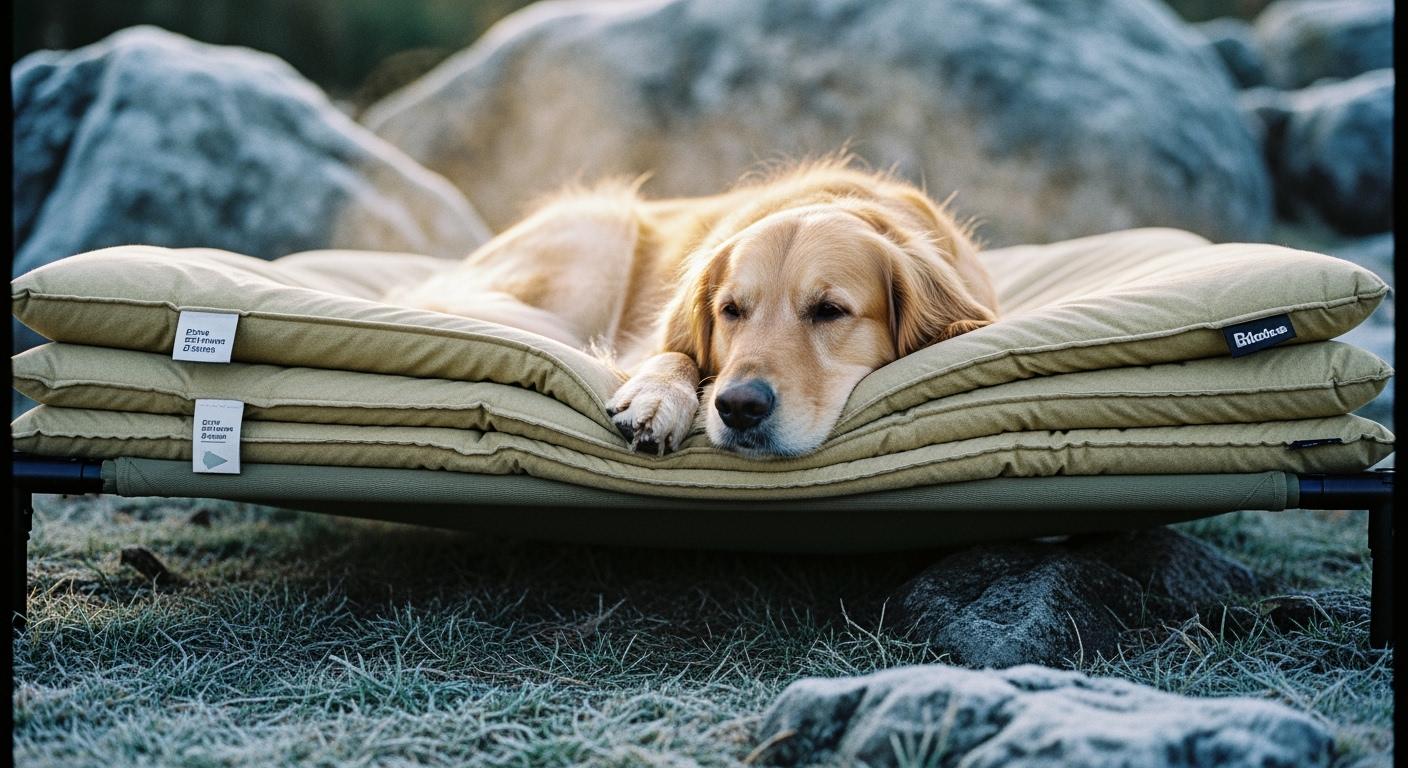
A camping dog bed can feel thick to the hand and still fail overnight. The dog starts out stretched and relaxed. Two hours later it is curled into a tight ball, shivering, shifting positions every few minutes. The bed did not suddenly get thinner. The cold ground simply found a path through.
That path is almost always the same: the padding compressed under body weight, the bottom fabric sat directly against cold earth, and conductive heat loss did the rest. No single material fixes this. The fix is structural — a combination of design choices that each block a different part of the thermal path. This article walks through what those choices are, why each one matters, and how to tell when any one of them is not doing its job.
Why a Thick-Looking Camping Bed Still Pulls Cold from the Ground
A bed fails at insulation long before the dog visibly shivers. The first sign is positional: the dog lies down normally, then within 20 to 30 minutes curls incrementally tighter. Each adjustment trades exposed surface area for retained heat. The dog is doing the insulating that the bed is not.
What is happening underneath is straightforward physics. Body heat conducts from the dog into the padding, through the padding, and into the ground — provided there is a continuous solid path. Still air is a poor thermal conductor. Solid material, especially when densified under load, is a much better one. The chain runs like this: body weight compresses the padding → trapped air pockets collapse → the remaining solid foam or fiber matrix forms a denser conduction bridge → heat flows downward with less resistance → the ground, with its enormous thermal mass, sinks that heat away.
You can verify this without instruments. After your dog has been lying on the bed for 30 minutes, slide your hand under the bed at the spot where the hips were. If the underside feels noticeably colder than the surrounding groundsheet — not just cool, but cold enough to register as a temperature drop — the padding has bottomed out and conduction is running at full efficiency. That fails fast.
Moisture accelerates the problem. Damp ground, wet grass, or condensation inside a tent introduces water into the bottom fabric layer. Water conducts heat roughly 25 times faster than still air. Even a small amount of moisture bridging the fabric fibers can turn a bed that performed adequately on dry ground into a cold sink on damp ground. The bed does not need to feel wet to the touch — capillary action pulls moisture into the fiber matrix long before the surface feels damp.
| Failure Signal | Likely Design Cause | Better Design Direction |
|---|---|---|
| Dog shivers or avoids bed after 30 min | Padding compresses to near-zero loft under load | Layered foam with different densities; bottom layer firmer |
| Dog shifts positions repeatedly overnight | No air gap; bed bottom sits directly on cold ground | Raised base structure creating even a half-inch clearance |
| Bed underside feels cold and damp in the morning | Bottom fabric wicks ground moisture into padding | Moisture-resistant or coated bottom fabric with sealed seams |
The Three Design Features That Block Ground Chill — and How Each One Works
Insulation from cold ground is not a single property. It is three independent design problems, and each one needs its own solution. A bed that solves two of them but not the third will still run cold.
A Raised Base Breaks the Conduction Path
Conduction requires contact. Lift the bed even half an inch off the ground and the primary heat-loss mechanism — direct solid-to-solid transfer — disappears. What replaces it is an air gap. Still air has a thermal conductivity of roughly 0.026 W/m·K, which is low enough that a thin trapped layer can meaningfully slow heat loss from the bed bottom to the ground below.
The gap does not need to be large. What matters more is that it stays consistent under load. A raised frame that sags in the center when the dog lies down eliminates the gap exactly where it is needed most — under the torso, where body mass concentrates and heat loss peaks. The design detail that matters here is not the height of the legs but the rigidity of the span. A well-designed elevated dog bed with a steel frame keeps the sleeping surface flat under load so the air gap holds across the full contact area, not just at the edges.
Check this yourself: set up the bed, press down hard in the center with one hand, and slide the other hand underneath. If your fingers touch the frame or fabric, the gap closed under simulated body weight. That gap will not reopen until the dog shifts off it.
Layered Padding Resists Compression
A single thick foam slab and a thinner two-layer stack can look identical in product photos. Under sustained pressure, they behave differently. A single-density foam compresses uniformly — every pore collapses at roughly the same rate. Once the foam bottoms out, adding more thickness does not add more insulation because the material is already fully densified.
A layered construction changes the compression curve. A firmer bottom layer provides structural resistance; a softer top layer provides initial comfort and surface give. The dog’s weight is distributed across both layers, but the bottom layer takes more of the load and deforms less. This preserves some trapped-air volume even after hours of continuous pressure — which is what overnight camping demands. In production terms, laminating two foams of different densities is also more repeatable than casting a single very thick foam, which tends to develop internal density gradients and inconsistent compression resistance across the batch.
This is one reason the support structure of an outdoor dog bed matters more than its listed thickness. A 2-inch layered pad can outperform a 4-inch single-density pad if the bottom layer stays resilient under load. Thickness sells. Density insulates.
Moisture-Resistant Bottom Fabric Stops the Water Bridge
Water multiplies the thermal conductivity of any fabric it saturates. A dry nylon bottom layer might conduct heat at roughly 0.25 W/m·K. The same fabric with moisture wicked into the fiber matrix can conduct at rates closer to water’s 0.6 W/m·K — more than double. The bed does not need to feel soaked. Capillary action pulls moisture film up through the weave, and that film alone is enough to degrade insulation performance.
A moisture-resistant bottom fabric, typically a coated oxford cloth or a laminated barrier layer, prevents liquid water from entering the fiber matrix in the first place. The coating causes water to bead on the surface rather than wick into the weave. That is the visible part. The less visible part is seam construction — a coated fabric with unsealed stitching is still a path for moisture. Welded or taped seams close that path. In the morning, run your palm across the underside of the bed. If it feels cool and slick rather than cold and tacky, the barrier held. If the fabric feels even slightly damp, moisture bridged through overnight and the dog was sleeping on a chilled surface regardless of how thick the padding looked.
For camping shelter and rest setups where the groundsheet is thin or the campsite is on packed dirt, this bottom-layer protection often makes a larger difference to overnight comfort than adding more padding on top.
| Design Difference | Why It Matters | Main Limitation |
|---|---|---|
| Raised base (air gap) | Breaks the conduction path; air is a poor thermal conductor | Gap closes if frame sags under torso weight; needs rigid span |
| Layered padding (dual-density) | Bottom layer stays resilient under sustained pressure; preserves trapped air | Adds weight and bulk compared to single-layer pads |
| Moisture-resistant bottom fabric | Prevents capillary wicking from damp ground into the fiber matrix | Seam stitching can still leak if not welded or taped |
When a Raised, Layered, Moisture-Blocked Bed Still Is Not the Right Answer
These three design features solve the problem of conductive heat loss from cold ground. They do not solve every camping comfort problem, and there are conditions where they are not the priority.
Warm-weather camping is the obvious case. On a night where the ground temperature stays above 60°F, a raised bed with layered insulation can trap more body heat than a double-coated breed needs. The dog pants, shifts off the bed onto the cooler tent floor, and the expensive insulated bed sits empty. The design is working — it is insulating — but the dog’s thermoregulatory needs have moved in the opposite direction. A simple ground pad or an elevated cot without heavy insulation is the better tool for that job.
Joint stress shifts the priority order. A dog with hip dysplasia or arthritis needs pressure distribution more than it needs thermal separation. In that case, a thicker single-layer memory foam pad placed directly on the tent floor — with an insulated blanket on top — can be more functional than a raised bed with moderate padding. The cold ground is a discomfort; the hard ground is a mobility problem. They are not the same thing.
Double-coated breeds — huskies, malamutes, shepherds — have their own built-in insulation layer. They may show subtler discomfort signals on cold ground. A husky that tolerates a mildly chilled bed without shivering is not necessarily comfortable; it simply has more biological buffer before the behavioral signals appear. The balance between warmth and cleanliness in a camping bed shifts for these dogs — moisture protection often outranks added insulation because their coat already handles dry cold effectively.
Disclaimer: These insulation checks assume a short-coated dog sleeping on packed earth or a thin tent floor at temperatures below 50°F. Double-coated breeds may tolerate more ground chill before showing discomfort signals. If the dog has existing joint issues, prioritize padding thickness over the air gap — cold ground is uncomfortable, but a hard surface under arthritic joints creates a different problem that insulation alone does not address.
| Condition | Priority | Why |
|---|---|---|
| Cold ground, dry weather, short-coated dog | Raised base + layered padding + moisture barrier | All three heat-loss paths are active |
| Warm ground (above 60°F), any coat type | Simple ground mat or uninsulated cot | Insulation can trap excess heat; dog may avoid the bed |
| Damp ground, moderate cold, any coat type | Moisture barrier first, then air gap | Water bridging accelerates heat loss faster than direct conduction alone |
| Joint-impaired dog, any ground temperature | Thick padding first; air gap secondary | Pressure distribution is the dominant comfort variable |
In most cold-weather camping scenarios, the difference between an elevated cot and a padded bed for winter comes down to which heat-loss path is dominant on a given night — conduction, convection, or moisture transfer. Pick the design that blocks the path most active under your conditions, not the one with the most features.
FAQ
How does a raised base keep a dog warmer than a flat pad of the same thickness?
Conduction requires continuous solid contact. A flat pad sits directly on the ground, so the heat path is: dog → padding → ground. A raised base inserts an air gap between the padding and the ground. Still air conducts heat poorly — roughly an order of magnitude less than the densified foam or fabric it replaces. The bed does not need to be warmer. It just needs to stop being a bridge.
Why does my dog curl up on a bed that felt warm when I tested it with my hand?
A hand press lasts two seconds and applies a few pounds of force. A 60-pound dog lying down for hours applies sustained pressure concentrated under the torso. That pressure compresses the padding far more than a hand check ever will. The compression eliminates the trapped-air pockets that gave the bed its initial insulation value. What felt warm to a quick touch became thermally transparent under sustained load.
Can a regular indoor dog bed work for camping if I add a blanket underneath?
A blanket under the bed adds a thin extra layer but does not solve the core problems. Body weight still compresses both the blanket and the bed padding into a single densified mass. Without a raised base, the conduction path to the ground remains intact — just slightly longer. Without a moisture barrier, damp ground still wicks up through the fabric layers. A blanket underneath delays the failure; it does not prevent it.
How do I know if the bottom fabric is actually moisture-resistant or just labeled that way?
Pour a tablespoon of water onto the bottom fabric and watch for 30 seconds. If the water beads and can be shaken off without leaving a dark wet spot, the coating is intact. If the fabric darkens where the water sat — even after shaking it off — moisture has entered the fiber matrix. That fabric will wick ground dampness overnight regardless of what the label says.






