
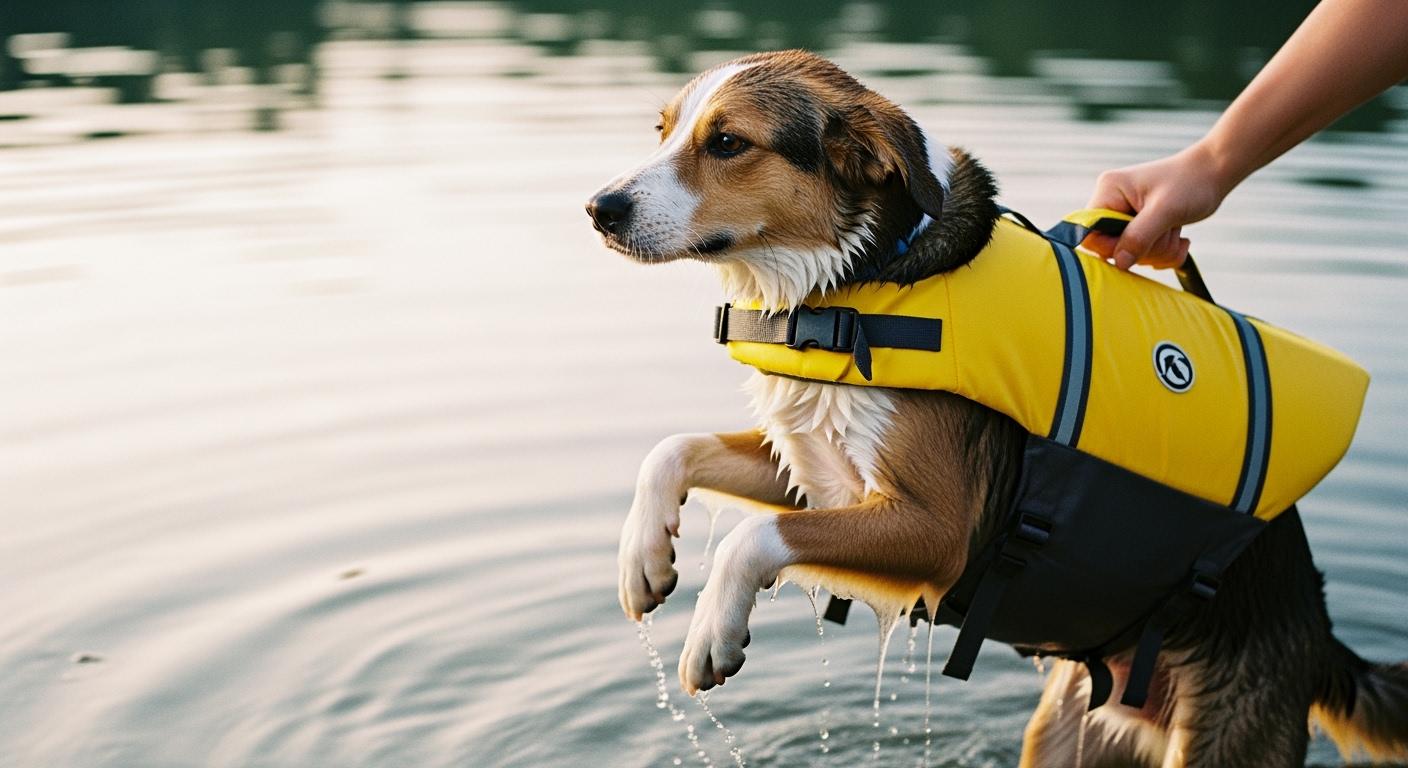
A dog life jacket handle looks simple. Grab it, lift the dog, done. That changes the moment the lift comes from the side of a dock or boat instead of straight down. Side retrieval introduces a horizontal force component that a centered, well-anchored handle resists — and a surface-stitched or off-center handle amplifies into twisting. The issue is not grip convenience. It is whether the handle position and its connection into the vest structure keep the jacket flat against the dog’s body during an angled pull.
Two design differences separate handles that stabilize a side lift from handles that roll the jacket: where the handle sits relative to the dog’s center of mass, and whether the handle ties into reinforced webbing that runs through the vest or is sewn only to the top shell fabric.
Why Handle Placement Decides Whether a Side Lift Stays Stable
When you lift a dog from the side of a dock, pool edge, or boat gunwale, your pulling hand creates a force vector that is angled — not vertical. If the handle sits directly above the dog’s center of mass, roughly mid-back behind the shoulders, that angled force passes through the center. The dog rises level. The jacket stays flat.
Shift the handle forward of that point and the force creates a torque. The front edge of the jacket digs into the chest while the rear floats up. The dog tilts head-down. Shift the handle rearward and the opposite happens: the rear sinks, the head rises, and the jacket’s belly panel can ride forward. In both cases the dog is fighting the vest to stay oriented — exactly when a clean lift matters most.
Here is where the mechanical difference shows up in practice. The handle position offsets the center of mass by a lever arm measured in inches, but under side load that small offset multiplies into visible rotation. This is why a handle that looks centered on a hanger can fail the moment you pull from the side with a wet dog inside the jacket.
You can verify this before ever touching water. Put the jacket on the dog, adjust the straps, stand beside the dog, and lift gently from the side — just enough to take a few pounds of weight off the paws. Watch the handle relative to the spine. If it drifts more than an inch off the midline, or if the front chest panel rides up past the sternum, the handle position is fighting the lift rather than guiding it. This same test, done on boating retrievals where a quick one-handed lift matters most, separates jackets that help from jackets that make the moment harder.
| Failure Signal | Handle Placement Problem | Better Design Direction |
|---|---|---|
| Dog rolls or twists in water | Handle off-center or weakly anchored | Centered handle with reinforced webbing |
| Vest shifts or bunches up | Loose girth straps | Stable, snug girth adjustment |
| Dog’s head or rear dips | Handle too far forward or back | Handle over center of mass |
How the Load Path Changes Everything
A handle sewn only to the top shell fabric concentrates lifting force at a narrow stitch line. Under side load, the fabric distorts. The stitch line elongates. The outer shell slides across the foam panels underneath, which are not connected to the handle. The jacket’s exterior moves relative to its interior. That differential movement is what you see as rolling: the shell twists while the foam stays, and the dog inside follows the foam.
A handle tied into reinforced webbing changes the mechanics entirely. The webbing runs through the vest structure and connects to the belly panel. When you pull the handle, the force travels through the webbing’s length — backed by its tensile strength, not the shell fabric’s tear resistance. The handle, webbing, back panel, and belly panel move as one unit. Side-load force distributes rather than concentrates. The jacket stays flat because there is no internal layer separation to create twist.
This is the kind of construction difference discussed in materials and sizing decisions that make a life jacket safer — it is not about whether the handle feels sturdy on a store rack. It is about what happens to the force path when the pull angle changes.
The observable check is straightforward. After 10 minutes of swimming or a few side lifts on land, pinch the jacket fabric over the foam panels. If you can feel that the foam edge has drifted relative to the outer shell, the handle anchoring is not tying into the vest body. A life jacket built with webbing-integrated handle anchoring keeps the foam and shell moving together — the panel positions stay fixed relative to the fabric regardless of how many times you lift.
| Design Difference | Why It Matters | Main Limitation |
|---|---|---|
| Handle sewn to top shell only | Force concentrates at stitch line; shell slides across foam | Fails under repeated angled lifts with a wet dog |
| Handle tied into vest-wide webbing | Force distributes across webbing length; panels move as one unit | Adds production steps; not visible from outside the jacket |
| Narrow anchor points at handle ends | Lift force channels through small contact patch; fabric tears sooner | Even with good stitching, the stress concentration remains |
| Wide, reinforced anchor points | Force spreads over larger area; the shell fabric is not the weak link | Requires more material; slightly heavier |
When the Handle Is Right but the Fit Undermines It
A centered, webbing-tied handle still fails if the girth straps are loose. Side lifting pulls the jacket toward the direction of the lift. If the belly strap has slack, the jacket slides across the dog’s body before the handle ever takes real weight. The foam panels shift, the center of mass alignment breaks, and the handle — however well-built — is now pulling against a vest that has already moved out of position.
You can check this in seconds. After the jacket is on and the straps are adjusted, pull the handle sideways with one hand while holding the dog steady with the other. Watch the belly panel. If it slides more than a finger’s width before the handle starts to take tension, the girth adjustment is too loose — no handle design can compensate for a jacket that shifts before the lift begins.
Breed shape introduces its own complications. A dog with a very short back — a French Bulldog or a Corgi — has less real estate between the shoulders and hips. A centered handle on these dogs sits close to both the chest and the rear, leaving the design less margin for position error. Barrel-chested breeds like Bulldogs and deep-keeled breeds like Greyhounds change the geometry of how the belly panel sits against the body, which in turn affects how the webbing path pulls during a side lift.
Disclaimer: The dry-land side-lift checks described here assume a smooth-coated dog where vest movement is visually obvious. Double-coated breeds — Huskies, Malamutes, Rough Collies — may show subtler jacket drift that needs to be felt rather than seen. Run your hand along the jacket edges during the lift to detect panel shifting that dense fur can mask. If the dog’s chest shape falls outside the breed norms this jacket was patterned for, particularly dogs with an unusually deep keel or a barrel chest, the fit checks described here may not catch every pressure point — a hands-on check after the first real swim is the only reliable verification.
A few home-test steps surface problems before water does:
- Put the jacket on and adjust all straps for a snug fit — two fingers should slide under each strap, but the jacket should not shift when you tug the handle.
- Stand beside the dog, grab the handle, and lift gently from the side — just enough to unweight the paws.
- Watch for vest twisting, the handle drifting off the spine’s midline, or the front chest panel riding up.
- Repeat the lift a few times. A jacket that stays flat on the third lift but not the fifth has strap creep — the adjustments are not holding.
These checks, alongside fit and buoyancy verification before trusting a handle, are what turn a dry-land fitting into real-water confidence. The handle is only as reliable as the fit underneath it. A strong handle on a loose jacket is like a solid door handle on a door that swings open on its own — the one good part cannot fix the system.
For broader context on how handle placement integrates into overall jacket design and water safety, building swimming confidence through better fit starts with understanding which features stabilize a dog in the water and which ones only look good on the product page.
FAQ
How can I tell if my dog’s life jacket handle is positioned correctly?
Lift from the side on dry land and watch the jacket. If the handle stays within an inch of the spine’s midline and the chest panel does not ride up past the sternum, the position is working. If the vest twists or the dog tilts, the handle is not over the center of mass.
Why does the jacket roll even though the handle looks centered on the rack?
Two common causes. The handle may be sewn only to the top shell — pulling it separates the outer fabric from the foam panels inside, creating twist. Or the girth straps are too loose, letting the jacket slide before the handle takes load. Check both, not just handle position.
How often should I inspect the handle stitching and webbing?
Before every swim session. Look for thread elongation at the handle attachment points, webbing fray where it enters the vest shell, and foam panel drift relative to the outer fabric. Salt water and chlorine accelerate thread degradation — rinse the jacket after use in those conditions and let it dry fully before the next inspection.
Does a stronger handle fix a life jacket that rolls during side lifts?
Not by itself. A stronger handle with the same narrow anchor points concentrates force at the same small contact patch. The handle may not tear, but the jacket still twists because the load path has not changed. The fix is a wider anchor spread and webbing that ties the handle into the vest structure — not a thicker grip. For features to check when sizing a swimming life jacket, the handle anchoring method matters more than the handle’s surface appearance.






