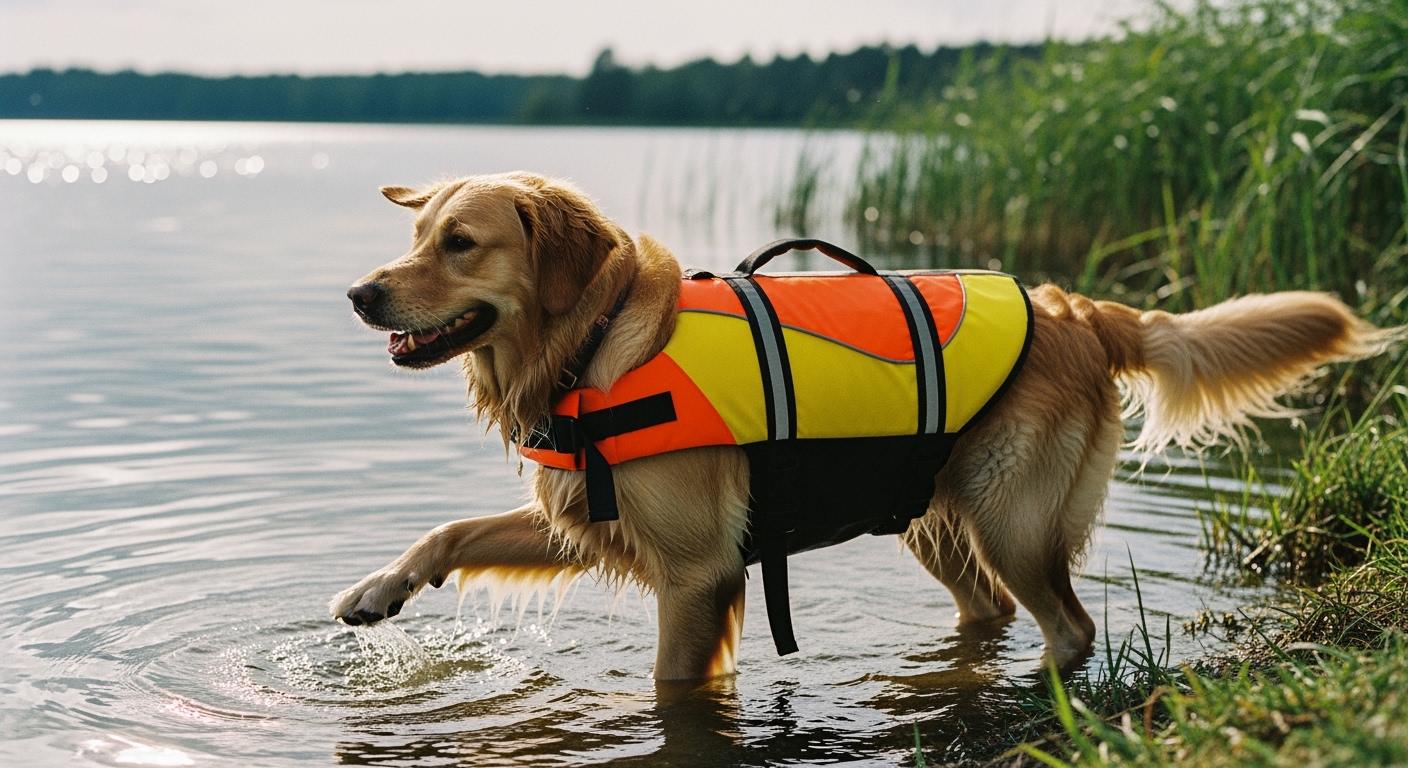
Water does not play fair with color. A vest that looks neon-bright on the dock can turn muted gray the moment a dog enters a lake. Sun glare scatters across the surface. Waves break the outline into fragments. A dark head bobbing at 40 yards blends into tree shadows along the bank. That is the visibility problem a dog life jacket is supposed to solve — but many designs fail the test before the dog even leaves the shallows.
This is not about fashion. It is about how long it takes your eyes to lock onto a moving target in broken water. A life jacket with bright color visibility shortens that window. Here is how the design decisions behind color panels, trim contrast, reflective placement, and handle visibility affect real-world spotting and retrieval.
Why Most Dog Life Jacket Colors Disappear on Open Water
How Water Optics Defeat Land-Based Color Perception
Color behaves differently once water enters the equation. On land, a red vest reflects ambient light in all directions, and your eyes register it against grass or pavement easily. On water, three things work against you simultaneously.
First, surface reflection. Water acts as a partial mirror. At shallow viewing angles — which is exactly how you see a swimming dog from shore or a boat deck — the water surface reflects sky, clouds, and shoreline vegetation more than it transmits light from below. A dark or muted vest competes against this reflected scene and loses.
Second, scatter. Suspended particles in lake or river water diffuse light. The farther your dog is from you, the more atmosphere and water scatter sits between you and the vest. Colors desaturate. Contrast flattens. A navy vest at 60 yards looks like a shadow among shadows.
Third, the luminance range of a typical outdoor water scene is extreme — bright sky highlights next to deep shadow under tree canopy next to glitter from wave crests. Human vision adapts to the brightest region of the scene. A dog vest sitting in the darker portion of that range simply does not register unless its luminance or chromaticity pulls it out.
This is the causal chain that makes bright colors mandatory, not decorative: fluorescence converts invisible UV energy into visible light within a narrow wavelength band, so the panel emits more light in that band than the surrounding water or vegetation reflects. It does not just contrast — it produces more photons at a specific color than the background, which is why hunter orange and neon yellow cut through in conditions where earth tones vanish.
Tip: Test a vest’s visibility before trusting it. Walk 50 yards down the shore, toss the jacket into the water where your dog would swim, and check whether you can identify its color — not just its shape — against the actual water surface you will be scanning.
When Muted Colors and Small Reflective Patches Fail
Low-contrast panels and postage-stamp reflective strips create a false sense of security. A vest in olive, gray, or dark blue blends into almost every natural water backdrop — shaded banks, dark lake water, wet rock, even overcast sky reflected on the surface. The problem is not that these colors are ugly. It is that they share the same luminance range as the backgrounds they sit against.
Small reflective patches fail for a different reason. Retroreflective material works by bouncing light back toward its source — a flashlight, a boat’s running lights, low-angle sunlight. But a half-inch strip at the chest is only useful if the dog faces the light source. Turn perpendicular, and the reflective surface disappears from the light’s return path. A visibility system that depends on one small patch at one angle is not a system. It is a lottery.
| Visibility failure scene | Why the jacket becomes hard to see | Better design direction |
|---|---|---|
| Shaded riverbank | Dark vest luminance matches tree shadow; no chromatic separation | Fluorescent panels with 180-degree coverage, high-contrast trim outlining torso |
| Open lake with sun glare | Surface reflection dominates; muted colors fall below glare threshold | Neon orange or yellow-green panels that emit above background luminance in their wavelength |
| Rocky or grassy shoreline | Earth tones share hue and luminance range with bankside vegetation and wet stone | Bright color blocking + visible top handle in contrasting color |
An effective water safety setup treats visibility as a system, not a single feature. High-visibility life jackets layer fluorescent base panels, high-contrast trim that outlines the dog’s silhouette, and reflective elements positioned for multi-angle return — not just one patch facing forward.
How Bright Panels and High-Contrast Trim Change What You Spot at 50 Yards

Why Fluorescent Orange and Yellow-Green Outperform Every Other Color on Water
Fluorescence is not just “bright.” It is a physical process. A fluorescent dye absorbs short-wavelength light — UV and blue, which are abundant outdoors even on overcast days — and re-emits it as longer-wavelength visible light. The panel literally glows compared to a non-fluorescent surface sitting under the same sky.
Orange and yellow-green dominate water-safety design for a reason that goes beyond convention. These wavelengths sit in the region where human photopic vision is most sensitive under daylight conditions. A fluorescent orange panel at 590–610 nm aligns with the peak sensitivity of the cone cells responsible for color discrimination. You do not just see “something orange.” You register it faster, at greater distance, with less cognitive effort.
Colors like blue, gray, and dark green have the opposite effect. They sit in luminance ranges shared by water, sky, and vegetation. They require your visual system to discriminate by texture or motion — processes that demand more time and closer proximity. In open water, time and proximity are the two things you may not have.
| Design Difference | Why it matters | Main limitation |
|---|---|---|
| Fluorescent base color (orange/yellow-green) | Active light emission via UV conversion; visible at greater distances than passive pigments | Fluorescent dyes fade faster with prolonged UV exposure than standard pigments; inspect annually |
| High-contrast trim outlining dog’s silhouette | Preserves shape recognition when main panel color washes out against similar backgrounds | Narrow trim strips lose effectiveness at extreme distance; wider banding performs better past 60 yards |
| Multi-angle reflective placement (chest + sides + back) | Returns light to source regardless of dog’s orientation; works when dog is perpendicular to viewer | Requires an active light source; passive in full daylight without directed beam |
How to Verify Visibility Before It Matters
A jacket that looks bright on a product page tells you nothing about how it performs on the water you actually visit. Here is a simple field check: take the jacket to your usual lake, river, or shore spot at the time of day you typically go. Have someone hold it at the distance your dog normally swims — 30, 50, 80 yards. Look at it across the water surface, not just along the shore. Can you pick out its color, or just a dark shape?
That distinction matters. A dark shape could be a dog, a log, or a shadow. A clear color signal is specific information. The difference between jacket types often comes down to how much of the dog’s body the fluorescent panels cover and whether the trim wraps fully around the torso — not just the top panel you see when the dog stands on land.
After a 10-minute swim session, check whether the jacket has shifted. A vest that rotates under water movement can hide its brightest panels against the dog’s underside, leaving only a dark back panel visible from above. That defeats the entire visibility design.
When Reflective Details and a Grab Handle Make the Biggest Difference
Low-Light and the Geometry of Reflection
Retroreflective tape works on a simple principle: microscopic glass beads or prismatic elements bounce incoming light back along the same path it arrived. Shine a flashlight at a reflective strip at dusk, and nearly all the returned light goes back to your eyes — not scattered toward the trees or the water. This is why a life jacket built for boating places reflective material across multiple surfaces, not just a single chest logo.
But the geometry is unforgiving. A reflective patch on the dog’s chest returns light only when the dog faces you. A reflective strip running along the spine returns light when the dog faces away. Full-coverage designs place reflective elements on both flanks, the back, and the chest so at least one surface is oriented toward the light source regardless of swimming direction.
This matters most in two specific scenarios: dusk swimming when natural light is fading but you are still on the water, and emergency retrieval when a boat’s spotlight or a dock light is the only directed beam available. In both cases, a vest with single-point reflective coverage can go dark if the dog turns the wrong way. Multi-surface placement turns that gamble into a near-certainty.
The Handle You Can See Before You Reach
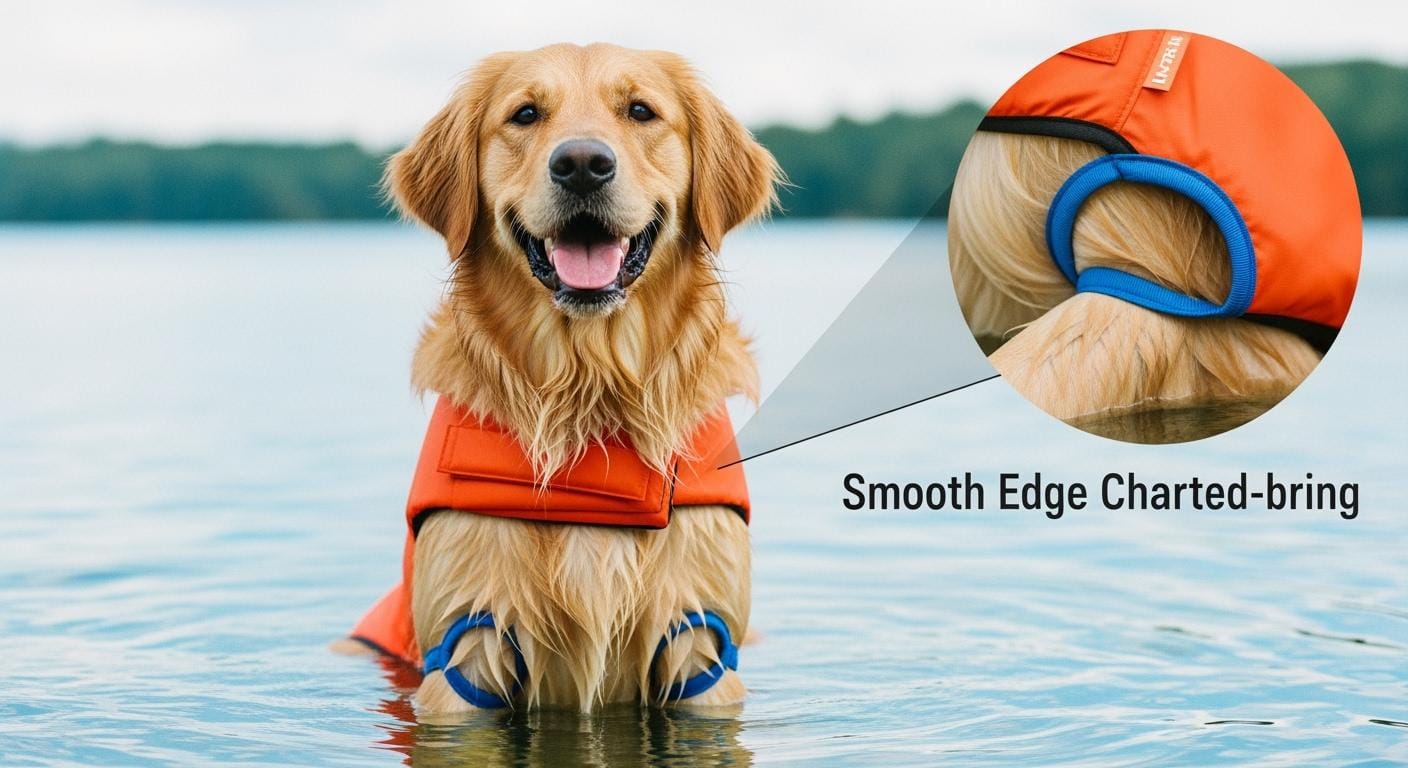
A rescue handle sewn into a dark vest body is a missed opportunity. In choppy water, the handle is the first thing you aim for — and if it blends into the jacket panel, you lose a split second locating it. A handle in a contrasting color — bright webbing against a dark panel, or vice versa — gives your hand a visual target before you close the distance.
The design logic extends beyond color. Handle placement relative to the dog’s center of buoyancy determines whether a lift is smooth or awkward. A handle positioned too far forward tilts the dog’s head down during retrieval; too far back and the rear sinks. A properly fitted life jacket positions the handle directly above the dog’s center of mass when floating, so a single-handed lift keeps the dog level.
In practice: Walk the jacket into waist-deep water with your dog wearing it. Grab the handle and lift. If the dog tilts forward or backward more than a few degrees, the handle placement or the buoyancy distribution is off — and it will be worse in an urgent situation.
Where Bright Color Visibility Helps — and Where It Cannot Replace Judgment
High-visibility design changes the speed at which you acquire and track a visual target on water. It does not change the physics of drowning, cold water shock, or current. These are separate problems with separate solutions.
The conditions where visibility features deliver the most value: open water with competing visual clutter (other boats, swimmers, floating debris), low-angle sunlight or patchy cloud cover, and any scenario where the dog is more than 30 yards from the nearest observer. The conditions where they deliver the least: clear, flat water at close range in full midday sun — precisely the scenario where almost any vest color works because nothing is challenging your vision.
Visibility features also degrade over time. Fluorescent dye fades. Reflective tape delaminates at the edges after repeated soaking and drying. Fit problems like ride-up can rotate panels out of view. A jacket that performed well last season may not perform the same way this season. Inspect the reflective surfaces under a flashlight before the first outing of the year. If the return looks dim or patchy compared to new, the jacket is no longer delivering the low-light visibility it was designed for.
Disclaimer: The visibility checks described here assume a short-coated dog where the jacket panels sit close to the body and remain unobscured. Double-coated or long-haired breeds may cover portions of the reflective trim or fluorescent panels with wet fur, reducing the effective visible surface area. In those cases, rely on handle visibility and the highest-mounted reflective strips — usually along the spine — rather than side panels alone. If the dog’s chest shape falls significantly outside the proportional model the jacket was patterned for — particularly barrel-chested breeds or dogs with a very deep keel — the fit may rotate under swimming motion, shifting bright panels away from the observer’s line of sight.
FAQ
Why do fluorescent colors work better than regular bright colors on water?
Regular bright pigments can only reflect the light that hits them. Fluorescent dyes absorb UV and short-wavelength visible light and re-emit it as visible color — the panel actively produces more light in its color band than the surrounding environment reflects. On water, where ambient light is abundant but background contrast is poor, this extra luminance output is what pulls the vest out of the visual noise.
Does reflective trim work during full daylight?
Barely. Retroreflective material relies on a directed light source — a flashlight, headlamp, or boat spotlight — pointed roughly in line with the viewer’s eyes. In diffuse daylight, the return is too weak to add meaningful contrast. Reflective trim earns its place at dusk, dawn, and under artificial light. In midday sun, the fluorescent panels and high-contrast trim do the heavy lifting.
How do I know if my dog’s life jacket is still visible enough?
Run a two-part check. First, in daylight, have someone hold the jacket at your dog’s typical swimming distance across actual water — not a parking lot or a lawn — and confirm you can identify the color, not just a shape. Second, at dusk, shine a flashlight at the jacket from shore at 30 yards and check whether every reflective panel returns a clear signal, not just the one facing you directly. If either check fails, the jacket’s visibility system is compromised.
Do small dogs need the same visibility features as large dogs?
The features are the same, but the stakes shift. A small dog presents a smaller visual target at any given distance — less surface area for color panels to work with, less reflective real estate, a lower profile against wave troughs. This makes high-coverage fluorescent panels and multi-surface reflective placement more important for small dogs, not less. Every square inch of visible surface counts more.