
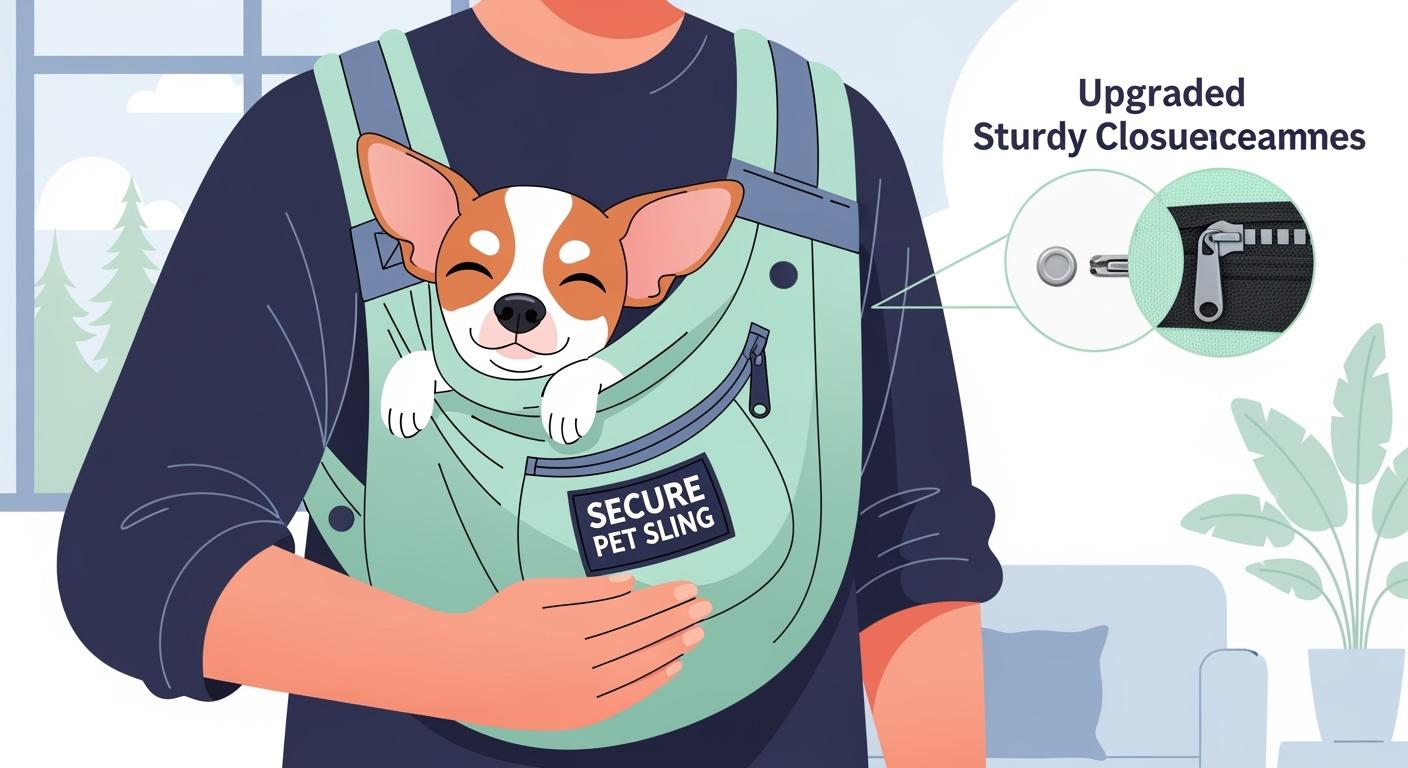
A small dog leans out of a carrier sling for one reason: the opening edge sits below the point where the dog’s weight can resist the upward push. Raise that edge and the dog settles. Leave it low and the dog stands, shifts, and eventually climbs. The problem is not the dog. It is the relationship between the pouch geometry and the dog’s center of mass.
This matters because a dog that braces against the pouch edge is not resting. It is working to stay in place. That effort reads as anxiety — panting, squirming, looking for an exit — but the root cause is structural. The sling is asking the dog to do the holding, when the sling itself should be doing that job.
Opening control is not one feature. It is four design decisions stacked together: the height of the pouch edge, the stiffness of that edge under side load, the stability of the base panel under the dog’s weight, and the strap position that sets the sling’s angle against the body. Get any one wrong and the dog compensates. Get all four right and the dog can go limp and watch the world go by.
Why Small Dogs Lean Out of a Sling Carrier
Pouch Edge Height and the Dog’s Center of Mass
When a dog stands inside a sling, its center of mass rises above the pouch edge. At that point the edge is no longer a barrier — it is a fulcrum. The dog pushes forward and up, the edge offers no counter-force above the dog’s midpoint, and the dog’s weight pivots over the rim. This is the mechanics of every lean-out.
Most small-breed dogs carry their center of mass roughly at mid-chest. If the pouch edge stops at the lower ribcage, the dog can shift its weight above that line just by straightening its legs. The fabric edge then sits below the dog’s balance point and becomes a pivot instead of a wall. A higher edge — one that reaches closer to the shoulder — moves the contact point above the center of mass. The dog can still push, but the force vector now has a downward component into the base panel rather than an outward component over the edge.
This is why sling sizing is less about the dog’s weight and more about where the pouch edge lands on the torso. A 10-pound dog with a deep chest and a 10-pound dog with a short, round body need different edge heights even though they weigh the same.
Soft Side Walls and Edge Collapse Under Load
Edge height only matters if the edge holds its position when the dog leans into it. Soft, unlined fabric folds under side pressure. The effective height drops. The dog feels the wall give way and pushes harder — not to escape, but to find a stable surface. That search reads as restlessness.
Fabrics with bias stretch — where the weave allows diagonal elongation — are especially prone to this. The dog’s weight against one side pulls the fibers at a 45-degree angle, the weave opens, and the edge folds outward. A reinforced edge with double-stitched piping or a foam insert resists this diagonal pull. The fibers are locked into a fixed plane, so side pressure transfers into the seam rather than distorting the fabric geometry.
Strap Drop and Sling Angle
A crossbody strap that hangs too low tilts the pouch opening forward. The dog’s weight slides toward the lowest point — which is now the front edge. The dog ends up leaning into the opening not because it wants out, but because gravity is pulling it there. Shortening the strap raises the pouch and levels the base. The dog’s weight centers over the base panel instead of the front rim.
In crowded settings — busy sidewalks, store aisles, transit stops — this effect compounds. Each step the wearer takes introduces a small forward swing. If the sling already tilts forward from a long strap drop, each swing pushes the dog further toward the opening. A short, high strap position reduces the pendulum length and keeps the sling close to the body, which limits the swing arc and cuts the forward drift.
What Opening Control Actually Does in a Sling Carrier
Adjustable Edge Height Matches the Dog, Not the Label
Adjustable closures — drawstrings, zippered gussets, clip-down flaps — let the user set the pouch edge to the dog’s actual torso height. A fixed-opening sling works for exactly one body shape: the one the factory patterned for. If the dog’s chest is shallower, the edge sits too high and obstructs breathing. If deeper, the edge sits too low and invites climbing.
The adjustment mechanism itself matters. A drawstring that loosens with body movement undoes the setting within minutes of walking. Test this by cinching the opening to the desired height, then walking for 10 minutes. Stop and check: has the cord slipped? Has the fabric gathered unevenly, creating a low spot? A closure that self-adjusts during wear is not a closure — it is a suggestion.
In practice: after a 15-minute walk on varied terrain, run your hand along the inside of the sling’s top edge. If you feel a concentrated band of warmth and moisture where the fabric pressed against the dog’s chest, the edge sat too low and the dog was leaning against it rather than settling into the base. A correctly adjusted edge leaves no hot stripe — the dog rested in the pouch instead of bracing on the rim.
Base Panel Stability Stops the Push Before It Starts
A dog cannot push upward from a surface that is already collapsing under it. If the base panel sags, the dog’s hind legs drop, the torso angles forward, and the dog plants its front paws on the front edge for stability. That paw placement is the first motion of every lean-out sequence.
A reinforced base — one with a stiff insert or a double-layer panel with cross-grain stitching — keeps the dog level. The hind legs stay under the body, the spine stays horizontal, and the dog’s weight distributes across the panel instead of concentrating on the front rim. After a walk, flip the sling over and look at the base. If the panel shows a single deep crease running front to back, the fabric is folding under load. A flat panel with only light compression marks means the structure held.
The interplay between sling materials and base structure is where manufacturing decisions show up most clearly. A base panel cut on the bias for cost savings will stretch diagonally under weight — it costs less to cut fabric this way, but the diagonal give means the panel deforms along the load line every time the dog shifts. A base cut on the grain resists that deformation but increases fabric waste at the cutting table. The difference shows up after the first 20 minutes of wear.
Close-Body Strap Position Locks the System
The strap is not just for the wearer’s comfort. It sets the entire carrying angle. A wide, padded crossbody strap pulled short keeps the sling high against the ribs. The pouch opening stays nearly vertical. The dog’s weight centers over the base. A long, narrow strap lets the sling drop toward the hip, the opening tilts forward, and the dog slides toward the lowest point.
An adjustable slide on the crossbody strap lets the wearer raise the sling when changing layers — a winter coat adds bulk that effectively lengthens the strap, so the same setting that worked with a t-shirt drops the sling 2 to 3 inches lower with a jacket. Without a quick slide adjustment, the dog rides lower in colder months and the lean-out risk increases seasonally.
Opening Designs Compared: Fixed, Adjustable, and Structured
A fixed-opening sling has a set edge height. The stitching, the panel cut, and the rim treatment are all optimized for one shape. That shape may or may not match the dog. When it matches, the sling works with no adjustment needed — the edge naturally sits at the right height and the dog settles without fuss. When it does not match, there is nothing the user can do. The edge is where the factory put it.
An adjustable-opening sling shifts the fit decision to the user. Drawstrings, zippered panels, or clip-down flaps let the edge height move up or down. This matters when two people share one sling for different dogs, or when a puppy grows through three torso heights in six months. The tradeoff: more adjustment points mean more seams, more hardware, and more places where fabric can bunch or a zipper can catch.
| Design Difference | Why It Matters | Main Limitation |
|---|---|---|
| Fixed-opening edge | Consistent fit for dogs that match the factory pattern; no hardware to fail | Zero adjustment for different chest depths or growing dogs |
| Adjustable-opening edge | Edge height can be set to the dog’s actual torso, not a size label | More seams and hardware; closures can slip during movement if underbuilt |
| Reinforced structured edge | Holds height under side pressure; the dog meets a firm barrier, not a folding wall | Adds weight and bulk; can feel rigid against the wearer’s body |
Closure Types: Zippers, Drawstrings, and Clips
Zippered closures lock at a set position and stay there. There is no gradual loosening — the zipper either holds or it fails. This makes zippers predictable. The downside: zippers set a single height. They open or close; they do not micro-adjust.
Drawstrings allow continuous adjustment. Cinch them tighter for a smaller dog, loosen for more head room. But drawstrings rely on friction to hold their setting. A cord lock that grips well on the showroom floor may slip after 10 minutes of body movement against the wearer’s side. The friction surfaces in budget cord locks are often smooth plastic on smooth cord — fine for static loads, unreliable under the cyclic loading of walking.
Clips and snap closures offer a middle ground: they lock at discrete positions (like a zipper) but can be placed at multiple points (like a drawstring). The limitation is spacing — if the clip points are 2 inches apart, the user must choose between slightly too tight and slightly too loose. For dogs between sizes, neither setting is ideal.
Material Effects on Opening Integrity
The fabric behind the closure determines whether the opening holds its geometry over time. Cotton and cotton blends feel soft against the dog’s coat but lose dimensional stability when damp — sweat, light rain, or a dog’s panting moisture can relax the fibers enough to drop the effective edge height by half an inch over the course of a walk.
Mesh panels solve the heat problem but introduce a structural tradeoff. Mesh has low resistance to diagonal stretch. When used as the primary material for the pouch wall, it can bell outward under the dog’s weight, widening the opening even when the closure itself stays tight. A well-designed sling carrier uses mesh as an insert within a structured frame — the mesh provides ventilation, but a woven edge band or piping handles the structural load.
Water-resistant fabrics hold their shape better in humid conditions, but they trap body heat. For flat-faced breeds or dogs prone to overheating, the ventilation loss may outweigh the structural gain. The right material is not universal — it depends on climate, breed, and outing length.
When a Sling Carrier Fits and When It Doesn’t
What Sling Carriers Do Well
A sling carrier works best when the outing is short, the dog is calm, and the environment calls for close-body carrying. Quick errands. A walk through a crowded market. A stop at a cafe with outdoor seating. In these settings, the sling’s design — hands-free, crossbody, compact — matches the task.
Small dogs that settle easily in confined spaces tend to accept a sling with minimal adjustment. The dog’s temperament does some of the work: a relaxed dog does not test the edge, so the closure has less load to manage. For these dogs, even a moderately well-designed sling can work, which is why a sling matched to short urban errands often succeeds with simpler designs. But a calm dog does not mean the design is good — it means the design was not pushed to its failure point.
Where Sling Carriers Fall Short
Dogs that jump, twist, or panic in confined spaces will defeat most sling openings. A sudden burst of force — a lunge at a passing dog, a startle reflex from a loud noise — applies peak load to the closure for a fraction of a second. Zippers can separate under this kind of shock load if the zipper tape is narrow or the teeth are fine-gauge. Drawstrings can slip through cord locks. Clips can unseat if the gate spring is weak.
Heavier dogs compound these forces. A 15-pound dog lunging sideways generates roughly double the impulse of an 8-pound dog shifting position. The sling’s base panel must be proportionally stiffer, the edge reinforcement thicker, and the closure hardware rated for a higher peak load. Many slings rated for “small dogs up to 15 pounds” use the same base panel and closure hardware as those rated for 8 pounds — the weight rating changes, but the structure does not.
Long walks amplify every fit problem. A base that holds for 10 minutes may sag after 30. A drawstring that stays set for a short errand may creep loose over a mile of walking. Heat builds inside the pouch, the dog gets restless, the restless movement loosens the closure, and the cycle accelerates. For walks longer than 20 to 30 minutes, a structured carrier with rigid walls and built-in ventilation usually keeps the dog more settled than a soft sling.
Disclaimer: the opening-height and base-panel checks described here assume a dog with typical small-breed body proportions — moderate chest depth, relatively short back. Dogs with unusually deep chests, such as miniature Dachshunds, or very round barrel chests may still shift in a sling even when the edge height and base panel pass every check. For these builds, hand-check pressure distribution across the chest and behind the front legs after 5 minutes of wear. If you feel concentrated pressure at any single point rather than even contact across a band of fabric, the sling geometry does not match the dog’s body shape.
Hot Weather and the Ventilation Tradeoff
Closing the opening for security traps heat. Opening it for airflow reduces security. This is the central tension of sling design in warm weather, and there is no single product fix — only situational decisions.
Short-nosed breeds reach heat stress faster than longer-nosed dogs at the same temperature. Dark fabrics absorb more radiant heat than light fabrics. A sling with dark, tightly woven fabric and a zipped-closed opening on an 85-degree day can raise the temperature inside the pouch 8 to 12 degrees above ambient within 15 minutes. The same sling in light mesh with the opening partially unzipped might only rise 3 to 5 degrees — but the dog now has room to push upward.
The user decides which risk to prioritize on each outing: heat or escape. Short trips in hot weather favor ventilation. Crowded environments favor security. Urban carrying on warm days often requires the sling to be run slightly more open and the walk slightly shorter — a compromise that works because the outing is brief.
For dogs that overheat easily or for outings longer than 30 minutes in warm weather, structured carriers with rigid frames and fixed ventilation ports offer a more predictable environment. The dog cannot push through a rigid wall, so the opening can stay partially open without the same escape risk. This is not a failure of the sling design — it is using the right tool for the conditions.
FAQ
How do you know if the sling opening is too loose?
Walk for 10 minutes on varied ground. Stop and look at the dog’s posture. If the dog’s front paws are braced on the front edge or the chest is pressed against the opening fabric, the edge is too low. A correctly adjusted opening lets the dog settle with its weight on the base panel, chest behind the edge, not leaning into it.
Can a puppy use a sling carrier?
Yes, but only with an adjustable opening. Puppies grow through multiple torso heights in their first year. A fixed-opening sling that fits at 12 weeks will be too low by 20 weeks. An adjustable drawstring or clip-down edge lets the user raise the opening as the puppy grows. Always use the safety tether attached to a harness — never a collar — for any puppy in a sling.
When does it make more sense to switch to a structured carrier?
Three signals: the dog repeatedly braces against the opening edge after adjustments, the base panel sags within the first 10 minutes of every walk regardless of how the dog sits, or the outing is longer than 30 minutes in warm weather. Any one of these suggests the sling design is underbuilt for that dog and those conditions. Small dogs with specific build traits — particularly barrel chests or very short legs — tend to hit these limits sooner than dogs with more typical proportions.
Why do some slings slip loose during a walk even after tightening?
The most common cause is a cord lock with plastic-on-plastic friction surfaces. Under the cyclic loading of walking — every step generates a small tug — the smooth surfaces creep apart. A cord lock with a metal spring or toothed grip resists this creep better because the friction surfaces bite rather than slide. The second cause: body heat and moisture relaxing cotton or cotton-blend drawstrings, which lose tension as the fibers swell.






