
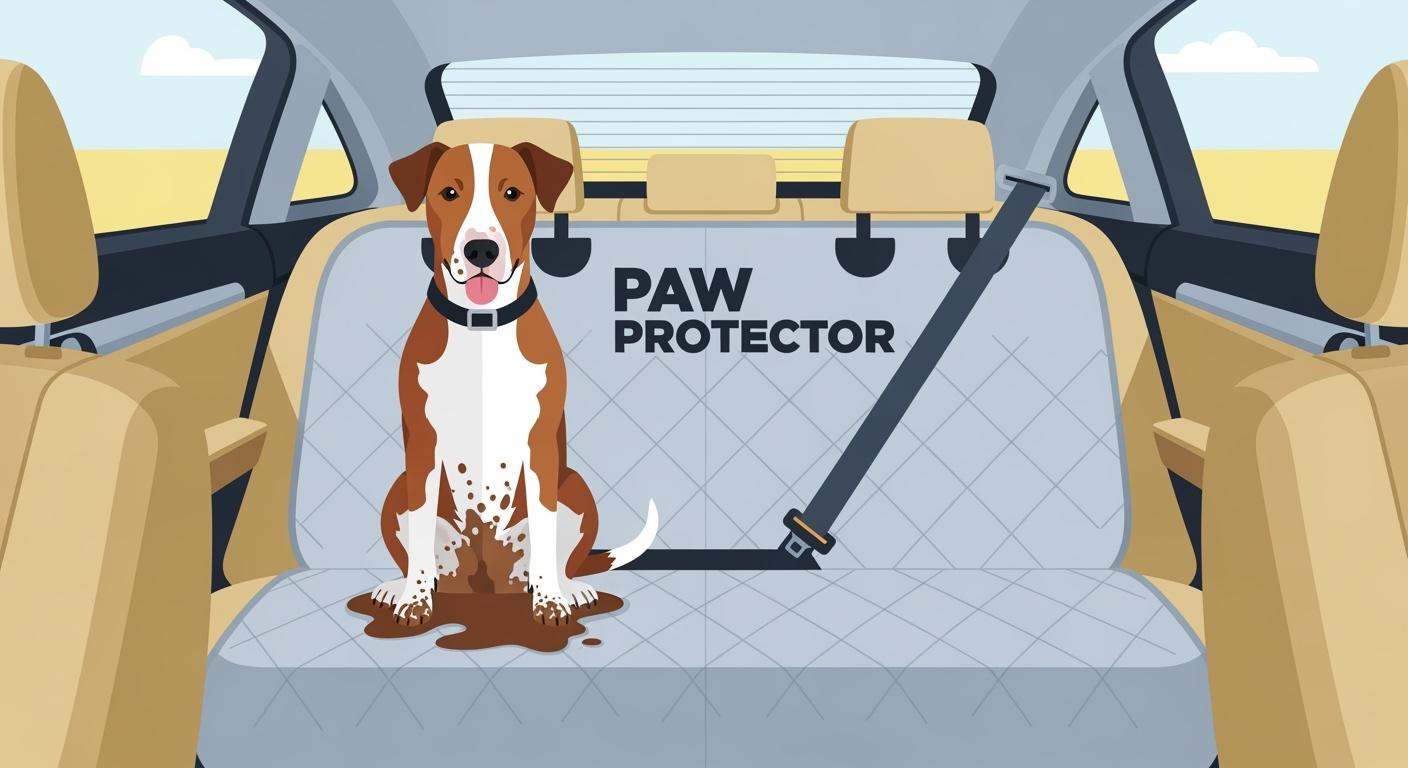
A dog jumps into the back seat after a wet trail run. Paws that just crossed mud, gravel, and standing water land on what is supposed to be a protective cover. What happens next depends entirely on whether that cover blocks moisture at the surface or lets it soak through.
Soft-fill dog seats look the part. They have padding. They feel substantial in the hand. But the materials that make them feel plush are the same ones that wick water inward the moment a wet dog settles in. Polyester weave and open-cell foam act like a sponge — the initial contact pulls moisture from the dog’s coat into the fill, and gravity does the rest, carrying grit and fine silt deeper into the padding with every minute the dog sits there.
A waterproof cover with a sealed internal liner stops that sequence before it starts. The outer fabric may get wet, but the membrane beneath it is non-porous at the pressures a dog’s weight generates. Water beads or pools on the surface. It does not travel into the core. That single material difference — porous fill versus sealed membrane — is what separates a two-minute wipe-down from a half-hour disassembly and wash cycle after every muddy outing.
The same layered approach also determines how long a back seat dog cover stays odor-free. When moisture never reaches the padding, the bacteria that break down organic matter in urine, mud, and saliva have no damp environment to multiply in. The seat smells like nothing. That is the design goal.
Why a Soft-Fill Seat Turns a Wet Dog Into a Car Interior Problem
A soft-fill dog seat fails in a predictable sequence. Water hits the surface fabric. Capillary action — the same force that pulls liquid into a paper towel — draws moisture through the weave and into the foam or fiberfill core. Unlike a towel, the core has no path for evaporation on the underside because it is pressed flat against the car seat, creating a sealed-off, stagnant layer. Moisture stays trapped.
Grit makes the problem worse. Mud and fine sand do not just sit on the surface of a soft cover. They work into the weave under the dog’s weight, where fabric flex and body heat cycle them deeper with every shift in position. After a few rides, the fill becomes a layered archive of every trail the dog has walked — dried mud near the surface, silt deeper in, fine particles pressed against the liner.
The trapped grit then acts as an abrasive. As the dog moves, those particles grind against the car seat upholstery underneath. A cover that was meant to protect the car interior is now sanding it.
Cleaning a soft-fill seat that has absorbed this much moisture and debris is its own problem. Machine washing saturates the fill completely. Drying takes hours, and if the fill clumps or shifts during the wash cycle — which open-cell foam frequently does — the seat never regains its original shape. It goes back into the car lumpy, thinner in some spots, and more likely to slide.
In practice: The fastest field test for a used seat cover is to press a dry paper towel firmly against the surface for 30 seconds after the dog exits the car. Moisture transfer to the towel means the cover’s moisture barrier has already failed — even if the surface looked dry.
How a Layered Waterproof Build Keeps the Core Dry
The design difference between a cover that protects and one that does not comes down to what sits between the outer fabric and the inner padding. In a waterproof dog car seat cover, that layer is a non-porous membrane — typically a polyurethane or TPU film bonded to the underside of the outer fabric. The membrane has no capillary channels. At the pressures a dog’s body weight applies, liquid water cannot pass through.
This is not a coating that wears off. Coatings sit on top of fabric and abrade away under friction from the dog’s movement. A bonded membrane is a separate physical layer. Even if the outer fabric frays or pills over time, the membrane underneath remains intact — as long as seam construction does not create pathways around it.
That is where seam sealing becomes the deciding factor. A waterproof membrane with unsealed stitching is like a boat hull with holes drilled along the gunwale. Water does not need to penetrate the membrane. It just needs to find a needle hole. Seam tape or welded construction closes those pathways. Without it, the membrane is decoration.
Beneath the membrane sits the core — typically a closed-cell foam or a thin polyester batting layer that exists for shape retention, not absorption. In a well-designed seat, this core has one job: keep the cover flat and the dog stable. It is not asked to handle moisture, because moisture should never reach it. The waterproof dog seat cover design isolates each layer by function — the outer fabric handles abrasion, the membrane handles moisture, the core handles structure. When these functions are combined in a single soft-fill material, all three degrade together.
At the bottom of the stack, a non-slip backing grips the car seat. This layer serves a mechanical function but also completes the moisture barrier — a rubberized or silicone-dotted underside prevents water that runs off the sides of the cover from wicking underneath and pooling against the upholstery.
The whole system works or fails at its interfaces: fabric-to-membrane, membrane-to-seam, cover-to-car-seat. When choosing between a waterproof cover for everyday cleaning versus occasional deep washing, the sealed interfaces are what allow a quick surface wipe to be enough most days.
Tip: After washing a removable cover, check that the membrane side still beads water before reassembling. Lay the cover flat, drip a small amount of water onto the inner surface, and tilt. If the water runs off without darkening the fabric, the membrane is intact. If it soaks in, the cover has delaminated and needs replacement — washing the core separately will not fix a failed barrier.
What Makes Cleanup Fast Versus a Wrestling Match
Two design details determine whether cleaning a dog seat cover takes two minutes or becomes a project: where the zipper is placed and whether the base keeps its shape after washing.
A zipper that runs along the bottom edge or under where the dog sits forces the owner to flip the entire seat over to remove the cover. That means lifting a muddy, hair-covered object, finding the zipper pull buried under fabric, and working it around corners while dirt falls onto the car floor or the person doing the cleaning. A zipper placed on the side or top edge — away from the contact zone — lets the cover peel off without repositioning the seat. The design trade-off is minor: a visible zipper track on the side panel versus a hidden one underneath. But after the fifth muddy ride, the visible zipper is not a cosmetic issue. It is the difference between a task that gets done immediately and one that gets postponed.
Removability also determines how thoroughly the seat can be cleaned. A non-removable cover means wiping the surface and hoping nothing soaked through. A removable cover means machine washing the fabric layer that actually contacts the dog, while the waterproof core — which should not be wet anyway — stays in the car or gets a quick wipe. This is the same logic behind soft-bottom versus hard-bottom seat cover designs for daily driving: a removable outer layer that separates from a structured base cleans faster and dries faster than a single-piece soft pad.
Base stability after washing is the second half of the cleanup equation. Open-cell foam cores absorb water during machine washing even inside a cover — they wick moisture through the zipper opening or through pinhole gaps in stitching. When they dry, they often shrink unevenly. The result is a base that cups at the edges, bunches in the center, or no longer sits flat on the car seat. A closed-cell foam or reinforced board base does not absorb water in the first place and returns to the car in the same shape it left.
After reinstalling the washed cover, drive for 15 minutes with the dog in place. Then check whether the base shifted more than an inch from its original position. If it did, either the non-slip backing has worn smooth or the base has warped enough to break surface contact with the car seat. Either way, the cover is no longer doing its job of keeping the back seat cover stable under a moving dog.
When a Waterproof Dog Seat Cover Fits the Job — and When It Adds Nothing
A waterproof, multi-layer seat cover makes the most sense when the dog gets wet or muddy on a regular basis — trail runs, lake trips, rainy-day walks. The design investment pays off every time the owner skips a deep clean and just wipes the surface dry. It also matters for dogs that shed heavily. Hair slides off a smooth waterproof surface more easily than it clings to textured soft-fill fabric, and a quick vacuum pass clears what does accumulate.
For dogs that stay clean and dry on short neighborhood walks, a waterproof cover may be unnecessary. A basic fabric seat protector with a non-slip backing can handle light dirt and occasional fur without the added material cost of a sealed membrane. The trade-off is that the first unexpected wet outing — a sudden rainstorm, a run through wet grass — will push moisture past what a basic cover can handle.
Large breeds benefit from a reinforced base more than small breeds do. A 70-pound dog shifting weight during cornering applies more lateral force to the seat cover than a 15-pound dog sitting still. The non-slip backing and base rigidity that keep a cover planted under a large dog are less critical for a small dog that barely disturbs the cover. But the waterproof membrane matters equally regardless of size — a small wet dog soaks a seat just as thoroughly as a large one, just in a smaller footprint.
Leather car interiors create a specific fit requirement. A cover that stays put on cloth seats may slide on leather because the non-slip backing relies on friction against a textured surface. Covers designed for leather seats typically use a tackier backing material or anchor straps that loop around the headrest, and the same principles of fit and movement that apply to selecting a dog car booster seat for the right vehicle carry over here — a cover sized for a bench seat will gap or bunch on a contoured bucket seat, leaving edges unprotected.
Disclaimer: The waterproof membrane check described above — pressing a dry paper towel against the cover surface — assumes a smooth-coated dog whose coat holds visible surface moisture. Double-coated breeds like Huskies or German Shepherds may carry water deeper in the undercoat, which transfers to the cover more slowly. With these breeds, hand-check the cover by pressing your palm firmly against the surface for 15 seconds instead. If the cover feels cool and damp against your skin after the dog exits, moisture has begun penetrating — even if the paper towel test passes.
FAQ
Can a waterproof cover be machine washed without damaging the liner?
Most removable covers with a bonded membrane can be machine washed on a cold or warm cycle. The risk is in the dryer. High heat can delaminate the membrane from the outer fabric. Air drying or using the lowest heat setting preserves the bond. Always check that the inner surface still beads water after the first wash — delamination often shows up as a dark wet patch on the inner side when tested with a few drops of water.
What is the difference between water-resistant and waterproof in a dog seat cover?
Water-resistant fabric is treated with a surface coating that repels light moisture — a few drops of rain or a damp paw. It fails under sustained contact with a wet dog because body weight presses moisture through the coating over time. A waterproof cover uses a non-porous membrane layer that blocks liquid water entirely, as long as seams are sealed. The distinction matters most after the dog has been sitting in one position for 20 minutes or more.
Why does the base of a soft-fill seat lose shape after washing?
Open-cell foam absorbs water during the wash cycle, and the weight of that water stretches the foam structure. During drying, the foam cells collapse unevenly as moisture evaporates faster from the surface than from the core. The result is a lumpy, shrunken base that no longer sits flat. Closed-cell foam and rigid base boards avoid this because they do not absorb water in the first place.
How do you stop a dog seat cover from sliding on leather seats?
Standard non-slip backings rely on friction against fabric upholstery and lose grip on smooth leather. Look for a cover with anchor straps that loop around the vehicle’s headrest posts, or a backing material specifically designed for low-friction surfaces — typically a tackier rubber compound. Even with straps, check the cover position after every trip, since a dog climbing in and out can gradually work the anchors loose.
Does a waterproof cover help with dog hair cleanup?
Hair clings to textured and woven fabrics through static and mechanical entanglement. A smooth waterproof surface reduces both — less texture means fewer anchor points for individual hairs, and the non-porous surface does not generate the same static charge. A quick pass with a vacuum or lint roller clears most hair. Soft woven fabrics grab hair at the fiber level, making removal noticeably slower.






