
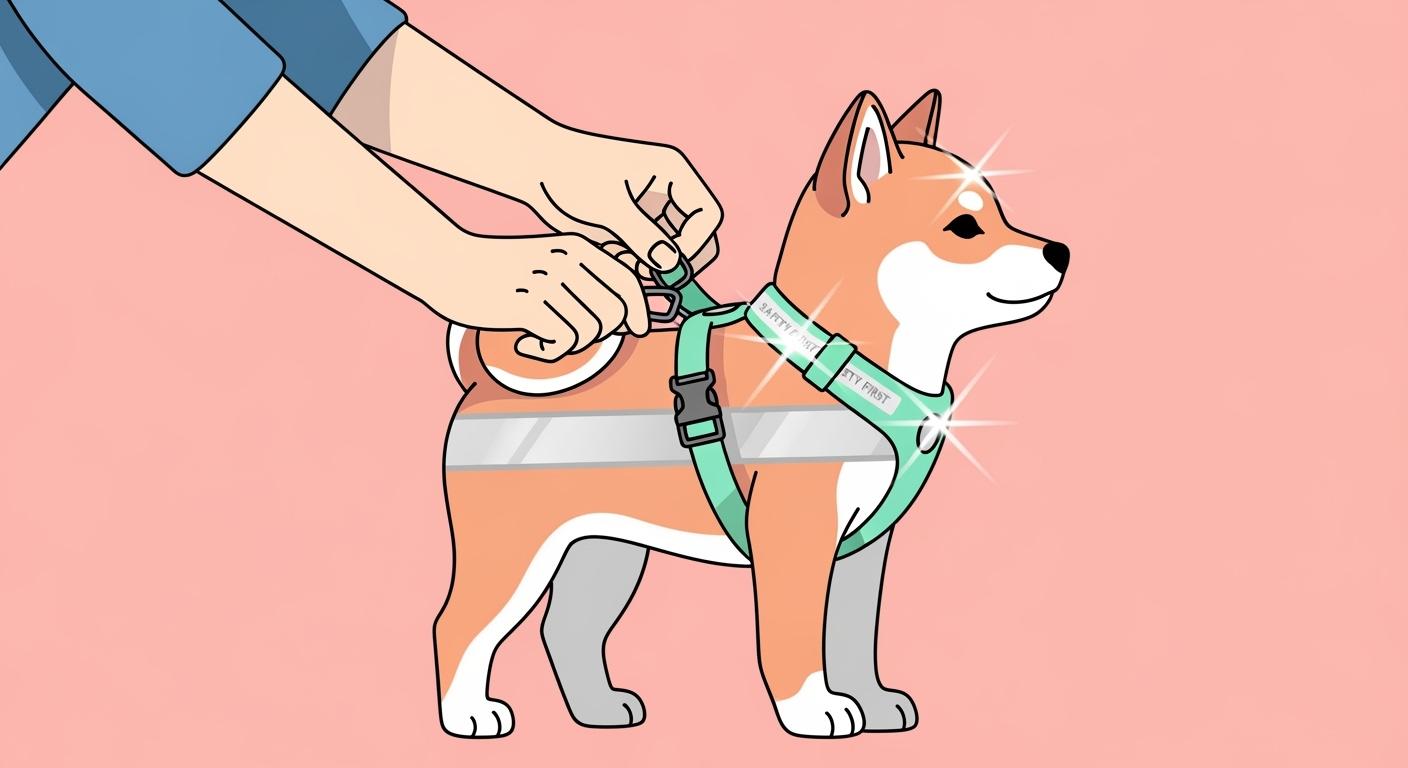
A reflective harness for a small dog loses most of its safety value the moment the trim folds under a slider or rotates against the dog’s body. The problem is not the reflective material itself — it is the gap between how the harness looks on a flat product photo and how the straps sit after being shortened for a proper fit. When the reflective area ends up under hardware, tucked into folded webbing, or turned inward toward fur, headlights and flashlights cannot reach it. The harness might still fit well and feel comfortable, but the visibility that justified the reflective feature in the first place is gone.
Tip: Check reflective trim in both bright and low light after every strap adjustment. A harness that looks bright on a table can lose most of its reflective surface once fitted to a small frame.
Why Reflective Trim Disappears After Strap Adjustment on a Small Dog Harness
How Trim Placement Interacts with Fit Tightening
Most reflective harnesses position the trim along adjustable straps — the chest strap, the back strap, or the side webbing. In a product photo the straps lie flat and the reflective strip runs in a clean, uninterrupted line. But a small dog needs a snugger fit, which means pulling more webbing through sliders and buckles. As the strap shortens, the reflective material bunches, twists, or slides directly under a buckle or slider body. The part that was meant to catch light now sits pressed against folded nylon under a piece of plastic or metal.
The issue is structural, not cosmetic. Reflective trim that is stitched directly onto adjustable strapping will always move with that strapping. When the adjustment range is wide — as it must be for a harness that spans multiple small-breed sizes — a significant length of reflective material can end up buried inside the adjustment path. The more a harness relies on strap-mounted reflective stitching for its visibility claim, the more visible surface area it loses after fitting.
| Design Approach | What Happens After Fit Tightening | Visibility Outcome |
|---|---|---|
| Reflective stitching on adjustable straps | Trim slides under sliders, folds into hardware, or bunches inside buckle path | Large reflective area lost; visible surface unpredictable |
| Fixed reflective panels on chest/back | Trim position does not shift when straps are shortened | Reflective surface stays exposed regardless of fit adjustment |
| Reflective edging on non-adjustable sections | Trim faces outward and remains clear of slider and buckle zones | Consistent side and front visibility after fitting |
Why Small Frames Magnify the Problem
Small dogs sit closer to the ground, with less body surface area visible to drivers. The reflective area on a harness that fits a Chihuahua or a Pomeranian is already small — often a strip of a few inches at most. When even part of that strip disappears under hardware or rotates inward, the remaining visible reflective surface may be too small to register at distance. A driver approaching from the side may see no reflective signal at all if the trim has twisted toward the dog’s chest or under the armpit.
Small breeds also tend to need more strap shortening relative to the total strap length, because the harness must accommodate both a Yorkie and a slightly larger small breed from the same size range. The greater the proportion of strap that gets pulled through the adjustment path, the higher the chance that reflective stitching ends up hidden. A harness designed with wider reflective coverage on a large-breed model may still work after tightening; the same design scaled down to a small frame often loses nearly all of it.
Common Failure Points
After fitting, reflective trim most often disappears at these points:
- Chest strap slider. The trim runs along the strap centerline; when the strap is shortened, the slider body covers the reflective strip entirely.
- Back buckle overlap. Folded webbing doubles over itself at the buckle, sandwiching the reflective material between two layers of nylon.
- Side strap rotation. The strap twists during walking motion, turning the reflective surface toward the dog’s body instead of outward.
- Underarm bunching. Excess strap length gathers near the front leg opening, burying reflective stitching under folds of webbing.
- Leash ring shift. Leash tension at an angle pulls the harness off-center, rotating reflective panels away from the road-facing side.
A quick post-fit check from three angles — front, side, and rear — in low light with a flashlight reveals whether any of these failure points have activated. If the reflective area cannot be seen from all three angles, the harness has lost functional visibility regardless of how bright the remaining trim may be.
The Design Details That Determine Whether Reflective Trim Stays Exposed
Fixed-Zone Placement vs. Strap-Mounted Stitching
The most consequential design distinction is whether the reflective material moves when the straps move. Harnesses with reflective stitching sewn directly onto adjustable webbing are the most vulnerable: every millimeter of strap that passes through a slider pulls reflective surface into a hidden position. Harnesses that place reflective material on fixed, non-adjustable zones — such as a chest plate, a back panel, or a vest body — keep the reflective surface in the same position regardless of how much the straps are tightened.
Fixed-zone placement is especially important for the side profile. A harness that places reflective panels or wide strips on the sides, rather than only on the chest and back, maintains visibility to cross-traffic even when the dog is moving. Fixed side-facing trim is harder to achieve on a minimalist strap harness than on a vest-style or mesh harness with more surface area, but it matters more for small dogs precisely because their body profile is already harder to spot.
When reflective trim covers more of the harness body — not just a narrow strip along the edge of a strap — the loss of a small section to hardware or folding is less likely to eliminate visibility entirely. Wider reflective coverage acts as redundancy: even if one segment gets covered, other segments remain exposed and catch light from different angles.
Hardware Profile and Trim Clearance
Sliders, buckles, and D-rings occupy physical space on the harness. If the reflective strip runs through or directly adjacent to a hardware zone, the hardware will cover part of it after tightening. Low-profile hardware — slimmer sliders, flatter buckles, smaller leash rings — reduces the footprint that blocks reflective surface. But the more reliable approach is to separate the reflective zone from the adjustment path entirely, so that no hardware sits between the reflective material and the light source regardless of fit position.
Strap Layout and Rotation Risk
A harness with thin, single-layer straps is more likely to twist during use than one with wider, padded, or dual-layer strap construction. When a strap twists, any reflective material sewn onto it twists with it, turning the reflective surface inward. On a small dog, where strap width is already narrow, a twist can rotate the entire reflective strip out of view. Wider chest and back panels resist rotation more effectively and keep reflective surfaces oriented outward.
The harness type also affects rotation risk. A step-in harness positions straps under the chest and around the neck; if the chest strap rotates, the reflective material faces the ground. A vest harness distributes tension across a larger surface, making rotation less likely but adding more material that may affect heat dissipation in warm weather. The trade-off between stability and breathability is real, and no single design resolves it for every use scenario.
When Reflective Trim Matters Most — and When Other Factors Take Priority

Use Scenarios Where Reflective Visibility Is Critical
Reflective trim is not equally important for every walk. In daylight on a quiet residential street, a driver can see a small dog without reflective assistance. The scenarios where reflective trim becomes a genuine safety factor are specific:
- Dawn and dusk walks. Low-angle light and long shadows make small, low-to-ground dogs hard to distinguish from the road surface or landscaping.
- Overcast or rainy conditions. Diffuse light reduces contrast, and wet roads create glare that washes out non-reflective surfaces.
- Urban streets with parked cars. A small dog emerging from between parked cars is below the sightline of most drivers; reflective trim at the side profile is the only signal that reaches the driver’s eye.
- Rural roads without streetlights. Headlights are the only light source, and they must hit the reflective surface directly for it to work.
- Multi-use paths shared with cyclists. Cyclists approach faster than walkers and have a narrower visual field; side-facing reflective coverage matters here more than chest-only placement.
Outside these scenarios, the harness still needs to do its primary job: fit without rubbing, stay in place during movement, and not restrict shoulder motion. A harness with perfect reflective coverage that chafes or shifts constantly will not be worn consistently, and an unworn harness provides zero visibility. The product direction that works is one where reflective design and fit comfort are resolved together, not traded off against each other.
When Reflective Trim Should Not Drive the Harness Choice
Reflective trim is a secondary feature — it does not correct a harness that fits poorly, restricts movement, or fails under pulling force. In scenarios where the dog is walked exclusively in full daylight, or where the walking environment has dedicated pedestrian lighting, the reflective feature carries less weight than strap adjustability, hardware durability, and chest plate coverage. A well-constructed non-reflective harness worn consistently in safe conditions outperforms a reflective harness that gets left at home because the dog resists wearing it.
Quick decision rule: If the walk environment regularly puts the dog in low-light conditions where drivers or cyclists share the path, reflective trim belongs on the must-have list. If walks happen primarily in full daylight on separated sidewalks, prioritize fit stability and comfort, and treat reflective trim as a bonus rather than a requirement.
What to Check in a Small Dog Reflective Harness Before Committing to a Product Direction
Trim Placement and Adjustment Clearance
Examine where the reflective material sits relative to sliders and buckles when the straps are fully extended. Then mentally shorten the straps to the approximate fit length for a small dog. If the reflective strip would enter a slider path, sit under a buckle, or get sandwiched in a fold, the design will lose visibility after fitting. The trim should sit in zones that remain static regardless of strap position — chest plates, back panels, and side panels that do not move when straps are adjusted.
Coverage Width and Multi-Angle Visibility
A single narrow strip along the back strap provides rear visibility only and may be obscured by a jacket or long fur. The minimum viable reflective layout for a small dog includes coverage visible from the front (chest), side (flank or shoulder area), and rear (back). Wider strips — at least half an inch — produce a stronger reflective return than thin piping or edge stitching. Multi-angle coverage matters more than total reflective surface area because a driver approaching from any single direction only sees one face of the harness.
Post-Fit Verification
The only reliable way to confirm that reflective trim works on a fitted harness is to test it:
- Fit the harness on the dog and secure all straps to the correct tightness.
- In a darkened space, shine a flashlight at the harness from the front, side, and rear at roughly the height of a car headlight.
- Confirm the reflective return is visible from all three angles without repositioning the harness.
- Check that no slider, buckle, or folded webbing sits directly over a reflective zone.
- Walk the dog a few steps and recheck — movement can shift the harness enough to rotate or cover trim that looked exposed at a standstill.
If any angle shows no reflective return, the harness has lost functional visibility at that angle regardless of what the product photo showed.
| Check | Pass Signal | Fail Signal |
|---|---|---|
| Front visibility | Reflective return visible on chest area from head-on flashlight | Trim hidden under chest slider, rotated under chin, or blocked by leash attachment |
| Side visibility | Reflective return visible along flank or shoulder from 90-degree angle | Trim twisted inward, buried under folded side strap, or covered by fur |
| Rear visibility | Reflective return visible on back panel from behind | Trim covered by back buckle, leash ring, or overlapping strap webbing |
| Post-movement stability | Trim remains in same exposed position after the dog walks 10–15 steps | Harness shifts off-center, rotating reflective zones away from outward face |
Reflective trim on a small dog harness delivers its safety value only when it stays visible after the harness is tightened to fit. The design details that determine whether it stays visible — fixed-zone placement, strap layout, hardware clearance, and multi-angle coverage — are more important than the brightness of the trim in a flat product photo. A harness built with reflective panels on static surfaces, low-profile hardware away from reflective zones, and wide enough coverage to survive partial obstruction will outperform one where the trim disappears into the adjustment path the moment the straps are shortened.
For a broader look at how harness design affects fit and daily use, the relationship between adjustable strap layout, hardware bulk, and small-frame coverage shapes whether a harness stays secure during walks or shifts and creates pressure points. Reflective safety adds nothing if the underlying fit does not hold up through movement. When visibility at night is the primary concern, the comparison between harness-based and collar-based reflective approaches clarifies which product type actually puts the reflective surface where headlights reach it.
FAQ
Why does reflective trim disappear after the harness is fitted?
When straps are shortened for a snug fit, reflective stitching or trim sewn onto adjustable webbing moves with the strap. It can slide under sliders, fold inside buckles, or get sandwiched between layers of tightened webbing. The trim itself is undamaged — it is simply positioned where light cannot reach it.
Which harness designs keep reflective trim visible after adjustment?
Designs that place reflective material on fixed, non-adjustable panels — chest plates, back panels, or vest side panels — keep the trim in the same position regardless of strap tightening. Harnesses with wide reflective strips that span beyond the slider path also maintain more visible surface after fitting than those with thin edge stitching.
Can a harness with hidden reflective trim be fixed by readjusting?
Sometimes. Loosening and re-routing straps to pull reflective stitching out from under hardware can restore visibility, but only if the fit remains secure afterward. If exposing the trim requires loosening the harness past the point of a stable fit, the design itself is the limitation and a fixed-zone layout is the more reliable direction.
What reflective coverage is enough for a small dog walked at night?
Visible reflective surface from the front, side, and rear — at minimum. A single back strip leaves the dog invisible to cross-traffic. For small dogs, coverage width also matters: a wider reflective band produces a stronger return at distance and is less likely to be fully obscured if part of it gets covered by fur or a slight harness shift.
How often should reflective trim be checked after fitting?
After every significant strap adjustment and periodically during regular use, since harness position can drift over multiple walks. A quick flashlight check in a dark room from three angles takes under a minute and catches trim coverage loss before it becomes a safety gap on the next low-light walk.






