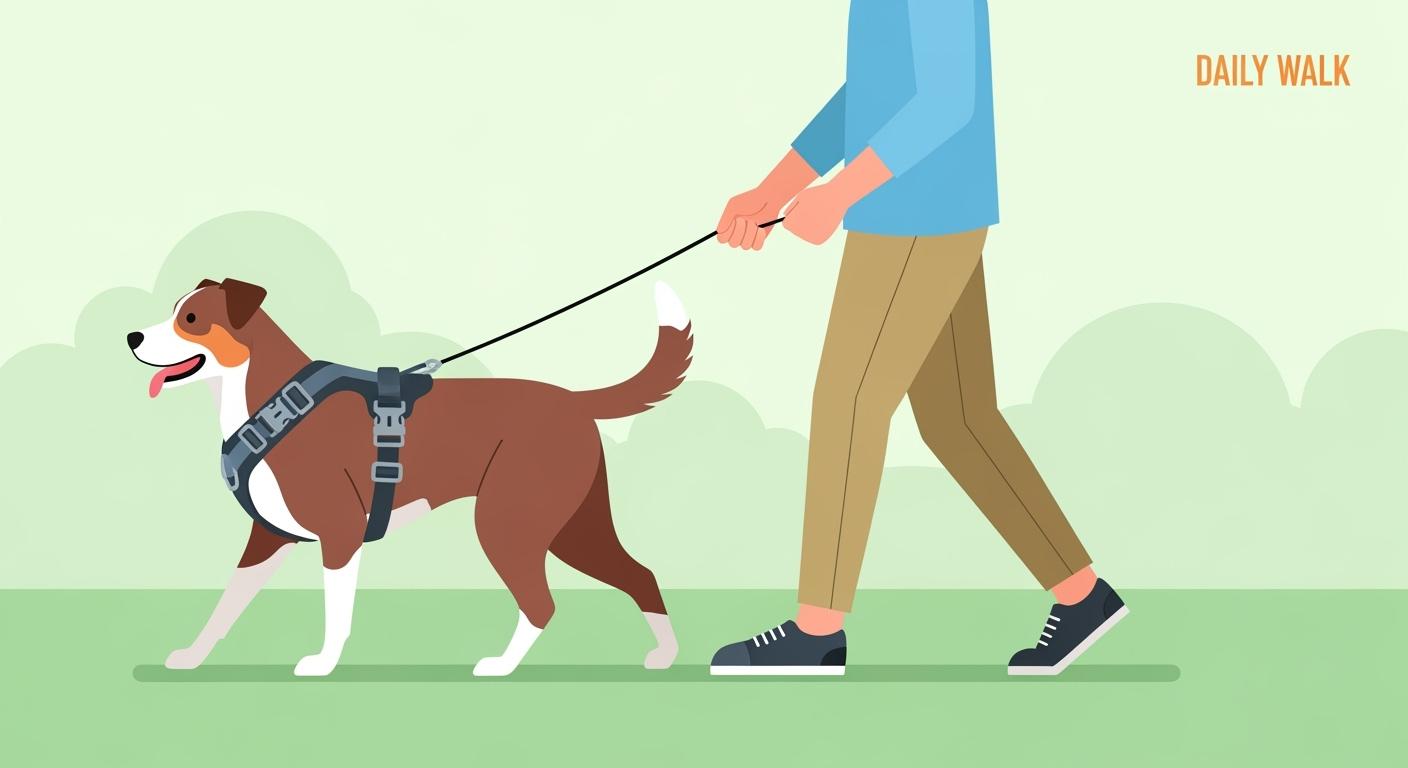
Choosing a heavy duty dog harness starts with checking harness fit matters. A harness built for active dogs can look strong but may fail if it restricts movement or traps heat. You need a secure fit for safety and comfort. Follow a step-by-step guide to find the best fit and enjoy the benefits of dog harnesses for enjoyable walks.
Measure your dog to ensure the best fit.
Look for features that support comfort and safety.
Key Takeaways
Measure your dog accurately to ensure a proper fit. Use the two-finger rule to check that the harness is snug but not too tight.
Choose a harness made from breathable materials like mesh and neoprene. These materials keep your dog comfortable during walks.
Regularly check the harness fit and your dog’s skin after walks. Look for signs of rubbing or discomfort to ensure your dog stays safe and happy.
Heavy duty dog harness fit and sizing
How to measure a dog for a harness
You need to measure your dog before choosing a heavy duty dog harness. Accurate measurement helps you avoid common mistakes and ensures the harness fits well. Start with chest girth. Place the tape measure around the widest part of your dog’s ribcage, just behind the front legs. Pull the tape snug but not tight. For neck size, measure at the base near the shoulders, not higher up. Some harnesses ask for back length, but only measure this if the size chart requests it.
Many owners make mistakes when measuring for a harness.
Measuring over thick fur instead of against the skin leads to wrong size.
Not waiting for your dog to calm down can cause the tape to slip.
Skipping the two-finger rule makes the harness too tight or too loose.
Measuring at the wrong spot on the neck gives inaccurate results.
You should always use the two-finger rule. After adjusting the harness, slide two fingers under each strap. The harness should feel snug but not squeeze. If you cannot fit two fingers, loosen the straps. If you can fit more than two fingers, tighten them.
Tip: Measure your dog when calm and standing. Double-check the numbers before ordering.
Dog harness sizing: chest, neck, and adjustment tips
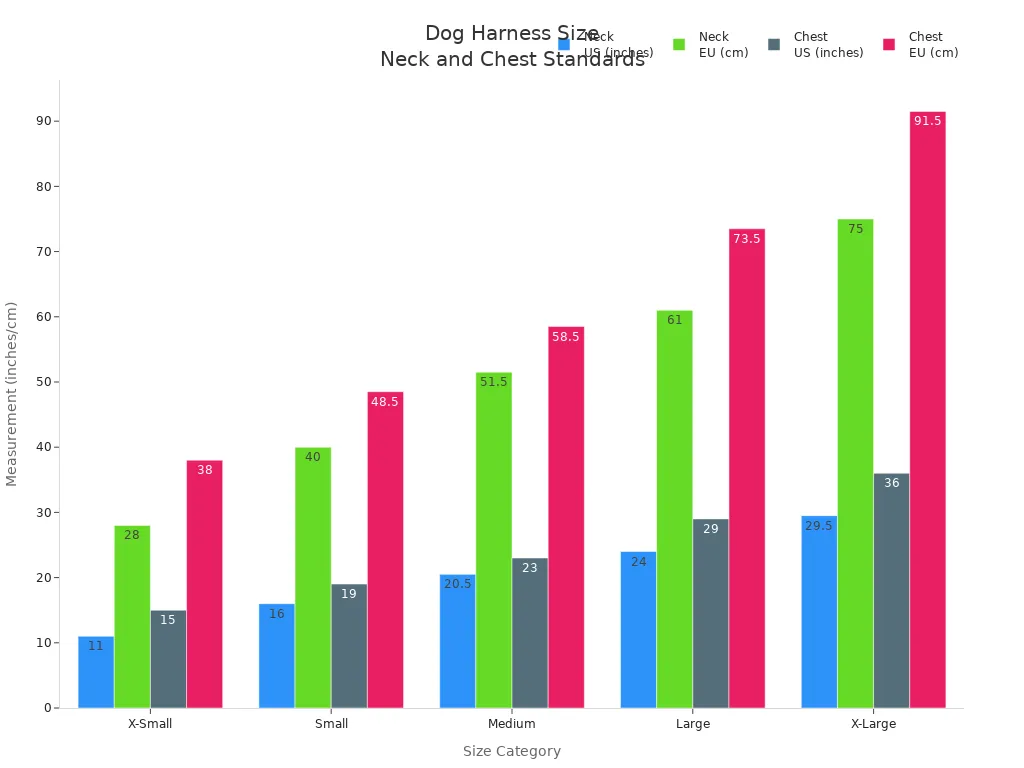
Dog harness sizing uses chest and neck measurements. Most US and EU brands follow similar standards. Check the size chart for each harness. Compare your dog’s numbers to the chart below.
Size | Neck (A) | Chest (B) |
|---|---|---|
X-Small | 9 – 13 in (23 – 33 cm) | 12 – 18 in (30 – 46 cm) |
Small | 12 – 20 in (30 – 50 cm) | 16 – 22 in (41 – 56 cm) |
Medium | 16 – 25 in (40 – 63 cm) | 18 – 28 in (46 – 71 cm) |
Large | 18 – 30 in (46 – 76 cm) | 24 – 34 in (61 – 86 cm) |
X-Large | 24 – 35 in (61 – 89 cm) | 28 – 44 in (71 – 112 cm) |

You must check harness fit after adjusting the straps. Use these fit tests to make sure the harness works for everyday walks.
Fit Test | Description |
|---|---|
Doorway test | Walk through a doorway and make one slow turn; the harness should stay centered. |
Three-minute walk test | Walk at a normal pace on a flat surface; check for shoulder crowding or rubbing. |
Post-walk recheck | Check for hot spots or areas that feel overly compressed after the walk. |
Fit Test | Description |
|---|---|
Indoor on/off check | Ensure the harness can be put on easily and that straps lie flat. |
Driveway or hallway walk | Walk a few steps, stop, turn, and restart; check if the harness stays centered. |
Post-walk recheck | Check for rubbing, heat, or shifting after the walk. |
You want the harness to allow shoulder freedom and distribute pressure across the chest. Avoid harnesses that press on the throat or crowd the shoulders. Check for rubbing behind the elbows. Make sure the hardware stays secure and does not shift.
Escape risk increases if the harness is too large.
An oversized harness shifts and becomes unstable.
Loose straps and visible gaps let your dog back out and escape.
Stop using a harness that slips or shows gaps.
Note: This content gives general product-fit guidance. It does not replace medical advice. If your dog shows pain, skin injury, limping, coughing, breathing stress, or major mobility issues, contact a veterinarian.
You now know how to measure a dog for a harness and check dog harness sizing. Always use the two-finger rule and fit tests to keep your dog safe and comfortable.
Dog harness materials and features

Webbing, padding, and breathability
You want a harness made from strong materials. It should also keep your dog comfortable. Nylon webbing is tough and easy to clean. Mesh is lighter and lets air move through. But rough mesh edges can rub your dog’s skin. Neoprene padding makes the straps soft and comfy. This padding can hold heat and moisture. It works best in cool weather or for dogs with sensitive skin.
Breathable materials help your dog stay cool on long walks. The Wildflower Strolls harness uses soft neoprene and mesh padding. This design spreads out pressure and lets air flow. The padded lining stops skin irritation. This helps dogs with sensitive skin.
Breathable mesh keeps your dog cool when it’s hot.
Soft neoprene padding stops rubbing and pressure.
Smooth edges keep your dog’s skin from getting sore.
Check that thick webbing and big panels do not crowd the chest or shoulders. Extra attachment points should not block movement or make your dog too hot. Always test the harness by letting your dog walk and turn.
Hardware, handle, and adjustability
Hardware must stay strong and not rust. Look for buckles and D-rings that do not move or come loose. Smooth edges protect your dog’s skin from getting hurt. The panels should support the chest but not press on the throat.
Handles give you quick control in busy places or at doors. Do not use the handle to lift your dog. The table below shows how handle design changes control and safety:
Aspect | Description |
|---|---|
Animal Safety | Equipment should lower stress and use soft, smooth edges to stop injury. |
Ergonomics | Comfy, non-slip handles help you control strong dogs and feel less tired. |
Durability | Parts must last a long time and work well in tough spots. |
Adjustable straps help you fit the harness snugly. Make sure you can change the harness for your dog’s shape. Test the fit often to keep your dog safe and happy.
Note: This content gives general product-fit guidance. It does not replace medical advice. If your dog has pain, skin injury, limping, coughing, trouble breathing, or big movement problems, call a veterinarian.
Harness mistakes, checks, and troubleshooting
Common harness selection mistakes
You can stop many problems if you know common harness mistakes.
If harness straps twist, they press on your dog in bad ways.
Using the wrong size chart makes the harness uncomfortable and unsafe.
Straps that are too tight make it hard for your dog to move and can hurt the skin.
Picking a harness just because it looks cool or is big can squeeze the shoulders and make your dog hot.
Using the handle to lift your dog or thinking a tough look means safer can hurt your dog.
Not checking for heat or skipping fit checks can make your dog feel bad.
Tip: Always use a good fit guide and check your dog’s skin after walks.
Pass/fail fit checklist table
Use this easy table to check if your harness fits right:
Test | Pass Criteria | Fail Criteria |
|---|---|---|
Two-finger rule | Two fingers fit under each strap | Too tight or too loose |
Centered harness | Stays centered during walk and turn | Slides, rotates, or shifts |
Shoulder freedom | Dog moves freely, no crowding | Restricts movement or rubs |
Skin check | No redness or swelling after walk | Redness, swelling, or sores |
Escape risk | No visible gaps, secure clips | Gaps, loose straps, easy escape |
Heavy duty vs. standard harness comparison table
See how heavy duty dog harnesses are different from standard ones:
Feature | Standard Harness | Heavy-duty and customizable fit |
|---|---|---|
Materials | Synthetic webbing, plastic buckles | Seatbelt-grade webbing, memory foam |
Construction | Basic stitching | Reinforced stitching |
Attachment Points | Front or back only | Multiple (front, back, dual) |
Reflective Elements | Minimal | Integrated 360° reflectivity |
Adjustability | Few points | 4-6 adjustable straps |
Escape Prevention | Basic buckles | Secure clips, double-locking |
No-Pull Design | Rare | Steering or gentle correction |
Best for | Calm walkers, basic control | Pullers, active dogs, precise fit |
Watch-outs | Limited durability, poor fit | Heat buildup, bulky panels |
Fit note | May slip or twist | Stable, distributes load evenly |
Troubleshooting fit, rubbing, and slipping
If your harness rubs or slips, try these steps:
Take off the harness and look at your dog’s skin for red spots or swelling.
Clean sore spots with pet-safe cleaner and keep them dry.
Wait one to three days before using the harness again.
Check the fit again with a good guide and size chart.
Make sure two fingers fit under each strap.
Walk your dog, turn, and pull gently to test movement.
Get a new harness if the old one still hurts or does not fit right.
Symptom | Likely Cause | Fast Check | Fix |
|---|---|---|---|
Rubbing | Straps too tight/loose | Skin check after walk | Adjust straps, reposition |
Slipping | Harness too loose | Walk and turn test | Tighten straps, recenter |
Restricted motion | Bulky panels, poor fit | Observe movement | Choose lighter harness, refit |
Escape risk | Gaps, loose clips | Pull test | Secure clips, adjust straps |
Note: This is general advice about harness fit. It is not medical advice. If your dog has pain, skin problems, limps, coughs, or seems upset, call a veterinarian.
Dog harness FAQ
Sizing and measuring questions
You may wonder how to measure your dog for a heavy duty dog harness. Here are the most common questions:
How do you measure a dog for a harness?
What should you do if your dog is between sizes?
How often should you re-measure your dog?
Do you need to measure differently for a no-pull harness?
Can you use a collar instead of a harness?
“Just like shoes for humans, a harness must match the dog’s unique anatomy. One size does not fit all—even within breeds.” — Dr. Lena Torres, DVM
To get the best fit, use a soft fabric tape. Measure neck girth, chest girth, and back length if needed. Measure your dog while standing. Do not rely only on breed charts or weight. Size up if your dog is between sizes or has a thick coat. Check the fit every 1-2 months for adults and monthly for puppies.
Rubbing, slipping, and pulling control
Different types of dog harnesses help with rubbing, slipping, and pulling. If you notice rubbing, check the fit and adjust the straps. Slipping often means the harness is too loose. For pulling, the right harness type can make walks easier.
Type of Harness | Pressure Distribution | Pulling Tendency | Best For |
|---|---|---|---|
Front-Clip Harness | Chest and shoulders | Reduces pulling through steering | Dogs learning loose-leash walking |
Back-Clip Harness | Across back and chest | May encourage pulling | Calm dogs, everyday walks |
No-Pull Harness | Dual attachment points | Highly effective at discouraging | Training transitions, powerful breeds |
Some types may not work for every dog. Strong pullers may need a training collar or professional help. Always check the fit and watch for discomfort.
Handle use and harness types
Handles on harnesses give you quick control in busy places. You should not use the handle to lift your dog. Different types of dog harnesses offer features for various needs:
Front-clip harnesses help steer dogs that pull.
Back-clip harnesses suit calm dogs and everyday walks.
No-pull dog harness designs use dual clips for training.
Some types may not fit every dog’s body shape.
Professional training may help if harnesses alone do not solve pulling.
Walking vs. car safety harness
Walking harnesses and car safety harnesses serve different purposes. You need to know the difference to keep your dog safe.
Feature | Walking Harness | Car Harness |
|---|---|---|
Primary Use | Leashed walks and outdoor activities | Vehicle travel and crash protection |
Attachment Point | Leash via back or front clip | Vehicle seatbelt or LATCH system |
Force Resistance | Low to moderate | High, built for crash impacts |
Sarah from Colorado Springs learned that a walking harness does not protect dogs in car accidents. She switched to a CPS-recommended car harness after a near-accident. Always use the right harness type for each activity.
Note: This FAQ gives general product-fit guidance. It does not replace medical advice. If your dog shows pain, skin injury, limping, coughing, or distress, contact a veterinarian.
You can make your dog safer and more comfortable with the right heavy duty dog harness. First, measure your dog’s chest and neck. Pick a harness with straps you can adjust. Check the fit often to make sure it is not too tight or loose. Neoprene and mesh are good materials because they help your dog stay cool. Use the checklist and tables to help you choose.
Always put your dog’s comfort first and ask a vet if your dog seems uncomfortable.
FAQ
How do you choose the right step-in harness for your dog?
You measure your dog’s chest and neck. You check the size chart. You select a step-in harness that allows shoulder movement and fits snugly.
What should you do if your step-in harness rubs or slips?
You check the straps. You adjust the fit. You make sure two fingers fit under each strap. You try a short walk with the step-in harness.
Can you use a step-in harness for dogs that pull?
You use a step-in harness with a front clip. You test the fit. You watch your dog during walks. You combine the step-in harness with training for best results.
Tip: Always check your step-in harness after each walk. Look for signs of rubbing or discomfort.
Step-in Harness Issue | Quick Fix |
|---|---|
Rubbing | Adjust straps, check edges |
Slipping | Tighten straps, recenter |
Escape risk | Secure clips, check gaps |