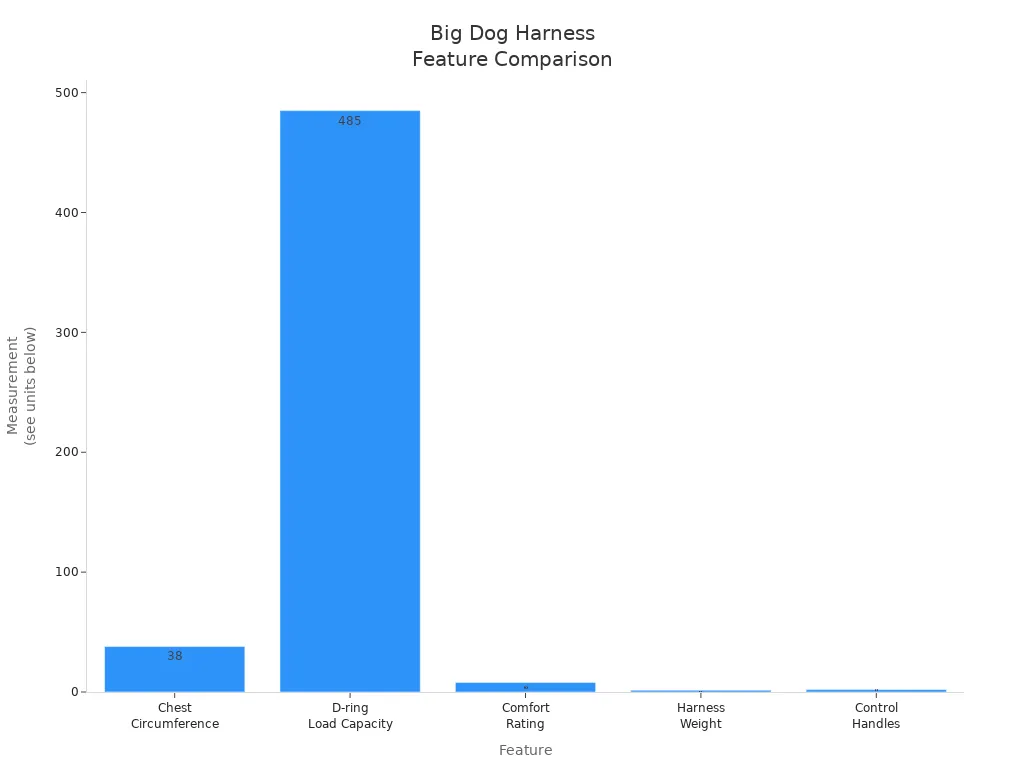
You want buyers to trust you. Buyers want facts, not hype, when picking a dog harness big. Buyers look for proof in every feature. They check things they can measure. Chest circumference fit (30-38 in / 76-97 cm), D-ring load capacity (485 lb / 220 kg), comfort rating, and handle count are most important.
Feature | Measurement | User Impact |
|---|---|---|
Chest Circumference Fit | 30-38 in / 76-97 cm | Makes sure the harness fits well and stops escapes. |
Load Capacity of D-ring | 485 lb / 220 kg | Keeps big dogs safe during activities. |
Comfort Rating | 8 out of 10 | Makes it easier to use for a long time outside. |
Weight of Harness | 1.5 lb / 0.68 kg | Light so it is comfy to wear. |
Adjustability | Multiple adjustment points | Keeps the harness tight and does not slip. |
Control Handles | 2 | Makes it easier to control the dog on walks. |
A storyboard helps you show clear proof. It helps you organize your message so people trust you. When you plan your talk, buyers see real value.
Key Takeaways
Buyers look for things they can measure, like chest fit, how much weight it holds, and how comfortable it is when picking a dog harness.
A good storyboard helps people trust you by showing clear facts and proof about the harness’s strength, comfort, and control.
Use the girth-first sizing way to make sure the harness fits right. This lowers the chance of returns and makes customers happier.
Get ready for buyer questions by giving clear, fact-based answers and proof for every claim about the harness.
Give many harness choices to fit different needs, like no-pull features and eco-friendly materials, so more people will like them.
Storyboard Flow for Dog Harness Big
60-Second Opener
You want buyers to trust your facts. Start by showing that you understand what matters most: risk reduction, clear sizing, and proof of strength, comfort, and control. Tell your audience that this storyboard will show how the dog harness big meets these needs with real data and safe claims.
Slide 1 – Positioning Statement
Explain that the dog harness big is built for large dogs who need reliable gear. State that you focus on measurable features, not hype. Show that your harness uses strong materials, smart design, and clear fit rules.
Slide 2 – Buyer Risks
List the main risks buyers face:
Unclear sizing can lead to returns.
Guessing by breed or weight causes confusion.
Poor fit means escapes or discomfort.
Returns and exchanges cost time and money.
Slide 3 – Three Pillars Overview
Introduce the three pillars:
Strength: Materials and build.
Comfort: Padding and fit.
Control: Handling options.
Say that each pillar is backed by facts, not promises.
Slide 4 – Strength Pillar
Describe how strength comes from wide webbing, reinforced stitching, and metal hardware. Mention that the dog harness big uses nylon and padded polyester for durability.
Slide 5 – Strength Proof
Show a table of construction features:
Feature | Description |
|---|---|
Webbing Width | 1.5 in / 3.8 cm |
Stitching Pattern | Box-X reinforced |
Hardware Type | Metal D-ring, load tested |
Material | Nylon, padded polyester |
Slide 6 – Comfort Pillar
Explain that comfort means padding, smooth edges, and adjust points. The dog harness big has padding at pressure spots and adjustable straps for a custom fit.
Slide 7 – Comfort Proof
List comfort checks:
Padded chest and belly.
Adjustable straps for girth and neck.
Two-finger fit test.
No rubbing in armpits.
Slide 8 – Control Pillar
Say that control comes from dual handles and front-back leash clips. The dog harness big gives you options for steady walks or quick redirection.
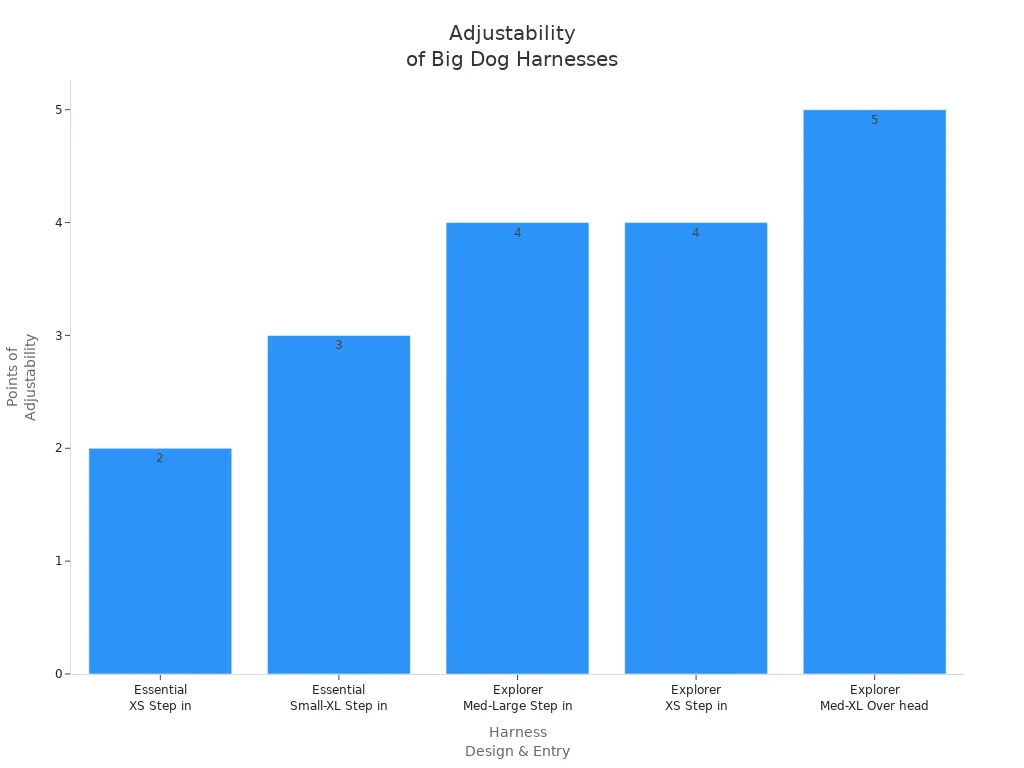
Slide 9 – Control Proof
Show a chart of adjustability points:
Slide 10 – Big Dog Sizing
Explain how to measure chest girth (in/cm) and neck. Show that the dog harness big uses a girth-first rule for best fit.
Slide 11 – Returns Prevention
List returns prevention cues:
Clear size chart.
Measurement graphic.
Fit checklist.
On-dog photos.
Slide 12 – Objection Handling
Prepare for questions about fit, comfort, or control. Use only claims you can prove with tests, photos, or records.
Slide 13 – Program Options
Show options buyers want:
No-pull front clip.
Adjustable straps.
Step-in style.
Reflective trim.
Eco-friendly materials.
Slide 14 – Compliance Language
Remind buyers to use dual units, fit warnings, and only approved claims. Avoid words like “miracle” or “100 percent safe.”
Slide 15 – Next Steps
Invite buyers to review the storyboard, ask questions, and check the proof for each claim.
30-Second Closer
End by repeating that the dog harness big reduces risk with clear, measurable features. Thank buyers for focusing on facts and trust.
Best Dog Harnesses for Medium to Large Dogs – Pillars and Proof
Defining Strength
A harness should last through daily use. Strength means it will not break or stretch. Look for harnesses made with tough materials. Strong webbing and secure hardware are important. The best harnesses use weather-resistant materials. They have solid construction. You can trust a harness more if you see details about how it is built.
Here is what shows strength:
Feature | Description |
|---|---|
Durability | Uses weather-resistant, long-lasting materials for outdoor use. |
Material | Neoprene and nylon offer flexibility and resist wear. |
Webbing | High-quality webbing does not fray or stretch under pressure. |
Buckles | Secure side-release buckles are easy to use and hold strong. |
Hardware | Plated zinc alloy or steel hardware resists corrosion and adds strength. |
Strength Evidence
You can trust a harness when you see proof of how it is made. Many top harnesses use reinforced stitching and steel joins. Rugged buckles help keep the harness strong. Some harnesses have handles with metal attachments. This gives extra control. A strong harness fits well. It has many adjustment points. This helps the harness stay in place. It also lasts longer. Check for load-tested D-rings. Make sure the webbing does not stretch. These features show the harness can handle walking a medium or large dog.
Durable materials and strong finishes make top harnesses better.
Reinforced joins and cobra-style buckles help the harness stay reliable.
Solid construction means the harness works in many situations.
Handles with metal attachments give you more control and flexibility.
A snug fit with several adjustment points helps the harness last and keeps your dog comfortable.
Defining Comfort
Comfort means your dog can move easily. Your dog should not feel pain or pressure. The harness should fit well around the neck and chest. Measure your dog’s chest girth and neck to pick the right size. Adjustability is important. You can change the straps to fit your dog’s body. A good fit means the harness is snug but does not squeeze or rub. Watch for signs of discomfort like chafing. Adjust the harness if needed. Padding and smooth edges help your dog feel better.
Comfort Evidence
Look for these features to check comfort:
Feature | Description |
|---|---|
Even Pressure Distribution | Spreads force to prevent choking or injury during walks. |
No-Pull Features | Helps you control strong dogs without causing discomfort. |
Adjustable Fits | Lets you change the harness for different body shapes. |
Safety Elements | Reflective trim and secure closures help with visibility and safety. |
Comfort and Durability | Allows your dog to move without restriction. |
Always check the fit before each walk. The harness should not pinch or leave marks. Padding at pressure points and smooth edges help stop rubbing. You can trust a harness that lets your dog move naturally. Your dog should stay comfortable during long walks.
Defining Control
Control means you can guide your dog safely. You want a harness with features that help you manage your dog’s movement. The best harnesses for medium to large dogs have front-ring leash attachments. These help you redirect your dog if needed. Dual handles give you more options for steady walks or quick corrections. Reflective features help you see your dog in low light. You can trust a harness more when it gives you these handling options.
Front-ring leash attachment helps you guide your dog.
Reflective trim makes your dog easier to see in low light.
Multiple adjustment points keep the harness stable and secure.
Control Evidence
Look for safe claims about control. These claims talk about features, not promises. For example, a harness may have a front-attachment option for control. Fit-focused adjustment points help keep the harness in place. Some harnesses help reduce pulling when used correctly. Do not trust harnesses that promise to stop pulling completely. Every dog is different.
Claim Type | Example Phrase | Risk Level | Safe for Retail? |
|---|---|---|---|
Claim_Feature | front-attachment option for directional control | Low | Yes |
Claim_Feature | fit-focused adjustment points for stable positioning | Low | Yes |
Claim_Function | helps reduce pulling leverage for the handler when used correctly | Medium | Yes |
Claim_Function | may help reduce pulling for some dogs when properly fitted and used with training | Medium | Yes |
You can trust a harness that gives you clear, measurable features for control. Always use the harness as directed. Check the fit before each walk.
Tip: Some of the best dog harnesses for medium to large dogs have no-pull front rings, padded panels, and many adjustment points. These features help you trust your choice. They make walking a medium to large dog safer and more fun.
Dog Harness Big Sizing and Returns
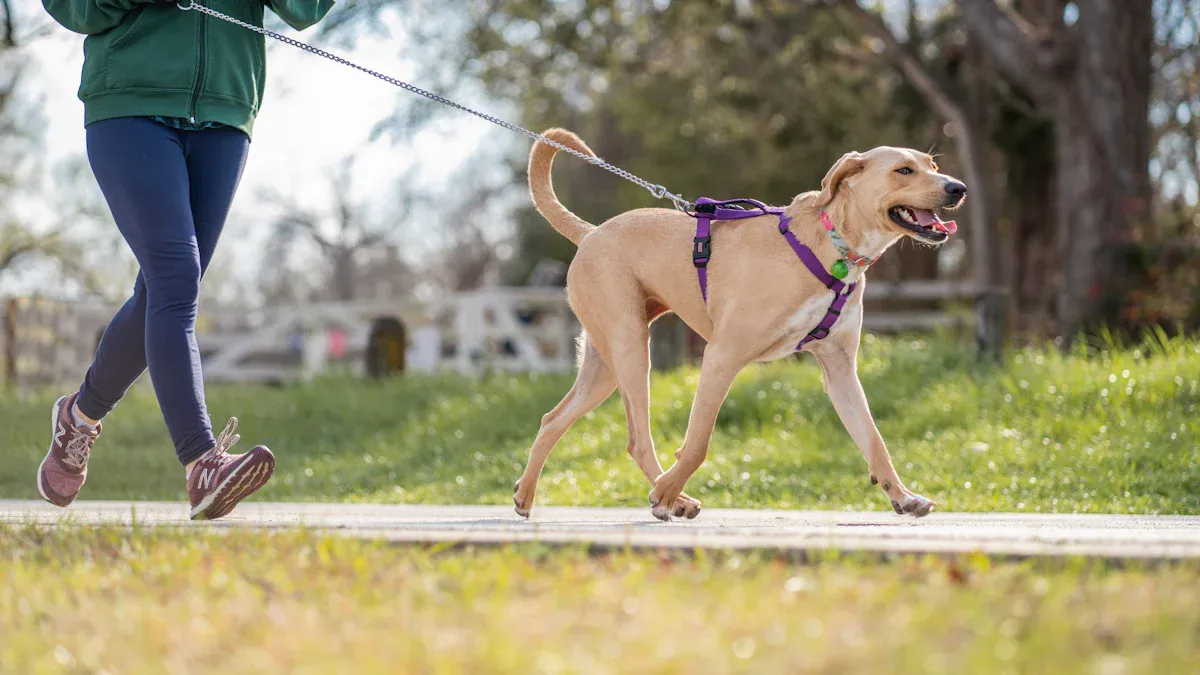
Girth-First Sizing
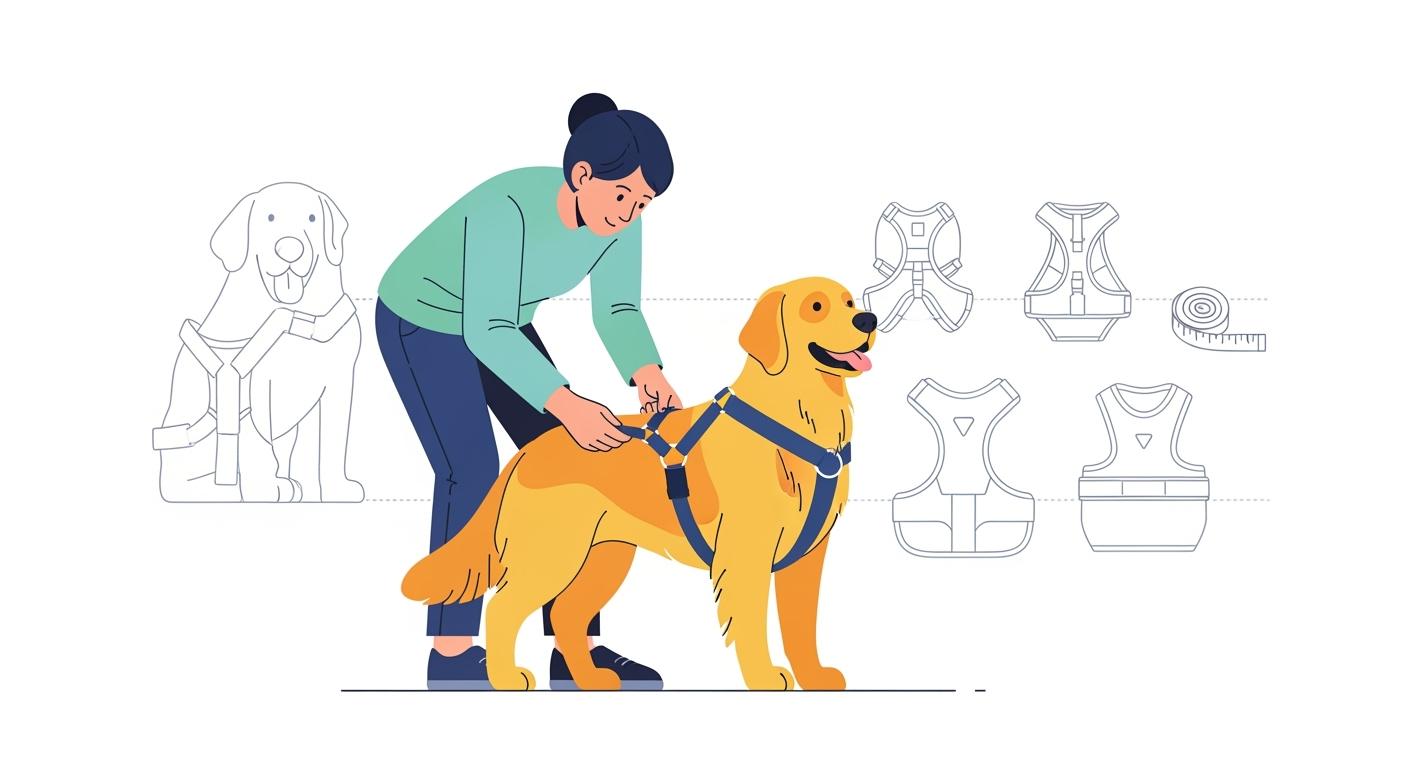
You want a harness that fits your dog well. Start by measuring your dog’s chest girth. Use a soft tape to wrap around the widest part of the chest, just behind the front legs. Write down the measurement in inches and centimeters. For example, a harness may fit dogs with a chest girth of 30-38 in (76-97 cm). Weight helps guide your choice, but chest girth gives the best fit. Most harnesses list both chest girth and weight ranges. Always check both numbers before you buy.
Tip: Chest girth is the main sizing rule. Weight is a backup guide.
Between-Sizes Rule
Sometimes your dog’s measurement falls between two sizes. In this case, pick the larger size. This helps you get a harness that adjusts better and does not squeeze your dog. Look for harnesses with clear between-sizes rules in the size chart. A good size chart uses dual units and shows chest girth first. You can see a sample chart below:
Size | Chest Girth (in/cm) | Weight (lb/kg) |
|---|---|---|
M | 24-30 in / 61-76 cm | 40-65 lb / 18-29 kg |
L | 30-38 in / 76-97 cm | 65-95 lb / 29-43 kg |
XL | 38-44 in / 97-112 cm | 95-130 lb / 43-59 kg |
Note: If your dog’s chest girth is between sizes, choose the larger size for easier adjustment.
Returns Prevention Cues
Sizing confusion causes most returns. You can lower your risk by checking the listing for clear size charts, measurement graphics, and fit checklists. Look for on-dog photos that show how the harness fits around the chest and neck. Hardware closeups and labeled clip points help you see how the harness works. Here is a table with common fit errors and return data:
Aspect | Details |
|---|---|
Common Fit Error | Sizing confusion is a main problem that causes returns. |
Baseline Return Rate | Usually between 4% and 12%, depending on channel and sizing clarity. |
Return Handling Cost | Normally costs from 6 to 18 USD for each returned harness, including checking and restocking. |
You can avoid returns by following the girth-first sizing rule, using the between-sizes guide, and checking all images and charts before you buy. Look for listings that show these cues to help you make a better choice.
Building Trust and Handling Objections
Top Buyer Concerns
You want buyers to trust your product and your process. Buyers often worry about these things:
Will the harness fit their dog well?
Can the harness handle a strong pull from a big dog?
Does the harness offer real comfort for long walks?
Are the no-pull features easy to use and do they help with control?
What happens if the harness does not fit or meet their needs?
Buyers want a good experience. They want to feel loyalty to a brand that listens and solves problems. You can build trust by showing you understand these concerns.
Safe Answers
You can answer buyer questions with facts and clear language. Use these tips to build trust and loyalty:
Show your experience with big dogs and harness design.
Explain how you measure chest girth (in/cm) and weight (lb/kg) for the best fit.
Point out the reinforced webbing and metal hardware for strength.
Describe the padding and adjust points for comfort.
Share how the no-pull features work when used with proper training.
Remind buyers to check fit before each walk for the best experience.
Honor your commitments by following up after the sale.
Act with integrity in every interaction.
Note: Buyers trust you more when you give honest answers and keep your promises. Each positive experience builds customer loyalty.
Evidence to Show
You can use proof to support your answers and build trust. Show buyers these items:
Proof Type | What to Show |
|---|---|
Size Chart | Dual units (in/cm, lb/kg) for chest girth and weight |
Construction Photos | Closeups of webbing, stitching, and hardware |
Fit Checklist | Steps for checking harness fit on the dog |
No-Pull Features | Images of front and back clips, with use instructions |
Returns Policy | Clear, simple steps for returns or exchanges |
You can also build trust through your experience. Use email to share helpful guides. Use phone or video calls to answer questions and show your expertise. Repeat quality touches with buyers to show your commitment. Each good experience increases loyalty and trust. Buyers remember when you act with honesty and keep your word. Over time, you earn customer loyalty and more repeat business.
Program Options and Compliance
Assortment Strategy
You can offer buyers a range of dog harness options to meet different needs. A strong assortment helps you cover more customer preferences. You might include:
No-pull harnesses with both front and back leash clips for flexible control.
Step-in harnesses for easy fitting, especially for dogs that do not like harnesses going over the head.
Reflective trim for better visibility in low light.
Eco-friendly materials for buyers who want sustainable choices.
Multiple sizes with clear chest girth ranges, such as 30-38 in / 76-97 cm, 38-44 in / 97-112 cm, and so on.
You can also choose between OEM and ODM programs. OEM means you ask a supplier to make products to your own design and branding. ODM means the supplier has a ready design that you can customize and brand as your own. Both options let you build a product line that fits your market.
Tip: Show a clear size chart with dual units (in/cm, lb/kg) for each harness. This helps buyers pick the right fit and reduces returns.
Claim-Safe Language
You need to use language that matches what you can prove. Buyers trust you more when you use clear, supportable claims. Avoid words like “unbreakable” or “guaranteed safe.” Instead, focus on features you can show, such as:
Feature Type | Example Statement |
|---|---|
Material | Uses nylon webbing, 1.5 in / 3.8 cm wide, for strength |
Hardware | Metal D-ring load tested to 485 lb / 220 kg |
Adjustability | Four adjustment points for a snug fit |
Comfort | Padding at chest and belly to reduce pressure |
Control | Dual handles for close guidance and steady walking |
Note: Only make claims you can support with test results, photos, or records. Use fit warnings and care instructions to help buyers use the harness correctly.
You build trust by using claim-safe language and showing proof for every feature. This approach helps you meet compliance needs and keeps your buyers confident in your products.
Proof-to-Claim Map Table
You need to show proof for every claim you make. This table helps you check each statement for real evidence. It also shows how to rewrite claims to make them safer. Use this map to keep your presentations honest and easy to trust.
Tip: Only use claims you can back up with tests, photos, or records. If you do not have proof, use softer words.
Pillar | Statement | What it really means | Evidence required | Safer rewrite | Where it appears |
|---|---|---|---|---|---|
Strength | Heavy-duty harness for big dogs | Uses strong materials and build for large dogs | Webbing width, stitching, hardware specs | Built with 1.5 in / 3.8 cm nylon webbing and metal D-ring load tested to 485 lb / 220 kg | Strength Pillar, Slide 4 |
Strength | Will not break | Designed for handling strong dogs | Load test results, QA records | Designed for handling dogs up to 485 lb / 220 kg when properly fitted | Strength Proof, Slide 5 |
Comfort | All-day comfort | Padding and fit help reduce pressure | Padding location, fit test photos | Padding at chest and belly helps reduce pressure during walks | Comfort Pillar, Slide 6 |
Comfort | Prevents rubbing | Smooth edges and fit reduce rubbing | Edge finish photos, fit checklist | Smooth edges and adjustable straps help reduce rubbing under arms | Comfort Proof, Slide 7 |
Control | Stops pulling | Front clip helps redirect pulling when used correctly | Clip design, use instructions | Front clip may help redirect pulling when used with training | Control Pillar, Slide 8 |
Control | Full control in any situation | Dual handles and clips give more handling options | Handle count, clip location photos | Dual handles and front-back clips offer more options for handling | Control Proof, Slide 9 |
Sizing | Fits all big dogs | Fits dogs within listed chest girth and weight range | Size chart, fit photos | Fits dogs with chest girth 30-38 in / 76-97 cm and weight 65-95 lb / 29-43 kg | Sizing, Slide 10 |
Returns | No returns | Clear sizing and fit help reduce returns | Return rate data, fit checklist | Clear size chart and fit checklist help reduce returns | Returns Prevention, Slide 11 |
You can use this table to check your claims before you talk to buyers. This helps you build trust and keeps your words safe and easy to understand.
Buyer Objection Matrix Table
You may hear many questions from buyers. You can use this table to get ready for common concerns. Each answer uses facts you can show. This helps you build trust and keep your claims safe.
Tip: Use photos, charts, and fit guides to support your answers. Show proof for every feature you mention.
Objection | Buyer concern | Best short answer | Evidence to show | Unsafe phrasing to avoid | Follow-up action |
|---|---|---|---|---|---|
Will this harness fit my dog? | Worry about sizing and escapes | Measure chest girth in in/cm. Use the size chart. Pick the larger size if between. | Size chart with dual units, fit photos | Fits all dogs, one-size-fits-all | Offer a fit checklist and photos |
Is the harness strong enough? | Concern about breakage or wear | Built with 1.5 in / 3.8 cm nylon webbing and metal D-ring load tested to 485 lb / 220 kg. | Webbing width, hardware closeup, load test record | Unbreakable, will never fail | Show test data and inspection process |
Will it rub or hurt my dog? | Fear of discomfort or chafing | Padding at chest and belly helps reduce pressure. Smooth edges help prevent rubbing. | Padding location photos, edge finish, fit checklist | Prevents all rubbing, pain-free | Share fit tips and padding details |
Does it stop pulling? | Want help with control | Front clip may help redirect pulling when used with training. Dual handles give options. | Clip design, use instructions, handle photos | Stops all pulling, no-pull guarantee | Explain proper use and fit |
What if it does not fit? | Worry about returns or exchanges | Clear size chart and fit checklist help reduce returns. Simple return steps if needed. | Return policy, fit checklist, measurement guide | No returns, always fits | Review return steps and fit guide |
Is it safe for big dogs? | Concern about control and handling | Designed for handling dogs with chest girth 30-38 in / 76-97 cm and weight 65-95 lb / 29-43 kg. | Size range, hardware specs, on-dog photos | 100 percent safe, crash tested | Show handling options and fit photos |
Note: You should avoid words like “never,” “always,” or “guaranteed.” Use only claims you can support with real proof.
Speaker Notes for Trust-Building
60-Second Opener Script
You want buyers to trust your facts. You start by showing that you understand what matters most. Buyers look for risk reduction, clear sizing, and proof of strength, comfort, and control. You explain that this storyboard will show how the dog harness big meets these needs with real data and safe claims. You focus on conversion. You want every buyer to see the value in conversion. You use conversion as your main goal. You show how conversion happens when you use facts. You explain that conversion does not come from hype. You say that conversion comes from trust. You set the stage for conversion by showing proof. You tell buyers that conversion is the result of clear, measurable features. You repeat that conversion is your focus.
3-Minute Pillar Walk-Through
You walk buyers through the three pillars. You start with strength. You show the webbing width in in and cm. You point to the metal D-ring load tested to lb and kg. You explain that conversion depends on showing these facts. You move to comfort. You talk about padding at the chest and belly. You show how adjust points help fit. You say that conversion happens when buyers see proof of comfort. You finish with control. You show the dual handles and front-back clips. You explain how conversion works when buyers see handling options. You use photos, charts, and checklists. You remind buyers that conversion is about trust. You say that conversion grows with every proof point. You keep the language clear and claim-safe. You tie every statement to conversion.
30-Second Closer
You close by repeating your focus on conversion. You thank buyers for looking at facts. You say that conversion is the result of trust. You remind buyers that conversion comes from clear sizing, strong materials, and real comfort. You say that conversion is not about promises. You end by saying that conversion is about proof. You invite buyers to review the storyboard for more conversion.
You build trust when you use facts that buyers can check. A claim-safe storyboard helps you show real features like webbing width in in and cm, or D-ring load in lb and kg. Buyers want to see proof, not promises. You lower risk by using clear charts, photos, and fit guides.
Remember: Measurable features and honest answers help buyers make smart choices. Use your storyboard, tables, and scripts to guide every presentation.
FAQ
How do you measure your dog for the right harness size?
You measure your dog’s chest girth with a soft tape. Wrap the tape around the widest part behind the front legs. Write down the number in in and cm. This helps you pick the right size for your customer.
What makes a harness comfortable for your dog?
A harness feels comfortable when it fits your customer well. Padding at the chest and belly helps. Smooth edges and adjustable straps help your customer move without rubbing. You check the fit before each walk for your customer.
How do you know if the harness is strong enough?
You look at the webbing width and hardware. A harness with 1.5 in or 3.8 cm nylon webbing and a metal D-ring load tested to 485 lb or 220 kg supports your customer. You check for reinforced stitching for your customer.
Can the harness help with pulling?
A front clip may help you redirect your customer when used with training. Dual handles give you more options for your customer. You do not get a promise to stop pulling, but you get features that help you guide your customer.
What should you do if the harness does not fit your dog?
You check the size chart for your customer. If your customer’s chest girth is between sizes, you pick the larger size. You use the fit checklist and look at on-dog photos for your customer. You follow the return steps if needed for your customer.
Tip: You help your customer by using clear sizing, fit checks, and proof of features. This supports conversion rate optimization for your customer.