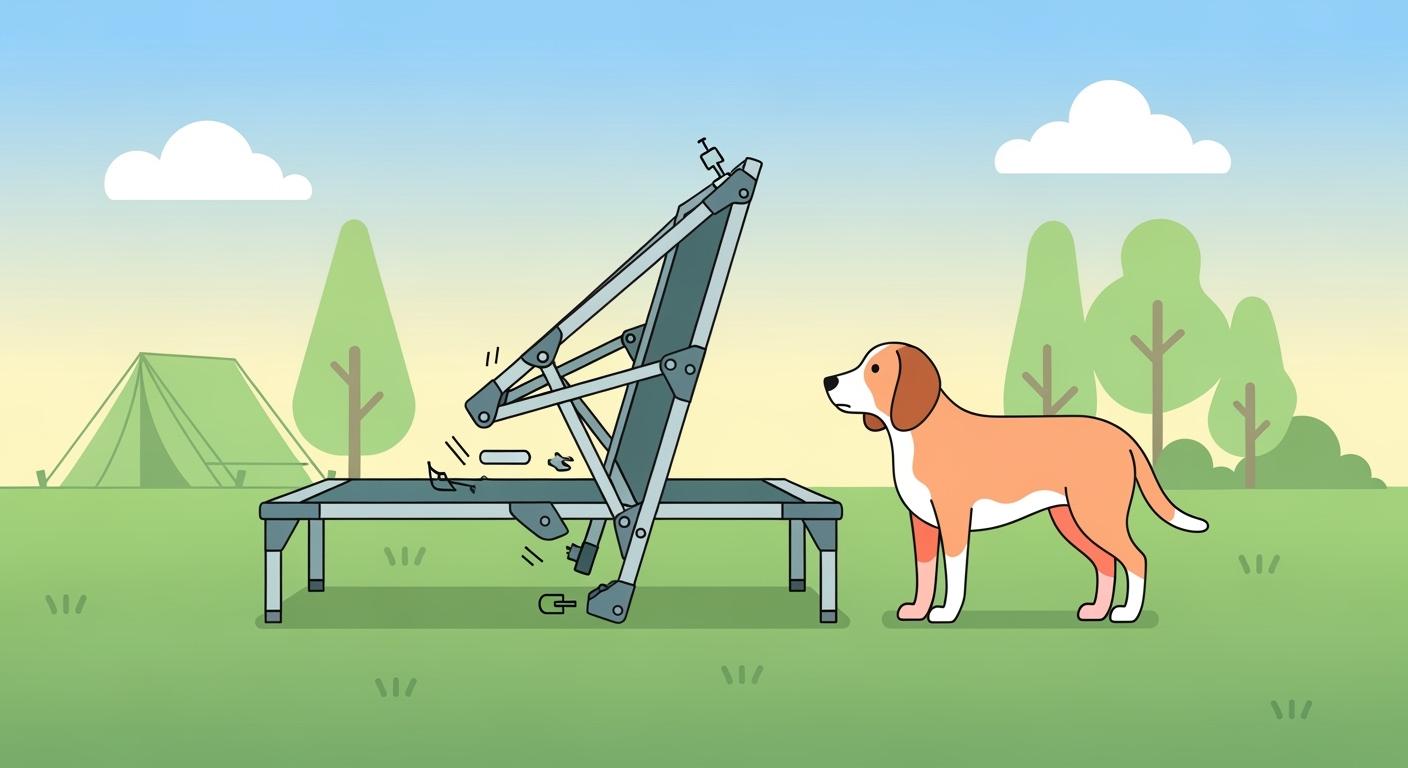
Set an elevated camping dog bed on a patio and it sits flat. Take the same cot to a campsite with packed dirt, tree roots, and a slight slope — and the wobble starts. The frame twists. A foot sinks half an inch. The fabric dips. Your dog steps on, feels the shift, steps off. That cot stays empty all night.
Campground ground is not patio ground. Every dimple, root, and soft spot tests the frame, feet, and fabric differently than a hard flat floor ever will. Most folding elevated cots are built for the patio. The ones that hold steady at camp are built around three specific design decisions — and those decisions show up in the joints, the foot contact area, and the way the fabric holds tension through weather cycles.
Why Some Elevated Camping Dog Beds Feel Unstable at Camp
A folding frame carries your dog’s weight through a series of hinge points. On flat ground, the load path is predictable: weight presses straight down, each leg bears roughly equal force, and the hinge pins act as simple pivots. Drop that same frame onto a slight slope with one corner sitting on a root — and the load path changes completely.
The downhill leg takes more than its share of the weight. That unbalances the hinge above it. Because the frame is a closed structural loop, torque at one hinge travels through the crossbars and twists the opposite corner. The cot does not just tip — it winds up like a weak spring. When your dog shifts position, the stored twist releases, and the bed lurches. A dog that feels that lurch once will often refuse the cot for the rest of the trip.
Locking frame points interrupt this chain. When a hinge locks, it stops transmitting rotation to the rest of the frame. The twist stays local. The bed stays level even if one foot sits higher than the others. Beds without locking joints rely on friction alone — and friction degrades. After a dozen setups, the pin fit loosens by fractions of a millimeter. Small enough that you would not see it by eye, but enough that the frame’s resistance to twist drops sharply. That is the moment a patio bed becomes a liability at camp.
Signs the Cot Is Failing Before It Collapses
Frames rarely fail all at once. They degrade in steps, and each step leaves a signal:
- The cot rocks diagonally when your dog steps on — one hinge has loosened and the frame is racking.
- A foot sinks into soft ground deeper than the others, canting the entire bed a few degrees off level.
- The fabric sags into a bowl shape rather than staying flat — tension has bled out through stretched stitching or weakened edge binding.
- The frame creaks during setup, not from new-material stiffness, but from metal-on-metal wear at a pivot point.
- Your dog approaches the cot, puts one paw on, and withdraws — a behavior pattern that often signals the bed moved on a previous attempt.
Any one of these means the cot has entered a failure curve. Catching it at the rocking stage costs a field adjustment. Missing it until the fabric bowl-forms usually means the bed is done for the season.
Where the Frame Fails First — and What Design Details Fix It
Loose Joints and What Locking Points Actually Do
A hinge that wobbles by a millimeter at the joint translates to several inches of movement at the far corner of the bed. That is leverage at work. The frame leg is a lever arm — a small gap at the pivot amplifies into a large arc at the sleeping surface. When a dog shifts weight from front paws to rear, the force direction reverses, and the gap slaps the opposite way. What feels like a gentle rock to you watching from above is a sudden jolt to a dog lying on the surface.
Locking mechanisms — whether a spring-loaded pin, a cam latch, or a threaded collar — close that gap. By mechanically binding the joint, they turn what would be a free-spinning hinge into a rigid connection. The lever arm can no longer amplify micro-movement because there is no pivot freedom to exploit. This is the same principle that keeps a steel-frame elevated dog bed from developing the diagonal racking that plagues friction-fit cots after a season of use.
In manufacturing terms, the tolerance between pin and socket is the variable that separates a locking joint from a loose one. A pin with 0.2 mm of clearance may feel snug on day one. After repeated folding — which burnishes both surfaces — that clearance grows. At roughly 0.5 mm, the frame racks visibly. Locking designs compensate for this wear path by introducing a clamping force that closes the clearance each time the lock is engaged, rather than relying on the initial interference fit alone. That is a production-level decision: it costs more to tool a locking joint, but the alternative is a joint whose stability has a known expiration date measured in folding cycles.
Tip: Before your dog uses the cot, press down hard on one front corner. Watch the opposite rear corner. If it lifts even slightly off the ground, the frame has lost torsional stiffness — at least one lock is not holding.
Narrow Feet vs. Wide Contact Area on Soft Ground
A narrow foot concentrates the dog’s weight onto a small patch of soil. On dry hardpack, that may not matter. On damp grass, loose gravel, or forest duff, the foot punches through the surface. Once it sinks, the bed tilts. The tilt shifts more weight onto the sunken leg, which sinks deeper — a feedback loop that ends with one corner of the cot near ground level and the dog sliding toward the low side.
Wide feet break that loop. By spreading the same load across a larger contact area, they reduce ground pressure enough that the foot sits on top of the surface rather than pushing through it. Identical weight, larger footprint, lower pounds per square inch. An anti-slip pad on the bottom of each foot adds a second stabilizing mechanism — it converts horizontal sliding forces into friction, which matters most when a dog scrambles onto the cot from the side rather than stepping on gently.
Observable check: set the cot up on the softest patch of ground at camp. Press down on the center of the sleeping surface with about the force of your dog’s weight. Walk around and inspect each foot. If any foot has sunk more than the thickness of a standard tent stake, that ground is too soft for those feet — add a leveling pad underneath or relocate. An outdoor dog bed with adequate foot spread tends to pass this check on all but the loosest sand.
| Failure Signal | Likely Design Cause | Better Design Direction |
|---|---|---|
| Frame wobble | Friction-fit hinge with worn pin clearance | Locking joint that clamps closed with each setup |
| Feet sink or slide | Narrow foot with high ground pressure per square inch | Wide foot with anti-slip base pad |
| Fabric sags | Edge binding that stretches under repeated load | Reinforced hem with low-stretch thread and re-tensioning points |
Fabric That Loses Tension Over Time
Fabric tension is what makes an elevated bed a bed rather than a hammock. When the fabric is pulled tight and locked into the frame, it creates a near-planar surface. A dog’s weight presses down, but the tension in the weave resists deflection. The tighter the initial tension, the less the surface dips and the closer the dog’s spine stays to a neutral position during sleep.
Outdoor conditions attack fabric tension from two directions. Moisture causes fibers to swell and then contract as they dry — each wet-dry cycle relaxes the weave by a small increment. UV exposure embrittles synthetic fibers at the surface, reducing their ability to rebound after stretching. After 20 or 30 nights outside, a fabric that started drum-tight may have a visible dip in the center. That dip is not just cosmetic — it changes how the dog’s spine aligns during hours of sleep. A subtle curve maintained all night can leave a dog stiff the next morning, particularly in older dogs or breeds with long backs.
The pre-trip check is simple: press your palm into the center of the fabric with moderate force. Release. If the fabric does not snap back flat within a second, tension has bled out. Some cots allow re-tensioning via adjustable straps at the corners. If yours does not, and the surface stays dimpled after the press test, the bed has entered its decline phase — it will still hold the dog but will not provide the spinal support it did when new.
Note: PVC-coated polyester mesh tends to hold tension longer than uncoated nylon in high-UV environments. The coating shields the load-bearing fibers from direct sunlight, slowing the embrittlement that leads to permanent stretch. This material difference matters more at altitude — where UV intensity is higher — than at sea level.
When an Elevated Cot Is the Wrong Choice
An elevated bed solves a specific set of camping problems: damp ground, uneven terrain, crawling insects, and the need for airflow underneath. It does not solve every sleeping problem a dog encounters outdoors — and in some conditions, the features that make it effective become drawbacks.
In cold weather — ground frozen or air temperature dropping below roughly 40 degrees Fahrenheit — the airflow that keeps a dog cool in summer turns into a heat sink. Cold air circulates under the cot and pulls body heat away faster than a pad directly on the ground would. A dog that curls tight and shivers on an elevated cot in those conditions needs a closed-cell foam pad on top of the fabric, or a different bed entirely for cold-weather trips.
For dogs that dig, circle compulsively before lying down, or launch onto surfaces at speed, elevated cots carry the same risk as any framed bed: a paw can slip between fabric and frame rail during an energetic entry. This is uncommon but worth noting for high-drive dogs in unfamiliar campsite environments. The same platform that keeps a calm dog dry and ventilated can become a pinch point for a dog that treats it like an agility obstacle.
And some dogs simply dislike the feel of a tensioned surface under their paws. The slight give, the textured mesh, the elevation off the ground — none of it bothers most dogs, but the dogs it does bother will refuse the cot outright. No design feature overcomes a strong sensory preference. If your dog has never used an elevated surface before, a pre-trip test in the backyard is cheaper than discovering the refusal at camp after dark.
Disclaimer: The stability checks described above — corner-press tests, foot-sink inspections, fabric-snapback timing — assume a dog within the cot’s rated weight range and a setup on ground that is not actively saturated. If the ground is wet enough that your own boot leaves a print deeper than the tread pattern, no foot width will prevent sinking. Move to higher, drier ground or use a groundsheet to bridge the softest patches. Additionally, double-coated breeds on elevated cots in cold weather may not show visible shivering even while losing body heat — hand-check the dog’s belly and inner thigh after 20 minutes on the cot. If those areas feel cool rather than warm, the cot is pulling heat faster than the dog can generate it.
Häufig gestellte Fragen
How do I tell if the frame locks are actually working?
Press down hard on one front corner and watch the diagonal rear corner. If the rear corner lifts, the frame is racking — the lock at one of the hinges between those two corners is not fully engaged. A locking frame that is working correctly keeps all four feet planted when you press on any one corner. Test this before every trip, because a lock that held last time may have worn its catch surface in the interim and will fail silently on the next setup.
What is the fastest way to stabilize an elevated cot on sloped ground?
Identify which foot sits highest on the slope. Dig a shallow depression under that foot — just enough to bring the frame level. Do not dig under the low feet to sink them deeper; that puts the frame under permanent twist that accelerates joint wear. If the slope exceeds roughly 5 degrees, rotate the cot so the long axis runs across the slope rather than up-and-down it. A dog cot set up across a slope distributes the height difference across two feet instead of concentrating it all on one corner.
Can I use the same cot indoors and outdoors without it loosening faster?
You can, but the folding cycles add up faster. Every fold-and-unfold cycle burnishes the hinge surfaces by a tiny amount. Using the same cot daily indoors means the hinges see roughly 365 cycles per year instead of 20 or 30 camping nights. A cot with locking joints tolerates this better because the lock re-clamps each time, compensating for the accumulated clearance. A friction-fit design loosens on roughly the same total cycle count regardless of where it is used — it just reaches that count sooner with daily deployment.
How much sleep space should the cot provide beyond my dog’s body length?
Add 6 to 10 inches beyond the dog’s nose-to-tail-base measurement when lying in a natural sprawl — not curled. This gives room to stretch without paws or nose hanging off the edge, which is the single most common reason a dog abandons an otherwise comfortable cot mid-night. Side sleepers need the high end of that range. For large-breed elevated beds, the extra length also keeps the dog’s weight centered within the frame rails — weight concentrated near an edge puts maximum leverage on the nearest hinges, accelerating wear on that side.
Does fabric material matter more than frame design for stability?
They address different failure modes. Frame design determines whether the cot stays geometrically flat under load — that is a structural problem. Fabric material determines whether the sleeping surface stays planar within that frame — that is a tension-retention problem. A perfect frame with sagging fabric still gives the dog a curved sleeping surface that tilts the spine. Perfect fabric on a racking frame still pitches and lurches with every weight shift. Both must be right. In field use, frame locks tend to degrade more gradually and give earlier warning signs — rocking, creaking. Fabric tension loss can happen in a single wet night if the material is not engineered for moisture cycling.
Frame stability is not about price points or brand names. It is about three design decisions: whether the joints lock or rely on friction, whether the feet spread the load or concentrate it, and whether the fabric resists tension bleed through wet-dry and UV cycles. A cot that gets all three right stays flat on ground that would defeat a patio bed in minutes. A cot that misses any one of them will wobble, sink, or sag — and a dog that feels that once will not forget it the next time the cot comes out of the car.
Before the next trip, press each corner, check each foot’s contact patch, and verify the fabric snaps back. Fifteen seconds of pre-trip inspection catches every failure mode described here before it catches your dog. For the conditions where an elevated cot pulls ahead of a ground pad — and the conditions where it does not — comparing a camping cot against a ground pad on wet campsites walks through the trade-off in detail. And when you are ready to match specific sleep equipment to the conditions you actually camp in, the camping shelter and rest gear overview covers what each piece is designed to solve and where its limits sit.