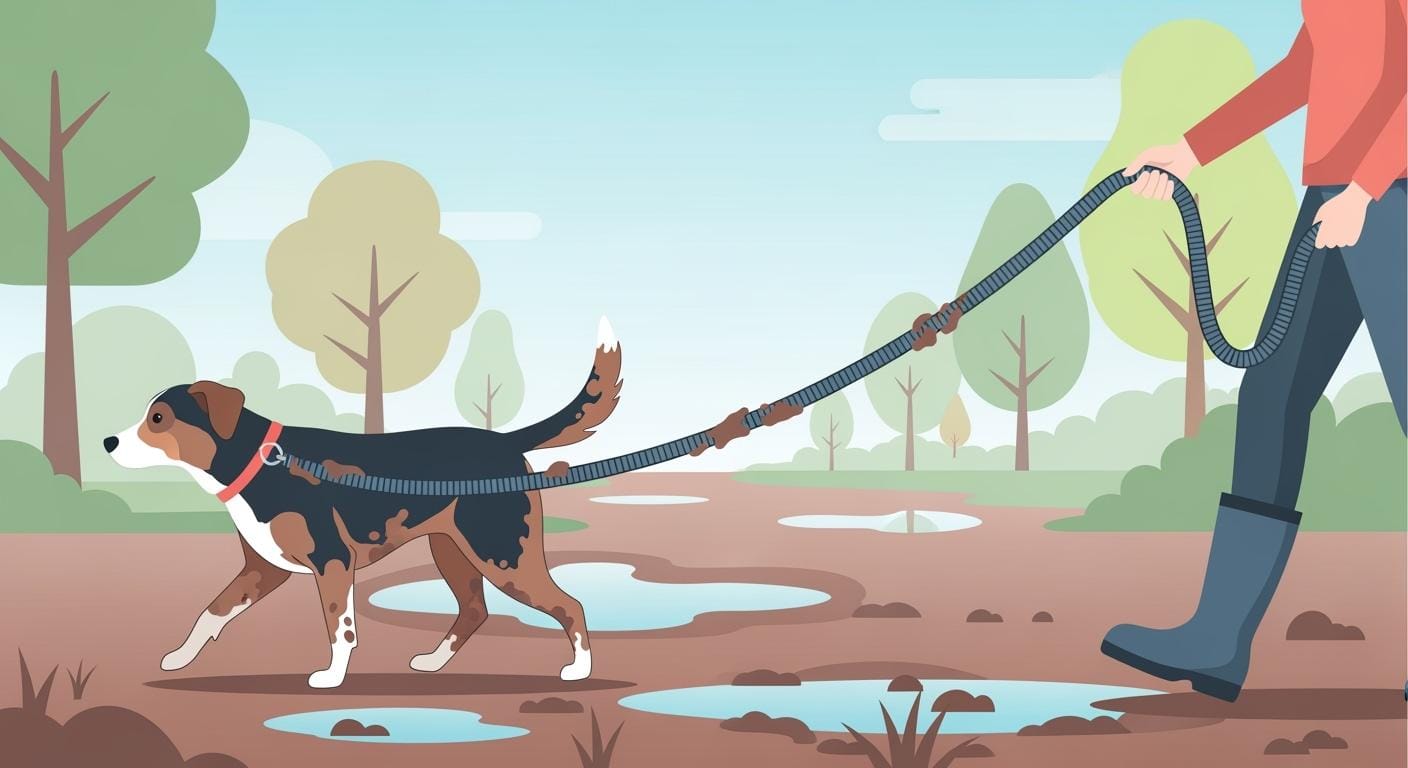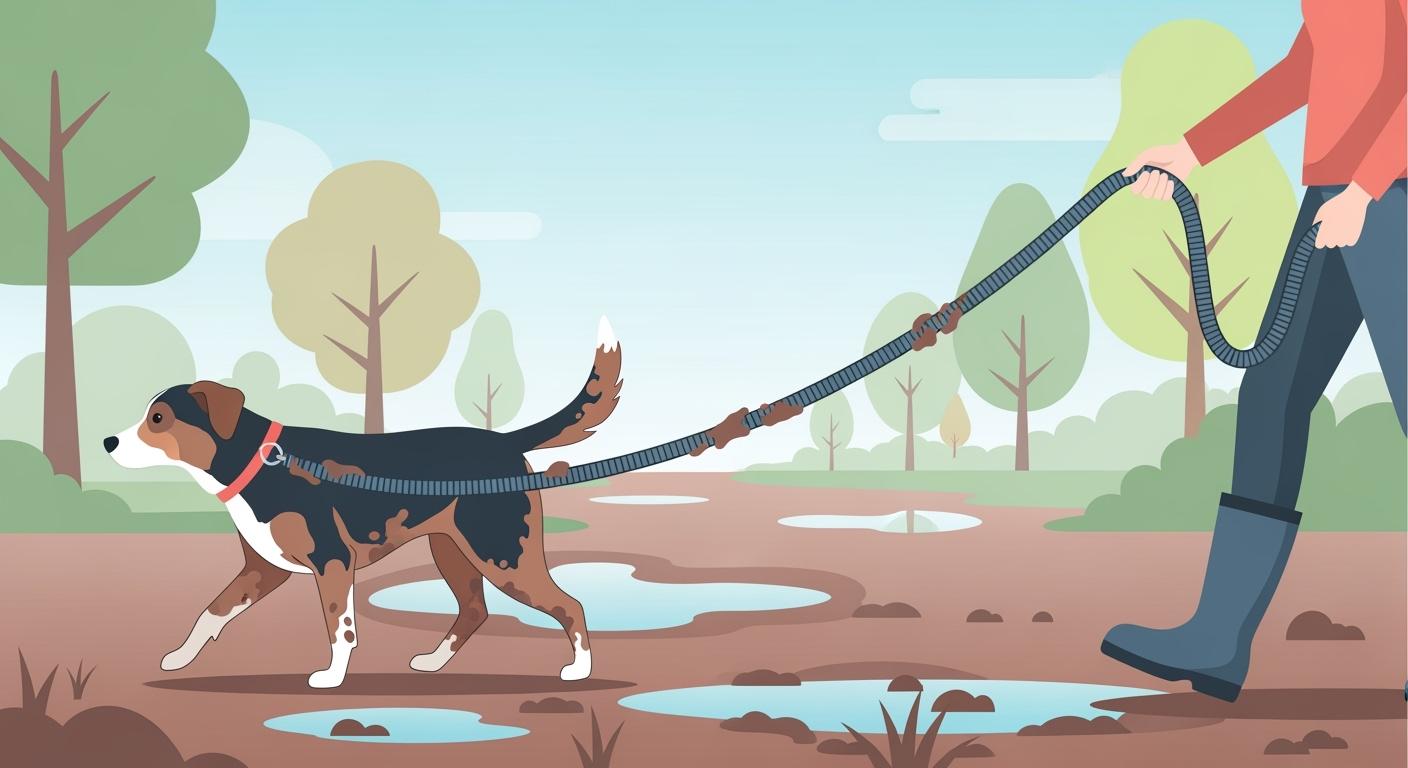
A leash that works fine on dry pavement can fail completely on a muddy trail. The difference is not about brand or price. It comes down to two design choices: how smooth the webbing surface is, and how few places the construction gives mud a place to hide.
Mud is not just wet dirt. It is a suspension of fine particles in water, and those particles are small enough to work their way into fiber gaps, seam pockets, and clip joints. Once inside, they stay there. They dry, harden, and abrade the material from within. A leash built for sidewalks never accounts for this. A leash built for trails has to.
The design features that matter most are not the ones advertised on hang tags. They are the ones you notice five minutes into rinsing a leash after a wet hike—or the ones you curse when you are still scrubbing ten minutes later.
Why Muddy Trails Test Leash Design Differently Than Pavement Walks
Mud Penetrates Where Water Only Wets the Surface
Water beads up on most leash webbing and evaporates. Mud does not. The fine particulate load in trail mud—silt, clay, decomposed organic matter—creates a paste that fills the voids between woven fibers. On rough or textured nylon, each fiber intersection becomes a mechanical anchor point for dried mud. The particle-to-fiber bond is weak individually, but across thousands of contact points across a 6-foot leash, the collective adhesion makes rinsing ineffective without scrubbing.
This is the physical mechanism that separates easy-clean leashes from the rest: smooth-surfaced webbing presents fewer anchor points. Water sheets across the surface instead of channeling into fiber valleys, carrying particles away rather than pushing them deeper. Materials like coated nylon, polypropylene, and dense polyester blends exploit this principle. Their surface energy is low enough that the water-mud slurry cannot establish the capillary grip it needs to stay lodged in the weave.
Leather fails here outright. Its porous grain structure absorbs moisture and swells, then cracks as it dries unevenly. Standard uncoated nylon fares little better—its hydrophilic tendency pulls water and dissolved silt into the fiber core, where drying takes hours and odor-causing bacteria find a damp, dark habitat. The same material choices that determine leash durability also determine how much mud stays behind after a rinse.
Grit Accelerates Wear at Specific Stress Points
Trail mud often carries angular mineral particles—sand, crushed rock fragments, crystalline clay platelets. These act as a low-grit abrasive paste. When mud works into a clip joint or a D-ring swivel, every open-and-close cycle grinds those particles against the metal surfaces. The result is not instant failure but accelerated surface wear that introduces play into the mechanism, which then traps more grit in a compounding cycle.
Hardware shapes determine how much of this grit the leash retains. A clip with recessed spring housing and narrow clearances traps particles that a smooth, open-bodied design sheds. The difference is not just manufacturing tolerance—it is a deliberate choice between complex articulation and clean rinsability. Rust-resistant coatings help, but they are secondary. If the shape holds grit, the coating eventually wears through at the friction points regardless.
| Design Difference | Why It Matters | Main Limitation |
|---|---|---|
| Smooth, low-absorption webbing vs. rough textured nylon | Fewer fiber anchor points for mud particles; water sheets off instead of requiring scrubbing | Smooth webbing can feel slicker in hand when wet; a textured grip section may be needed near the handle |
| Simple open-body clip vs. complex multi-part hardware | Grit passes through instead of accumulating in recessed joints; fewer wear surfaces | Simpler shapes may lack辅助 locking mechanisms some users prefer for escape-prone dogs |
| Minimal flat-seam construction vs. thick padded layers | No mud pockets between stitched layers; water drains freely; dries in minutes not hours | Less padding under load; not ideal for handlers who grip the leash body directly during sudden pulls |
Webbing Materials That Change the Cleanup Equation
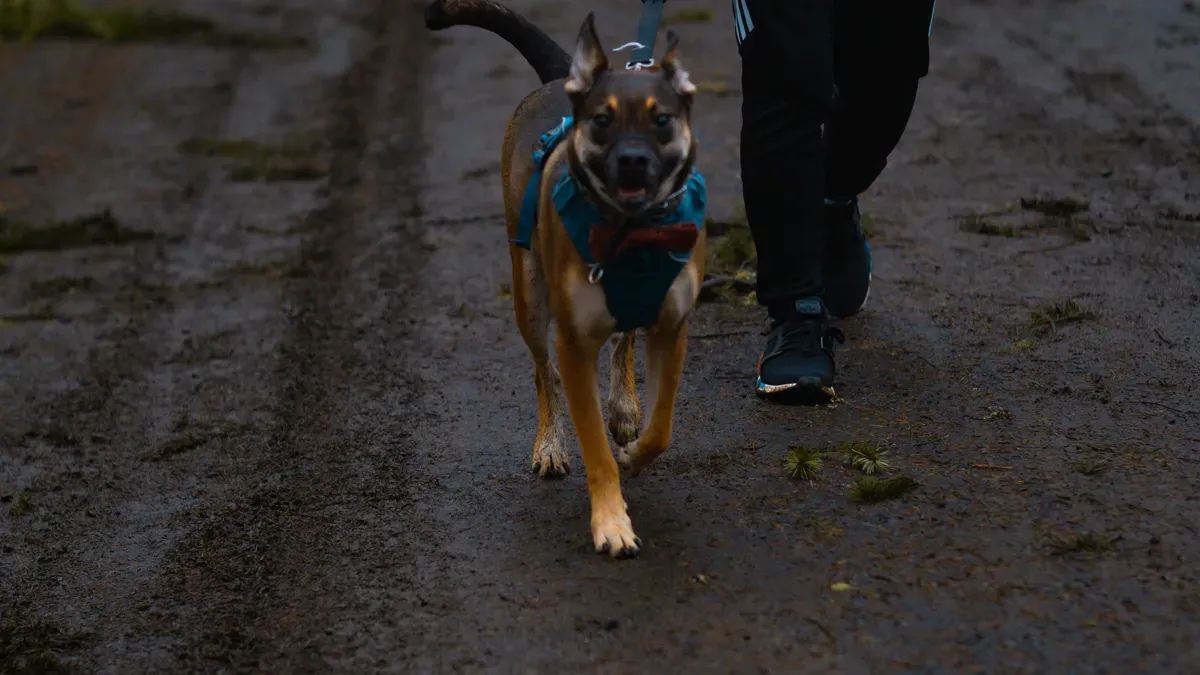
Not all webbing labeled “water-resistant” performs the same way under mud. The distinction that matters on trails is surface texture and absorption rate working together.
Polypropylene has the lowest moisture regain of common leash materials. It absorbs essentially zero water into the fiber itself, so mud dries on the surface as a brittle crust that cracks and falls away with a quick flex of the webbing. Coated nylon adds a polyurethane or silicone layer over the weave, sealing the fiber gaps that would otherwise trap silt. The coating is the active design feature—without it, the same nylon weave becomes a mud sponge.
Polyester blends land in the middle. They absorb less than uncoated nylon but more than polypropylene. Their advantage is dimensional stability: they do not stretch when wet, so a leash that fits comfortably dry will not turn into a different length after a creek crossing. This matters more than most people realize. Wet nylon can elongate enough to change the effective leash length and alter the dog’s turning radius.
In practice: After a muddy walk, rinse the leash under running water for 10 seconds and hang it. Check back in 20 minutes. If the webbing still feels cool and damp to the touch, the material is holding water inside the fiber structure. If it feels dry or nearly dry, the surface-shedding design is working.
The same material properties that keep a leash functional in rain apply to mud—but mud adds the abrasive particle load that rain alone does not. A material that merely repels water but has a rough surface texture will still trap dried silt in its topography. Smoothness and low absorption need to work as a pair.
Construction Choices That Keep Mud From Hiding
Seam Density and Stitch Profile
Every seam on a leash is a linear mud trap. The thread stands proud of the webbing surface, creating a ridge that interrupts water flow during rinsing. On the upstream side of the stitch line, mud accumulates. On the downstream side, it washes cleaner. Multiply this by every seam on the leash—handle attachment, bungee housing, reflective strip borders, clip anchoring—and the total mud-holding capacity of the construction becomes significant.
Flat, reinforced stitching with a low-profile thread reduces this effect. The stitch sits closer to the webbing plane, so water carrying mud particles can flow over it rather than pooling against it. Bar-tack reinforcements at stress points concentrate thread density into a small area, which is structurally necessary but creates the densest mud traps on the leash. The design tradeoff is real: reinforcement points that extend leash life also extend cleaning time. A leash designed for trails minimizes the number of these points without eliminating the ones that prevent premature wear at high-stress locations.
Handle Padding and Bungee Sections
A padded handle absorbs mud-laden water like a sponge. Open-cell foam padding, common in comfort-grip handles, has exactly the structure that maximizes mud retention: interconnected voids that capillary action fills with whatever liquid is present. Once the water evaporates, the silt stays inside the foam matrix. Each wet-dry cycle deposits another layer.
Bungee sections introduce a different problem. The elastic core is typically sheathed in a woven outer layer, creating an annular gap between the stretch element and the casing. Mud works into this gap at both ends of the bungee section and resists rinsing because water flowing over the outside of the sheath does not reach the interior. A simpler bungee design—shorter section, tighter sheath fit, sealed ends—reduces the inaccessible volume where mud can accumulate. The difference between a bungee leash that cleans easily and one that does not often comes down to these sheath-end details, not the elasticity rating.
Disclaimer: The handle and bungee observations above assume a short-coated dog walking on clay-based mud. Sandy trail soils drain faster and leave less residue in foam and elastic folds. If you primarily walk on sandy or gravel trails, even padded handles tend to dry acceptably fast—the moisture retention problem is most acute with high-clay soil that forms a paste.
Hardware Shape and Rinsability
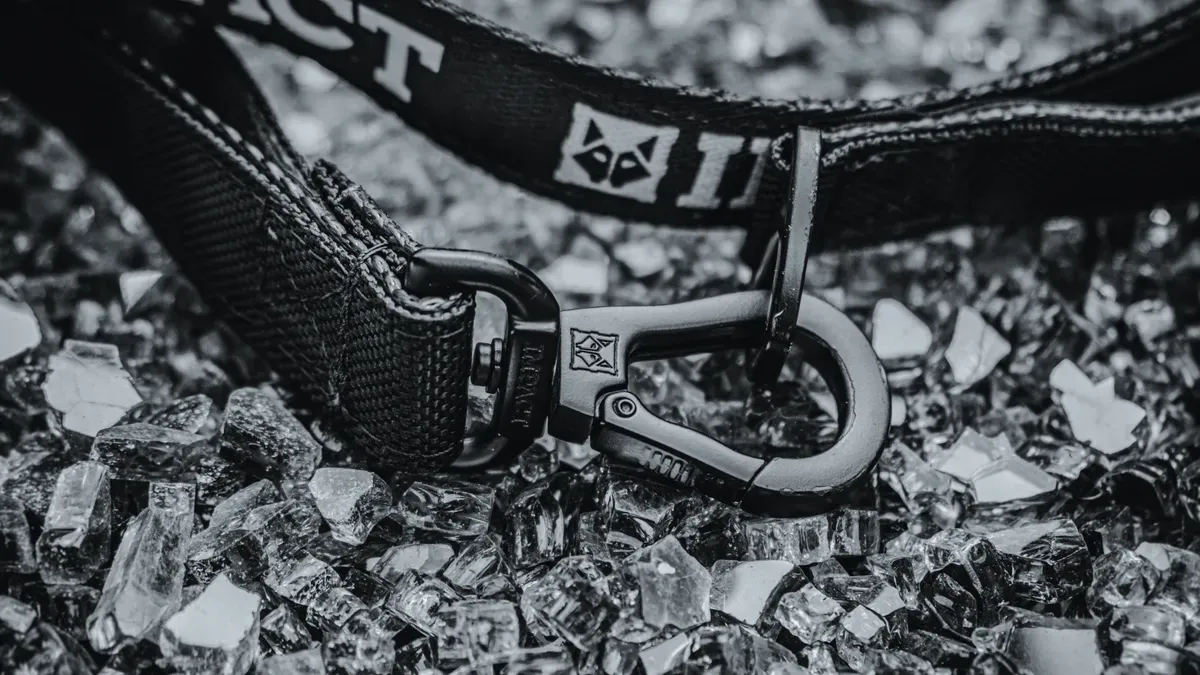
A snap hook with a simple open curve and an exposed spring rinses clean in seconds. A clip with a shrouded mechanism, multiple pivot points, and narrow internal clearances does not. The physics is straightforward: water must reach every surface that mud can reach. If the hardware geometry blocks line-of-sight water access to an internal cavity, that cavity will accumulate dried mud over repeated uses.
Rust-resistant coatings extend hardware life, but they do not change the rinsability of the shape underneath. Stainless steel and coated zinc alloys both resist corrosion, yet a complex stainless clip still jams faster with mud than a simple coated clip—the failure mode shifts from rust to mechanical grit-lock, but the outcome is the same: a clip that stops operating smoothly.
Walk ten minutes on a muddy trail, then try rinsing the clip under a running faucet for five seconds without scrubbing. If the clip opens and closes smoothly after that—no grit-grind feel, no stick-tion mid-travel—the hardware shape is doing its job. If it catches or grates, grit has already found the internal clearance.
| Where It Works | Where It Falls Short |
|---|---|
| Smooth webbing on clay-trail mud: particles slide off with minimal rinse pressure | Smooth webbing on oily or sticky mud (wetland trails): surface tension holds the film; needs soap |
| Minimal seams for weekend hikers who rinse gear at home: fast dry, no odor buildup | Minimal seams for daily urban walkers in wet weather: salt and road grime are finer than trail mud and penetrate tighter clearances |
| Simple hardware on forest trails: leaf litter and loam rinse out easily | Simple hardware in sandy conditions: fine sand is more abrasive than clay and accelerates pivot wear even in open shapes |
| Unpadded handles for short-coated breeds in wet conditions: dries fast, no funk | Unpadded handles for handlers with grip strength issues: the comfort tradeoff is real and may outweigh cleanup speed |
When a Mud-Ready Leash Is Not the Right Choice
A leash built to shed mud prioritizes smoothness, minimalism, and fast drying. That set of priorities leaves some use cases underserved.
If the dog is a sudden lunger—a young, strong breed still learning loose-leash walking—the shock load from a surprise pull travels directly through a minimally padded handle into the handler’s hand and wrist. The same thin, quick-dry construction that rinses clean in seconds transmits peak force more directly than a cushioned grip would. A properly fitted harness with a front attachment point changes the force equation enough that handle padding becomes less critical, but the leash itself still needs to manage the impulse.
Hands-free leashes worn around the waist introduce a different set of mud-exposure dynamics. The leash body runs closer to the ground on downhill sections and passes through brush that transfers mud directly onto the webbing. The waist belt attachment point accumulates mud from the handler’s own clothing and hands. These leashes need the same smooth-webbing and simple-hardware principles applied across more connection points—and maintaining consistent control through varied terrain depends as much on leash design as on harness choice.
Reflective detailing deserves a specific note. Built-in reflective threads woven directly into the webbing survive mud and rinsing far better than applied reflective strips, which can delaminate at the edges after repeated wet-dry cycles. But woven-in reflective threads have lower retroreflectivity than applied tape. On a truly dark, muddy trail at dusk, that brightness gap is real. Check reflective visibility after cleaning by shining a headlamp at the leash from 20 feet away in a dark room. If the reflected glow is visible but dimmer than expected, the reflective material is present but may not meet the brightness needed for roadside visibility.
Disclaimer: This mud-ready design analysis assumes typical temperate-forest trail conditions with clay-loam soil. Desert trails with high-silt dust create a different failure mode—fine particulates that work into hardware clearances as a dry abrasive, without water to flush them out. In those conditions, periodic disassembly and dry-brush cleaning of clip mechanisms matters more than webbing material choice. Double-coated breeds may also transfer more mud from their own coat onto the leash, which means even the best-shedding webbing faces a higher mud load than it would with a smooth-coated dog.
FAQ
Why does my nylon leash still smell after rinsing?
Uncoated nylon absorbs water into the fiber core, carrying dissolved organic matter from mud with it. Surface rinsing removes visible dirt but leaves bacteria-harboring residue inside the fibers. A coated or polypropylene webbing avoids this because the mud never enters the fiber structure in the first place.
Are bungee leashes worse for muddy trails?
Not inherently worse, but they have more dirt-trapping interfaces—the sheath-to-core gap, the end seals, any fold-over construction at the attachment points. A bungee leash with tight sheath fit and sealed ends performs close to a standard leash. One with loose casing and open ends will hold mud in places you cannot see or reach with a rinse.
How often should hardware be checked after muddy walks?
Open and close the clip after every muddy outing, even after rinsing. If you feel any grit-grind sensation—a scratchy resistance mid-travel rather than smooth spring action—particles are still lodged in the mechanism. Flush the joint with running water while cycling the clip open and closed. Do not lubricate; oil attracts more grit.
Does a waterproof leash work better than a quick-dry leash in mud?
They address different parts of the problem. A truly waterproof leash (fully sealed surface, often biothane or heavy coated webbing) prevents mud from reaching the fiber core entirely and can be wiped clean. But sealed surfaces are often heavier and stiffer. A quick-dry uncoated synthetic sheds water fast but may still trap fine silt in surface texture. For most muddy trail use, a smooth-faced coated webbing splits the difference best: near-waterproof surface behavior with the flexibility of textile construction.