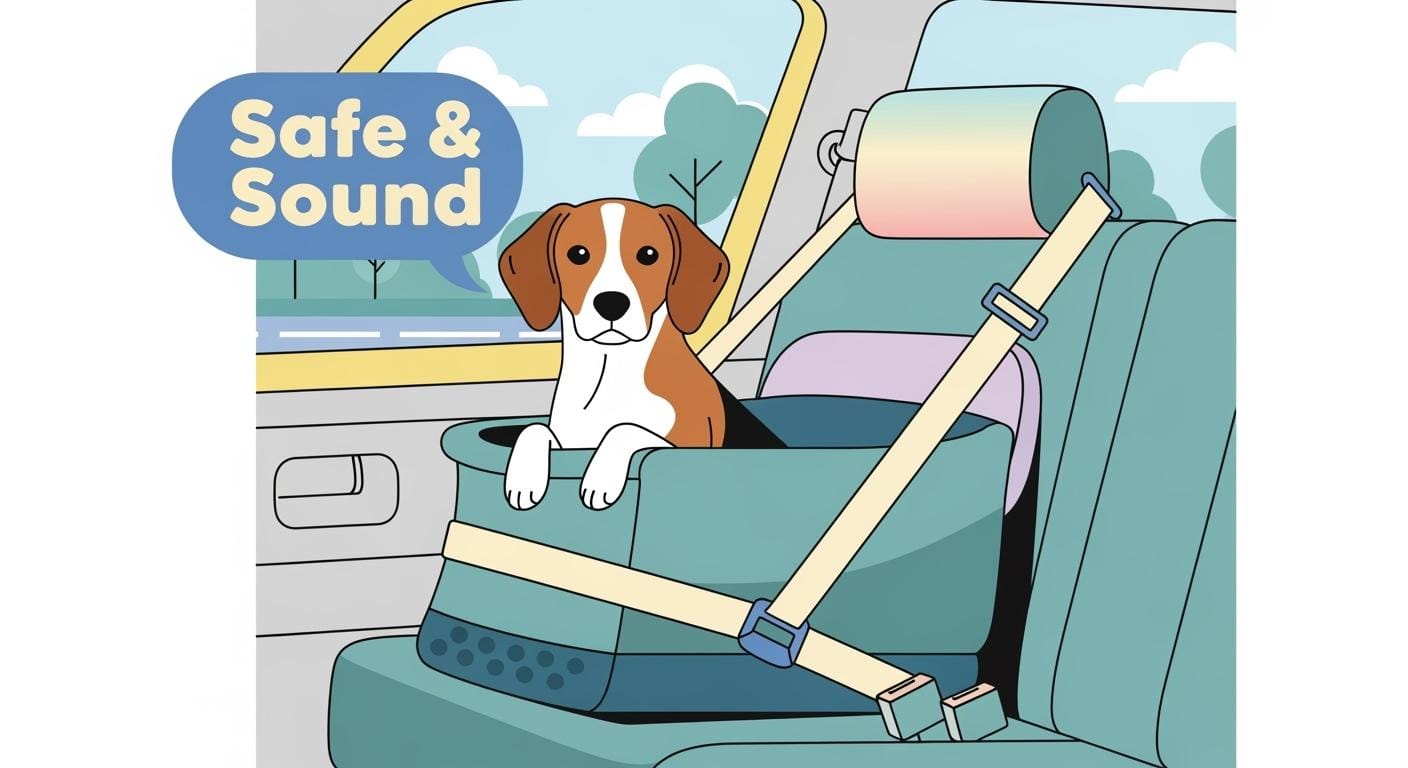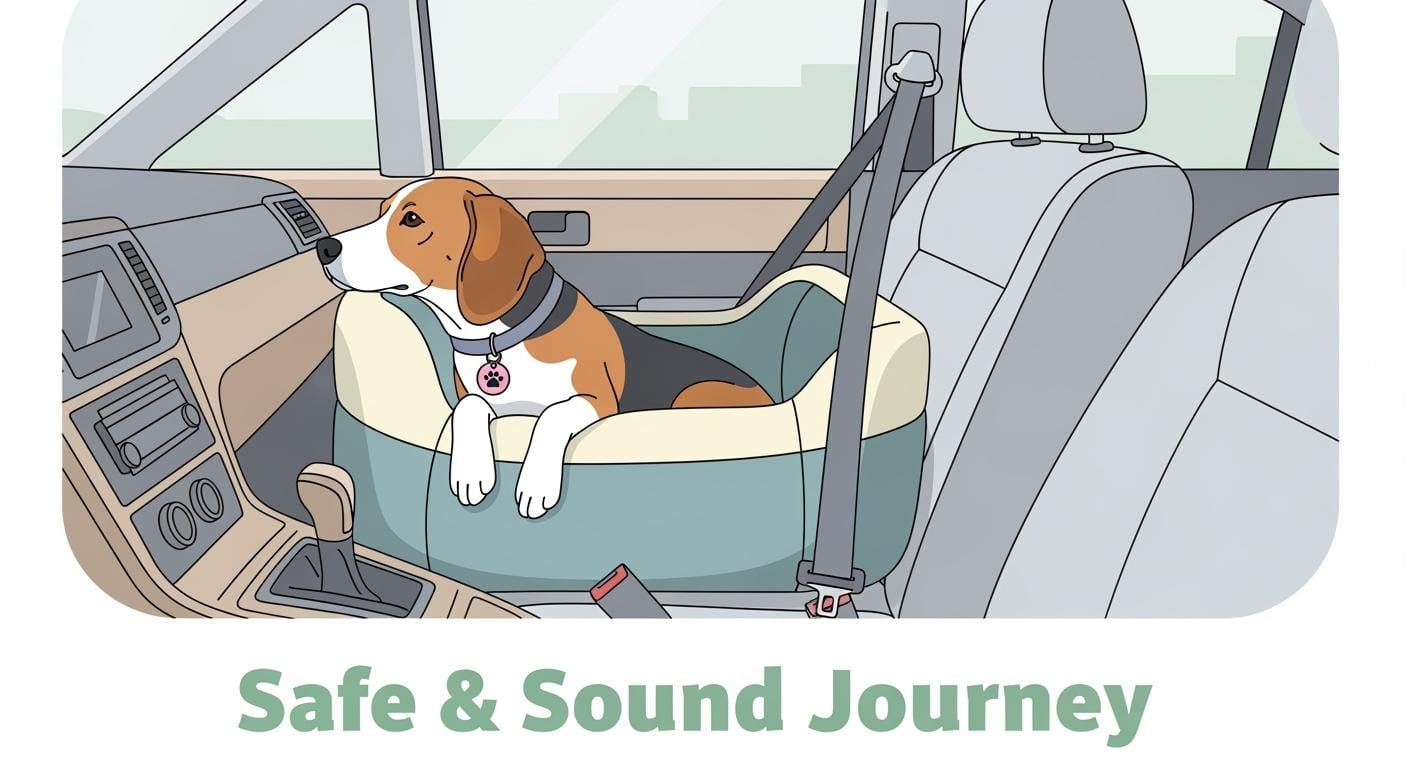
A non-slip bottom on a dog car seat sounds like it should solve everything. Press it into the vehicle seat, the textured backing grabs hold, and the seat stays put. That is how it looks in the product photo. On the road, with a live dog shifting weight through every turn and stop, a grippy bottom alone is not enough. The seat still slides forward under braking. It still tilts sideways when the dog leans. The non-slip material did its job — it just was never the whole job.
The real question is not whether the bottom is non-slip. It is whether the base is wide enough to create a meaningful moment arm against the forces that act on the seat during a drive, and whether the internal structure is rigid enough to keep the contact patch flat against the vehicle seat under load. Those two things — footprint and stiffness — matter more than how grippy the bottom fabric feels to the touch.
Why a non-slip bottom still lets the seat slide or tip
During hard braking, the entire car decelerates — the vehicle seat, the dog car seat, and the dog inside it. The deceleration force acts through the seat’s center of mass, which sits well above the base, close to where the dog rides. A narrow base gives this force a short lever arm to work against. Even moderate braking creates enough rotational torque to lift the rear edge of the seat. The non-slip bottom, which was designed to resist sliding, cannot resist rotation — that requires a longer moment arm, and a moment arm comes from base width, not from grip.
This physics chain — braking force through a high center of mass against a short base → torque → rear-edge lift → the grip patch peels away starting at the lifted edge — is why a seat with a narrow non-slip bottom can still tip forward. Once the rear edge lifts, the contact area shrinks, grip falls off sharply, and the seat begins to slide. The failure is not in the material. It is in the footprint.
Where sideways movement comes from
Turning creates lateral forces that push the seat sideways. A narrow base concentrates those forces onto a small contact patch, which means higher pressure per square inch and less resistance to sliding. On smooth vehicle seats — leather, vinyl, faux leather — the problem compounds because there is less surface texture for even a grippy bottom to key into. The seat can walk sideways through a long sweeping turn, a few fractions of an inch at a time, until the base is no longer centered on the vehicle seat.
Side structure plays a role here too. If the side walls are soft and collapse when the dog leans into a turn, the base angle changes — the outer edge lifts, the inner edge digs in, and the effective contact patch tilts. The wider the base and the more rigid the side panels, the more that lateral force gets distributed across the full footprint instead of concentrated at one edge. When comparing designs, the difference between a narrow booster that tips and a wide one that stays planted often comes down to whether the base extends far enough beyond the dog’s center of gravity to act as a counterbalance during turns.
Soft bases that compress into a tilt
A soft base feels forgiving to the hand, but under a dog’s weight it behaves differently. When the dog stands or shifts, the foam or padding compresses unevenly — the loaded side sinks, the unloaded side stays high, and the base tilts. That tilt reduces the effective contact patch: instead of the entire non-slip bottom pressing flat against the vehicle seat, only the compressed edge makes firm contact. Grip drops because grip depends on full, even contact.
A rigid floor panel — typically a stiff board sewn into the base or a molded semi-rigid insert — prevents this. It distributes the dog’s weight across the full footprint and resists localized compression. The result is a base that stays flat and keeps the non-slip backing engaged across its entire surface, even when the dog stands up or leans. This is one of the structural details that separates a car seat designed to resist sliding from one that relies on grip alone.
In practice: Press down firmly on the center of an uninstalled booster seat base. If the bottom compresses by more than roughly half an inch under hand pressure, it will compress further under a dog’s full weight during a stop — and each compression cycle walks the seat a little farther out of position.
Strap routing that ignores the base
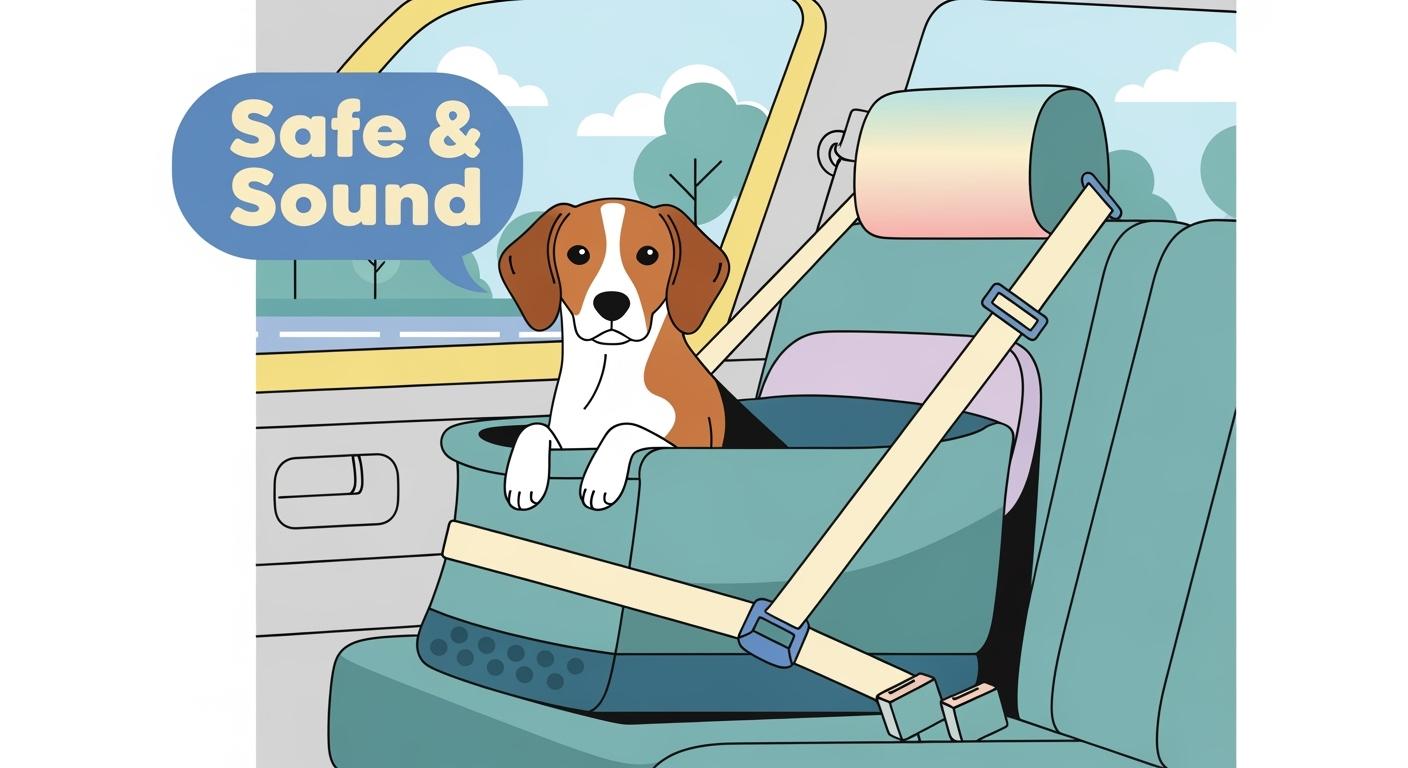
Many dog car seats use a single strap that wraps around the back of the vehicle seat. That strap holds the upper portion — it prevents the seat from tipping forward as a whole unit. But it does nothing to pull the base down into the vehicle seat. During braking, the base can still lift or slide forward independently of the backrest. The strap and the non-slip bottom operate in parallel rather than together.
A more effective routing pulls the base downward into the vehicle seat, creating compression that amplifies what the non-slip backing can do. The strap angle matters as much as the strap position. If the anchor pulls straight back, the base is free to shift. If it pulls down and back at the same time, it preloads the base against the vehicle cushion — and that preload, combined with a wide rigid base, is what keeps the whole seat steady through consecutive stops. The right installation approach turns the strap from a tether into a stabilizer.
What structure actually keeps a car seat stable on daily drives
Wider footprint, longer moment arm
The wider the base, the longer the moment arm resisting rotation around any edge. That is straightforward lever physics. When braking force pushes the seat forward at its center of mass — roughly at dog height — a wide base means that force has to travel farther to reach the front pivot edge. More distance means more resistance to rotation. A short, square base puts the pivot point nearly under the dog, where even modest deceleration can tip the seat. A rectangular base that extends farther forward and backward lengthens that moment arm in the direction braking forces actually travel.
On smooth vehicle seats like leather or vinyl, the wider footprint also increases the total friction area. Even if the coefficient of friction is low — these surfaces offer little texture for the non-slip backing to key into — more square inches of contact means more total grip. A folding car seat with a thoughtfully proportioned base uses that extra area to compensate for what slick upholstery takes away.
Note: After a 10-minute drive with a few normal stops, park on level ground and check whether any corner of the booster seat base has shifted more than an inch from its starting position. Movement at just one corner often signals a base that is too narrow for the forces it is seeing — grip is not the issue, leverage is.
Rigid internal floor panel
Fabric and foam alone cannot resist the compressive forces from a dog’s weight during a stop. A rigid floor panel — typically a stiff board or a molded semi-rigid insert — spreads the load across the full base footprint and prevents the localized sinking that starts a tilt. When the floor does not deform, the non-slip backing stays fully engaged. When it does deform, the contact patch shrinks, grip drops, and the seat enters the slide-and-tilt cycle described earlier.
This matters even more for dogs that stand up or shift frequently during drives. Each weight shift compresses one side of a soft base, and each compression is a chance for the seat to walk a few millimeters in the direction of the tilt. Over a 20-minute drive, those millimeters add up. A rigid floor panel eliminates the compression variable — the base stays flat regardless of where the dog’s weight is, so the non-slip backing works the same way through the whole trip. This is also why some booster seats feel cramped even when the measurements match: if the base deforms, the usable flat area shrinks and the dog ends up perched on a slope.
Side structure that resists roll
When a dog leans into a turn, the load shifts to the outer side wall. If that wall is soft and collapses, the base angle changes — the inner edge lifts, the outer edge digs in, and the seat begins to roll. A rigid side panel resists that collapse, keeping the base flat and the non-slip backing engaged across the full footprint.
This is not about making the walls tall or bulky. It is about making them stiff enough to hold their shape under lateral load without crowding the dog. Press on the side of an uninstalled seat. If it folds inward with light pressure, it will fold more under the dog’s weight during a turn — and each fold is another degree of base tilt that reduces grip. The side structure does not need to be armor. It just needs to not be the weakest link in the stability chain.
Strap angle that compresses the base
The difference between back-only strapping and strapping that stabilizes the base comes down to angle. A strap routed straight back to the headrest holds the upper portion of the seat and prevents the whole unit from tipping forward. But the base can still lift, shift, or rotate independently. A strap routed at a downward angle — anchored lower, or passing through a base-level routing point — pulls the base into the vehicle seat cushion, preloading it with compression. That compression increases the normal force between the non-slip bottom and the vehicle seat, which directly increases friction.
This is why installation matters as much as design. A well-designed strap system with base-level routing points makes it easy to achieve the correct angle. A poorly designed one — where the only anchor point is at the top of the seat back — leaves the base to fend for itself. In daily use, the difference between a seat that stays put and one that creeps forward is often visible in how the strap angles down toward the anchor rather than running flat across the backrest.
Bottom material that grips without sacrificing washability
The bottom surface needs two things that often work against each other: enough texture to grip the vehicle seat, and a surface that can be cleaned without losing that grip over time. Rubberized non-slip backings — the kind with a slightly tacky, textured feel — tend to hold better on smooth seats than fabric bottoms. Fabric bottoms can grip well on cloth vehicle seats but slide on leather or vinyl.
Polyester waterproof fabrics balance these needs reasonably well. They resist stains, wipe clean, and can be produced with a textured finish that adds friction. Heavy-duty canvas offers more natural grip from its weave structure but takes longer to dry after washing and may hold odors. Neither material is universally better — the right choice depends on the vehicle seat surface and how often the cover needs deep cleaning. The key is that the bottom material maintains its surface texture after repeated washes. Some non-slip coatings break down with detergent exposure and become progressively slicker. A car seat cover that grips well on day one but slides by month six is worse than one with moderate grip that holds steady over time.
| Design Difference | Why It Matters | Main Limitation |
|---|---|---|
| Wide base footprint | Longer moment arm resists braking torque; more contact area increases total friction | May not fit deeply contoured bucket seats where the base overhangs the bolsters |
| Rigid internal floor panel | Prevents localized compression that tilts the base and shrinks the effective contact patch | Adds weight and bulk; less “cushy” feel for dogs that prefer soft surfaces |
| Base-anchoring strap angle | Pulls the base down into the vehicle seat, increasing normal force and friction | Requires compatible anchor points; some vehicle seats lack accessible lower anchors |
When this design works — and when it does not
A wide, rigid base with good strap routing works best on relatively flat vehicle seats where the entire base can make contact. Cloth seats amplify the benefit because the fabric provides additional mechanical grip that the non-slip backing can key into. Sedans, crossover rear benches, and vehicles with modest side bolsters tend to give the base enough flat area to work with.
The design advantage shrinks in two conditions. First, deeply contoured bucket seats — the kind with aggressive side bolsters that angle sharply upward — may leave parts of a wide flat base hovering above the seat surface. If the base cannot make full contact, the non-slip area effectively shrinks to whatever portion touches the seat. Second, very short trips with frequent on-off cycles — running multiple errands — can test the strap installation more than the base design, because the seat gets unbuckled and rebuckled each time and small installation variances compound.
Disclaimer: The stability checks described here assume a booster seat secured with both a headrest strap and a seatbelt routed through the designated path. If your vehicle seat has sharp side bolsters that prevent the base from making full contact, check each corner individually — if a corner hovers above the seat surface, add a thin non-slip mat underneath to fill the air gap. A wide base that only makes 70% contact is not much better than a narrow base that makes 100%. Also, this guidance assumes a smooth-coated dog; double-coated breeds that shed heavily can deposit enough hair on the vehicle seat over time to reduce the non-slip backing’s effectiveness, so check the contact surfaces before each trip.
FAQ
What size dog car seat should you choose?
Measure your dog from the base of the neck to the base of the tail for length, and take the chest girth at the widest point. Check the seat’s internal floor dimensions rather than the exterior measurements — exterior dimensions include wall thickness and padding that shrink the usable space. The dog should be able to sit without the head pressing against the top and turn around without the shoulders wedging against the sides.
How do you keep a dog car seat from sliding on leather seats?
Choose a seat with the widest base that fits your vehicle seat — more contact area compensates for the lower friction of leather. A rubberized non-slip backing grips slick surfaces better than fabric bottoms. Route the strap so it pulls the base down into the seat at an angle, not straight back. After installation, grip the base at each corner and try to slide it sideways; movement of more than an inch at any corner means the base is not fully engaged with the vehicle seat surface.
Can you wash a dog car seat with a non-slip bottom?
Most have removable covers that can be machine washed on a gentle cycle with mild detergent. Air dry rather than machine dry — heat can degrade rubberized non-slip coatings and cause shrinkage that affects fit. Harsh detergents and fabric softeners can also break down non-slip backing over time, so check whether the bottom surface still feels tacky or textured after the first few washes.
Is a booster seat safe for all dog breeds?
Booster seats work best for small and medium-sized dogs — typically under 20 to 30 pounds depending on the seat’s weight rating. Large breeds may exceed both the weight limit and the floor dimensions. Even if the weight checks out, a dog that cannot sit without the shoulders pressing against the side walls is too large for that seat. Use a harness with a seatbelt tether rather than relying on the booster seat walls alone for restraint during sudden stops.
Why does a non-slip dog car seat still tip when the dog stands up?
Standing shifts the dog’s weight to a smaller contact area — typically the front paws — which concentrates the load near the front edge of the base. If the base is narrow or the internal floor is soft, that concentrated load compresses one area, tilts the seat, and reduces the non-slip backing’s contact patch. A wider base with a rigid floor distributes that front-loaded weight across more surface area and resists the tilt. After a drive where the dog stood up frequently, check whether the front edge of the seat has crept forward or whether one corner sits higher than the others — both are signs the base is deforming under point loads rather than distributing them.