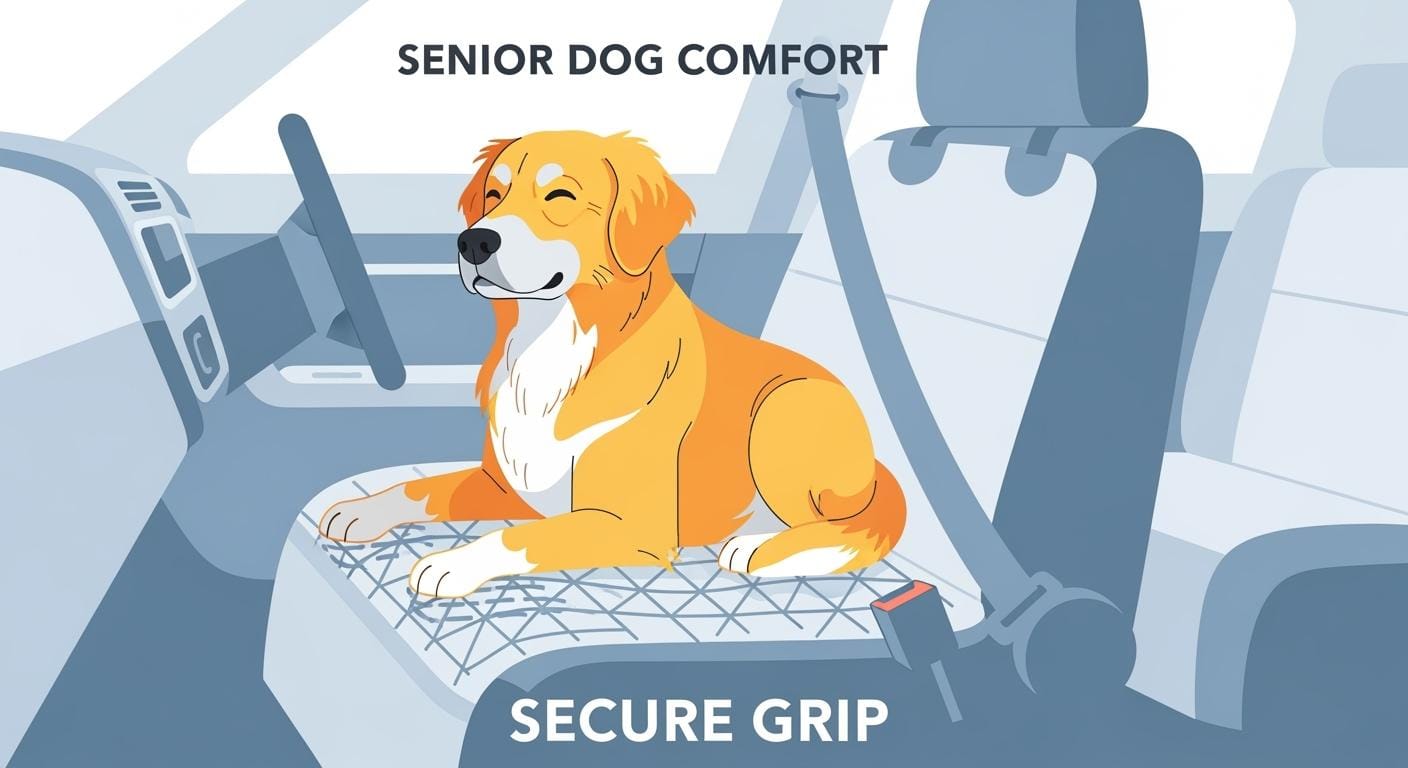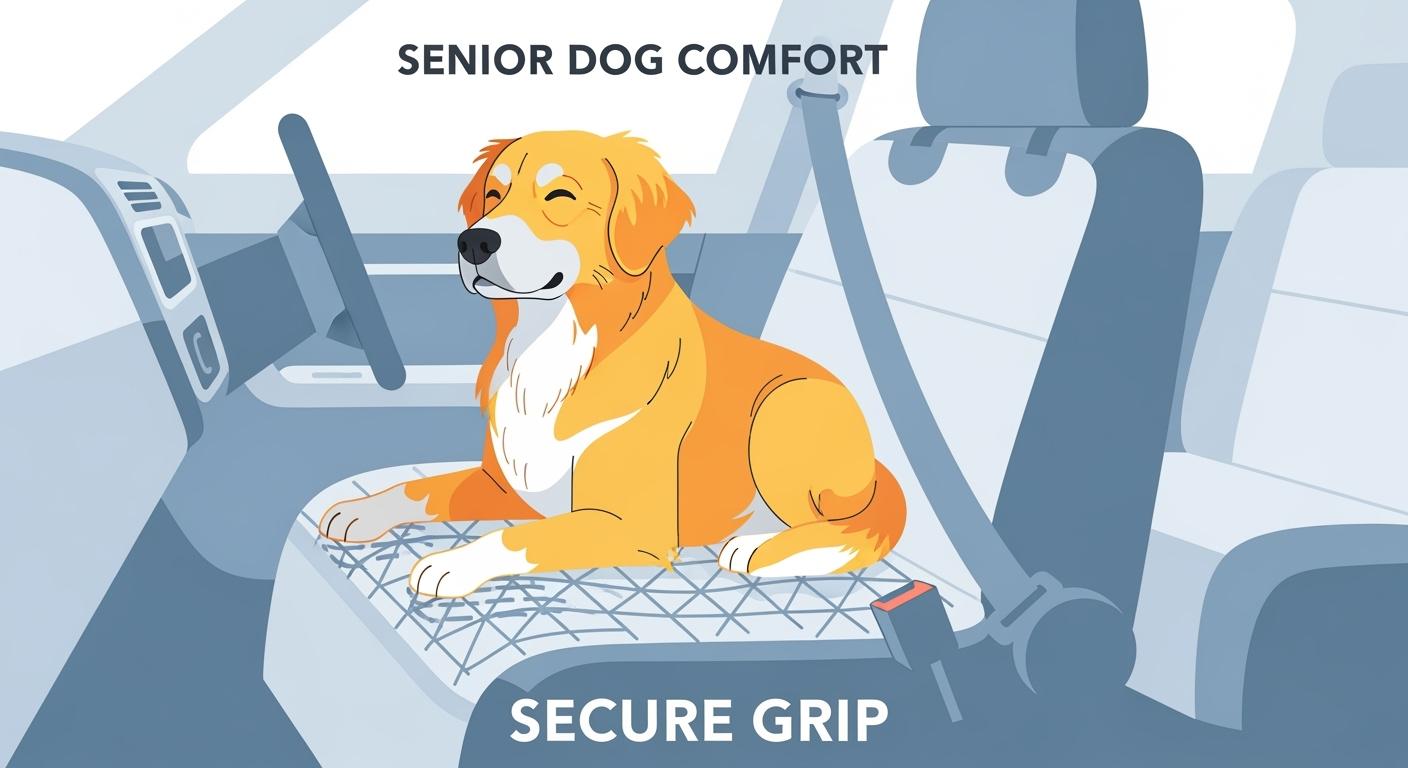
A dog car seat cover either creates traction or it takes it away. For a senior dog, that difference is not subtle. Older dogs push off with less muscle strength, feel joint pressure sooner, and correct balance more slowly. A cover that slides under their paws turns an already challenging entry into something they learn to dread. The right surface, by contrast, gives them a platform they can read before they commit their weight — and that changes the whole experience.
What makes one cover grip and another slip comes down to four design layers: the surface texture the paw touches, the padding density under it, the rigidity of the base that holds shape, and the backing that grips the car seat. Each layer either works or it does not. When one fails, the dog compensates. Senior dogs compensate poorly.
Why Standard Car Seat Covers Work Against Senior Dogs
The Surface Friction Gap
Most car seat covers use a smooth waterproof top layer. That surface protects the seat underneath, but it creates a low-friction interface against a dog’s paw pads. When a senior dog steps up, the horizontal force vector from the push-off leg meets a surface that cannot return enough static friction. The paw slides backward. The dog’s proprioceptive system registers the slip and triggers a reflexive muscle clamp — shoulders tense, the spine stiffens, the dog freezes mid-step.
That reflexive stiffening is what turns a routine entry into a struggle. A young dog absorbs the slip and repositions. A senior dog with reduced muscle mass and slower neural feedback cannot correct fast enough. The slip registers as a threat. The next time, the dog hesitates before even trying.
Textured surfaces solve this at the material level. Raised dot patterns, quilted stitching lines, and rubberized grip patches create mechanical interlock — the surface pattern physically engages the ridges on the paw pad rather than relying on surface-on-surface friction alone. This matters because seat cover stability starts with what the paw touches first — not the straps, not the anchors, but the top millimeter of surface material.
Tip: Run your palm across a cover before buying. If your hand slides with light pressure, a senior dog’s paw will slide under full body weight — the surface fails the friction test before the dog even enters the car.
Padding That Fails Two Ways
Thin padding fails by not padding at all. A 3mm foam layer compresses to nothing under a 50-pound dog, so the dog feels the hard seat pan through the cover. For a senior dog with osteoarthritic joints, that hard stop at the bottom of each step sends impact up through the carpals and into the elbows and shoulders. The dog learns to step gingerly, and a ginger step on a moving surface is an unstable step.
Overly soft padding fails differently but just as badly. When the foam has no rebound resistance, the paw sinks in and the dog’s weight shifts unpredictably as the material compresses unevenly. A sinking surface is a moving surface. Senior dogs, already fighting reduced proprioceptive acuity, cannot micro-adjust to a pad that keeps changing shape under them. They stiffen up. They wobble. They look for a different spot that never comes.
Moderate-density padding — firm enough to resist full compression but compliant enough to round off the hard edges of the car seat — is the design sweet spot. Combined with a rigid base layer, it creates what amounts to a portable stable floor. A hard-bottom cover design keeps the mat from bunching under lateral weight shifts, which is when most covers fail: not during the calm ride, but during the step-in and the turn-around.
When the Cover Moves Under the Dog
A cover that shifts is worse than no cover at all. At least the bare car seat is predictably slippery — the dog knows what to expect. A shifting cover is a moving target. The dog plants a paw, the mat slides half an inch, the dog’s balance system fires a correction, and now the dog is bracing against the cover instead of standing on it.
This is where non-slip backing becomes the load-bearing design choice. A tacky rubber or silicone backing layer converts the cover from a free-floating mat into a surface that is mechanically coupled to the car seat. The backing grips the seat upholstery. The top surface grips the paw. Between them, a rigid internal base prevents the middle of the cover from buckling when the two outer layers are under opposing shear forces. Getting the fit right from edge to edge closes the last gap — an exposed seat corner is where paws slip when the dog steps wide to find balance.
What Design Features Actually Create Traction
Surface Texture as a Friction Multiplier
A smooth cover and a textured cover can be made of the same base fabric, yet perform as if they were different products. The difference is surface geometry. Quilted stitching creates a grid of raised ridges. Rubberized dots create point-load grip zones. Woven textures create directional friction — more grip against forward-backward paw slide, which is the direction that matters during entry and braking events.
The mechanism is mechanical, not chemical. It is not that the material itself is grippier; it is that the raised pattern gives the paw pad something to push against beyond simple surface friction. Think of it as the difference between walking up a smooth ramp and walking up a ramp with shallow treads cut into it. The overall slope is identical. The foothold is not.
For a senior dog, that distinction is amplified. A younger dog can compensate for marginal grip by recruiting more muscle. An older dog with sarcopenia cannot. The surface either provides the grip, or the dog does without. There is no middle gear.
| Design Feature | How It Creates Stability | Main Limitation |
|---|---|---|
| Quilted or raised-dot top layer | Mechanical interlock with paw pad ridges; multiplies effective friction without requiring the dog to press harder | Deep grooves can trap dirt that reduces grip over time if not cleaned |
| Moderate-density foam padding | Cushions joint impact without sinking; resists full compression so the dog feels a consistent surface | Too firm for dogs under 10 lb who may not compress it enough to feel the benefit |
| Rigid internal base panel | Prevents bunching under lateral weight shifts; distributes load so no single point bottoms out | Adds folding bulk; less convenient for quick removal and storage |
| Rubber or silicone non-slip backing | Locks the cover to the car seat so the mat does not become a sliding surface under the dog | On some seat materials the grip can be too aggressive, making repositioning harder |
In practice: The most telling test is the step-in. Watch where the dog places the first paw. If the cover wrinkles or slides under that single-paw load, the backing or base rigidity is insufficient — no amount of top-surface texture will compensate for a mat that moves before the dog is even fully in the car.
Non-Slip Backing and the Anchor System
The backing layer does one job: it prevents the cover from becoming a sled. When a dog pushes off with the rear legs to climb in, the force vector includes a horizontal component that can slide an unsecured cover forward. On leather seats, the problem compounds — the seat surface is already low-friction, so the cover slides against the seat and the dog slides against the cover.
A rubberized backing increases the coefficient of friction between the cover and the seat. Headrest straps and seat anchors add a mechanical lock that backs up the friction grip. The two systems work together: the backing handles small shifts from the dog repositioning during the ride, and the anchors handle the larger forces from entry, exit, and hard braking. The same anchoring principles that keep a booster seat stable apply here — the difference is that a seat cover covers more area, so the consequences of anchor failure are spread across a wider surface. But the failure mode is the same: when the anchor lets go, the dog’s footing becomes unreliable.
Note: After installing a cover, grip the front edge and pull it toward you with moderate force. If it shifts more than an inch at the belt path before the anchors engage, the installation is too loose — a senior dog stepping in will feel that slack as instability.
Edge-to-Edge Coverage and Why Exposed Corners Matter
Most slipping does not happen in the middle of the cover. It happens at the edges — specifically the outboard edge near the door, where the dog places the first paw during entry. If the cover stops three inches short of the seat edge, that exposed strip of seat upholstery is the first thing the dog steps on. On leather or vinyl, that strip is slick. The paw slips. The dog scrambles. Confidence erodes before the dog even reaches the cover.
Edge-to-edge coverage eliminates that entry hazard. The cover extends to the seat bolsters on both sides and tucks into the seat crease at the back, leaving no exposed surface for a paw to misjudge. A flat, unwrinkled installation matters just as much — a bunched fold near the door edge acts like a small ramp that the dog must negotiate at an angle. Rear-seat covers designed with side flaps and door-panel protection close off the last gaps where a dog’s paw can find the seat instead of the cover.
When Traction Design Matters Most — And When It Does Not
Surface grip is not equally important for every dog on every trip. The design differences described here matter most when three conditions overlap: the dog is over seven years old or showing mobility decline, the car has leather or vinyl seats, and the trips involve frequent entry and exit — errand runs, vet visits, multiple stops.
They matter less when the dog is young and athletically sound, when the seats are cloth (which provides its own friction), or when the dog is lifted into the car and placed on the cover rather than climbing in independently. A young Labrador who bounds into the back of an SUV with cloth seats does not need the same level of surface engineering. The cover is primarily a dirt barrier in that scenario. Its traction specs are secondary.
This is not a defect of the design — it is a recognition that different use cases load different features. Traction-forward covers optimize for the senior-dog entry problem. They are not the universal best cover for every dog. They are the right cover when paw stability, not just seat cleanliness, is the primary requirement. Choosing a back-seat cover with a textured surface and rigid base makes the biggest difference for dogs that step in under their own power but no longer do it easily.
Disclaimer: The paw-slide checks described in this article assume a dog with normal paw pad texture. Dogs with hyperkeratosis, worn-down pads from years of hard-surface walking, or long paw fur that covers the pad surface may show less grip even on well-textured covers. For those dogs, run your hand across the cover surface to feel for slip under light pressure — visual paw-slide checks may underreport the friction problem. Similarly, dogs with barrel chests or very deep keels that shift their center of mass forward during entry may load the cover differently than the breed norms these design assessments assume. If the dog’s body type falls far outside typical proportions for its breed, supplement the surface checks with a hands-on stability test: press down on the cover at the point where the dog’s front paws typically land and verify the mat does not shift or compress fully to the seat beneath.
FAQ
Does a textured surface actually make a measurable difference for a senior dog?
It does, and you can verify it directly. Watch the dog’s first step onto the cover. On a smooth cover, a senior dog often does what trainers call a “double-tap” — the paw touches, slides slightly, lifts, and repositions before committing weight. On a textured cover, the first placement tends to stick. The dog reads the surface as stable and transfers weight in one motion. That single-step difference — no double-tap — is the texture working at the material level.
How do I know if the padding is the right density for my dog?
Press your thumb firmly into the cover surface. If your thumb bottoms out and you feel the base layer or the car seat underneath with less than 5 pounds of pressure, the padding is too soft for a dog over 30 pounds. If the cover barely yields at all under thumb pressure, it is too firm for a dog under 15 pounds — the dog will feel like it is standing on a hard bench. The right density gives about a quarter-inch of compression under firm thumb pressure and rebounds immediately when you release.
Will a non-slip backing damage leather seats?
Most rubberized and silicone backings designed for pet seat covers are non-reactive with automotive leather and vinyl. The risk is not chemical but mechanical — if grit or sand gets trapped between the backing and the seat, vibration during driving can cause micro-abrasion. Wiping down both the seat and the backing before installation removes the abrasive particles that cause most of the damage. A thin seat protector mat placed between the cover and the leather adds a sacrificial layer if the concern persists.
How often should I check the cover’s grip performance?
After every wash cycle and before any long trip. Dirt, dried slobber, and detergent residue all reduce the effective friction of the top surface. A quick palm-slide test across the main step-in zone tells you whether the grip is still there. If your hand slides with light pressure, wash the cover — or spot-clean the step zone — before the next trip with a senior dog.