A dog bed looks generous on the floor. The outer dimensions suggest plenty of room. But the question that determines whether a large dog actually uses it is narrower: what happens at the first step?
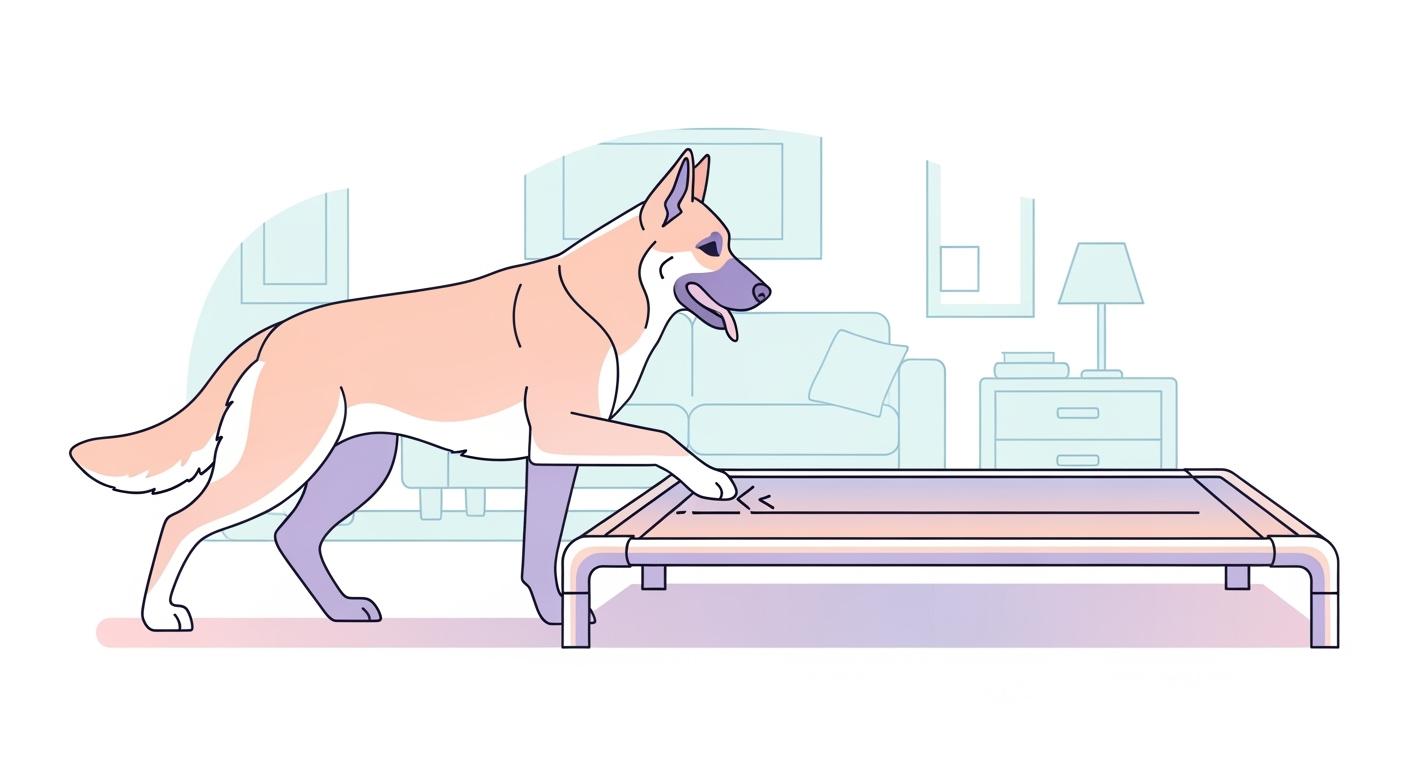
Large breeds do not hop into the center. They plant a paw on the edge, shift weight forward, then step in. If that edge buckles, the bed has already failed — before the dog ever reaches the cushion. The center could be the thickest orthopedic foam on the market. It will not matter.
This is not a comfort problem. It is a structural one. And the solution does not come from adding more fill. It comes from changing what holds the perimeter.
Why Soft-Edge Dog Beds Feel Unstable at First Step
The Mechanics of Edge Loading
When a large dog approaches a bed, the sequence is consistent: front paw contacts the edge, weight transfers forward, the second paw follows. The edge takes the full body weight momentarily before the dog reaches the center. For a 70-pound dog, that is roughly 70 pounds concentrated on a strip of fabric or foam perhaps two inches wide.
Soft bolsters and loose-fill beds handle this poorly. The fill shifts away from the pressure point. The fabric covering has no structural backing behind it, so it folds downward. The dog feels the floor through the bed — or worse, feels the edge tip and retreats.
Here is the causal chain that matters: a paw lands on unsupported fabric → the fill displaces laterally because it has no containment at the edge → the fabric loses tension and folds → the paw drops until it hits the floor or an internal seam → the dog registers instability and hesitates or abandons the bed. Each link in that chain is avoidable with a different frame design.
Steel-frame beds short-circuit this chain at the first link. The frame intercepts the load before it reaches any fill. For a closer look at how frame construction affects stability across floor types, the differences between a bed frame that grips tile versus one that drifts on wood come down to foot design and frame weight distribution.
| Failure Signal | Likely Design Cause | Better Design Direction |
|---|---|---|
| Edge folds under paw | Soft bolsters, loose fill | Steel frame, taut fabric |
| Bed tips when dog turns | Weak seams, uneven base | Balanced corners, firm joints |
| Dog avoids bed | Unstable step-on area | Non-slip feet, frame support |
How Large Dogs React to an Unstable Surface
You can read the bed’s stability in the dog’s behavior. A dog that trusts the surface walks straight on, circles once, and settles. A dog that does not pauses at the edge, tests it with one paw, pulls back, circles repeatedly, or bypasses the bed for the floor. Some dogs lie down with their head and shoulders on the bed and their hindquarters off — compensating for the part they do not trust.
These behaviors are not personality quirks. They are feedback about the bed’s edge structure.
Disclaimer: this check assumes a smooth-coated dog where paw placement is visible. Double-coated breeds may show subtler hesitation signals — watch for repeated circling without settling rather than visible paw-testing.
Confidence and the Surface a Dog Can Feel
Sleep quality in large breeds is tied to surface stability more than cushion depth. A dog that cannot trust the edge will not relax fully on the center. The nervous system stays partly alert — monitoring for the surface shift that happened last time. This is why some dogs prefer a hardwood floor over a plush bed: the floor is predictable.
A taut surface on a rigid frame removes that unpredictability. The bed feels the same every time. That consistency matters more than extra padding for dogs who have learned to distrust soft edges. The wider question of how much real sleep space a bed provides — separate from its labeled dimensions — is explored in the comparison of usable surface area versus outer measurements in extra-large beds.
Where Edge Support Fails Under Large Dog Weight
Soft Bolsters and Loose Fill: What Compresses First
A bolster looks supportive because it has volume. But volume without containment is just loose material waiting to be pushed aside. When a large dog loads a bolster edge, the fill migrates inward — away from the pressure. The fabric shell, now unsupported, folds. The dog’s paw sinks until it contacts whatever is underneath: the floor, a seam, a zipper.
This is why a bed can feel plush to the human hand but unstable to a dog. A hand presses down with 5 to 10 pounds of force spread across a small area. A large dog’s paw delivers body weight through a similar contact patch. The forces differ by an order of magnitude, and loose fill behaves differently at each scale.
You can verify this at home: press your fist into the edge of a bolster bed with roughly 30 pounds of force — about what a medium-sized dog’s forelimb loads during a step. If your knuckles hit the floor or feel the fill slide out from under your hand, the edge lacks structural support. The center cushion is irrelevant to this test. For breeds that actively chew or dig at bed edges, the material and construction choices that hold up over time are covered in the guide to outdoor dog bed materials and frame durability.
Narrow Contact Zones and the Wobble Problem
Some beds measure wide but support narrow. The usable step-on area is the portion of the surface backed by structure — not the outer fabric dimensions. When a bed’s frame sits several inches inside the fabric edge, the perimeter becomes a soft skirt rather than a load-bearing surface. A dog stepping near the edge steps onto unsupported fabric.
Uneven bases compound this. A frame that does not sit flush on the floor creates a pivot point. When the dog’s weight shifts off-center, the bed rocks. That small movement — sometimes just an inch of tilt — is enough to trigger hesitation in a dog that has felt a bed tip before. Non-slip feet help but cannot compensate for a fundamentally unstable base geometry.
Weak Joints and the Tipping Sequence
A bed tips when the force applied at the edge creates a moment that the frame cannot resist. Soft-corner beds fail here because their joints flex rather than transfer load. The sequence is fast: paw on edge → frame corner bends → opposite side lifts → dog feels the surface angle change → dog steps off.
Steel-frame beds resist this differently. The welded or mechanically fastened corner joints create a rigid perimeter. Load applied at any point on the edge is distributed through the frame to all four corners. The frame does not flex locally — it loads globally. That means the dog can step anywhere on the edge and feel the same resistance. There is no weak entry point to learn and avoid.
How a Steel Frame Keeps the Sleep Surface Steadier
A steel frame changes how the bed handles edge pressure. Instead of relying on fill density to resist compression, the frame intercepts the load directly. When a paw presses on the fabric near the edge, the tension in the fabric transfers force to the steel tube. The tube carries it to the corner joints and down through the legs to the floor.
This is fundamentally different from a foam or fill-based edge. Foam resists compression by internal air pressure and cell wall strength — properties that degrade with use. A steel tube resists bending through its cross-sectional geometry and material stiffness — properties that do not meaningfully change over the bed’s lifespan. The edge feels the same on day 500 as it did on day one.
A bed with a steel-frame elevated design applies this principle across the entire perimeter, so there is no entry angle where the edge performs differently. The frame also addresses a secondary problem: airflow. Elevated designs keep the sleeping surface away from cold or damp floors, which matters for breeds prone to joint stiffness.
Taut Fabric and Balanced Corners
The fabric on a steel-frame bed is not just a cover — it is a tensioned surface. When stretched tight and secured at all four corners, it behaves more like a trampoline deck than a cushion cover. Point loads are distributed across the fabric plane and into the frame, rather than being absorbed by fill compression at a single spot.
Balanced corners are part of this. If one corner sits higher or lower than the others, the fabric tension becomes uneven. The loose corner becomes the failure point — the spot where the surface sags and the dog feels instability. On a bed with properly leveled corners and consistent tension, the dog can step anywhere along the edge and encounter the same resistance.
An after-walk check confirms whether the tension is holding: run your hand along the fabric edge from corner to corner. Any section that deflects more than an inch under light palm pressure has lost tension. That spot is where your dog will feel the difference.
Non-Slip Feet and Joint Rigidity
Non-slip feet solve the horizontal problem — the bed sliding when a dog steps on or off. This matters most on tile and hardwood, where a bed without grip can drift several inches during entry. For senior dogs or dogs with hip issues, that drift can be the difference between using the bed and avoiding it.
Firm joints solve the rotational problem. A corner joint that flexes under load creates a pivot. The bed twists along its long axis, and the dog feels the surface angle change mid-step. Steel corner joints — whether welded or bolted with tight tolerances — eliminate this flex. The frame behaves as a single unit.
Place the bed on a hard floor and press down at one corner with about 40 pounds of force. If the opposite corner lifts, the frame joints are flexing. If all four feet stay planted, the frame is distributing load as designed. This same test works for evaluating how elevated bed height interacts with edge stability for large breeds, where a taller frame amplifies any joint play.
| Design Difference | Warum das wichtig ist | Main Limitation |
|---|---|---|
| Steel frame vs. soft bolster | Frame intercepts edge load; bolster displaces fill | Frame adds weight; harder to move between rooms |
| Taut fabric vs. loose cover | Tensioned surface distributes point loads; loose fabric folds | Requires periodic re-tensioning as fabric relaxes |
| Non-slip feet vs. bare frame | Prevents horizontal drift during entry and exit | Rubber feet may leave marks on some vinyl flooring |
When a Rigid Frame Is Not the Right Choice
A steel-frame bed solves the edge-collapse problem for most large breeds. But the design has conditions where the advantages narrow or reverse.
Dogs that dig or nest before lying down may find a taut surface frustrating. The fabric provides no material to push around. Some dogs adapt quickly; others do not. If your dog routinely scratches and circles for thirty seconds or more before settling, a framed bed may not match that ritual.
Dogs with very deep chests or pronounced keels — common in sight hounds and some bully breeds — may experience pressure concentration where the ribcage contacts the tensioned surface. The fabric, unlike foam, does not contour to body shape. In these cases, a cushioned topper on the frame can bridge the gap.
Floor temperature also shifts the equation. Elevated beds increase airflow underneath, which is an advantage in summer and a liability in winter. On unheated floors in cold climates, the air gap can make the bed feel colder than a floor-level foam mattress. Adding a blanket helps but partially defeats the cleaning ease that makes framed beds attractive. The indoor sleep support solutions for different home environments cover how to match bed type to room conditions.
Disclaimer: the stability checks described here assume a dog within the weight range the bed frame is rated for. A frame that handles a 70-pound Labrador may not perform the same way under a 140-pound Mastiff — even if both fit within the surface area. Frame gauge and joint design, not surface dimensions, determine the real weight ceiling. If your dog falls near the upper end of a bed’s listed range, test the corner-loading check described above before the first use.
Häufig gestellte Fragen
Why does my large dog avoid a bed that looks comfortable?
The edge is the likely culprit. Large dogs test the perimeter before committing. If the edge folds or tips, the dog may circle, pause, or lie on the floor instead — even if the center cushion is thick. Frame-supported edges remove that first-step uncertainty.
Does a taut fabric surface feel too hard for a dog?
A tensioned surface distributes weight across a wider area than a soft cushion, which concentrates pressure where the fill compresses most. Dogs that prefer firm surfaces often settle faster on taut fabric than on deep foam. If your dog consistently chooses hard floors over cushioned beds, a framed bed may match that preference better than a plush alternative.
How can I tell if a bed has enough edge support before buying?
Press your fist into the edge with roughly 30 pounds of downward force. If you feel the floor, or the fill slides sideways under your hand, the edge will not hold a large dog. A steel-framed bed with taut fabric will resist that pressure with almost no deflection.
Do non-slip feet really matter that much?
Yes — especially on hard floors. A bed that slides two or three inches during entry can deter a dog that has balance concerns or joint sensitivity. The dog learns that the bed moves and chooses the floor instead. Non-slip feet prevent the problem at its source.
What is the single most important design feature for large dog beds?
What supports the edge. Not the cushion thickness, not the cover material, not the outer dimensions. If the edge holds, the bed works. If it does not, nothing else compensates.