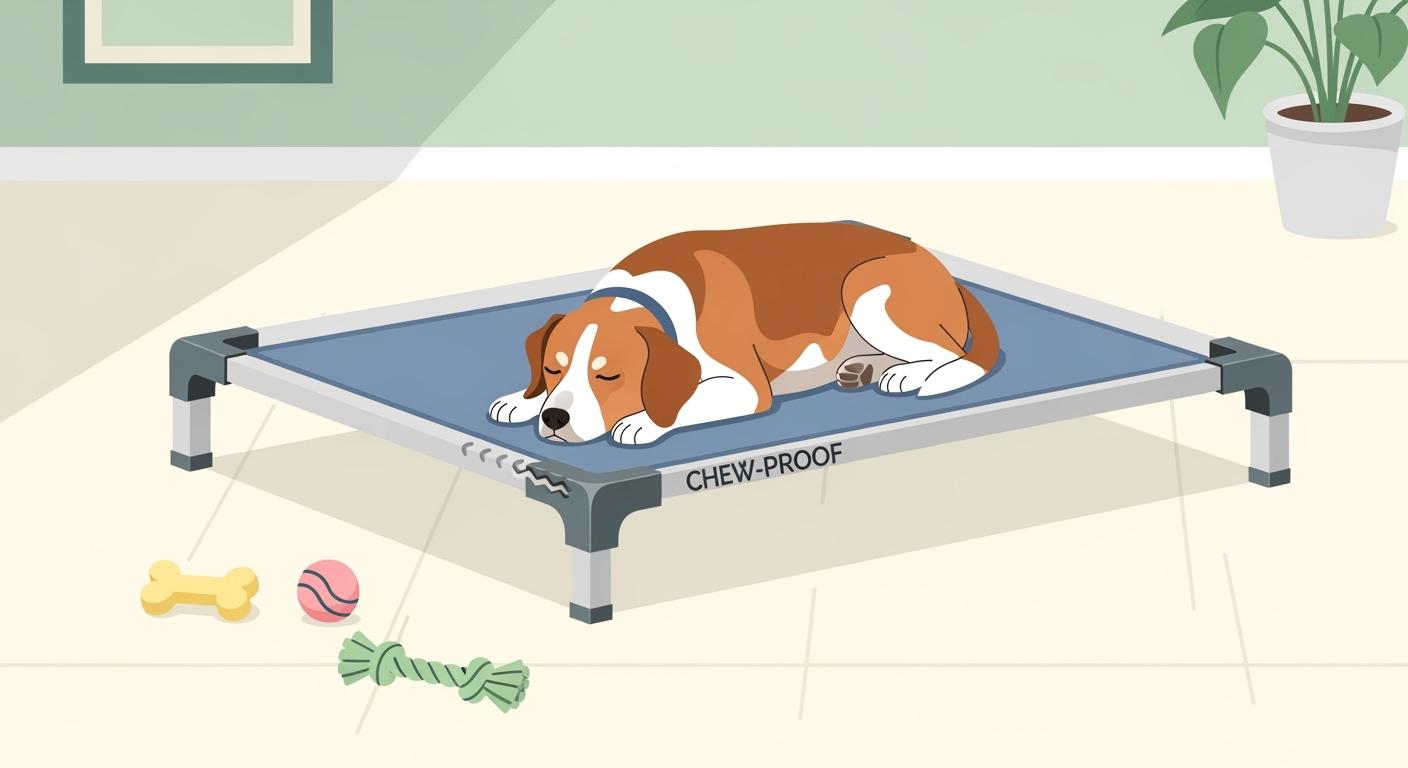
A dog that works the corners of an elevated bed is not being destructive for the sake of it. The bed itself offers the invitation. Corners concentrate fabric edges, seam intersections, and frame joints into one small zone — a zone that sits right at mouth height when the dog lies down next to it. A chew proof elevated dog bed removes that invitation by eliminating the physical features a dog needs to start a bite: exposed fabric edges, loose panel tension, and unprotected corner joints.
What separates a design that survives chewing from one that fails within weeks is rarely the material label on the tag. It is whether the bed denies the dog a grip point in the first place. Without an edge to hook a tooth behind, even a determined chewer often gives up.
Choosing a chew proof elevated dog bed reduces the risk of your dog chewing and protects your investment in a durable dog mattress.
Where Elevated Bed Corners Invite Chewing
Why Corners Become the First Target
Corners concentrate three things a chewing dog needs: a protruding edge, intersecting seam lines, and a structural joint underneath. An edge gives the dog something to hook a tooth behind. Seam lines create texture variation that draws mouthing behavior. And the rigid joint underneath acts as an anvil — the dog bites fabric against a hard surface, multiplying the force concentrated on each thread.
Dogs explore with their mouths. A raised bed corner sits at muzzle height when the dog rests beside it, making it the most accessible part of the bed to investigate. If the corner offers a loose fabric fold or a visible seam ridge, the dog has everything it needs to start.
Tip: If the corner fabric lifts when pinched between two fingers, the edge is already loose enough for a dog to work.
Loose Panel Tension Creates Grab Points Everywhere
A panel under slack tension does not just look untidy — it hands the dog a series of pinch points across the entire sleeping surface. When fabric sags, the dog can gather a fold in its front teeth and pull. That pulling motion loosens stitching incrementally. Over days, the same spot becomes easier to grip, and the chewing escalates.
Tight panel tension changes the physics. A drum-tight surface leaves no slack to gather. The dog’s teeth slide off rather than catch. This is why panel tension often matters more than fabric type — even ballistic nylon becomes vulnerable if there is enough slack to grasp.
Boredom Amplifies a Design Problem
Boredom and anxiety increase chewing frequency, but they do not create the target. The target is already there, built into the bed. A dog with nothing else to do will interact with whatever is physically available. If the bed corners are exposed, that is where the interaction centers. If the panel sags, the dog will work the slack.
The table below maps what drives chewing against what the bed design either enables or blocks:
| What is Happening | Design Factor That Enables or Blocks It |
|---|---|
| Dog mouths corners during rest | Exposed fabric edges provide an accessible starting point; hidden edges remove it |
| Chewing escalates over days | Slack tension lets the dog gather fabric; tight tension denies the grip entirely |
| Dog chews when left alone | Understimulation increases interaction, but the bed design determines whether interaction leads to damage |
Stress and separation anxiety can turn occasional mouthing into persistent chewing. But the question the bed design answers is the same regardless: does the physical structure offer something to grip? A dog cannot chew what it cannot get its teeth around. The same elevated bed frame that survives casual mouthing may fail quickly if the fabric offers slack or exposed seams — not because the dog’s motivation changed, but because the design gave it something to work with. And indoor sleep support starts with a surface that stays flat and edge-free through daily use.
How Hidden Edges and Panel Tension Remove Grip Points
The Physics of Denying a Bite
A dog’s tooth needs an edge to start a bite. The incisor hooks behind a raised surface, the jaw closes, and the fabric is trapped between tooth and gum. From there, the dog can pull, tear, or grind. Remove the edge, and the sequence never starts. The tooth slides across the surface with nothing to catch.
This is the causal chain that makes hidden-edge construction effective: the fabric wraps under the frame and is fastened on the underside → there is no protruding lip at the corner → the dog’s incisor slides past rather than hooking in → no bite initiates → no fabric damage accumulates. The protection is mechanical, not behavioral. It does not require the dog to lose interest. It requires the bed to offer nothing to act on.
After 10 minutes of rest, run a hand along each corner where fabric meets frame. If fabric lifts away from the frame or forms a ridge taller than a fingernail thickness, the edge is already accessible enough for a determined chewer to engage.
Tight Panel Tension as a Structural Defense
Panel tension works on the same mechanical principle but across the entire sleeping surface. A slack panel creates folds. Each fold is a temporary edge — the dog can grip it, pull, and create a larger fold. The process feeds itself.
Tight tension — achieved through double-stitched perimeter seams and panel material that resists stretch under body weight — denies that first fold. The surface stays flat even after hours of a dog lying on it. No fold, no grip, no starting point. Elevated bed sizing and support features influence whether tension stays consistent across the panel or degrades unevenly over time.
Press your palm into the center of the sleeping panel and hold for five seconds. When you release, the fabric should snap back flat within one second. If the depression lingers or measures deeper than half an inch, the tension has loosened enough to offer grab points.
A custom dog crate cover fit is the single most important feature for a puppy. When a cover is tailored to the exact dimensions of the crate, it fits like a second skin. There are no gaps for them to exploit, no droopy top panel to pull down.
Protected Corner Joints
The corner joint is where fabric, frame, and fastener converge. It is the highest-stress point on any elevated bed. A dog chewing at the corner concentrates force on a single seam intersection. If that joint uses an exposed plastic connector or a visible screw head, the dog has both a grip point and a hard surface to chew against.
Rounded, covered corner joints serve two functions. First, they eliminate the sharp transition where the dog’s tooth can find purchase. Second, they distribute bite force across a curved surface rather than concentrating it on an edge — the same principle that makes it harder to bite through a sphere than a cube of the same material. An elevated dog bed with a steel frame starts with joints that resist deformation under sustained pressure.
Common failure modes trace back to specific design choices:
| Failure Signal | Likely Design Cause | Better Design Direction |
|---|---|---|
| Fabric lifts at corners | Exposed edges, loose perimeter fit | Hidden edges wrapped under frame, tight perimeter stitching |
| Sagging sleep surface | Panel material stretches under load, single-stitch perimeter | Low-stretch panel with double-stitched reinforced seams |
| Loose threads at corner seams | Single lock stitch at high-stress intersection | Reinforced bar-tack stitching at all four corner intersections |
Fewer Grip Points Across the Frame
Every transition on the bed — fabric to frame, corner to side rail, panel edge to underside — is a potential grip point. Reducing the count of exposed transitions reduces the number of places a dog can start. A bed with smooth, continuous frame rails and fabric that wraps cleanly underneath presents fewer opportunities than one with multiple joint caps, exposed hardware, and fabric that stops at the top edge.
Smooth, rounded frame edges make the grip problem worse for the dog — meaning harder. A sharp corner provides an edge to bite. A rounded profile forces the tooth to slide off, the same reason it is harder to grip a smooth pebble than a jagged one. Run your hand along the full perimeter of the frame. Any ridge, bump, or texture change you can feel, a dog can find with its mouth.
| Frame Edge Profile | Grip Accessibility | Injury Risk From Chewing |
|---|---|---|
| Sharp or squared corners | High — incisor hooks easily | Higher — splintering possible with plastic or wood |
| Smooth, rounded edges | Low — tooth slides off | Lower — no sharp fragments if material fails |
Materials and Joint Construction at Stress Concentration Points
Why Fabric Choice Alone Is Not Enough
Ballistic nylon and ripstop canvas resist puncture better than standard polyester. That is well established. But a fabric’s labeled durability means little if the dog can still gather a fold and pull. Pulling force is distributed differently than puncture force — it loads the weave in shear along the stitch line, not in direct penetration through the face.
This is why seams fail before fabric does on most chewed beds. The thread takes the full shear load of the dog’s pulling motion, concentrated along a single line of perforations in the material. A bar-tack stitch pattern at corner intersections spreads that load across multiple thread lines and angles, reducing the shear force on any single stitch point.
A bed marketed as tough or chew-resistant is still only as strong as its weakest seam intersection — and corner seams are almost always that point.
Frame Material and Joint Integrity
Aluminum and steel frames resist the two failure modes that matter most under chewing: deformation and fragmentation. When a dog bites a plastic corner joint, the material can flex, crack, and eventually splinter — creating sharp edges that make further chewing more dangerous. Metal joints deform less under the same load, and when they do fail, they tend to bend rather than fracture.
The joint design matters as much as the material. A welded or tightly press-fitted metal corner eliminates the gap where a dog can insert a tooth between frame sections. Open gaps at frame connections are one of the most overlooked failure points — a gap wider than a dog’s incisor thickness becomes a lever point for chewing. Preventing edge curling on an indestructible dog bed starts with frame connections that stay flush under load.
The table below maps how material and design choices interact at the key stress points:
| Design Difference | Why It Matters at the Stress Point | Main Limitation |
|---|---|---|
| Ballistic nylon vs. standard polyester panel | Higher thread count resists shear loading when dog pulls gathered fabric | Still fails if panel tension is loose enough to allow gathering |
| Bar-tack reinforced corner seams | Multi-directional thread lines spread shear force across 8–12 anchor points instead of one | Adds production complexity; cannot compensate for a weak frame joint underneath |
| Steel or aluminum frame vs. plastic joints | Bends rather than splinters under bite pressure, eliminating sharp fragment risk | Heavier; metal corner caps still need smooth finishing to avoid becoming grip points |
| Hidden fabric edges vs. exposed seam binding | Removes the physical ledge a dog’s incisor hooks behind to initiate a bite | Requires more fabric yardage and precise tensioning during assembly |
When a Chew-Proof Elevated Bed Is Not the Right Choice
The design features discussed here reduce the physical opportunity to chew. They do not address why a dog chews. A dog with severe separation anxiety or compulsive oral fixation may still damage a bed with hidden edges and tight panel tension — not by gripping fabric, but by grinding teeth directly against the frame or digging at the panel surface with enough repetition to abrade the material.
No elevated bed design eliminates all chewing risk. What these design features change is the threshold: how much determination and jaw strength the dog needs before damage begins, and how many accessible starting points the bed presents. For most dogs that chew out of casual mouthing or moderate boredom, removing grip points is enough to break the cycle. For dogs that grind compulsively regardless of edges, no textile surface is immune.
Disclaimer: The fit and fabric checks described here assume a smooth-coated dog with typical jaw structure. Double-coated or brachycephalic breeds may produce different wear patterns — particularly grinding rather than gripping — that need hand-checking rather than visual inspection. If the dog has a known history of ingesting fabric, frame, or hardware fragments, no bed design eliminates that risk; direct supervision during initial use remains necessary.
An elevated bed also assumes the dog is willing to rest on a raised, firm surface. Some dogs prefer a cushioned, ground-level bed and will not settle on a cot-style frame regardless of how well the corners are protected. If the dog refuses to use the bed, chew resistance becomes irrelevant.
Häufig gestellte Fragen
What design feature actually stops a dog from starting to chew?
Hidden fabric edges. When the panel wraps under the frame and is fastened from below, there is no protruding lip for the dog’s incisor to hook behind. Without that first grip, the bite sequence cannot start. Tight panel tension supports this by eliminating the fabric folds that create temporary edges.
Does a metal frame guarantee the bed survives chewing?
No. A metal frame prevents the joint from splintering, but the fabric panel and seams remain the primary failure points. A steel frame with a loose, single-stitched polyester panel still fails — the fabric gives way at the seam long before the frame is threatened.
How can I tell if my dog’s current bed is already developing chew points?
Run your hand along every corner where fabric meets frame. Fabric that lifts more than a fingernail’s thickness away from the frame is already accessible. Press into the center panel for five seconds — a depression that stays deeper than half an inch or takes more than a second to recover means tension has loosened enough to create grab points.
Is a chew proof elevated bed safe for a puppy?
The hidden edges and tight panel construction reduce the risk of a puppy finding and swallowing loose fabric or hardware fragments. But puppies explore with their mouths constantly, and no textile surface is immune to persistent chewing. Inspect corners and seams weekly during the first month of use, and remove the bed if loose threads appear.
How long should a well-designed chew resistant elevated bed last?
With hidden edges, bar-tack reinforced corner seams, and a metal frame, a bed typically outlasts a standard elevated bed by a factor of two to three under the same dog. The limiting factor is usually the fabric panel, not the frame — and the panel life depends more on tension consistency than on the fabric’s labeled denier rating.