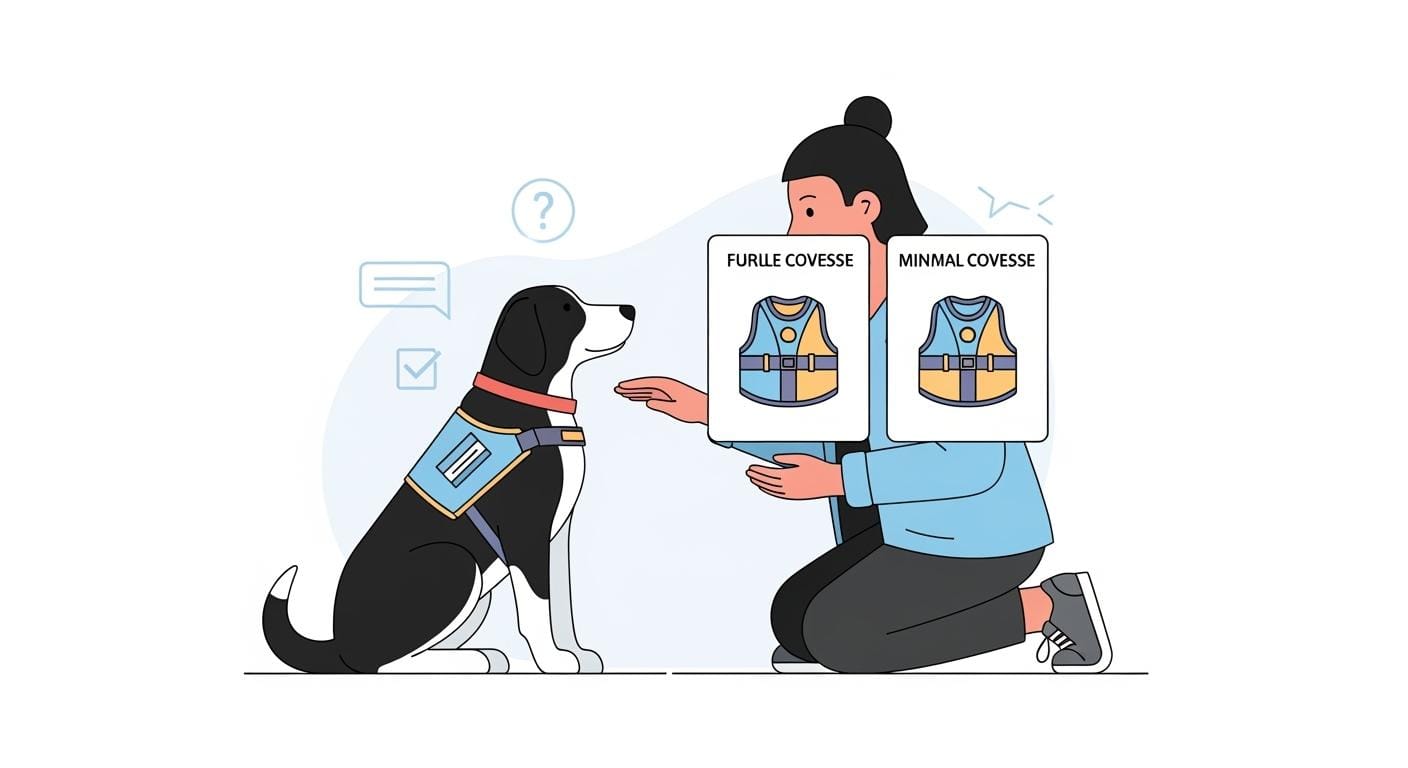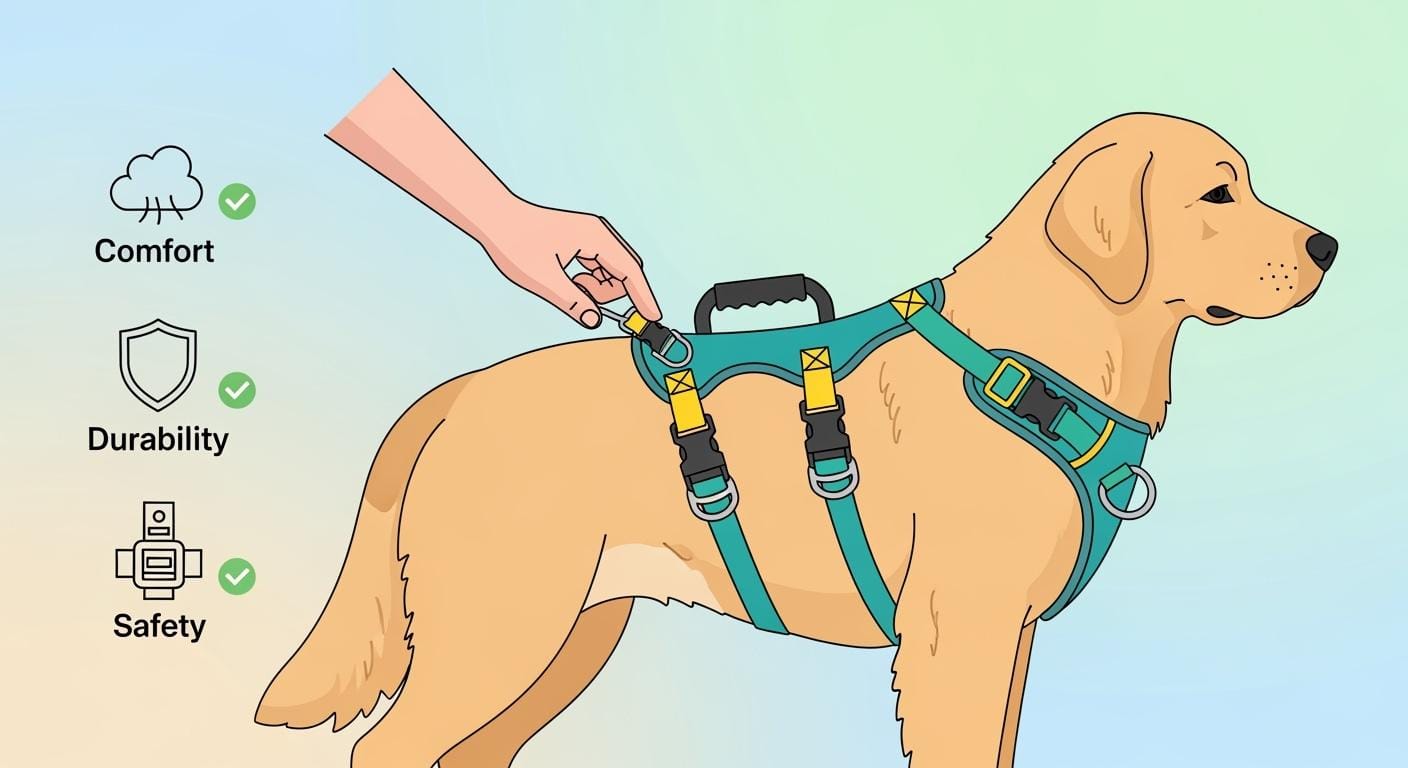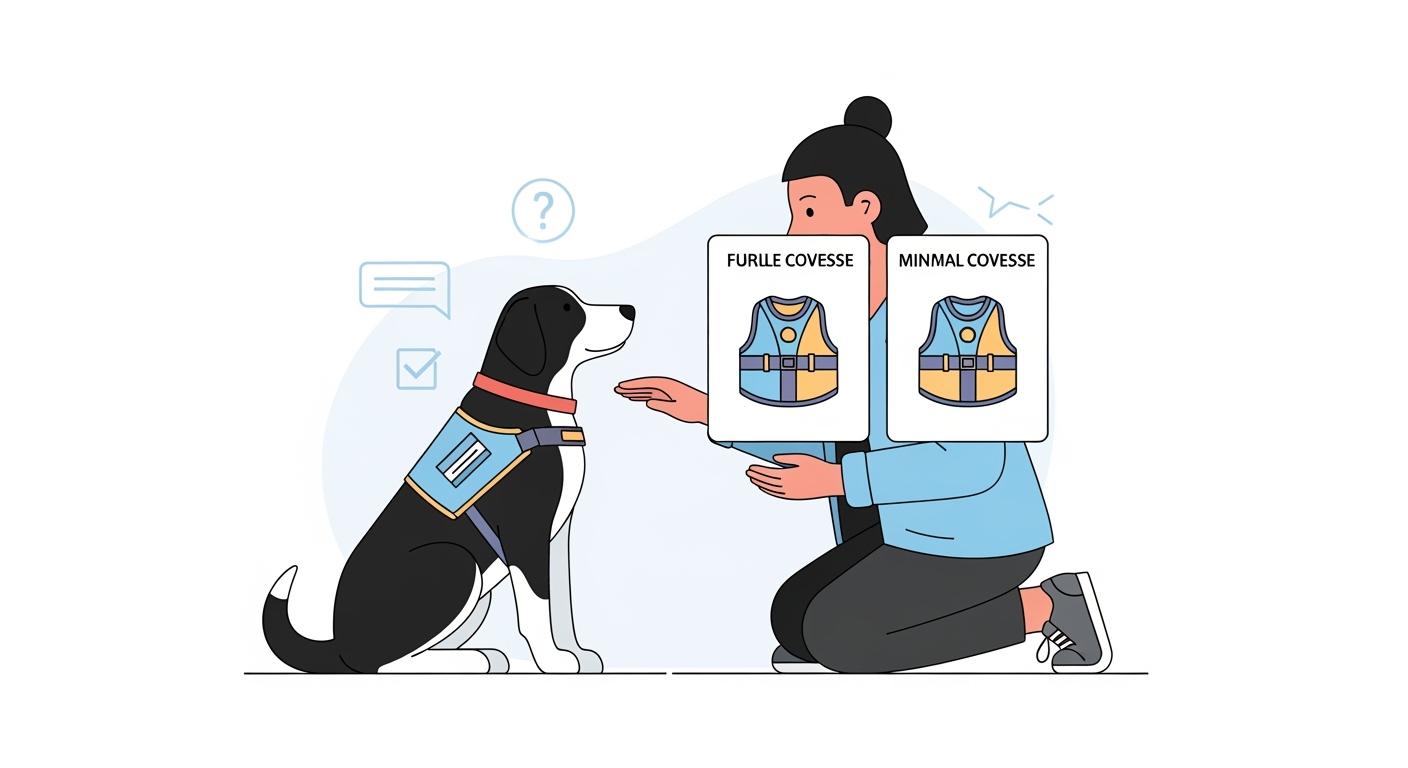
A service dog vest harness does not need maximum coverage to be useful. Extra panel area can help when you need clearer patch visibility, light weather shielding, or room for a handle and small daily items. It becomes a problem when the vest traps heat, shifts sideways, rubs behind the front legs, or crowds the shoulder. The better question is not whether more coverage looks more official, but whether that coverage matches your dog’s task, coat, climate, and workday. If you use a service dog in training vest, or you travel with your dog, check any rules that apply to your destination before you go. This article focuses on real-use tradeoffs, not appearance alone.
| Coverage Level | What Usually Changes |
|---|---|
| Minimal coverage | Lighter feel, faster on and off, and better airflow in warm conditions. |
| Mid coverage | Balanced patch space, stable fit, and enough structure for most daily public work. |
| Full coverage | More room for patches or gear, but also more heat, bulk, and edge contact to monitor. |
- Check where the vest sits when your dog walks, turns, and lies down, not just when standing still.
- Use extra coverage only when it gives you a clear benefit, such as patch room, light weather protection, or better organization.
- Watch for early signs of trouble: panting sooner than usual, side shift, rubbing near the elbows, or shorter stride length.
- Choose the least bulk that still supports the job your dog actually does.
Key Takeaways
- Pick a service dog vest that stays stable without crowding the shoulder. A vest that looks secure but twists in motion will become a daily problem fast.
- Extra coverage is most useful when you need larger patches, light weather shielding, or a cleaner setup for public work.
- If coverage adds heat, rubbing, or slower movement, the vest is doing too much and the dog is doing the work around it.
What Extra Coverage Actually Changes
Visibility and working readability
Coverage matters because it changes how clearly the setup reads in public. More panel area gives you better space for patches and makes the harness easier to recognize at a glance. That can reduce repeated questions and make crowded settings less distracting. The benefit here is not that more coverage proves anything by itself. It is simply easier to read from a distance, especially when the dog is moving through stores, stations, or check-in areas.
- Larger side panels give patches more room to stay flat and visible.
- A cleaner layout is easier to read than several small tags clustered around straps.
- Visibility helps most in busy places where people only get a quick look.
- Coverage should support clarity, not turn the harness into dead weight.
A vest can make the team easier to read, but it does not replace handling, training, or day-to-day reliability.
Handle access and task support
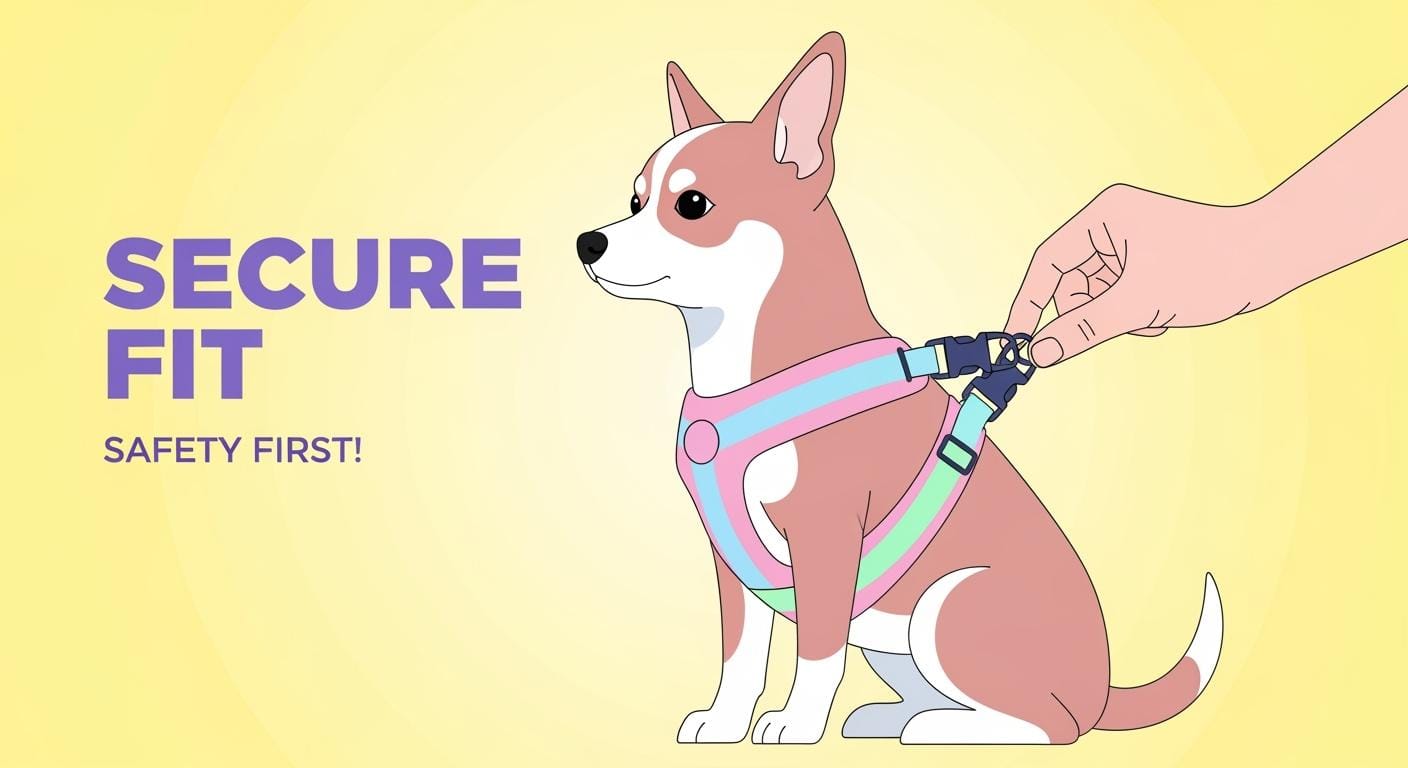
Some service dog vest harness designs combine panel coverage with a working harness body. In that setup, coverage can help by giving the structure a more settled feel and by making handles or attachment points easier to reach. This only works when the vest stays centered and leaves the shoulder free enough for normal stride length. If the body panel rides too far forward, the dog may shorten steps, rotate oddly through the shoulder, or start leaning away from pressure.
- A handle is more useful when you can reach it quickly without searching for it.
- A stable body panel can keep the setup from twisting during turns.
- Too much material around the shoulder often feels secure at first and awkward after ten minutes.
- The right amount of coverage depends on the task, the dog’s build, and the length of the outing.
Check the vest in motion. A standing fit can look acceptable while the harness still shifts once the dog starts walking, turning, or settling under a chair.
Coverage should not fight movement
The most common mistake is treating added coverage as a free upgrade. It is not. Larger panels and heavier trim can hold more heat, create more edge contact, and add drag when the harness shifts to one side. That matters most on dogs with shorter coats, pronounced elbows, deep chests, or longer work sessions. If you find yourself tightening the vest harder just to stop it moving, the design may be too bulky for the dog rather than too loose.
- Watch where the front edge lands when the dog reaches forward.
- Check whether the side panel slides backward on one side after a few minutes.
- Feel under the straps after use instead of judging fit only by sight.
- Less coverage often works better than a heavier vest that needs constant adjustment.
Use the design that your dog can ignore while working. The best setup is often the one that disappears once it is fitted correctly.
Where Extra Coverage Helps and Where It Starts to Hurt
Weather, shaved areas, and patch space
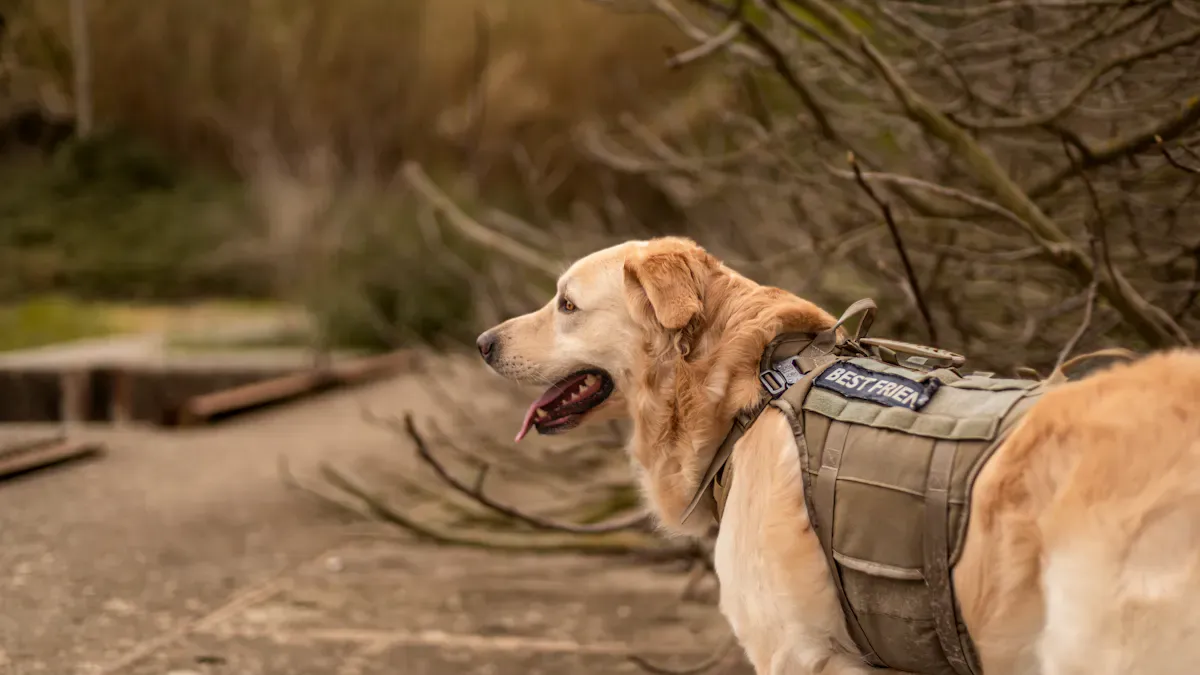
Added coverage helps most when there is a clear job for it to do. A little more body panel can make sense in light rain, cool wind, or on dogs that need a shaved area covered from direct rubbing. It also helps when you need larger patches that stay readable without bunching over narrow straps. In those situations, the extra material is solving a real-use problem rather than just making the setup look more substantial.
Coverage also helps when you need better organization. Some handlers prefer a vest body that gives them room for small, flat items and keeps the setup visually tidy. That works best when the added storage stays light and does not turn the harness into a load-bearing pack.
When bulk becomes the problem
Coverage starts to hurt when the dog is carrying around panel area that is not doing anything useful. Heat builds faster, the edge contact zone gets larger, and the harness becomes harder to center. You often notice the problem in motion first: the dog pants earlier than expected, the panel creeps to one side, the front edge bumps the shoulder, or the dog looks fine standing but moves less freely once the outing gets longer.
If you see your dog panting sooner, slowing down, or trying to shake the vest back into place, the current setup needs a second look. Run your hand behind the front legs after use. Check whether one side sits lower than the other. Look for flattened coat, damp hot spots, or a front edge that has drifted closer to the shoulder than where you started.
Sometimes the better answer is not a full vest at all, but a simpler harness body with less panel coverage. That usually gives you better airflow and fewer contact points to manage, especially in warm weather or on shorter public outings.
Comparison Table: more coverage vs. less coverage
Use this table to decide whether the extra material is earning its place in daily work:
| Feature/Use Case | Service Dog Vest Harness (More Coverage) | Lower-Coverage Harness Setup |
|---|---|---|
| Patch visibility | More room for larger, flatter patches | Enough for a simpler patch layout |
| Daily carry needs | Better when you need light organization | Best when you do not need to carry extras |
| Weather exposure | Helps more in light wind or light rain | Less shielding, but less trapped heat |
| Heat buildup | Higher risk on warm days or long outings | Usually easier to manage |
| Bulk and weight | Heavier and more noticeable on the dog | Lighter and less intrusive |
| Freedom through the shoulder | Good only when the front edge stays clear | Usually easier to keep open |
| Stability in motion | Can feel solid, but can also side shift if overbuilt | Often easier to center and recheck |
| Adjustment time | More straps and edges to monitor | Usually faster to put on correctly |
| Best for | Dogs that benefit from patch space, light shielding, or a more structured setup | Dogs that do better with less heat and fewer contact points |
| Main risk | Heat, rubbing, and bulk that the dog has to work around | Less visual area for patches and fewer add-on options |
| Durability feel | Often feels more substantial | Often feels simpler and less padded |
| Escape and shift check | Watch for one-sided slide after walking | Watch for looseness if the frame is very minimal |
| Daily routine fit | Better when the added features get used regularly | Better when you want a clean, repeatable setup |
Tip: If you cannot name the job the extra panel area is doing, you probably do not need that much coverage.
When less coverage is the better call
Skip added coverage when the dog works in warm conditions, has a coat or body shape that rubs easily, or moves best in a cleaner, lower-profile setup. Less coverage is also the better call when you keep tightening straps to control side shift. That usually means the vest shape and the dog’s body are not working together.
- The dog starts warm and gets noticeably hotter before the outing is over.
- The side panel rolls or drifts after a few minutes of walking.
- The front edge sits too close to the shoulder once the dog is in motion.
- You need the harness to be simple, fast, and easy to recheck throughout the day.
The goal is not maximum coverage. The goal is a setup that stays readable, stable, and comfortable for the full working period.
Common Mistakes and Fast Checks
Mistakes that show up first
Most coverage problems are easy to miss at the start because the vest looks fine when the dog is standing still. Trouble usually shows up after a few minutes of real movement.
- You choose the fuller vest because it looks more complete, even though the dog does not need the extra panel area.
- You judge fit only at the chest and forget to watch the shoulder and elbow area in motion.
- You load the vest with patches or small items and never recheck how that extra weight changes side balance.
- You ignore early heat signals because the dog still keeps working.
- You keep adjusting the same vest instead of asking whether a lower-coverage design would solve the problem faster.
Tip: Do one walking check, one turning check, and one post-use skin check. That tells you far more than a mirror check at the door.
Pass/Fail Checklist Table
| Check Item | Pass Signal | Fail Signal | Fix |
|---|---|---|---|
| Overall balance | Panel stays centered while walking | One side drops or drifts backward | Recheck adjustment or move to a simpler setup |
| Shoulder clearance | Front edge stays clear during stride | Edge bumps or crowds the shoulder | Shift the fit back or reduce coverage |
| Heat management | Dog works at normal pace and temperature | Panting ramps up early or the panel feels hot underneath | Use lighter materials or less body coverage |
| Skin and coat check | No rubbing, flattening, or damp hot spots | Redness, friction marks, or one-sided pressure points | Change fit, edge placement, or harness style |
| On/off routine | Quick to put on the same way each time | Takes repeated correction to sit right | Simplify the setup before the routine becomes the problem |
Troubleshooting Table for Harness Fit
| Symptom | Likely Cause | Fast Check | Fix |
|---|---|---|---|
| Dog pants sooner than usual | Too much trapped heat or too much panel contact | Feel under the vest after a short walk | Reduce coverage or move to a lighter build |
| Vest slides to one side | Too much bulk for the dog’s frame or uneven loading | Walk ten steps, turn, and stop | Rebalance the setup or remove unnecessary add-ons |
| Rubbing behind the front legs | Edge placement or coverage depth is wrong | Check the coat and skin right after use | Shorten the contact zone or switch styles |
| Shorter stride or awkward reach | Front edge is crowding the shoulder | Watch the dog from the side in motion | Refit farther back or choose less coverage |
| Vest feels like constant work to manage | The design is asking too much from daily use | Notice how often you re-center it | Simplify before small annoyances become routine problems |
Note: The best service dog vest harness is not the one with the most coverage. It is the one that stays readable, stable, and easy for the dog to work in.
Before you choose, narrow the decision down to the tradeoff that matters most in your daily routine:
| What You Need Most | More Coverage | Less Coverage |
|---|---|---|
| Readable public-facing setup | Usually easier to achieve | Possible, but patch space is tighter |
| Cooler and lower-bulk wear | Harder to maintain on long or warm outings | Usually easier to maintain |
| Freedom of movement | Depends heavily on edge placement and fit | Usually simpler to preserve |
- Choose the amount of coverage your dog can work in comfortably for the full outing, not the amount that looks most complete at the start.
- Recheck after movement, after weather changes, and after longer public sessions.
FAQ
How do you choose a service dog vest for public travel?
Start with the job the vest needs to do. For travel, clear patches, stable fit, and easy rechecks usually matter more than maximum coverage. Make sure the vest stays centered, does not trap too much heat, and leaves the shoulder free in motion.
What makes an adjustable service dog vest better for pulling tasks?
Adjustment helps only when it leads to a steadier, more comfortable setup. A vest that can be tuned around the chest and body is easier to center, but too much coverage can still get in the way if the front edge sits too close to the shoulder.
Can a service dog vest cause problems with overheating or rubbing?
Yes. You often see it first as earlier panting, hot fabric underneath the panel, friction behind the front legs, or a vest that starts to slide sideways. When that happens, less coverage or a lighter structure is usually the better direction.