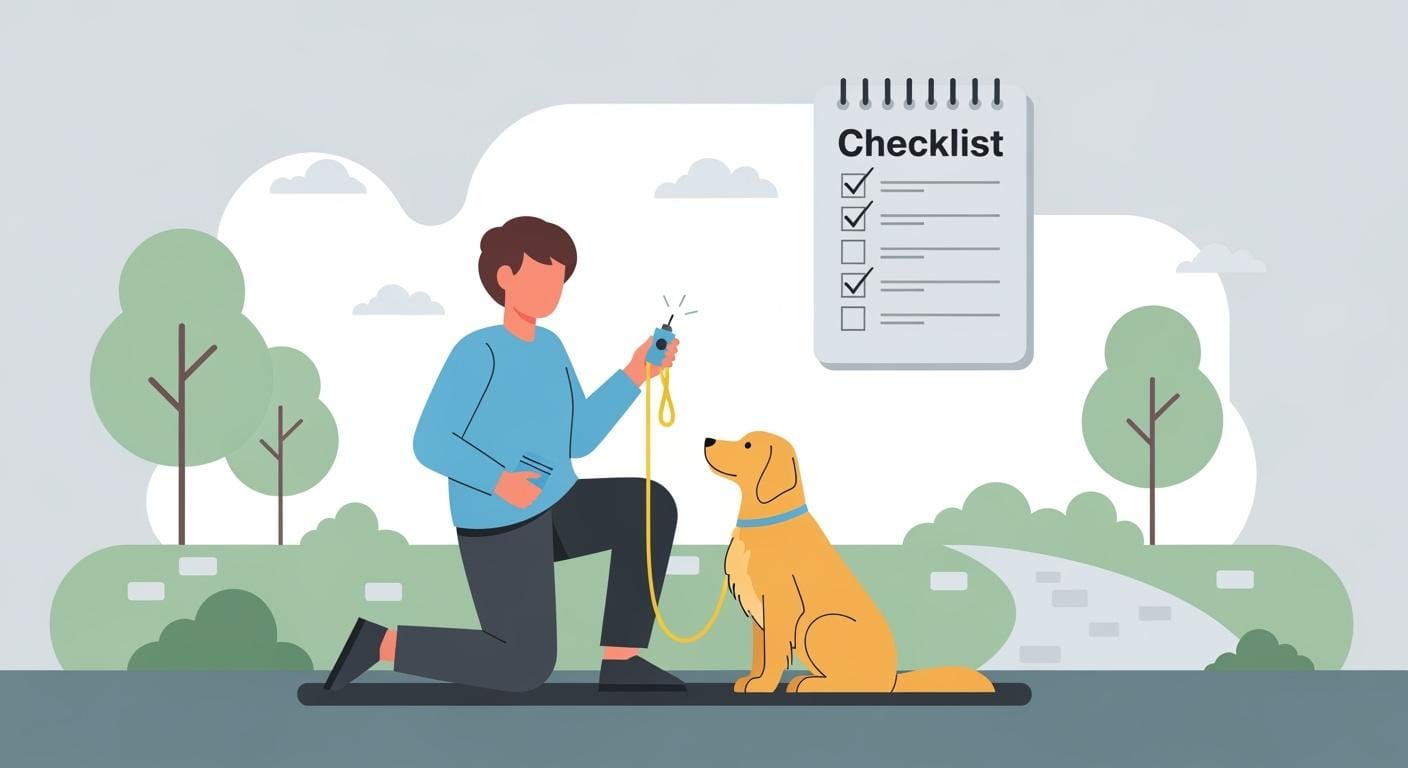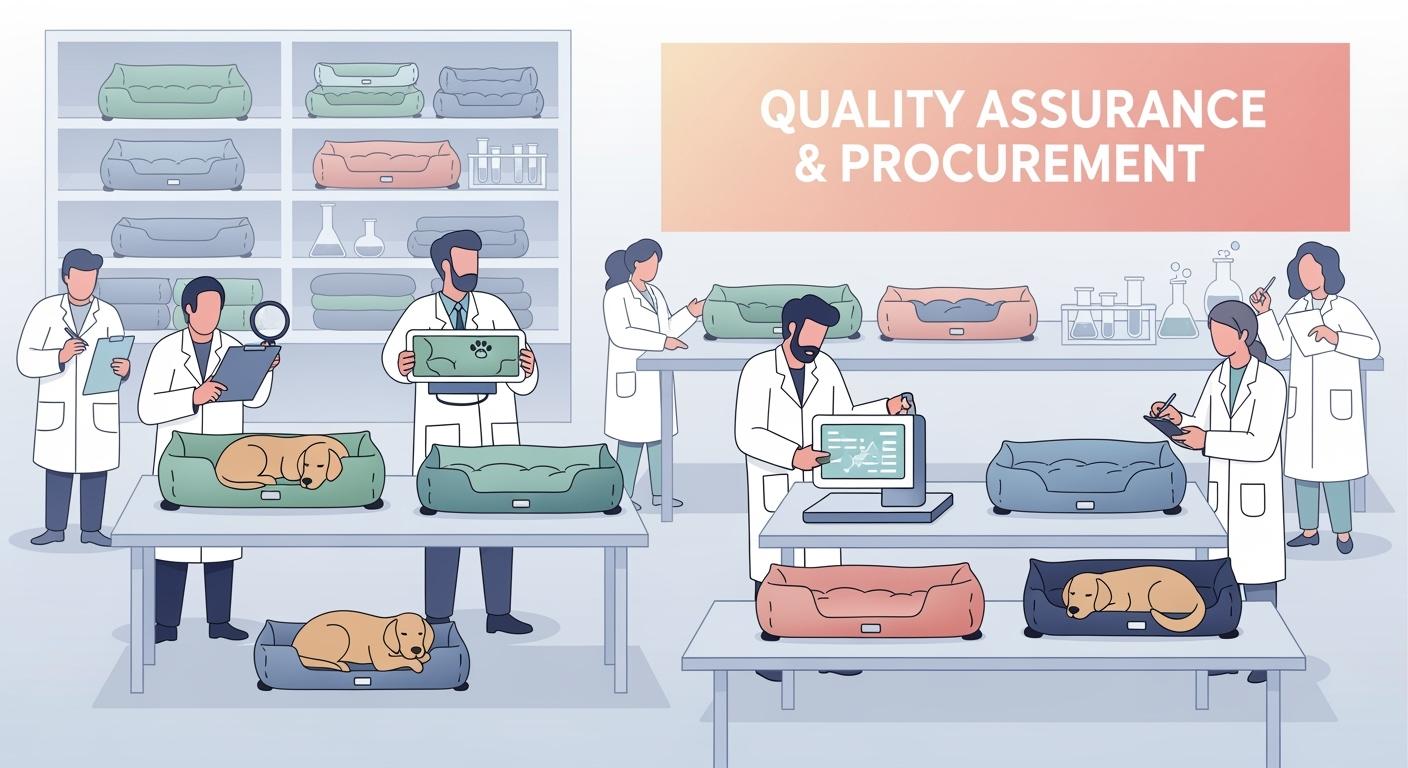
You have an important job. You make sure every outdoor dog bed is good quality before buying. Lab testing helps you check if each bed can last long, stay dry, handle sun, stop mildew, and keep seams tight. These tests help you feel sure about your choices. They also help you avoid spending money on returns. Use simple lists and clear requests when you talk to suppliers. This helps you get results you can trust.
Key Takeaways
Lab testing checks if outdoor dog beds are good quality. It helps stop expensive returns and keeps customers happy.
Pick third-party or in-house testing for your needs. Third-party labs give fair results. In-house labs are faster and you have more control.
Always ask for full lab reports. Look for test methods, results, and clear pass or fail signs to check product quality.
Make a strong sampling plan. Set your Acceptable Quality Level (AQL) to find problems before you get shipments.
Know the difference between water repellency and waterproofing. Ask for hydrostatic head values to prove a bed can resist water.
Do careful UV testing. Test all parts, like threads and handles, for color and strength.
Check if the bed resists mildew. Look at risky spots and ask for proof of anti-mildew treatments to stop future problems.
Test seam strength. Find weak spots in seams to make beds last longer and handle rough use.
Lab Tests for Outdoor Dog Bed Procurement
You must check that each outdoor dog bed meets your company’s rules before you buy it. Lab tests help you see if the beds are strong, last outside, and keep dogs comfy. You can use these tests to compare different products and suppliers. This part tells you how to pick the right test, read lab reports, and plan how many samples to test.
Third-Party vs In-House Testing
You can test outdoor dog beds in your own lab or send them to a third-party lab. Both choices have good points. Third-party labs use standard ways to test and give fair results. In-house labs let you test faster and control the steps. You should choose based on your time, money, and how risky the product is.
Checklist for RFQ or Supplier Inquiry:
Say if you want third-party or in-house testing.
List the test methods (like ISO, ASTM, AATCC) for each thing you check.
Ask for the lab’s proof or records that show they test well.
Request a sample lab report with your RFQ.
Tip: Always ask for the test method, how the sample was kept, units, what counts as a pass or fail, photos, and the end result in every lab report.
RFQ Lab Test Request Template:
Please give lab test results for these:
- Material: [Say what fabric and weight]
- Seam Map: [Add a drawing or tell about it]
- Stitch Type: [Like double-stitched, overlock]
- Thread Specification: [Like polyester, bonded nylon]
- Target Environment: [Like outdoor, high UV, high humidity]
- Test Methods: [List the standards you need]
- Third-Party Lab Accreditation: [If you need it]
- Sample Size: [How many units]
- Reporting: Add method, units, end result, before/after photos, and pass/fail.
Reading Lab Reports
You need to know what each lab report says about the outdoor dog bed. Look for clear facts about the materials, test methods, and results. Make sure the report matches your RFQ and has all the info you asked for.
Key Element | Description |
|---|---|
Fabric Types | Heavy-duty woven fabrics (600-1000 denier) do not tear or wear out easily. |
Waterproof Liners | Materials like TPU, PVC, and Vinyl stop liquid from leaking and protect the foam. |
Smart Fabrics | Fabrics with cooling, heating, or anti-microbial treatments. |
Structural Components | Includes aluminum frames, PVC pipes, and strong zippers or fasteners to stop chew damage. |
Quality Certifications | CertiPUR-US certification means the foam does not have harmful stuff, which is expected. |
Report Reading Rules:
Method: Check that the test method matches your RFQ.
Conditioning: See if samples were kept right (like humidity, temperature).
Units: Results should use normal units (like N, mm, cycles).
Endpoint: Look for clear pass/fail or end result.
Photos: Before/after photos help you see the test results.
Pass-Fail: The report should say if the sample passed or failed.
Incoming QC Checklist:
- Make sure the lab report matches the PO and RFQ.
- Check the test method and units.
- Confirm the sample size and how it was kept.
- Look at before/after photos.
- Write down any fails or changes.
- Record pass/fail for each thing you check.
Sampling Plans
You need a sampling plan to make sure your lab tests show what the whole shipment is like. A good plan helps you find problems before you accept the order.
Decide why you are checking, based on past results and controls.
Write down the Acceptable Quality Level (AQL) and Lot Tolerance Percent Defective (LTPD) for your plan.
Check your sampling plans often to make sure they still work well.
Checklist for Sampling Plan Setup:
Set your AQL and LTPD for each test.
Pick sample size based on shipment size and risk.
Review and update your plan every year or after a big quality problem.
How Lab Tests Verify Durability and Performance
Test Type | Description | Outcome Recorded |
|---|---|---|
Durability Test | Scraping the bed to copy wear and tear from nails | Survived, scuffed, or punctured |
Strong fabrics like heavy-duty nylon or ballistic-grade fibers mean the bed lasts longer.
Water- or tear-resistant fabrics can handle claws and rough play.
Do not use thin polyester or cotton blends because they rip easily.
Look for double-stitched seams or strong edges to stop fraying.
By following these steps, you can make sure every outdoor dog bed you buy meets your rules and keeps your customers happy.
Outdoor Dog Bed Abrasion Testing
Abrasion testing shows how well outdoor dog bed fabric holds up. It checks if the fabric can take scratching, rubbing, and daily use. You need to pick the right test method. You also need to set clear rules for when to stop the test. This section helps you avoid mistakes and get good results.
Standard Methods & Parameters
There are two main ways to test abrasion on outdoor dog beds. These are the Wyzenbeek and Martindale methods. Each one uses a different machine. They measure how much wear the fabric gets in cycles or double rubs. The Wyzenbeek method moves back and forth. The Martindale method moves in a circle. Both show how long the fabric lasts when used again and again.
Test Method | Description | Cycles/Tests |
|---|---|---|
ASTM D4157-02 | Wyzenbeek method for abrasion testing. | 15,000 double rubs (General) |
30,000 double rubs (Heavy Duty) | ||
ASTM D4966-98 | Martindale method for abrasion testing. | 20,000 cycles (General) |
40,000 cycles (Heavy Duty) |
Checklist for RFQ:
Say which test method you want and how many cycles.
Ask for the abradant type, load, and number of cycles in the report.
Defining Endpoints
You must set clear rules for when to stop abrasion testing. An endpoint is when the fabric shows enough wear to end the test. Most labs stop when they see a hole, yarn break, or color loss. For outdoor dog beds, 15,000 to 20,000 double rubs is good for normal use. Heavy-duty beds may need 40,000 double rubs or more. Some fabrics for public places go up to 100,000 double rubs.
Endpoints are how many cycles or double rubs until you see wear.
For home use: 15,000–20,000 double rubs.
For heavy use: 40,000 double rubs.
For public use: up to 100,000 double rubs.
Actionable Step:
In your RFQ, say the lowest cycles or double rubs needed before wear.
Common Pitfalls
Many teams miss important details in abrasion testing. You might forget to check the abradant type or load. This can change your results. Some reports do not have before and after photos. This makes it hard to see fabric damage. Labs may use different endpoints, so always check what counts as a failure.
Common mistakes to avoid:
Not matching the test method to how the product is used.
Not checking the abradant type or test load.
Accepting reports with no before or after photos or clear notes.
Not making sure all suppliers use the same endpoints.
Checklist for Reviewing Lab Reports:
Make sure the report lists abradant, load, cycles, endpoint, photos, and failure notes.
By following these steps, you can make sure your outdoor dog bed fabrics are strong enough and avoid problems later.
Hydrostatic Head & Waterproofing
Hydrostatic Head vs Water Repellency
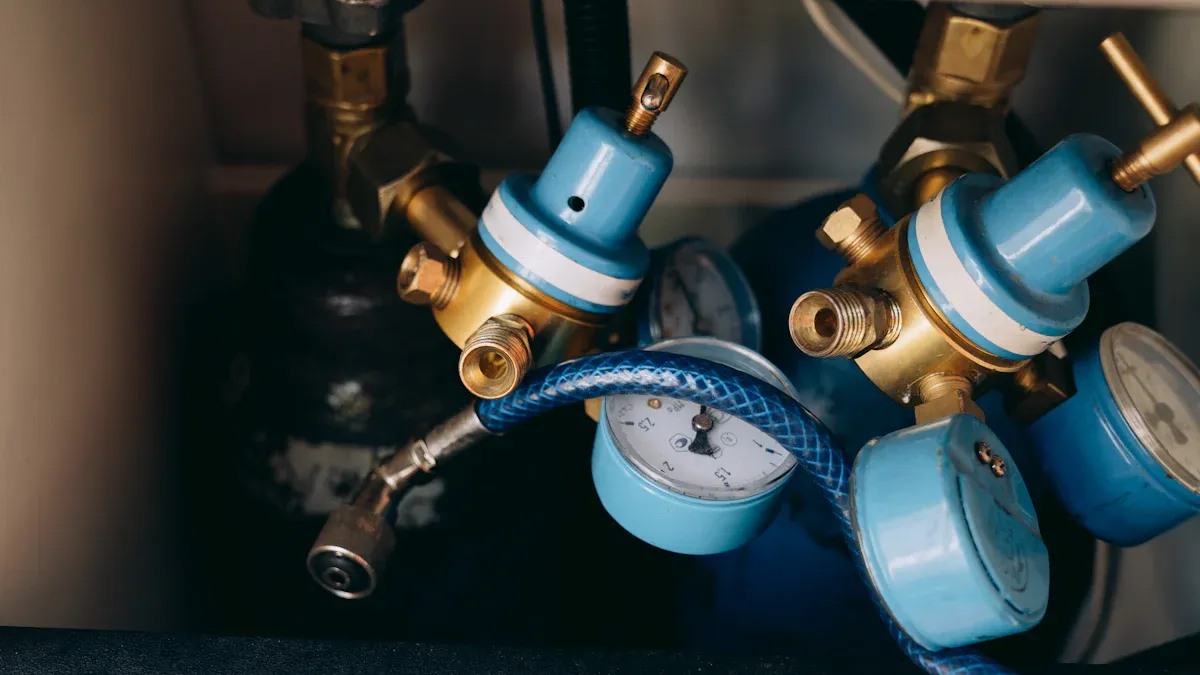
It is important to know how hydrostatic head and water repellency are different. Hydrostatic head tells you how much water pressure a fabric can take before it leaks. This test shows if the fabric keeps water out during rain or when the bed sits on wet ground. Water repellency means the fabric can stop light moisture, like a splash or drizzle, but not heavy rain. Most outdoor dog beds are water-resistant, not fully waterproof. They can handle some rain but should not stay outside in storms. Look for fabrics with a hydrostatic head value of at least 1500 mm for basic water resistance. For full waterproofing, a value over 10,000 mm is best, but this is rare for dog beds.
Checklist for RFQ:
Ask suppliers to give the hydrostatic head value (in mm) and the test method used (ISO 811 or AATCC 127).
Request details about water repellency treatments and how long they last.
Reporting Requirements
You need clear lab reports to check waterproofing claims. The report should show the test method, the hydrostatic head value, and the pass/fail rules. The most common test methods are ISO 811 and AATCC 127. These tests measure how much water pressure the fabric can take before it leaks.
The lab should do these steps:
Step | Description |
|---|---|
1 | Put the test sample over the chamber opening and seal it to stop leaks. |
2 | Fill the chamber with distilled water so the sample is under water. |
3 | Slowly add pressure in the chamber until water gets through. |
4 | Watch the pressure gauge and write down when water comes through. |
5 | Record the height of the water above the sample to get the hydrostatic head score. |
You want the report to show the unit (mm), the method (ISO 811 or AATCC 127), and photos of the tested area. The report should also say if the sample passed or failed based on your rules.
RFQ Inquiry Example:
“Please give hydrostatic head test results (in mm) using ISO 811 or AATCC 127, with photos and clear pass/fail notes.”
Seam Sealing Tests
Seam sealing is just as important as fabric waterproofing. Water can leak through needle holes or seams if they are not sealed well. You should check if the supplier uses seam sealing tape or other waterproofing on the seams. This step helps keep the inside of the bed dry.
Common seam sealing methods are:
Seam sealing tape on all stitched seams
Waterproof tape on outer covers
Special seam construction to stop leaks
You should set a pass/fail rule: any moisture that gets through a seam means the sample fails. Ask for a test report that shows no leaks after seam sealing.
Checklist for Seam Sealing Verification:
Ask suppliers to describe seam sealing methods and show test results with no leaks.
Ask for photos of seams after testing and details about any waterproof tape or treatments used.
By following these steps, you make sure your outdoor dog bed can handle wet weather and keep pets comfortable.
UV Testing for Outdoor Dog Beds
Color & Strength Retention
UV rays from the sun can make outdoor dog bed fabrics fade and get weaker as time passes. You need to check if the color stays bright and if the fabric stays strong after being outside. Standard UV testing shines UV light and adds moisture to samples in cycles. Then, it checks if the color changes and if the fabric loses strength. You should ask suppliers to use well-known methods like ASTM G154 or ISO 4892. They should report color change using a gray scale or Delta E value. They should also show how much strength the fabric keeps after testing.
Checklist for RFQ:
Ask for UV test results that show color change and strength retention after testing.
Tell suppliers which test method and how long to test.
Tip: Always look at before and after photos in the lab report to see if the fabric faded or got damaged.
Scope: Threads & Handles
UV testing is not just for the main fabric. Threads, handles, and trims can also get damaged by sunlight. If these parts break, the bed may not be safe or useful anymore. You should test all these parts, not just the fabric. Ask suppliers to give details about the UV resistance of threads, handles, and zippers. Make sure they test these parts the same way as the main fabric.
RFQ Inquiry Example:
“Please give UV test results for all threads, handles, and trims. Include details about test cycles and standards used.”
Note: If you use different materials for handles or threads, make sure each one passes your UV resistance rules.
Reporting UV Results
Clear lab reports help you make good choices. A good UV test report should have these steps:
Get test samples that are like the final product and write down their starting details.
Put samples in the UV test chamber so all parts get the same amount of light.
Pick the right UV light and set up the test cycle with UV and moisture.
Keep the temperature and humidity like real outdoor weather.
Set how long the test will last based on how tough you want the bed to be.
Check samples for color change and test if they lost strength.
Write down all results, including test cycles, standards, color change, and strength retention.
Checklist for Reviewing UV Test Reports:
Make sure the report lists UV cycle details, standards, color change, and strength retention.
Check that results include all exposed parts, not just the main fabric.
Actionable Step: Always ask suppliers to send full UV test reports with your RFQ or purchase order.
Mildew Resistance in Dog Bed Materials
High-Risk Areas
You should know where mildew can grow on an outdoor dog bed. Mildew likes damp spots. Foam inserts, fabric covers, and seams can hold water. If beds are kept in humid places or shipped in sealed bags, moisture can get trapped. Wet foam can get moldy in just one or two days, especially if it is hot and humid. Always check the places that stay wet the longest, like inside covers and under the bed. Airflow helps keep beds dry. Dry beds near open windows or with fans. Sunlight is good because UV rays kill bacteria and mildew.
Checklist for High-Risk Areas:
Look at foam inserts and inside covers for wet spots.
Check seams and corners for any water.
Check how beds are stored and shipped for humidity.
Make sure beds are dry before packing.
Pass/Fail Criteria
You need simple rules to see if a bed passes mildew resistance tests. Outdoor dog beds should be water-resistant, mildew-resistant, and not fade. Test the fabric and foam for mildew after getting them wet. If you see mold or smell something musty, the bed fails. If there is no mildew and no smell, the bed passes. Always use the same test and steps for every batch.
Pass/Fail Table:
Test Condition | Pass Criteria | Fail Criteria |
|---|---|---|
24–48 hours humidity | No mildew or bad smell | Any mildew or bad smell |
After drying | No stains or damage | Stains, color change, or rot |
Tip: Pick water-resistant and mildew-resistant fabrics so beds last longer, even when they get wet.
Required Documentation
You must collect papers that show how suppliers stop mildew. Ask for details about how beds are stored and packed. Suppliers should tell you about any anti-mildew treatments on fabrics or foam. You need to know when to test again, like after changing materials or finding mildew. Keep all test reports and treatment records for every shipment.
Required Documentation Checklist:
Records of storage and packing humidity
List of all anti-mildew treatments used
Mildew resistance test reports with photos
When to retest (like after changes or failed checks)
Actionable Step: Make a plan to check supplier papers and ask for new tests if you change materials or find problems.
Seam Strength for Outdoor Dog Beds
Failure Modes
Seam strength testing helps you find weak spots in dog beds. You need to know where seams break and why they fail. Most seams break at corners, in the middle, or near the zipper. Each kind of break has a reason and a way to fix it. The table below lists the main ways seams fail, how often they happen, what causes them, and how to fix them.
Failure Mode | Percentage of Failures | Cause | Solution |
|---|---|---|---|
Corner Blowouts | 42% | Single stitching at high-stress points | Box-stitching with cross-stitch reinforcement |
Center Collapse | 31% | No internal support, low-density foam | Multiple baffle walls, layered foam system |
Zipper Failure | 18% | Lightweight zippers, exposed teeth | Heavy-duty #5 or larger zippers, fabric flap protection |
Non-Slip Surface Degradation | 9% | Adhesive failure, thin rubber | Heat-bonded dots, adequate coverage percentage |
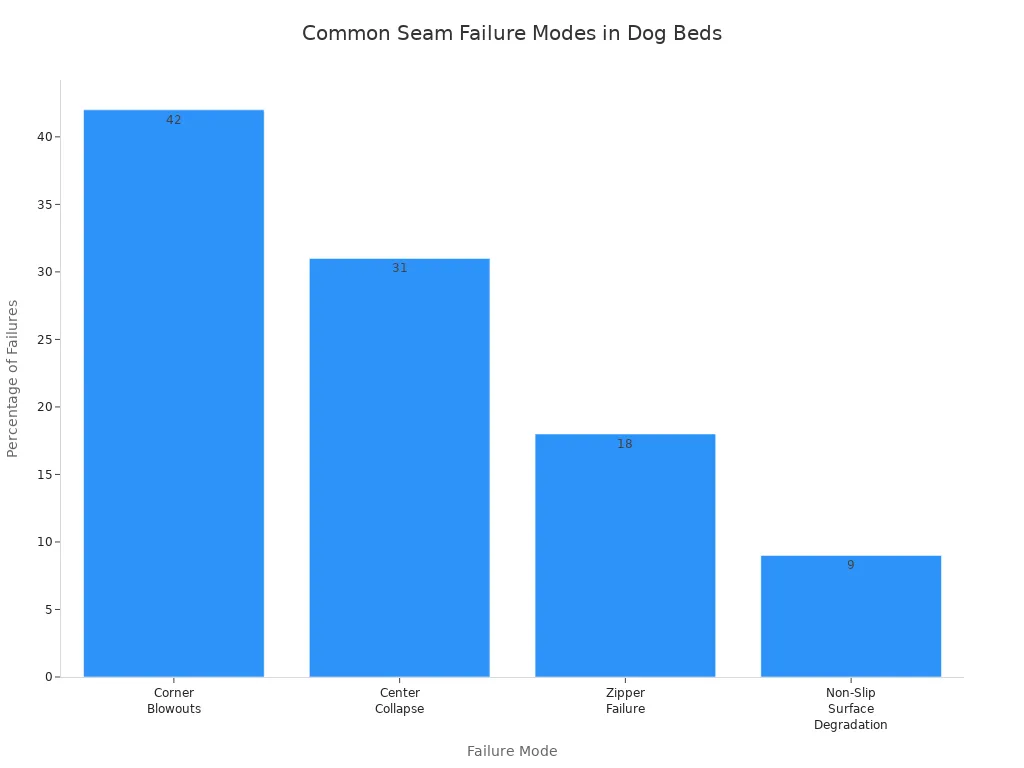
Tip: Always look at photos of seam failures in lab reports. These pictures help you see problems and make your product better.
Seam Construction Specs
You can make seams stronger by picking good materials and using strong stitches. Tough fabrics like chew-resistant canvas and waterproof polyester last longer. Using double or triple stitching helps seams stay together when pulled or chewed. Beds with strong seams last longer when dogs play rough.
Pick chew-resistant canvas or waterproof polyester for the cover.
Use double or triple stitching on every seam.
Make corners stronger with box-stitching and cross-stitch patterns.
Choose thick, bonded nylon or polyester thread.
Check that stitches are even and none are missing.
Checklist for RFQ and Lab Reports:
Say what fabric and thread you want.
Ask for double or extra stitching at stress spots.
Ask for seam efficiency numbers (how strong the seam is).
Request photos of seams and where they broke.
Handle & Zipper Tests
Handles and zippers get pulled a lot during use. You need to test these parts to see if they are strong. Handles should not rip off, even when you lift the bed with weight. Zippers should stay closed and not break when pulled.
Test handle strength by pulling it at a 45-degree angle with set force.
Use strong zippers, size #5 or bigger, with fabric flaps to protect them.
Check zipper seams for missing stitches or loose threads.
Write down how much force it takes to break handles or zippers.
Add before and after photos of handles and zippers in lab reports.
Actionable Step: Always ask for lab reports to show force units (like Newtons), pull direction, photos of failures, and seam efficiency. This helps you compare beds and find weak spots.
You can make your buying and quality checks better by following easy steps for lab tests. Use clear checklists and tell suppliers what you need. Add lab testing rules to your RFQ and when you pick suppliers for each outdoor dog bed. Stridepaw says you should use these steps every time. Contact Stridepaw if you want help making a strong, test-based buying plan.
FAQ
What is the most important lab test for outdoor dog beds?
You should focus on abrasion testing. This test shows if the fabric can handle scratching and rough use. Always check the test method, cycles, and failure points in the report.
How often should you request lab testing from suppliers?
You should request lab tests for every new material, design change, or supplier. For ongoing orders, test at least once per year or after any major quality issue.
Which standards should you specify for waterproof testing?
You should specify ISO 811 or AATCC 127 for hydrostatic head testing. Ask suppliers to report the value in millimeters and include photos of the tested area.
Why do you need to test seams separately from fabric?
Seams can fail even if the fabric is strong. You should test seam strength to find weak points and make sure the bed stays together during use.
What is the difference between water repellency and waterproofing?
Water repellency means the fabric resists light moisture. Waterproofing means the fabric blocks water under pressure. Always ask for hydrostatic head test results to confirm waterproofing.
How do you verify UV resistance in all components?
You should request UV test results for fabric, threads, handles, and trims. Make sure the report lists test cycles, standards, and strength retention for each part.
What documentation should you keep for quality audits?
Keep all lab reports, sampling plans, RFQs, and supplier treatment disclosures. Store before/after photos and pass/fail records for each shipment. This helps you track quality and solve problems quickly.