Dog Training Leash SKU Naming Rules for Length and Hardware in Retail Catalogs

Dog Training Leash SKU Naming Rules for Length and Hardware in Retail Catalogs

Messy naming for dog training leash SKUs creates problems for you. Duplicate SKUs make it hard to track dog leash inventory and cause mistakes in shipments. You see returns from customers who receive the wrong dog training product. This confusion slows down your team and frustrates people who want the right leash for their dogs. Clear SKU rules help you avoid mix-ups and improve catalog accuracy for every dog product you manage.

Key Takeaways

  • Give each dog leash its own SKU name. This stops mix-ups and helps track inventory.

  • Put leash length and hardware type in the SKU title. This helps customers and your team pick the right product.

  • Set up your catalog with standard leash lengths. Use clear naming rules to avoid confusion and work faster.

  • Check your SKU names and product details often. This keeps things correct and stops expensive returns.

  • Teach your team about SKU rules and good habits. This makes catalog management better and keeps customers happy.

Why SKU Naming Fails in Dog Leash Catalogs

Duplicate Variants and Photo Errors

You see duplicate variants when you use unclear SKU naming for dog products. If you list two dog leashes with similar names, your team may pick the wrong item for a customer. This mistake leads to confusion and extra work. You also risk showing the wrong photo for a dog leash. When your catalog has duplicate SKUs, your system may link the wrong image to the product. Customers expect to see the exact dog leash they will receive. If the photo does not match, you get returns and complaints.

Tip: Always check that each dog leash SKU has a unique name and the correct photo. This step helps you avoid mix-ups and keeps your catalog clean.

Wrong Leash Length and Hardware Issues

You face problems when your SKU naming does not show the right leash length or hardware type. If you use vague names, your team may send a 4 ft leash when the customer ordered a 6 ft leash. Dogs need the right length for training and safety. Hardware mistakes also cause trouble. If you do not name the clip type, you may ship a bolt snap when the customer wanted a trigger snap. These errors lead to returns and unhappy customers. You must name the length and hardware clearly for every dog leash.

Here is a table to help you prevent returns caused by poor naming:

Return reason

Root cause in naming

Fix in naming or attributes

Wrong leash length received

Length not shown in title

Add clear length (imperial/metric)

Wrong hardware type shipped

Clip type missing in name

Specify hardware in title

Photo does not match product

Duplicate or vague SKU name

Use unique SKU and correct photo

Clear SKU naming helps you avoid these problems. You keep your dog training catalog accurate and make sure dogs get the right products.

Naming Principles for Dog Training Leash SKUs

Leash Length in Titles

You need to show leash length in every dog training leash title. This step helps your team and customers pick the right product for their dogs. Always use both imperial and metric units. For example, you can write 6 ft (183 cm) in the title. This rule keeps your catalog clear for US and EU shoppers. Use the same rounding for all leash lengths. If you round to the nearest centimeter, do it for every dog leash. You avoid confusion and mistakes when you follow this rule.

Tip: List leash length first in the title. This makes it easy for shoppers to scan and compare dog training leashes.

Hardware Clarity for Teams

You must name the hardware type in each dog training leash SKU. Use clear words like bolt snap, trigger snap, or carabiner-style clip. If the leash has a swivel, say so in the title. This detail helps your team pick the right dog leash and prevents mix-ups. You reduce returns when you show hardware type clearly. Your catalog stays organized, and your team works faster.

Hardware Type

Example in Title

Bolt Snap

6 ft (183 cm) Bolt Snap

Trigger Snap

15 ft (457 cm) Trigger Snap

Carabiner-Style

30 ft (914 cm) Carabiner Clip

Swivel Included

10 ft (305 cm) Swivel Bolt Snap

Shopper vs Internal Naming

You need to separate shopper-facing titles from internal SKU codes. Shoppers want to see leash length and hardware type. Your team needs codes that help track dog training leash variants. Only put high-signal details in the title. Put other facts like width, material, or color in structured fields. This method keeps your catalog clean and easy to search. You help shoppers find the right dog training leash and make your team’s job easier.

Note: Use simple, direct language in shopper titles. Save technical details for internal records.

Dog Training Leash Length Taxonomy

Dog Training Leash Length Taxonomy

Everyday and Long-Line Lengths

You need to organize your dog training leash catalog using a clear length ladder. This step helps you avoid confusion and makes it easy for your team to manage products. Everyday leashes work best for walking dogs in busy areas or during basic dog training. The 4-foot leash gives you more control, especially when you want your dog close. The 6-foot leash balances freedom and control, making it the best leash length for most training sessions. Long-line leashes help dogs practice recall and explore open spaces safely. You can use a 10-foot, 15-foot, or even a 30-foot leash length for these activities.

  • 4-foot leash: Ideal for obedience training and keeping your dog close.

  • 6-foot leash: Best leash length for general dog training and walking.

  • Long lines (10 to 30 feet): Perfect for recall work and letting dogs roam in safe areas.

Fixed Ladder for Catalogs

You should publish a fixed ladder of leash lengths in your catalog. This method keeps your product list simple and prevents mistakes. Avoid adding in-between lengths unless you have a strong reason from manufacturing. Always show both imperial and metric units, rounded to the nearest centimeter. This rule helps shoppers in the US and EU understand your offerings.

Here is a table to guide you:

Use Case Group

Standard Lengths to Offer

How to Name It

Everyday Walking

4 ft (122 cm), 6 ft (183 cm)

4-foot leash, 6-foot leash

Close Control

1 ft (30 cm), 2 ft (61 cm)

Tab leash, 2-foot leash

Long-Line Training

10 ft (305 cm), 15 ft (457 cm), 30 ft (914 cm)

10-foot leash, 15-foot leash, 30-foot leash

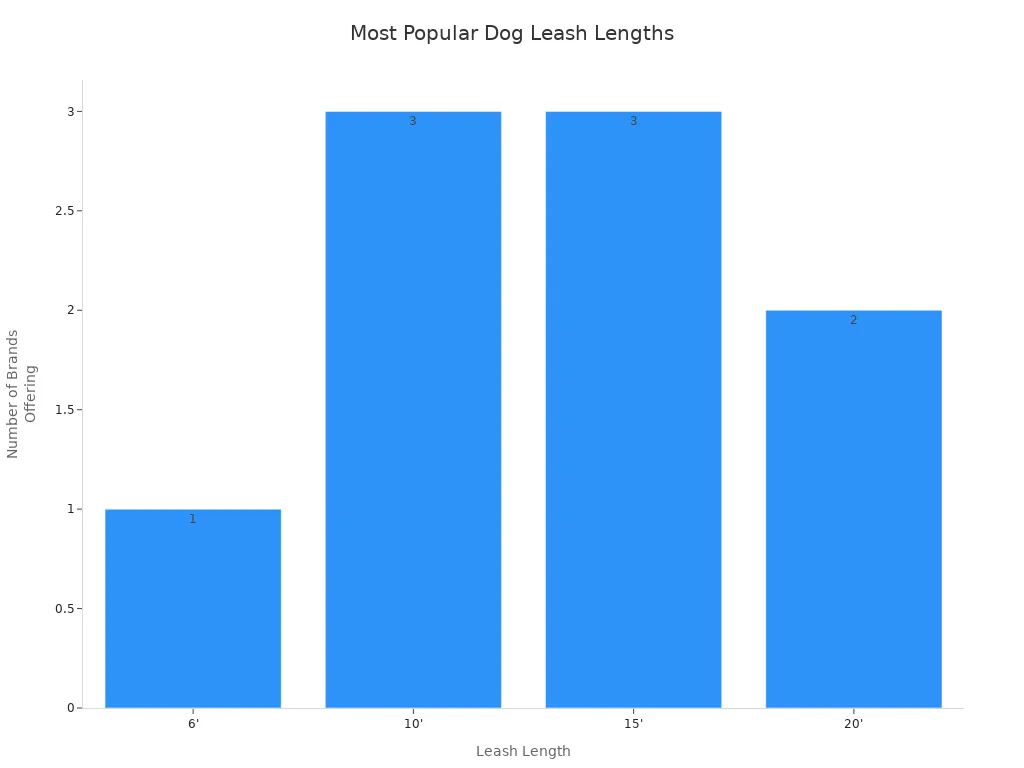
You can see that leading brands offer these standard lengths most often. The chart below shows how often each leash length appears in retail catalogs.

Bar chart showing the frequency of dog leash lengths offered by leading brands

Tip: Stick to the fixed ladder for your dog training leash catalog. You make it easier for your team and shoppers to find the best leash length for every dog.

Hardware Types and Strength in Dog Leash SKUs

Hardware Types and Strength in Dog Leash SKUs

Clip and Swivel Naming

You have to use the right words when you name leash hardware in your catalog. Clear words help your team avoid mistakes. They also keep your dog training leash listings correct. The most common clip and clasp designs are bolt snap, trigger snap, and carabiner-style. Swivels stop the leash from twisting and should be named clearly. You must show these features in the title for every standard dog leash.

Here is a hardware dictionary for your catalog:

Hardware Term

What It Means

How to Show It in the Title

Bolt Snap

Manually operated snap clip

6 ft Bolt Snap

Trigger Snap

Lever-triggered snap clip

15 ft Trigger Snap

Carabiner-Style

Gate clip, not climbing rated

30 ft Carabiner Clip

Swivel

Rotating joint to prevent twisting

Swivel Bolt Snap

Frog Clip

Quick-release, high strength

Frog Clip

Cobra Buckle

Quick-release buckle, corrosion-resistant

Cobra Buckle

O-Ring

Circular ring for attachment

O-Ring

V-Ring

Triangular ring for rapid deployment

V-Ring

D-Ring

Secure attachment ring

D-Ring

Tip: Always use these words for every dog lead and retractable dog leash. This helps your team and shoppers know what types of leashes you sell.

Rings and Attachments

You must name rings and attachments in your standard dog leash SKUs. O-rings, V-rings, and D-rings all do different jobs. O-rings can release if they get caught. V-rings let you use the leash quickly. D-rings give a strong place to attach things. These features make your dog training leash more useful. You should put rings in the title only if they change how the dog lead works.

Strength and Durability Language

You need to use strength and durability words that match what you can prove. For every standard dog leash, only mention the material and test method if you have proof. Brass hardware is stronger and lasts longer than zinc alloy, especially for big dogs. You must not promise too much. Use words like minimum breaking load and safe working load. Testing, load rating, and material quality all change how strong and tough your leash hardware is.

  • Zinc alloy costs less but does not last as long.

  • Brass is very strong and lasts a long time.

  • Always ask for supplier test reports for retractable dog leash hardware.

Note: Only say things about strength and durability if you have test data. This keeps your catalog safe for dogs and helps shoppers trust you.

SKU Naming Formula and Cleanliness Rules

You must use a clear formula to name each dog leash SKU. This formula stops mistakes and keeps your catalog neat. It also helps your team find the right dog training products fast. Simple rules and templates make shopper-facing titles and internal SKU codes easy. These steps help you control variants and stop errors with leash length and hardware.

Shopper-Facing Title Template

Shoppers need to see the most important details first. The title must show leash length and hardware type. Do not add extra words or features that do not change the product. This way, your catalog is easy to scan and compare.

Shopper-Facing Title Template:

[Leash Length in ft/cm] [Hardware Type] Dog Leash

Examples:

  • 6 ft (183 cm) Bolt Snap Dog Leash

  • 15 ft (457 cm) Trigger Snap Dog Leash

  • 30 ft (914 cm) Carabiner Clip Dog Leash

Tip: Put leash length first. This helps shoppers find the right dog leash quickly.

Do not put width, color, or material in the title. Add these details in other fields. This rule keeps your catalog simple and helps shoppers focus on the main features.

Internal SKU Code Structure

You need a strong system for internal SKU codes. This system helps your team track every dog leash variant. It also helps in the warehouse. Use a set order for tokens, keep codes short, and do not use special characters. Dashes or underscores can separate attributes. Always use uppercase letters and numbers. Never start codes with zero.

Internal SKU Code Template:

[LEASH LENGTH]-[HARDWARE]-[COLOR]-[WIDTH]

Examples:

  • 06FT-BSNAP-BLK-12MM

  • 15FT-TSNAP-RED-10MM

  • 30FT-CARAB-BLU-08MM

Add more tokens if you need to track extra features. Make sure each part is easy to read. Plan for growth so you can add new leash lengths or hardware types later.

Note: Check marketplace rules before you set your SKU code format. Some sites limit code length or allowed characters.

Best Practices for Internal SKU Codes:

  • Use only letters, numbers, dashes, or underscores.

  • Do not use spaces or special characters.

  • Make abbreviations clear and easy to understand.

  • Keep codes short but detailed enough for control.

SKU Cleanliness Rules Table

You must follow strict rules to keep your dog leash SKUs neat and easy to manage. This table shows the main rules, why they matter, and good naming examples.

Rule/Practice

Why it matters

Example of correct naming

SKU Code Formatting

Stops system errors and import issues

06FT-BSNAP-BLK-12MM

Attribute-Based Categorization

Makes it easy to sort and find products by key features

15FT-TSNAP-RED-10MM

Consistency in Process

Reduces mistakes and training time for your team

All SKUs follow the same template

Regular Inventory Audits

Helps you catch errors and keep your catalog up to date

Audit SKU list every quarter

Technology and Automation

Improves accuracy and speed with barcode scanners and software

Use barcode for 30FT-CARAB-BLU-08MM

Practical Tips for SKU Management

Keeps codes short, documentation updated, and staff trained

Train team on SKU rules

You should check your dog leash SKUs often. Use barcode scanners to help your team work faster and avoid mistakes. Always update your documentation and train your staff on SKU rules.

Tip: Clean SKUs help you avoid returns, picking errors, and confusion. You keep your dog training catalog safe and easy for everyone.

Attributes and Feed Discipline for Dog Training Catalogs

Numeric Leash Length and Width

You need to set up your catalog so every dog leash shows numeric length and width with units. This step helps your team and shoppers compare products quickly. You should use a dedicated field for length, such as “Length (ft/cm).” You must also use a separate field for width, like “Width (mm/in).” Always round width to the nearest millimeter or inch. This rule keeps your catalog consistent and easy to search.

Attribute

Example Value

Units

Length

6 / 183

ft / cm

Width

12

mm

You should avoid putting width in the product title. Instead, use the width field in your feed or product information management system. This method reduces errors and helps you manage dog training leash variants.

Material, Color, and Finish

You must keep material, color, and finish in structured fields, not in the title. This step makes your catalog easier to filter and sort. You can use a dropdown or attribute field for each. For dog leashes, common materials include:

  • Biothane: Combines the look of leather and nylon. It stands up to weather and keeps its color in sunlight.

  • Nylon: Lightweight and strong. You find it in many colors. It works well for hands-free use and often has a UV coating for extra durability.

  • Sewing: You see this method in strong leashes. It gives consistent results and makes it easy to check for wear.

You should list color and finish separately. For example, use “Color: Red” and “Finish: Matte.” This practice helps you avoid confusion and keeps your catalog clean.

Variation Themes and SKU Splits

You need to split dog leash SKUs by high-signal attributes only. Length and hardware type should drive your main variants. You should use width, material, and color as secondary attributes in your feed. This rule keeps your catalog simple and helps you avoid duplicate SKUs. You can set up variation themes like:

  • Length

  • Hardware type

  • Width

You should not split SKUs by color or finish unless your shoppers demand it. This method keeps your catalog easy to manage and reduces picking errors. You help dogs get the right dog training leash every time.

Tip: Always check your feed for missing or mixed width values. Consistent width fields help you avoid costly mistakes.

Photo and Packaging Alignment

Photo Set for Length and Hardware

You need to use clear photos for every dog leash. Each photo must show the leash length and hardware type. This helps your team and shoppers know what they will get. Take a close-up picture of the clip. Show the whole leash in another photo. Put the leash next to a ruler or measuring tape to show its length. These pictures make it easy to check if the product matches the catalog title. You can stop mistakes and returns by making sure every dog training leash photo is correct.

  • Show the whole leash with a length marker that is easy to see.

  • Take a close-up photo of the hardware, like a bolt snap or trigger snap.

  • Add a picture of any special rings or attachments.

  • Use pack photos to show what the product looks like in its packaging.

Tip: Always check that your photos match the catalog description. This step helps you prove the product details for every dog.

Packaging Label Consistency

You must make sure packaging labels match your catalog naming. The label on each dog leash should be the same as the title and details shown online or in your product feed. Custom packaging helps your brand look good. Think about if the leash will sell online or in stores. Packaging must be strong for shipping and look nice for store displays. Keep label artwork and revision history up to date. This helps you track changes and avoid mistakes.

Here is a table to help you check your packaging:

Evidence Item

Description

Importance

Label artwork + revision history

Source files and version details

Makes sure the label matches the catalog

Bill of materials (BOM)

Details on materials used

Shows where the product comes from and what it is made of

Pack photos

Pictures of the packaging

Helps with audits and checks labeling rules

You should always check that the packaging label shows the right leash length and hardware type from your catalog. This step helps you keep your dog training products correct and easy to check. You make sure dogs get the right leash every time.

Receiving and QA for Dog Leash Variants

Inspection Checklist

You need a clear process when you receive a shipment of dog leashes. Start by checking the labels on each box. Make sure the leash length and hardware type match your catalog. Open a sample from each variant. Look at the leash and hardware. Check that the dog leash has the correct clip, such as a bolt snap or trigger snap. Measure the leash to confirm the length matches what you ordered.

Use this table to guide your inspection:

Test Type

Purpose

Tensile

Checks the strength of the leash and snap

Salt Spray

Tests for corrosion resistance

UV

Looks for fading from sunlight

Static Wet

Checks for color transfer when wet

Crock Testing

Checks for color transfer from rubbing

Visual Inspections

Confirms correct hardware and packaging

You should also check the packaging. Make sure the label matches the catalog name and shows the right dog training details. Take photos of any issues you find. This helps you keep records and solve problems fast.

Tip: Always use the same checklist for every shipment. This keeps your process simple and helps you catch mistakes before they reach your customers.

Handling Mixed Variants

Sometimes you find mixed variants in a shipment. You might see different leash lengths or hardware types in the same box. This can cause confusion and mistakes for your team and for dogs who need the right product.

Follow these steps if you find mixed variants:

  1. Stop unpacking and separate the mixed items.

  2. Count each type of dog leash and record the details.

  3. Take photos of the mixed variants for your records.

  4. Contact your supplier with the details and photos.

  5. Hold the mixed items in a separate area until you get instructions.

  6. Update your inventory records to show the issue.

You help dogs get the right leash when you follow these steps. You also protect your business from costly returns and unhappy customers.

Note: A strong receiving and QA process keeps your catalog accurate and your dog products safe for every dog.

RFQ and Supplier Controls for Leash Programs

Naming Consistency in RFQs

You must set clear rules when you ask suppliers for prices. Tell them to use the same names on every label, box, and barcode. This helps your catalog stay neat and helps your team match products. Give your suppliers a naming template to follow. Tell them to use the same leash length and hardware words as your catalog. Ask for barcode text that matches your SKU code. Request packaging words that repeat the leash length and hardware type. This stops mix-ups and makes picking the right gear easy for everyone.

Tip: Always add a checklist to your RFQ. Ask for sample labels, box markings, and barcode text before you say yes to production.

OEM means the supplier builds a product using your design and brand. ODM means the supplier designs and makes the product, but you sell it with your brand name. Private label means you put your brand and catalog info on the product. You must control names on labels, barcode text, packaging words, and catalog details. This keeps your dog leash program the same and helps you pick the right gear for dogs.

Supplier Scorecard for Variants

You should use a scorecard to check how well your suppliers handle leash types. The scorecard shows if suppliers follow your naming rules and keep products sorted by leash length and hardware type. You can rate suppliers on these things:

  • Label and barcode are correct

  • Packaging words match catalog names

  • Each box has only one type

  • Samples get checked before shipping

  • Fast fixes for mix-ups

Scorecard Item

What to Check

Why It Matters

Label Consistency

Leash length and hardware on label

Stops picking errors

Barcode Text Match

Barcode matches SKU code

Helps with inventory control

Carton Sorting

Each carton has one variant only

Reduces mix-ups

Sample Review

Samples match catalog before shipment

Ensures quality and accuracy

Issue Resolution

Fast fix for mixed variants

Protects your business and dogs

You help your team and shoppers pick the right leash and gear every time. You keep your dog leash program strong and safe for all dogs.

You keep your catalog strong when you follow clear SKU naming rules for every dog leash. You help your team avoid mistakes and make sure each puppy gets the right training gear. You improve safety and support obedience with the right working dog leash for every puppy. Start by using the templates, audit your catalog, and train your team. Use this checklist:

  • Check leash length and hardware in every SKU.

  • Update photos and packaging for each puppy product.

  • Review supplier labels for working dog leash accuracy.

Keep learning and share feedback to improve your puppy catalog.

FAQ

What leash lengths should you include in your retail catalog?

Offer standard lengths like 4 ft, 6 ft, 10 ft, 15 ft, and 30 ft. These sizes work for most training and walking. Do not use custom lengths unless manufacturing needs them.

How do you name hardware types in leash SKUs?

Use clear words like bolt snap, trigger snap, or carabiner clip. Always put the hardware type in the product title. This helps your team and shoppers find the right product fast.

Why do you need both imperial and metric units in leash naming?

Showing both units helps shoppers in the US and EU compare products. It makes things less confusing and keeps your catalog correct. Always round metric numbers to the nearest centimeter.

What is the best way to handle color and material in your catalog?

Put color and material in special attribute fields, not in the product title. This keeps your catalog neat and helps shoppers filter and compare products easily.

Get A Free Quote Now !

Table of Contents

Blog

Canine Pulling Harness How to Spot Wear Before a Hard Pull Turns Risky

Spot wear on your canine pulling harness by checking stitching and hardware before each hard pull to ensure durability and keep your dog safe.

Puppy Collars Custom: How to Check Tightness and Prevent Slipping Safely

Puppy collars custom should fit snugly with two fingers under the collar. Use the slip test to prevent loss and keep your puppy safe and comfortable.

Dog Running Leash: How to Select Hands-free or Standard Based on Real Pulling Patterns

Choose the right dog running leash by matching hands-free or standard setups to your dog's pulling and walking style for safety and control.

Dog Carry Bike Risk Checklist: Body Language Warnings and When to Stop Immediately

Spot stress or danger in your dog during dog carry bike rides. Learn body language warnings and when to stop for your dog's safety on hikes or rainy walks.

Which Waterproof Dog Bed Stays Dry on Wet Ground?

A waterproof dog bed with sealed seams, strong base, and high hydrostatic head value keeps your dog dry on wet ground during outdoor use.

Dog Leashes: How to Spot Wear Before a Leash Fails on a Walk

Check dog leashes for fraying, weak stitching, and hardware issues before walks. Spot stress points early to prevent leash failure and keep your dog safe.
Scroll to Top

If You Have Any Questions, Please Do Not Hesitate To Contatct With Us.

Get A Free Quote Now !

Welsh corgi wearing a dog harness on a walk outdoors