Returns Economics: Why Support Macros Matter To EU/US Buyers
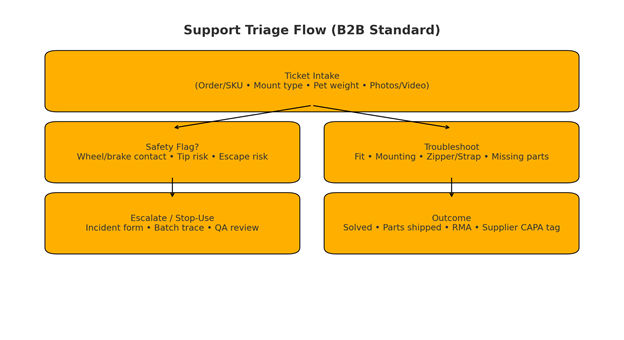
For buyers and product teams, a bike category launch lives or dies on two numbers: return rate and defect-confirmation rate. Returns are not just a customer-service expense. They change margin, chargeback exposure, and how confident a retailer is to reorder. In the latest U.S. retail returns landscape, industry projections point to hundreds of billions of dollars in returns and a notably higher return share for online transactions compared with store sales. That matters because bike dog carrier programs often start online, where fit and installation confusion create “avoidable” returns.
A Customer Support Macro Pack is a procurement control. It standardizes how your team collects evidence, troubleshoots safely, and decides between ‘how-to guidance’, ‘parts replacement’, and ‘RMA’. The goal is not to deny returns. The goal is to resolve legitimate issues faster while reducing preventable returns caused by missing info, unclear setup, or misclassified defects.
What EU/US buyers typically want this pack to achieve:
- Lower preventable RMAs (wrong fit, incorrect mounting, missing steps).
- Faster time-to-resolution for true defects (with clear evidence standards).
- Safer escalation for incidents or near-misses (stop-use language and documented intake).
- Cleaner data for QA and supplier corrective actions (ticket tags that translate into CAPA).
Bike Dog Carrier Ticket Taxonomy Procurement Can standardize Across Channels
Your macro pack will fail if tickets are tagged inconsistently. A buyer-ready taxonomy uses a small set of mutually exclusive buckets that work for marketplaces, DTC, and wholesale accounts. Keep it simple enough for a first-line agent, but structured enough for QA analytics.
Recommended routing buckets (keep the same names in every channel):
| Bucket | Typical customer wording | First-line action |
| Compatibility & Fit | “Doesn’t fit my bike / dog” | Run Fit & Bike Check intake; confirm limits and clearances |
| Mounting & Stability | “Wobbles / tilts / feels unsafe” | Run mounting checklist; request wobble video; check interference |
| Missing / Wrong Parts | “Parts not in box” | Parts-ID checklist + carton photo; ship parts kit if eligible |
| Transit Damage (DOA) | “Arrived damaged” | Carton evidence workflow; classify damage vs defect |
| Functional (zipper/buckle) | “Zipper stuck / buckle broke” | Adjustment steps + defect screen; parts decision |
| Material/Construction | “Stitching came apart” | Seam photo set; stop-use if load-bearing seam |
| Safety Escalation | “Tip-over / near miss / injury risk” | Stop-use macro + incident intake + QA review |
| Policy / RMA Request | “I want a refund” | Confirm eligibility + evidence + route based on above bucket |
Tip for EU/US teams: mandate these fields before an agent can authorize a return. It reduces back-and-forth and protects you from return fraud without turning support into an interrogation.
Intake Checklist That Prevents Back-And-Forth And Misclassified Defects
Most ‘defect’ tickets are actually missing context. A standardized intake checklist is the cheapest way to reduce contact loops and speed up correct resolutions. Make these fields required in your helpdesk form and in wholesale partner claim forms.
Minimum evidence package (request once, up front):
- Order ID + SKU + color/size variant.
- Carrier type (rear rack / handlebar / frame mount) and the mounting hardware currently used.
- Pet weight and basic posture notes (can the pet sit/turn without pressing into zippers/panels).
- Bike type + rack type (if rear rack): fixed rack vs aftermarket rack; disc-brake clearance if relevant.
- 4 photos: installed side view, installed rear view, top view, and close-up of fasteners/attachment points.
- If stability is reported: a 10–15 second wobble video on a stationary bike (no riding required).
- If DOA/transit damage: photos of the outer carton (all sides) plus the product damage close-up.
Buyer note: when your intake is structured, your internal defect-confirmation rate becomes meaningful. That makes supplier conversations faster and more objective.
Bike Dog Carrier Step-By-Step Mounting And Stability Fixes (Copy/Paste Macros)
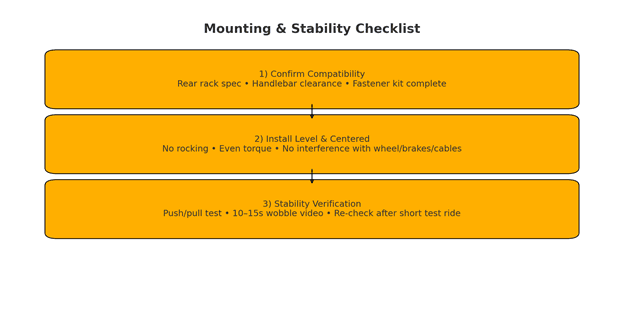
Mounting confusion is one of the biggest drivers of preventable returns in bike carriers. The macros below are written in a neutral, safety-first tone. They avoid absolute claims and are designed to work for both retail and wholesale support.
Macro 1-Mounting triage (request the right facts):
Subject: Quick mounting check to confirm compatibility and safe setup
Thanks for reaching out. To confirm a safe setup and avoid an unnecessary return, please reply with:
1) Your mounting type (rear rack / handlebar / frame)
2) A side photo of the carrier installed on the bike
3) Two close-up photos of the fasteners or attachment points (left and right)
4) Confirm whether any part touches the wheel, brake, or cables during steering.
If there is any wheel/brake contact, please pause use until we review your photos.
Macro 2-Wobble/tilt fix checklist:
Subject: Step-by-step wobble fix checklist
Please try these steps with the bike stationary and supported:
1) Re-seat the base so it sits flat with no rocking.
2) Tighten fasteners evenly, alternating sides to reduce twist.
3) Verify the bike rack or mounting point itself is tight.
4) If straps are used, tension both sides evenly (avoid over-tightening that bends panels).
5) Send a 10–15 second video showing any remaining wobble.
If wobble remains after these steps, we’ll confirm whether a parts replacement or a return is the safest option.
Macro 3-Interference warning (high priority):
Subject: Clearance concern-please pause use while we verify
Based on your description, there may be a clearance issue. For safety, please stop using the carrier until we confirm:
– No contact with wheel/brake/cables
– The carrier stays level on flat ground
– Fasteners are fully seated and tightened evenly
Send a side photo and a close-up of the contact area, and we’ll advise next steps.
Fit, Capacity, And Containment Scripts That Reduce “Wrong Item” Returns
In EU/US markets, a large share of returns come from ‘wrong fit’ rather than true quality failures. The fix is not more marketing language. It is a consistent fit-verification process with clear evidence. These macros help you set expectations without sounding strict or dismissive.
Macro 4-Fit verification (bike + pet):
Subject: Fit verification to confirm the correct model and safe use
To confirm fit and avoid a return, please share:
1) Pet weight and approximate shoulder height
2) A side photo of the bike and the mounting area
3) A top view photo of the carrier installed
4) Confirm the mounting type (rear rack / handlebar / frame)
Once we review this, we’ll confirm compatibility and the safest next steps.
Macro 5-Capacity reminder (non-absolute, safety-first):
Subject: Capacity confirmation for safe operation
For safe operation, we need to confirm the pet weight is within the rated limit and that the pet can sit and turn without pressing into panels or zippers. If you’re unsure, please share a photo of the pet seated in the carrier while the bike is stationary. We’ll advise based on what we can verify.
Macro 6-Containment / tether reminder (risk control):
Subject: Containment check before riding
Please confirm the pet is attached using the internal tether to a harness (not a collar) and that openings are fully closed before movement. If the pet shows repeated attempts to exit, please stop use and tell us what you observed so we can recommend a safer approach.
Buyer note: If your product pages and support scripts use the same fit questions, you’ll see fewer mismatched purchases and fewer ‘instant refund’ requests.
Defect Screening Macros For zippers, Straps, Stitching, And Structural Parts
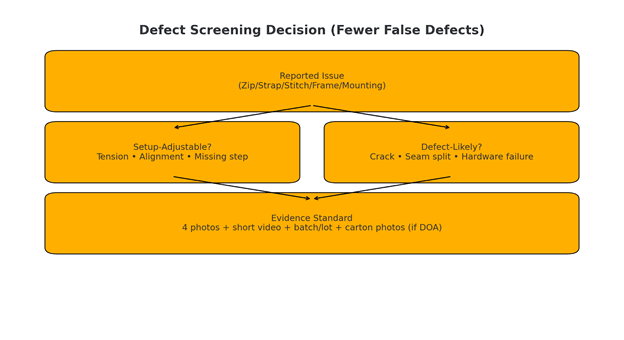
Defect screening should be fast, consistent, and fair. The aim is to avoid two costly mistakes: treating a setup issue as a defect, and treating a real defect as ‘user error’. Use the decision structure below to keep agents aligned with QA.
Macro 7-Zipper jam / hard to close:
Subject: Zipper troubleshooting (quick fix + defect check)
Zippers may feel tight if fabric panels are under tension. Please try:
1) Empty the carrier completely
2) Check that padding or liner fabric is not caught in the zipper path
3) Gently move the slider back and forth a short distance to re-track
4) Send a close-up photo of the zipper teeth and slider
If the zipper separates or skips teeth consistently, we’ll evaluate a replacement option.
Macro 8-Strap or stitching concern (load-bearing):
Subject: Strap/stitching inspection needed (please pause use if load-bearing)
Please send close-up photos of the affected seam, plus a full photo showing where the strap connects. If the area is load-bearing, please pause use until we confirm whether a replacement is needed.
Macro 9-Structural crack / deformation:
Subject: Structural inspection (safety-first)
Thanks-this may affect safe use. Please do not ride with the carrier until we review:
1) A photo of the damage with a coin or ruler for scale
2) A full photo of the carrier installed (stationary)
3) If it arrived this way: photos of the shipping carton on all sides
This helps us determine transit damage vs in-use stress and choose the correct resolution path.
Safety Escalations: Documentation Aligned With EU GPSR And U.S. CPSC Expectations
For EU/US operations, the safest support policy is one that escalates potential hazards early. This is not about panic. It’s about disciplined documentation. EU rules have moved toward stronger operator responsibilities and safety communication readiness. In the U.S., firms may have reporting duties when certain risk signals appear. Your macro pack should include a stop-use script, a standardized incident intake form, and internal routing to QA.
Macro 10-Stop-use escalation (near-miss, tip-over risk, or suspected hazard):
Subject: Safety escalation-please pause use while we review
We’re sorry to hear this. For safety, please stop using the carrier until we review details.
To investigate, please provide:
1) A short timeline of what happened
2) Bike type and mounting type
3) Pet weight
4) Photos of the installed setup and the affected area
5) Whether there was any contact with the wheel, brake, or cables
We will review and advise the safest next step, which may include parts replacement, return, or safety review.
Internal workflow (recommended for QA and compliance teams):
- Flag ticket as Safety Escalation and lock the return decision until QA review.
- Collect traceability: SKU + batch/lot + component IDs (if available).
- Quarantine any physical returns from resale until inspection is complete.
- Document conclusions and corrective actions (instructions, parts, packaging, supplier change).
- Maintain a recall-readiness folder: incident template, contact list, and decision log.
Important: This blog provides operational best practices, not legal advice. Your internal counsel or compliance advisor should confirm market-specific obligations and timelines.
Analytics And CAPA: Turning Tickets Into Supplier Improvements (Not Just Replies)
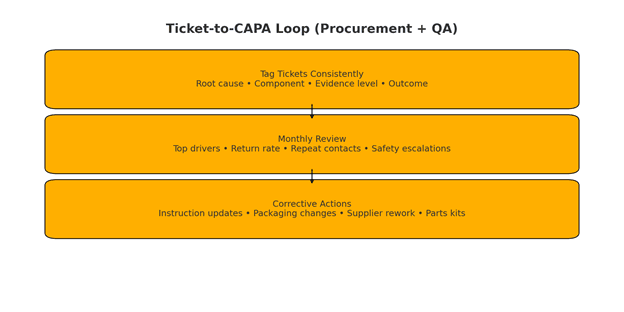
A macro pack becomes a quality system when you measure it. In EU/US channels, buyers should treat support data like a production line signal: it shows what failed, where, and how often. Use consistent tags and define a monthly review cadence with procurement, QA, and your factory partner.
Metrics that matter for buyers (simple, comparable, action-driven):
- Preventable return rate: returns tied to fit/setup confusion versus confirmed defects.
- Defect confirmation rate: % of tickets verified as defects using your evidence standard.
- First-contact resolution rate: % solved without follow-up (usually a macro quality indicator).
- Repeat-contact rate (7–14 days): highlights unclear instructions, missing parts kits, or ongoing defects.
- Parts-to-RMA ratio: how often parts replacement resolves issues versus full returns.
- Safety escalation volume: trend line for risk signals and potential recall triggers.
Procurement FAQ: What To Require In A Support Macro Pack For Bike Carriers
Q: What should we require as a deliverable from StridePaw for wholesale programs?
A: Ask for: ticket taxonomy, required intake fields, copy/paste macros, evidence checklists, safety escalation scripts, and a monthly KPI template. If you run multiple channels, require a shared tag dictionary.
Q: How do we prevent macros from becoming ‘refund scripts’?
A: Link the macro to measurable results: defect confirmation rate, first-contact resolution rate, and preventable return rate. If the macro fails to improve these metrics within the defined testing window, the input fields and installation steps should be modified.
Q: What is the fastest way to roll this out across EU and U.S. operations?
A: Start with two high-volume buckets: Fit and Mounting/Stability. Train agents with real photos and examples. Then add defect screening and safety escalation once the intake process is stable.
Q: How do we decide between shipping parts and authorizing a return?
A: Use the evidence standard and decision rules: parts replacement is best when the fault is localized (hardware, buckle, zipper slider) and the installation is verified. Return is best when structural integrity is uncertain or safety cannot be confirmed remotely.
Q: How do we handle transit damage claims efficiently?
A: Provide standardized photos of the cardboard box, the label (with personal information redacted), and close-up photos of the damage. Classify claims as “Damaged on Arrival” (DOA) and “Damaged During Use” to maintain clarity in the carrier claims and supplier corrective and preventive action (CAPA) workflows.