
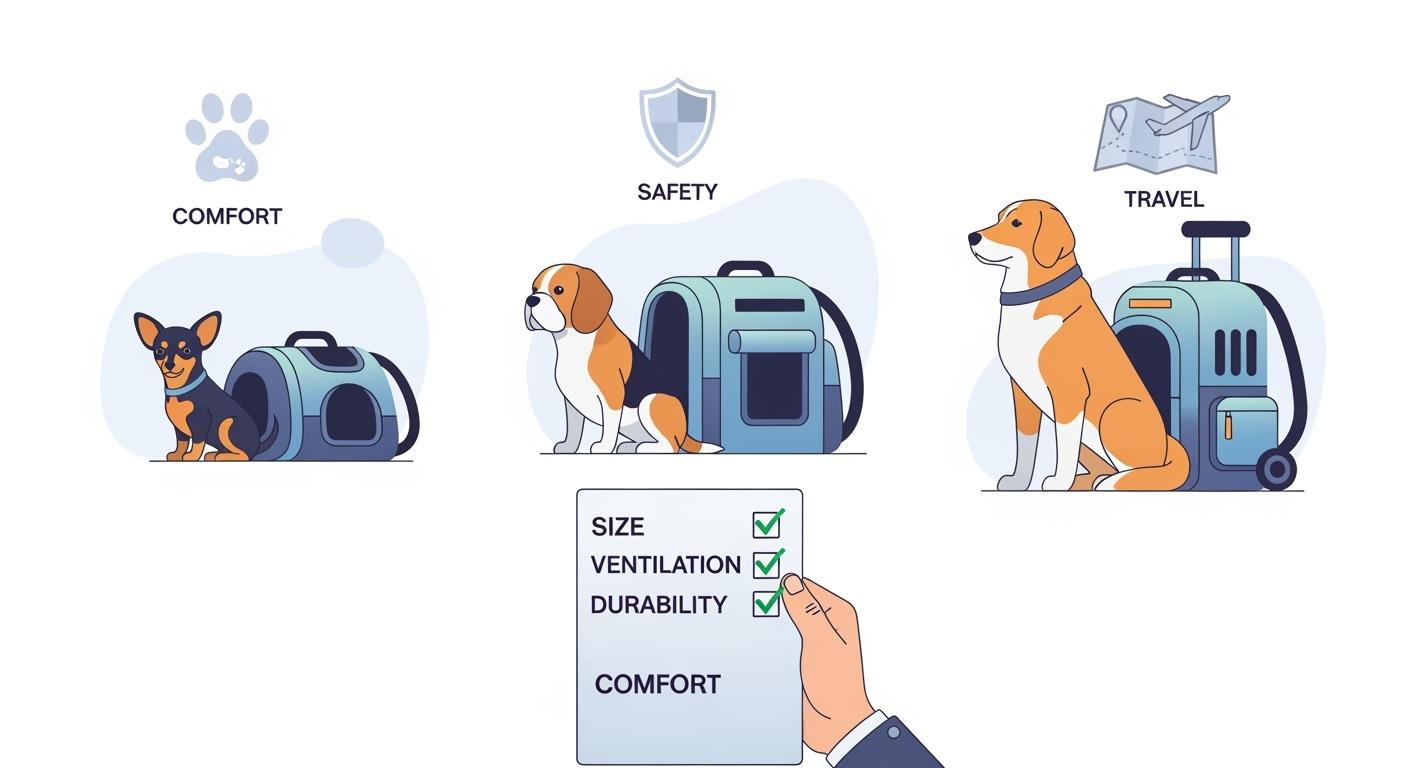
A dog can be under the listed weight limit and still fit poorly in a carrier backpack. If the usable inner space is too short, narrow or low, the dog may slump, twist, block airflow, make the base sag or cause the backpack to swing during movement. A size chart is only the starting point; the real fit check should also include body length, seated shoulder height, chest width, base support, airflow and a short carry test before using the carrier for longer outings.
Start with usable measurements, not weight alone
Weight is useful, but it does not tell buyers how the dog will sit, rest, breathe, or shift inside the carrier. A size chart that only lists maximum weight can create poor-fit decisions, especially for long-bodied dogs, deep-chested dogs, and dogs near the upper end of the size range.
For a clearer size recommendation, compare the dog with the carrier’s usable inner space, not only the outside product size.
- Body length: measure from the nose or neck-base reference point to the tail base, depending on how the carrier is designed and how the dog is expected to rest.
- Seated shoulder height: check whether the dog can sit or settle without pushing into the top, hunching, or curling too tightly.
- Chest width: compare the widest ribcage area with the internal width so the sides do not squeeze, rub, or force a tilted posture.
- Usable base area: check whether the base supports the chest, belly, and hips instead of letting the body hang through a soft bottom.
The common mistake is sizing up only to create extra room. Extra room can make the dog slide, lean, and swing inside the carrier. For buyers, the better question is whether the carrier keeps the dog supported and stable after the carrier is lifted, not whether the dog can fit inside while the backpack sits on the floor.
Match each size group to the carrier structure and real route
Dog carrier backpack size should be judged together with the route and handling scenario. Short city transfers, stairs, weekend travel, and outdoor walking do not place the same load on the carrier. A size that works for a quick try-on may still feel unstable when the customer walks, turns, or climbs steps.
Small dogs
Small dogs often fit the listed dimensions more easily, but oversizing can still create a poor carry experience. Check whether the base stays flat, whether the sidewalls keep shape, and whether the opening gives enough security without pressing around the face or neck.
For product listings, avoid suggesting that a roomy carrier is always better. Small dogs need enough space to settle, but too much empty space can increase sliding and side-to-side shifting.
Medium dogs
Medium dogs are where sizing problems usually become more visible. The dog may be under the weight limit, but the carrier can still feel heavy, saggy, or unstable once lifted. If the product is positioned for regular outings, stairs, or longer walks as part of a travel setup, treat base support, strap comfort, and bounce control as size-related checks.
A medium-size carrier should not only hold the dog. It should keep the load close to the handler, reduce swing, and prevent the dog’s body from collapsing into a soft lower compartment.
Larger dogs within the stated limit
When a dog is close to the upper end of the stated range, structure becomes more important than the label size. Weak bases, thin straps, soft sidewalls, and narrow openings can all make the product feel unsuitable even when the published weight limit looks acceptable.
- Base support: the bottom should stay flat under load, without creating a hammock effect.
- Strap support: padded shoulder straps, chest straps, or waist support can help reduce bounce and keep the load close.
- Airflow: mesh is only useful if it stays open near the dog’s nose after the dog settles into the carrier.
- Entry and closure: openings, zippers, and locking points should stay secure during loading and movement.
Run a short fit and carry test before approving the size
A short fit and carry test is one of the simplest ways to catch wrong-size or weak-structure problems before the product is used for longer trips. For B2B buyers, this type of test also helps turn vague comfort claims into clearer product requirements.
| Check area | Pass signal | Risk signal |
|---|---|---|
| Posture | The dog can sit or rest without forced curling, twisting, or slumping. | The dog leans hard to one side, braces, or cannot settle. |
| Base | The body is supported underneath and the bottom stays flat. | The carrier sags, folds, or lets the body hang through the base. |
| Airflow | Mesh and openings remain clear near the nose after the dog settles. | The face area becomes blocked by posture, padding, or collapsed fabric. |
| Stability | The carrier stays close to the handler with limited swing. | The backpack bounces, pulls backward, or shifts from side to side. |
| Closures | Zippers, openings, and tether points stay controlled during movement. | Closures creep open, feel weak, or create easy escape points. |
For catalog-wide sizing language, keep these checks consistent with your dog backpack carrier fit guide, especially when comparing usable inner dimensions, structure, and comfort across backpack styles.
Know when the size is not the real problem

Some product failures look like size problems, but the real cause is the carrier structure or use case. Moving up one size will not fix a soft base, poor ventilation, weak strap geometry, or a route that is too warm or too long for the dog.
- The dog is under the stated weight limit but still slumps because the base is too weak.
- The dog fits inside but pants quickly because airflow is blocked or the route is too warm.
- The carrier looks stable while standing still but twists, leans, or bounces once the handler starts walking.
- The dog shows repeated stress in confined spaces, even after short and calm test sessions.
In these cases, the answer is usually a different structure, a clearer use-case limit, or a different carrier style. For B2B buyers, this matters because the product page should not promise broad use when the carrier is only suitable for short trips, light loads, or calm dogs.
FAQ
Can buyers choose a dog carrier backpack by weight only?
No. Weight should be treated as a starting point, not a full sizing rule. Body length, seated height, chest width, base support, and usable inner space often explain why a carrier feels wrong even when the dog is under the stated limit.
What is the fastest sign that the backpack size is wrong?
Watch for slumping, twisting, blocked airflow near the nose, or a base that sags as soon as the dog settles inside. These signs are usually more useful than the size label alone.
Should customers size up if a dog is between two options?
Not automatically. A larger carrier can create more sliding and bounce. The better choice is the size and structure that keeps posture supported, airflow open, and movement stable during a short carry test.
How can buyers judge whether the airflow is good enough?
Check airflow after the dog has settled inside the closed carrier, not only when the carrier is empty. Mesh helps only if it stays open near the face and is not blocked by the dog’s posture, padding, or collapsed fabric.
When should a customer stop using a backpack carrier?
Stop use if the dog shows panic, repeated escape attempts, heavy panting in mild conditions, or obvious discomfort from sagging and poor support. These signs usually mean the current size, structure, or use case is not a good match.






