
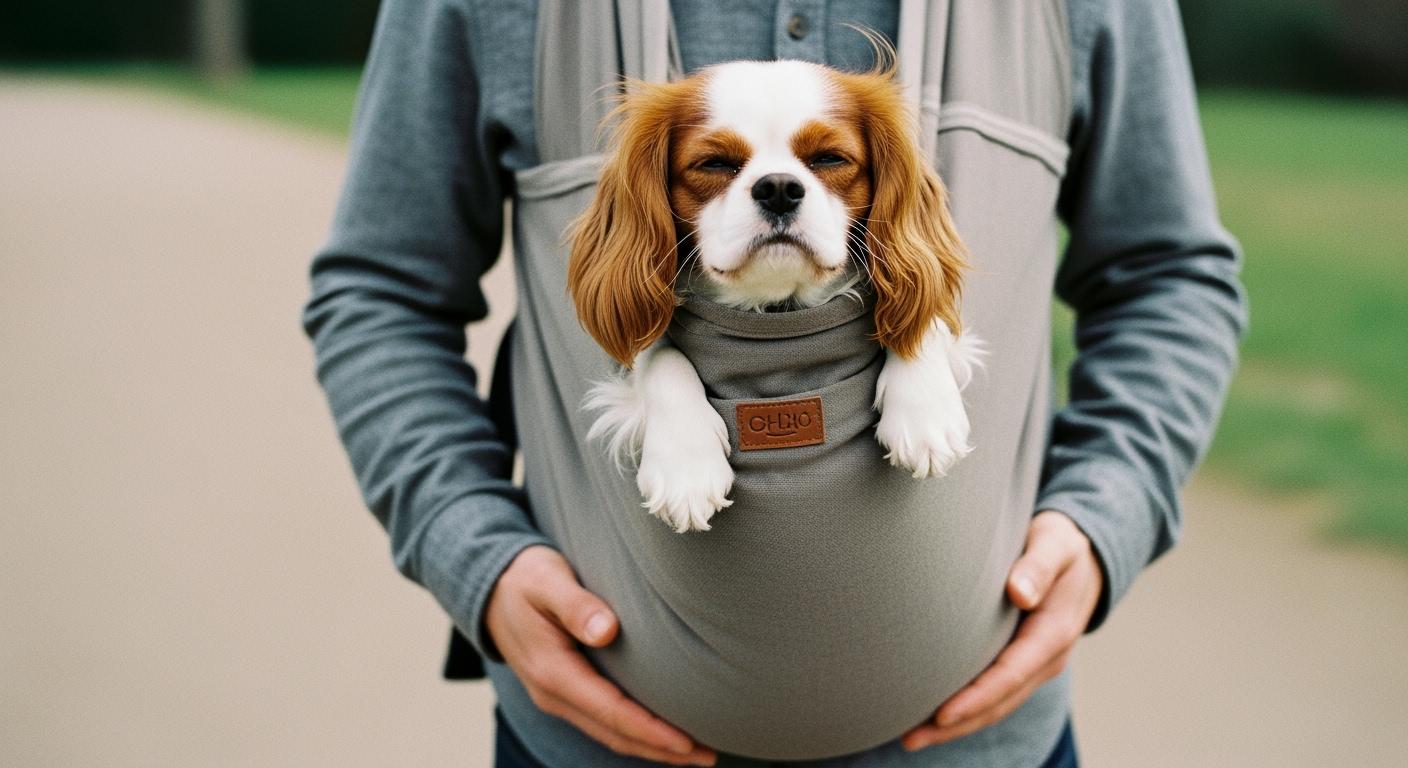
When a small dog sits upright in a sling carrier, gravity does something predictable. The dog’s torso weight vectors straight down through the hips, concentrating force onto whatever the base panel offers beneath it. If that base is shallow or narrow, the contact patch is small — and the pressure per square inch climbs fast. The fabric gives. The dog sinks. And a posture that was supposed to feel natural turns into a slow-motion slide toward the bottom of the bag.
This is not a comfort preference. It is a structural problem with a structural answer. A sling carrier built with a deeper bucket-style base and wider bottom panel changes the equation: same dog weight, larger contact area, lower pressure at any single point. The dog stays where it sits. The carrier holds its shape. That is the difference between a design that fights the dog’s posture and one that works with it.
Why a Shallow Base Fails an Upright-Sitting Dog
An upright sitting posture loads a carrier differently than a curled or lying position does. The dog’s weight presses downward on a relatively small footprint — the area directly under the hips and rear. In a carrier with a narrow bottom panel, that footprint gets even smaller. The vertical force exceeds what the fabric panel can support without deforming. The base sags. As it sags, the dog’s hips drop below shoulder level, the spine curves into a C-shape, and the dog compensates — usually by leaning against the side wall or trying to climb out.
This chain of events — concentrated weight → base deformation → spinal tilt → compensatory movement — explains why some of the most common sling carrier design flaws for small dogs are really just physics problems dressed up as comfort complaints. A dog that keeps shifting, leaning, or clawing at the opening is not being difficult. The carrier is failing a basic load-distribution test.
Low side walls compound the problem. When the base sags and the side panel sits only a few inches high, the dog’s chest and upper body have no lateral contact to push against. The dog leans outward, the opening stretches, and the feeling of being contained — the very thing that calms most small dogs in a carrier — disappears. A loose opening that gapes wider under body pressure turns the carrier from a secure pocket into an unstable hammock.
| Upright sitting issue | Likely design cause | Better design direction |
|---|---|---|
| Dog slumps or sinks | Narrow base, soft bottom panel | Wider base with structured, padded panel |
| Dog leans outward | Low side walls, loose opening | Higher padded side walls, secure drawstring or zipper closure |
| Dog shifts or tries to climb | Bunched fabric, uneven sitting surface | Structured fabric that resists bunching under load |
| Uneven pressure on hips | Shallow body depth | Deeper bucket-style body space |
You can verify this yourself. After a 10-minute carry, check whether the base panel has held its original contour. If the dog’s rear sits noticeably lower than the front shoulders — creating a downhill slope — the base is deforming under load. A stable carrier keeps the dog roughly level from shoulders to hips, even after the fabric has warmed up and the dog has settled in.
What Structure Actually Holds a Sitting Dog Stable
The relationship between base depth and sitting posture is one of the first things to check when sizing a sling carrier for a dog that sits rather than curls. Depth is not about giving the dog more space for the sake of generosity. It is about giving the downward force vector room to resolve across a larger contact area before it hits the limits of what the fabric can resist.
Think of it as a pressure equation. A 10-pound dog sitting upright might concentrate roughly two-thirds of that weight — about 6 to 7 pounds — through the hips onto a contact patch the size of a fist. If the base panel is narrow and soft, that patch might be 8 square inches. The result is close to 0.8 pounds per square inch concentrated on a small zone of the dog’s lower body. A wider, structured base might spread the same weight across 14 to 16 square inches — cutting the per-square-inch pressure nearly in half. The dog feels the difference as stability instead of sink.
Side wall height matters just as much, but for a different reason. When the base is deep enough that the dog sits inside the carrier rather than on top of it, the side walls become lateral contact surfaces. A dog that leans slightly to one side meets padded fabric instead of empty air. That contact signals containment without compression — the dog feels held without feeling squeezed. For a carrier to function as a genuinely stable urban carrying option for a dog that stays upright, both the vertical support (base) and the lateral support (side walls) need to be designed as a system, not picked independently.
Structured fabric plays an underappreciated role here. Soft, stretchy materials sag progressively under sustained load — the dog starts level, then sinks as the minutes pass. A base panel with internal reinforcement or a denser fabric construction resists this creep. The fabric stays flat. The dog stays put.
| Design feature | Why it matters for upright sitting | Where it falls short |
|---|---|---|
| Deeper bucket-style base | Spreads hip pressure across a larger contact area instead of concentrating it | Adds bulk; may sit lower against the wearer’s body |
| Wider bottom panel | Prevents the dog’s weight from collapsing the base into a narrow V-shape | Can feel wide on a smaller-framed person |
| Higher padded side walls | Provides lateral contact that signals containment without squeezing the chest | Reduces airflow if the padding is dense and non-perforated |
| Structured, low-stretch fabric | Resists progressive sagging under sustained load | Less conforming; may not drape as naturally when empty |
| Adjustable shoulder strap | Lets the wearer position the carrier at a height where the dog sits level, not tilted | Adjustment hardware that slips under movement defeats the benefit |
A second observable check: look at the dog from the side during a walk. The spine from shoulders to hips should trace a relatively straight line. If you see a pronounced C-curve — shoulders higher, hips lower, belly rounding into the base — the carrier is either too shallow or the base panel is too soft. Straighten the strap, reposition the dog, and check again in five minutes. If the curve returns, the structure is the problem, not the adjustment.
When the Design Difference Is Most Noticeable
Not every outing demands a deep, structured carrier. A short trip from the car to the vet’s office — 90 seconds of carrying with the dog curled and still — masks the shortcomings of a shallow sling. The base has no time to sag. The dog has no reason to shift. In that scenario, almost any carrier with a secure closure works.
The design difference reveals itself under sustained load. A 20-minute walk through a farmers’ market. A 30-minute errand run where the dog stays in the carrier the whole time. Any scenario where the dog sits upright for more than a few minutes. That is when a shallow base progressively deforms, when side walls that looked adequate in the mirror start letting the dog list to one side, and when fabric that felt supportive at minute one starts bunching into the dog’s sitting area by minute fifteen.
Body type amplifies or dampens the effect. A short-backed, compact dog — a Chihuahua or a Brussels Griffon — may sit upright in a shallower carrier with fewer problems simply because the dog’s center of mass sits lower and the spine has less leverage to tilt. A longer-backed dog — a Dachshund, a miniature Pinscher — needs that deeper base more urgently because the longer spine creates more rotational leverage when the hips sink. The same shallow base that a compact dog tolerates for 20 minutes may tilt a long-backed dog within five.
Disclaimer: These fit observations assume a small dog with standard body proportions and a smooth, short coat. Double-coated breeds may show subtler signs of fabric pressure — the extra fur can mask the visual cues described here. In those cases, use your hand to feel whether the base panel is cupping or staying flat under the dog’s hips rather than relying on a visual check alone. Brachycephalic breeds may pant or tilt their head due to breathing restriction rather than postural discomfort, so evaluate respiratory comfort separately from carrier fit.
Strap adjustment interacts with base structure in ways that are easy to miss. A carrier with an adjustable strap but a soft base still fails — the strap can raise the carrier higher on the wearer’s body, but it cannot stop the base from sagging under the dog. Conversely, a structured base with a fixed strap length limits who can wear the carrier at the right height. The dog might sit perfectly level, but only if the wearer happens to match the strap’s fixed geometry. The two features need to work as a pair, not as independent checkboxes.
For anyone comparing sling carrier fit and stability across different designs, the question to ask is not “does this carrier feel good when I first put it on?” but “what does the dog’s spine look like after 15 minutes of upright sitting?” That second question is the one the base structure answers — or fails to answer.
FAQ
Why does my small dog keep leaning sideways in a sling carrier?
Sideways leaning typically traces back to one of two structural shortcomings. Either the base panel is narrow enough that the dog’s hips cannot settle into a stable position — so the dog braces against the side wall for balance — or the side walls are too low to provide lateral containment. In the first case, the dog is compensating for a collapsing base. In the second, the dog is searching for a contact surface that is not there. A deeper, wider base with higher padded side walls addresses both causes.
Can a carrier with a soft base still work for a dog that sits upright?
It can, for short durations and with a dog light enough that the base material does not reach its deformation threshold. The problem is that “soft” is not a fixed property — it is a relationship between material stiffness, dog weight, and time under load. A soft base that holds shape for a 5-pound dog on a 5-minute carry may sag noticeably under an 8-pound dog on a 15-minute carry. If your outings routinely run longer than 10 minutes, a structured base tends to be more predictable.
Does the shoulder strap angle affect how the dog sits?
Yes. The strap angle determines the tilt of the entire carrier relative to the wearer’s body. If the strap positions the carrier so the base tilts forward — opening angled toward the ground — the dog’s weight shifts toward the front edge, increasing the odds of leaning or sliding. If the strap holds the carrier too high and flat against the chest, the dog may feel compressed rather than cradled. An adjustable strap lets you fine-tune this angle so the base sits roughly level, which keeps the dog’s weight centered over the widest part of the bottom panel.
How do I know if the carrier base is wide enough for my dog?
Place your dog in the carrier and observe from the front. The dog’s hips and rear should sit fully inside the base panel with no part of the body overhanging the edges or pressing outward against the side seams. If the dog’s body visibly bulges the side walls — creating outward tension on the fabric rather than downward load — the base is too narrow. Many of the fit mistakes people make with sling carriers start with choosing a base width that matches the dog’s curled size rather than their upright sitting width. A dog takes up more horizontal space when sitting up than when curled — measure accordingly.
Tip: Test the carrier at home first. Load it with an object roughly your dog’s weight, let it hang for 15 minutes, then check whether the base has held its shape. A base that cannot support static weight in a controlled setting will not improve on a moving walk.






