
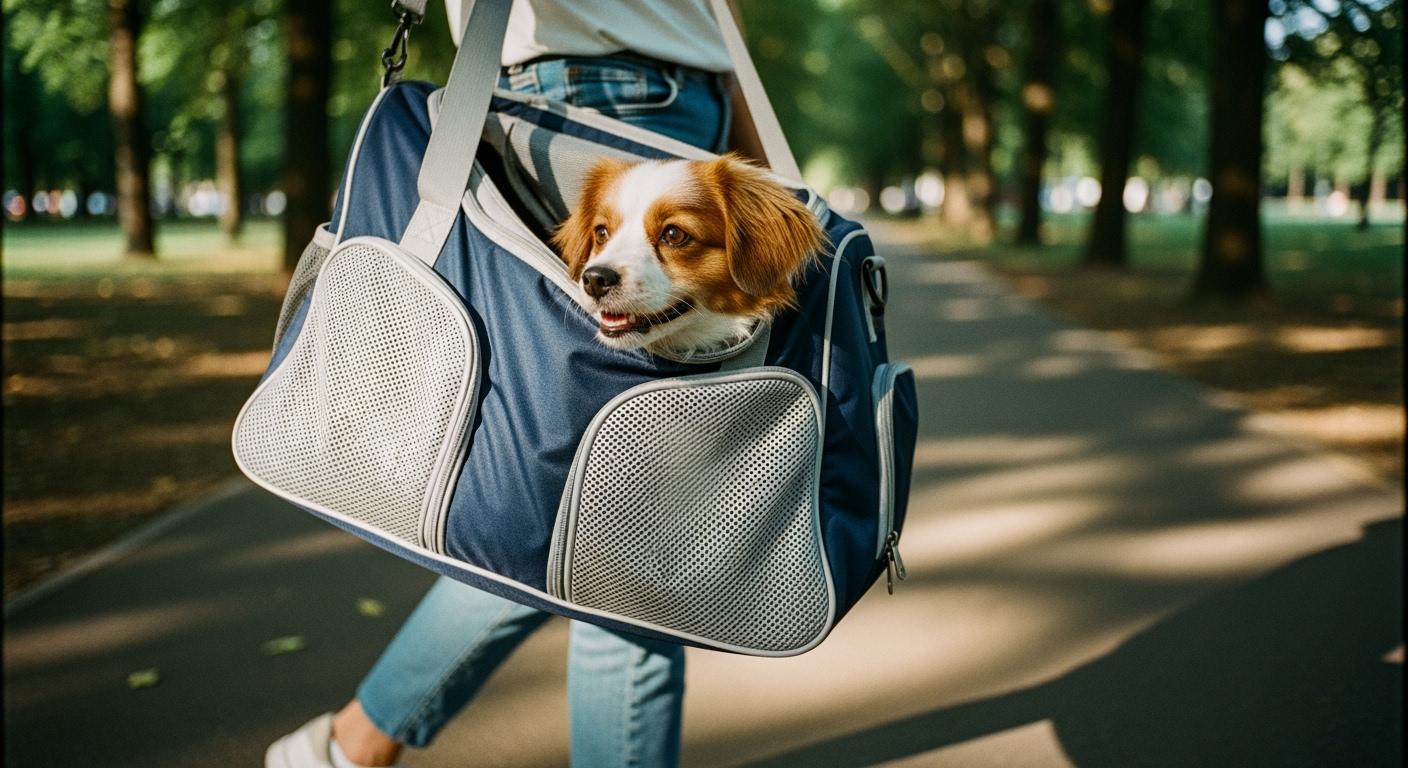
Mesh panels on a small dog carrier bag are not all equal. Some cool. Some do almost nothing. The difference is not the material. It is where the mesh sits and whether the bag’s structure keeps it open under load. A panel on one side alone stalls airflow the moment the pressure inside the bag equalizes with the outside — the air has nowhere to go, so it stops moving. Two panels on opposing sides create a path: air enters one, exits the other, and heat leaves with it. That cross-ventilation loop is what separates a small dog carrier bag with breathable mesh panels that works from one that only looks ventilated.
When Mesh Panels Do Not Actually Ventilate
Mesh on just one side of a carrier bag creates an illusion of ventilation. Light passes through. The fabric looks open. But air is a fluid — it needs a pressure differential to move. When mesh exists on only one face of the bag, incoming air raises the internal pressure until it matches the outside. Flow stops. The space inside becomes a still pocket. A small dog resting low in the bag breathes air that has already been warmed by its own body and is not being replaced.
This is not a material failure. It is a fluid dynamics problem baked into the panel layout. Top-only mesh is even worse for small breeds — heat rises, but a dog’s body sits below the roof panel. The warmest air collects at the top and stagnates there. The dog, at the bottom, gets none of the benefit. This is why carriers with top mesh only can feel stuffy within ten minutes even on a mild day. The most common carrier bag design mistakes trace back to treating mesh as a window rather than an airflow system.
Tip: Hold a tissue near each mesh panel on a breezy day. If it does not flutter on the leeward side, the bag has no through-path for air.
Signs a carrier is trapping heat, not venting it
Heat stress inside a carrier leaves observable signals before a dog shows overt distress. Panting is the late-stage alarm. Earlier signs are subtler:
| Early Signal | What to Check |
|---|---|
| Excessive shifting | Dog repeatedly repositions — body is searching for a cooler contact surface |
| Nose pressed against mesh | Dog is seeking the only moving air it can find, typically at the top opening |
| Damp inner fabric | Condensation from respiration building up with no exit path |
Other indicators include heavy panting with a wide-open mouth, thick drool pooling at the lip, and bright red gums. These escalate fast in brachycephalic breeds — French Bulldogs, Pugs, Boston Terriers — because their airway structure already limits heat exchange through panting. A carrier that traps heat compounds a pre-existing physiological constraint.
Why structure collapse kills whatever ventilation exists
Even well-placed mesh fails if the bag cannot hold its shape. The causal chain is straightforward: a soft or unsupported base sags under the dog’s weight → side walls lose tension → mesh panels go slack and press against the dog’s body → the only ventilation surfaces become sealed by the very animal they are supposed to cool.
This is a structural problem, not a mesh problem. The carrier’s frame — whether a rigid base plate, sewn-in battens, or tensioned fabric panels — is the load path that keeps the ventilation architecture intact. Without it, mesh area becomes irrelevant. A 60% mesh bag with a collapsing floor performs worse than a 30% mesh bag with a rigid frame. This is one reason some manufacturers reinforce the base with a stiffened insert: the added weight is a deliberate trade-off, not a design oversight. A sling carrier that passes fit and sizing checks still fails on ventilation if the fabric stretches under load and closes the very panels meant to breathe.
Note: After a 15-minute walk, unzip the carrier and place your palm flat against the inner fabric where the dog’s flank rested. Warm and dry is acceptable. Warm and damp means the ventilation loop never established.
What Makes Multi-Side Ventilation Work
Two mesh panels on opposite faces create what a single panel cannot: a pressure-driven flow path. Air enters the windward side, travels across the dog’s body, and exits the leeward side. This is cross-ventilation — the same principle that cools a room with windows on opposite walls. The moving air strips away the boundary layer of warm air that clings to the dog’s coat. That boundary layer is the true barrier to cooling, not the ambient temperature inside the bag.
The effect is measurable without instruments. On a walk, the carrier’s orientation relative to your body changes constantly — your torso blocks wind from one side, then the other, then neither. A bag with mesh on three or four sides catches airflow regardless of carry position. A bag with mesh on only one side catches it during roughly a quarter of the walk. The rest of the time, the single panel faces your body and pulls no air at all.
The materials that keep mesh open
Mesh fabric itself varies in ways that affect cooling. Open-weave polyester mesh with a hole diameter of roughly 1–2 mm passes air easily but offers less tear resistance. Tighter weaves trade airflow for durability — a reasonable choice on the bottom panel where the dog’s claws contact the fabric but a poor one on side panels where ventilation is the priority. The best designs grade the mesh: coarser weave on side panels for airflow, tighter weave on contact surfaces for longevity.
| Design Difference | Why It Matters | Main Limitation |
|---|---|---|
| Open-weave side mesh | Lower air resistance, faster heat exchange | Less resistant to claw punctures over time |
| Tight-weave base mesh | Withstands claw contact, holds shape | Restricted airflow where dog’s weight sits |
| Multi-side panel layout | Cross-ventilation regardless of carry position | Adds manufacturing complexity, more seam lines |
| Rigid base insert | Prevents wall collapse, keeps mesh panels taut | Adds weight, reduces packability |
Fabric selection at the production level involves a trade-off between ventilation performance and seam integrity. Open-weave mesh is harder to sew cleanly — the needle can skip between yarns, creating loose threads that unravel after repeated washing. A breathable carrier built with reinforced mesh seams addresses this at the construction stage rather than relying on denser fabric to hide the problem.
Interior space, closures, and how they interact with airflow
A dog needs enough interior room to shift position without blocking every vent. If the carrier is too snug, the dog’s body presses against the side panels and seals them — functionally reducing a multi-side mesh design to a single-panel one. The minimum functional space is not about comfort in the abstract. It is about keeping at least one ventilation pathway unobstructed.
Secure closures — zippers, snaps, reinforced Velcro — matter for ventilation indirectly. A closure that pops open under pressure forces the owner to keep a hand on the bag, which blocks one mesh face. A closure that holds reliably lets the carrier ride hands-free against the body in its intended orientation, with all panels clear. The urban carrying solutions that prioritize hands-free stability preserve mesh function by keeping the carrier in a consistent position rather than shifting with every step.
Padded straps and adjustable torso fits also reduce carrier sway. Sway changes the angle at which air hits the mesh — a bag rocking side to side presents panels at oblique angles where airflow separates from the surface instead of passing through. Stable carry equals stable ventilation.
Where Breathable Design Delivers — And Where It Does Not
Conditions that amplify the mesh advantage
Multi-side mesh ventilation matters most when three conditions overlap: high ambient temperature, low wind speed, and sustained carry duration. On a still 85°F day, a carrier with single-panel mesh has no driving force for airflow beyond the owner’s walking motion — and that motion creates only intermittent pressure pulses, not steady flow. A multi-side design creates a passive chimney: warm air rising from the dog’s body exits through upper mesh, drawing cooler air in through lower side panels.
Humidity amplifies the difference further. In high humidity, evaporative cooling from panting becomes less efficient — the air is already saturated, so moisture on the tongue and airway surfaces evaporates slowly. Under these conditions, convective cooling from moving air becomes the dominant heat-removal mechanism. Mesh that does not drive convection leaves the dog relying solely on a weakened evaporative pathway.
Crowded environments — transit, outdoor markets, vet waiting rooms — remove the owner’s forward motion as an airflow source. The carrier sits static. Only a bag with mesh on opposing sides maintains any ventilation in still air, driven by the dog’s own body heat creating a weak thermal updraft. The airflow challenges that flat-faced breeds face in carriers are magnified in exactly these static, crowded conditions.
When mesh design matters less
Breathable mesh panels recede in importance when carry durations are short — under ten minutes — or when ambient temperatures stay below 65°F. In these conditions, the heat load never builds to a level that challenges the carrier’s ventilation capacity, even with a single panel.
Mesh also matters less when the dog is carried in an open-top tote or sling where the primary opening provides a large cross-section for air exchange. The open top functions as an additional vent face, effectively turning a single-panel bag into a two-face system. But this benefit vanishes if the owner habitually rests a hand or forearm across the opening — a common posture that seals the largest vent.
The choice between sling, tote, and backpack styles changes which surfaces are available for ventilation and how the owner’s body interacts with them. A backpack presses one entire face against the wearer’s back — that side’s mesh is functionally dead. The remaining panels must carry the full ventilation load, making multi-side design more critical in backpack carriers than in hand-carried totes.
Disclaimer: The ventilation checks described here assume a smooth-coated or short-haired dog. Double-coated breeds — Huskies, Shiba Inus, Pomeranians — may show subtler signs of heat buildup because their undercoat insulates against both cold and heat. For these breeds, check the inner carrier fabric for dampness rather than relying on visible panting as the only heat-stress signal. If the dog’s chest shape falls far outside breed norms — particularly barrel-chested dogs like Staffordshire Bull Terriers or deep-keeled dogs like Whippets — the fit-checks described here may not catch every ventilation obstruction, because atypical body proportions can press against mesh panels in ways standard patterns did not anticipate.
FAQ
Does more mesh always mean better cooling?
No. Mesh area without structural support is ineffective. A bag with 70% mesh coverage and a soft, collapsible floor seals its own panels the moment the dog settles in. A bag with moderate mesh on opposing sides and a rigid base keeps those panels open and functional. Ventilation is about maintained open area under load, not total mesh percentage on the spec sheet.
Can a carrier with top-only mesh work for short trips?
It can, with caveats. On trips under ten minutes in mild weather, the heat load is too small to matter. But top-only mesh relies entirely on the owner’s motion to push air down into the bag — and small dogs, sitting low, sit below the airflow path. What reaches them is mostly still, warm air that has already passed across their own body.
How can I tell if mesh panels are actually venting mid-walk?
Stop for thirty seconds and feel the inner fabric near where the dog’s side or belly contacts the carrier. Dry and roughly ambient-temperature means airflow is reaching the dog. Damp or noticeably warmer than the outside air means the ventilation loop has stalled. In a functioning cross-ventilation setup, moving air continuously strips moisture and heat from inner surfaces. In a stalled bag, both accumulate.
What bag shapes tend to have the worst ventilation?
Deep, bucket-style carriers with mesh only on the top rim. The dog sits at the bottom of a fabric well, and the mesh sits well above body level. Heat pools around the dog while the vent sits in the warm air layer above — functionally disconnected. Wide, shallow carriers with mesh on at least two side faces avoid this stratification problem by placing vents at body height.






