
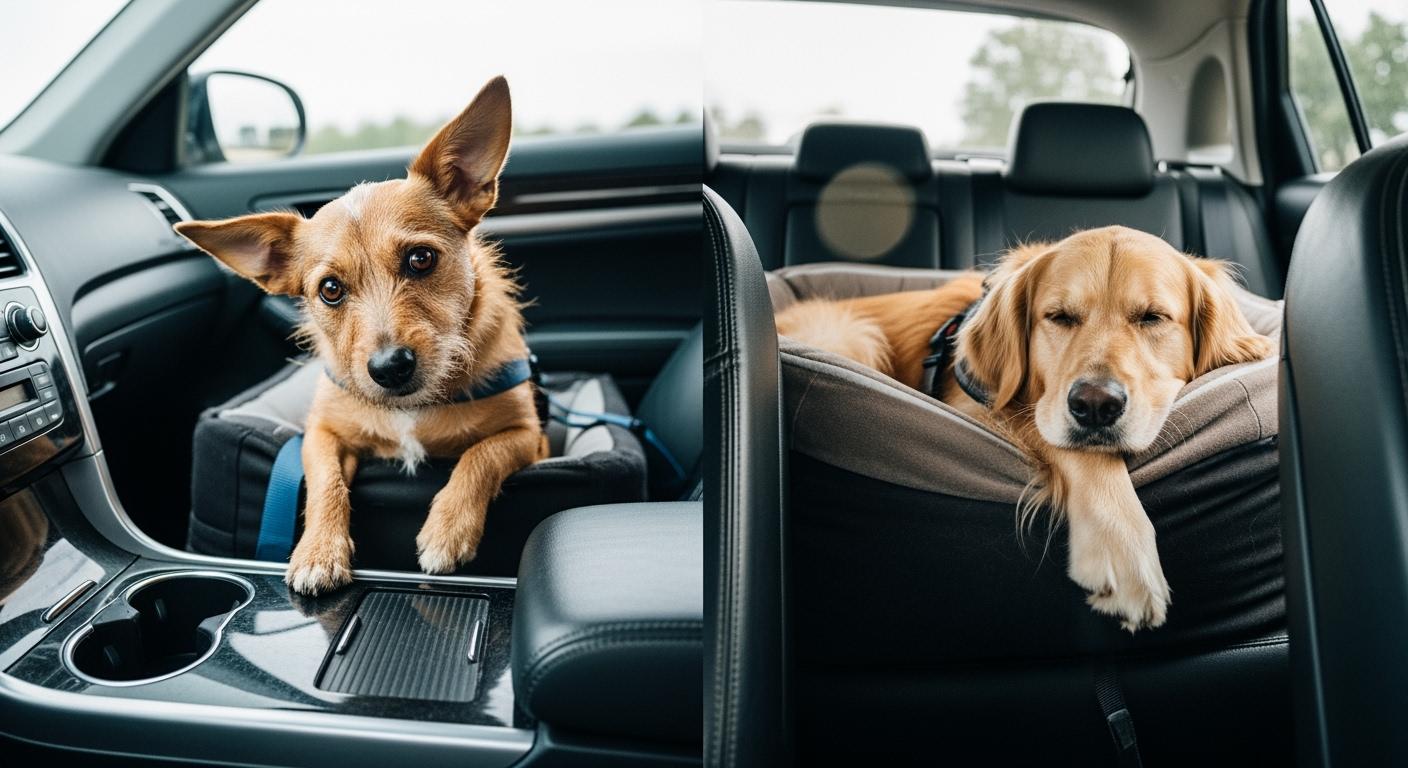
A dog car seat for console vs back seat is not just a question of where the dog sits. It is a question of what holds the seat in place when the car moves. A console places the seat on a narrow, often curved surface with no factory anchor points. A back seat places it on a wide, flat bench with a seat belt running through it. Those two surfaces behave differently under the same driving forces, and that difference defines whether the seat stays put or rocks and shifts with every input.
Placement dictates stability before the first strap is tightened. Get the surface wrong, and no amount of padding or side wall height can fix it.
Why Console Dog Car Seats Can Feel Unstable in Real Driving
The Geometry Problem: Narrow Base on a Curved Surface
Most vehicle consoles sit between the front seats on a contoured surface that was never designed to hold a pet seat. The console top typically slopes downward toward the rear or curves along its edges to blend into the center stack. A booster seat placed on this surface contacts it along a small, uneven footprint.
That is the root instability.
When the car enters a turn, lateral force pushes the dog’s body toward the outside of the curve. In a properly supported seat, that force transfers through a wide base into the vehicle seat and dissipates. On a console, the narrow contact patch concentrates the same force onto a few square inches. The seat tilts. The dog braces. The tether pulls at an angle it was not designed for.
Here is the causal chain: lateral acceleration → weight shift toward the outside shoulder → center of mass moves past the narrow base edge → restoring moment vanishes → seat tips. A wider base resists this because the center of mass stays inside the footprint longer, buying time before the tipping point. A console base offers almost no margin.
- An uneven console surface means the seat contacts only at high points, leaving gaps elsewhere.
- When the dog shifts weight to stand or turn around, the seat rocks across those gaps.
- Rocking turns into tipping if the car brakes mid-shift.
You can verify this yourself: after a drive with the seat on the console, lift it and check the contact pattern underneath. If the anti-slip pad shows wear or compression marks on only two or three small spots, the base never made full contact. That means every turn and stop worked against partial support.
Why the Tether Angle Changes Everything
A console-mounted tether often clips to a seat track, a headrest post, or a seat belt buckle that sits below or beside the dog. The resulting tether path angles sideways or downward. Under braking, the dog’s forward momentum pulls against a strap that is already pulling at a diagonal. The dog rotates. The harness twists. The tether slack that looked fine at a standstill becomes a liability.
In a back seat setup, the tether typically routes forward to a seat belt receiver or a dedicated anchor, staying closer to the dog’s centerline. That keeps the restraining force aligned with the direction of travel. Straighter tether path, less rotation, less harness twist.
Tip: After installing any booster seat, pull the tether taut by hand and trace its path from the dog’s harness attachment point to the anchor. If the line deviates more than roughly 30 degrees from straight ahead, the dog will rotate under hard braking.
What Changes When the Dog Seat Moves to the Back Seat
Surface Area and the Stability Multiplier
A back seat bench is flat, wide, and level across its entire span. That flat surface gives a booster seat full contact across its entire base. When lateral force hits, the load distributes evenly. The base edges resist rotation because the contact patch extends well beyond the dog’s center of mass in both directions.
The difference is measurable in everyday driving. After a 10-minute trip with a back-seat booster, lift the seat and look underneath. The anti-slip pad should show uniform contact — no gaps, no isolated compression spots. That full-contact pattern is what holds the seat in place during the next sudden stop. If you see clean stripes or patchy marks, the base is not sitting flat, and the stability advantage is partially lost.
A car booster seat with a broad footprint and a non-slip bottom uses the back seat surface the way it was designed to be used. The seat belt threads through the base slots, clicks into the receiver, and creates a mechanical lock that a console cannot provide. No straps running at odd angles. No guessing whether the next hard turn will shift it.
Room to Sit, Lie Down, and Stay Centered
A back-seat booster gives a small dog enough interior space to shift from sitting to lying down without pressing against the side walls mid-move. That matters because a dog that can settle into a comfortable position is a dog that moves less. Less movement means fewer weight shifts that challenge the base stability.
Console seats pack the dog into a small footprint — fine for a stationary pet, but restrictive during a drive. If the dog wants to lie down and the seat floor is too short, the dog stays half-sitting. Tense muscles. More fidgeting. More inputs into an already unstable base.
Lower Distraction, and Why That Matters Structurally
A dog in the back seat cannot reach the driver’s lap, cannot step onto the center stack, and cannot block the shifter. Those are driver-distraction arguments, but they also point to a design problem with console placement: proximity creates interaction. A dog close enough to touch is a dog that will seek contact during stress. That contact shifts weight in unpredictable directions, compounding the console’s geometric instability.
Moving the seat rearward also moves the dog away from the front airbag deployment zone — a risk that is particularly relevant for small dogs in boosted positions where the airbag trajectory aligns with the seat height.
Which Design Details Make a Back-Seat Booster More Reliable
Firm Base and Anti-Slip Bottom
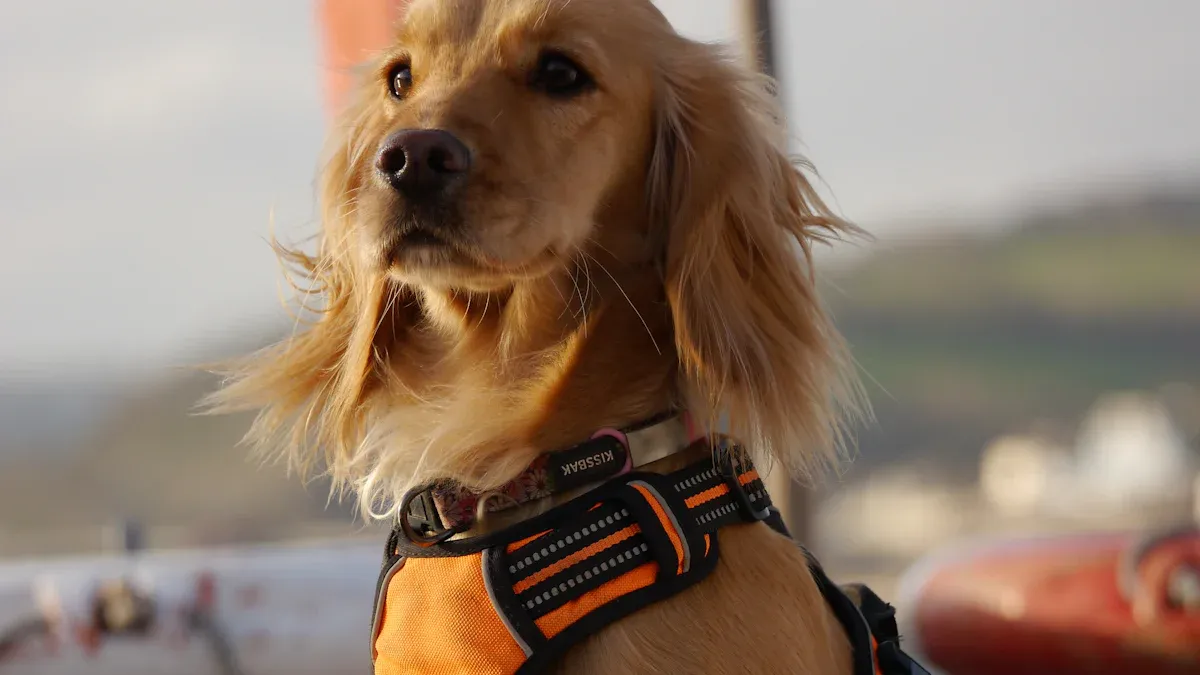
A base that flexes under the dog’s weight changes the seat geometry under load. A firm, structured base keeps its shape and keeps the dog’s body position predictable. The anti-slip material on the bottom resists lateral sliding on cloth or leather seats. Together, these two features prevent the seat from creeping across the bench during a series of turns.
| Design Difference | Why It Matters | Where It Falls Short |
|---|---|---|
| Firm structured base | Maintains seat shape under load; keeps center of mass predictable | Adds weight; makes folding storage bulkier |
| Anti-slip bottom coating | Prevents lateral creep on cloth and leather during turns | Effectiveness drops on heavily textured or wet seat covers |
| Seat-belt pass-through slots | Creates a mechanical anchor without additional straps | Slot position may not align with every vehicle’s belt path |
Side Walls and Tether Alignment
Side walls do two things: they contain the dog laterally and they provide structure for tether attachment points. A side wall tall enough to reach the dog’s shoulder keeps the dog from leaning past the seat edge during cornering. That lean is what starts the weight-shift cascade that tips a console seat.
The tether anchor position on the booster itself also matters. A tether point centered on the back wall routes the strap along the dog’s spine line. A tether point offset to one side creates a built-in twist. Matching the booster seat dimensions to the dog’s actual measurements means the side walls do their job without constricting movement.
Height, Cushion, and Seat Belt Compatibility
Height matters for a specific reason: a dog that can see out the window tends to stay oriented and calm. A dog staring at the seatback in front of it gets restless faster. But the height must work with the seat belt path. If the booster sits too tall, the belt angles across it awkwardly, and the anchor loses tension.
A removable, washable cushion handles the reality of dog travel — dirt, hair, occasional motion sickness. The design question is whether the cover comes off without tools and whether the fabric survives repeated washing without shrinking out of its attachment points.
- Removable covers make cleaning practical between trips.
- Machine-washable fabric keeps the booster seat from accumulating odors.
- Quick-dry foam or mesh backing prevents moisture trapping under the cushion.
A small dog folding car seat that gets these details right gives a dog a predictable, stable platform ride after ride. When cleaning takes 30 seconds instead of 15 minutes, the seat actually stays clean.
Size Match and What Happens When It Is Wrong
A booster seat sized correctly for the dog keeps the dog centered in the seat floor. Too large, and the dog slides side to side inside the seat on every turn — the side walls become irrelevant because the dog never reaches them. Too small, and the dog cannot lie down. It stays perched. Tense. Restless.
Seat sizing is not about the weight rating on the tag. It is about whether the interior floor length lets the dog lie with its spine straight. A seat that is too tight to settle into creates the same restlessness problem as a console seat, even with a wide base underneath it.
| Fit Issue | What Happens in the Car | What to Check |
|---|---|---|
| Interior floor too short | Dog cannot lie flat; stays half-sitting, fatigues faster | Measure dog from chest to rump in a lying position |
| Side walls too low | Dog leans past wall edge on turns; tether pulls sideways | Wall should reach at least to the dog’s shoulder height when seated |
| Base too narrow for vehicle seat | Booster overhangs seat edge; loses full-surface contact | Check booster base width against rear seat bench depth |
When a Back-Seat Booster Is Not the Right Pick
A back-seat booster works well in most passenger vehicles with a full rear bench. But the design has limits.
In a two-seat vehicle or a truck with a narrow rear jump seat, a booster with a wide base may not fit at all. The seat overhangs the bench edge, and the anti-slip bottom loses contact. A console seat might be the only option, and in that case the priority shifts to finding one with the widest possible base and a tether path that stays as close to centerline as possible.
For dogs that panic in isolation, being moved to the back seat away from the driver can trigger enough anxiety that the stress itself becomes a distraction. A higher booster position can either calm or amplify anxiety depending on the dog. If the dog settles better when it can see the driver, a back-seat booster that props the dog high enough to see over the front seatback may help — but only if the vehicle geometry allows that sightline.
For dogs significantly larger than the typical small-breed range these seats are designed around, the base width and side wall height become inadequate regardless of where the seat is placed. The size mismatch overwhelms any placement advantage.
Disclaimer: The stability checks described here assume a smooth-coated dog sitting in a booster on a standard rear bench seat. Double-coated breeds or dogs with very short legs may distribute weight differently, which can change how the anti-slip base grips. If the dog has a barrel chest or an unusually deep keel relative to its breed norm, the tether alignment tests may not catch every pressure point — hand-check the harness fit around the chest after a short drive to confirm the straps are not riding up into the armpits.
A dog car seat for console vs back seat comes down to the surface under the base and the tether path above it. A back seat delivers a flat, wide mounting plane that keeps the seat planted through turns and braking. A console fights geometry the whole way. Running through a quick fit and stability checklist before a long trip catches the problems that show up 10 minutes into the drive, not in the driveway.
FAQ
Can a console dog car seat work for short trips?
For trips under 10 minutes on straight roads at low speeds, a console seat with a wide base and a centered tether can hold adequately. The instability accumulates with duration and cornering frequency. A series of quick turns through city streets exposes the narrow-base problem faster than a single highway on-ramp.
How do you verify a booster seat fits a small dog correctly?
Measure the dog’s back length from shoulder to rump while lying down. Check that against the interior floor length of the booster. The dog should lie flat without curling or hanging over the front edge. After a 10-minute drive, check that the harness straps have not ridden up into the armpits and that the dog has not rotated sideways in the seat.
Do back-seat booster seats reduce driver distraction?
They reduce it by removing the dog from arm’s reach of the driver. A dog that cannot physically touch the driver cannot paw for attention at an intersection. The secondary benefit is that a dog in a stable seat moves less, and a stationary dog draws the eye less than a shifting one.
What design features contribute most to booster seat stability?
Three features matter in sequence: a base wide enough to stay fully on the seat bench, an anti-slip bottom that grips the seat fabric, and side walls tall enough to contain the dog’s shoulders. If the base overhangs the bench, the other two features cannot compensate. A tether that routes straight forward, not at a diagonal, keeps the dog from twisting in the harness under braking.






