
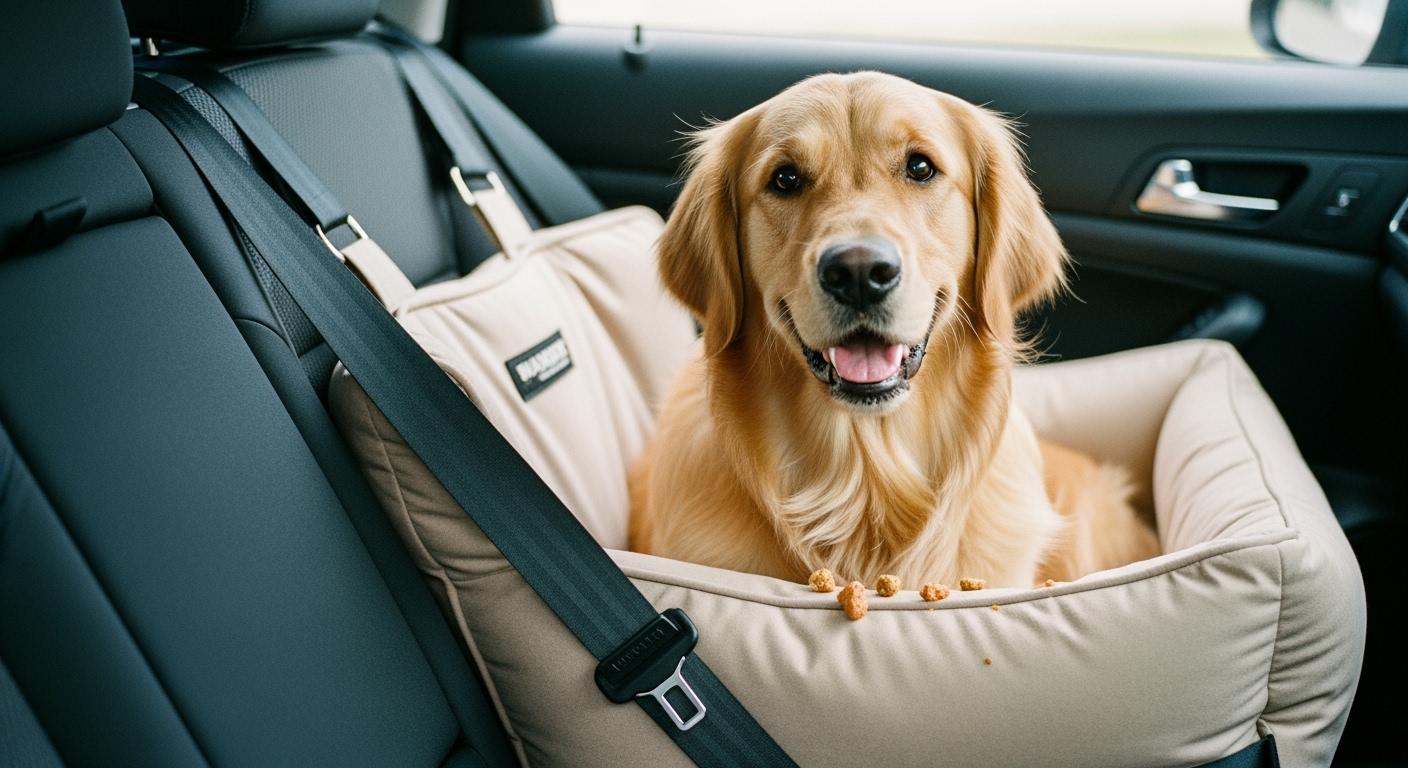
A muddy dog climbs into the back seat after a park run. Within seconds, wet paw prints, loose hair, and trail grit transfer from coat to cushion. The question is not whether this will happen. It is whether the cushion design lets you undo it.
A dog car seat with washable cushion makes the difference between a seat that resets after every trip and one that accumulates mess until the car smells like a kennel. But “washable” is not a binary. The specific design details — how the cushion attaches, how the seams are constructed, what the padding does under agitation — determine whether the feature actually holds up through dozens of wash-and-reinstall cycles.
The Design Problem — When a Cushion Cannot Come Off
Fixed Cushions Trap What Removable Ones Release
Mud, moisture, and hair do not just sit on the surface of a dog car seat cushion. They work into the fabric weave. Hair winds around individual fibers. Mud particles pack into the gaps between yarns. Moisture wicks downward through capillary action, pulling dissolved dirt into the cushion core.
With a fixed, non-removable cushion, none of this can be extracted. Surface wiping removes only the top layer. The deeper contamination — the mud packed into the padding, the hair tangled below the fabric face — stays. Over weeks of use, the cushion becomes a reservoir.
A removable washable cushion changes the physics of cleaning. Removal gives you full access to every fabric surface. Immersion and agitation — whether in a machine or a basin — dislodge particles that surface wiping cannot reach. The cushion comes back to a baseline state rather than degrading incrementally.
Seams, Absorbent Fill, and the Odor Loop
The mechanics of odor buildup follow a predictable chain. Open-cell foam and loose polyester batting act like sponges: moisture enters through the cover fabric, the fill absorbs and holds it, and the warm, dark interior of a parked car provides the temperature window for bacterial growth. Deep stitched seams add to the problem — they create narrow channels where wet hair and food crumbs collect, shielded from vacuum nozzles and surface wipes.
Once this cycle starts, it is self-reinforcing. Residual moisture from the last wet-dog trip makes the fill more absorbent for the next one. Bacterial colonies expand. Odor compounds concentrate. A surface-level cleaning addresses none of this.
Removable design breaks the loop at the first step. The cushion comes out, the entire surface area is exposed, and water and detergent reach the fill. For broader in-car protection beyond the seat itself, the same principle applies: anything that cannot be removed cannot be fully cleaned.
| Design Difference | Why It Matters | Main Limitation |
|---|---|---|
| Removable cushion vs. fixed cushion | Enables full-surface access and immersion cleaning; breaks the incremental contamination cycle | Zipper or attachment hardware adds a mechanical failure point over many cycles |
| Welded or taped seams vs. open stitched seams | Eliminates the narrow channels where hair and debris collect; reduces moisture entry points into fill | Welded seams can stiffen the fabric edge, affecting drape and comfort on longer rides |
| Closed-cell foam fill vs. loose batting | Resists moisture absorption; dries faster after washing; maintains shape through agitation | Closed-cell foam typically offers less initial plushness than high-loft batting |
What Removable Cushion Design Changes About Daily Use
Removal, Wash, Reinstall — The Reset Cycle
The design advantage of a removable cushion is not that cleaning becomes slightly easier. It is that cleaning becomes complete. Each wash cycle returns the cushion to approximately its original state — not perfectly, but close enough that cumulative degradation slows dramatically.
Three design factors determine how well this cycle works in practice. First, the release mechanism: a full-length zipper with a covered pull distributes tension evenly and reduces the chance of the slider jamming on fabric. A partial zipper or snap-tab system leaves sections of the cover captive, creating dead zones that never get properly cleaned. Second, the cover fabric itself: a tight-weave polyester face resists hair entanglement better than brushed nylon or cotton blends, which have more exposed fiber ends for hair to wrap around. Third, the liner beneath the cover: a washable cover with a non-slip base prevents the cushion from sliding during drives — but that same base layer must also shed water rather than trapping it against the fill during washing.
Why Padding Construction Determines Whether Washable Lasts
Here is where the design gets less visible but more consequential. A cushion can be removable and still fail after five washes. The failure mode is usually the fill.
Loose polyester batting — the most common budget fill — consists of short, crimped fibers carded into a web. Under agitation in a washing machine, these fibers shift. The web pulls apart. Fibers migrate toward the edges and clump. After drying, the cushion has thin spots where the dog’s weight concentrates and thick ridges where fill has bunched. The seat no longer distributes pressure evenly, so the dog shifts more often, which spreads more mess around the car.
A fill that holds its shape through wash cycles typically uses either a bonded batting (fibers thermally fused at contact points to resist migration) or a single-piece foam insert that cannot clump because it is one continuous structure. The tradeoff is real: bonded batting costs more to produce, and a foam insert makes the cushion slightly heavier. But the alternative is a cushion that is technically washable and practically useless after a month of use. The fit and material choices that affect car travel comfort extend to booster seats and cushions alike — padding stability under repeated use is the common thread.
Base Stability and the Reinstall Problem
Non-Slip Bottoms — What They Actually Prevent
A cushion that slides after reinstallation undoes the cleaning benefit. If the cushion shifts during a drive, the dog’s weight lands partly on the car upholstery — the very surface the cushion is supposed to protect. Mud and hair transfer directly to the seat.
A non-slip base addresses this through surface friction rather than mechanical attachment. The backing material — typically a rubberized dot pattern or a silicone-printed fabric — increases the coefficient of friction against car seat fabric. But the design detail that matters most is coverage: a non-slip backing that covers only the center of the cushion bottom leaves the edges free to lift and curl. Full-coverage backing keeps the entire footprint stable.
Observable check: After reinstalling a washed cushion, drive for 15 minutes with the dog in place, then check whether the cushion’s rear edge has drifted more than an inch from the seat back. Movement beyond that means the non-slip surface is not holding under load — either the backing material is too slick or the coverage is insufficient.
Quick-Dry Materials vs. Absorbent Covers
Not all “washable” covers dry at the same rate. A thick, plush cover fabric feels softer under a dog’s paws but holds significantly more water after washing. If the cover has not fully dried before reinstallation, residual moisture migrates into the fill and restarts the odor cycle that washing was supposed to break.
Quick-dry materials — thin-weave polyester, ripstop nylon, or mesh-faced fabrics — shed water faster because they present less capillary surface area. The tradeoff is tactile: they feel less plush. But the functional gain is that the cushion can go from wash to car in a single afternoon rather than overnight.
Observable check: After a wash cycle and spin dry, press a dry paper towel firmly against the cover surface for 10 seconds. Any visible moisture transfer means the material needs more drying time before reinstallation. If this happens consistently with a quick-dry-rated cover, the spin cycle may be insufficient, or the liner beneath is holding water that wicks back up. The material differences that affect how car bed fabrics handle cleaning and drying apply directly to seat cushion covers.
When a Washable Cushion Is Not the Right Fix
A washable cushion solves the cleaning problem for dirt, hair, and moisture that land on the seat. It does not address mess that bypasses the cushion entirely — a dog that shakes off mud against the door panel, for example, or drool that drips over the cushion edge onto the center console.
The design also has a practical ceiling. If the dog routinely soaks the cushion through to the car seat beneath, the issue is not the washability of the cushion but the absence of a waterproof barrier layer between cushion and seat. A car seat designed for medium-sized dogs with an integrated waterproof liner addresses this at the structural level rather than relying on the cover fabric alone.
For dogs that shed heavily year-round, a washable cushion still needs intervention between washes — hair that embeds deeply in the cover weave during a single long trip will not wait for the next wash cycle. A lint roller or rubber brush used immediately after the trip removes loose hair before it works deeper into the fabric.
Disclaimer: The fit and stability checks described here assume a smooth-coated or short-haired dog in a standard rear bench seat. Double-coated breeds may leave subtler dirt and oil residue that requires hand-checking rather than visual inspection — run your palm across the cushion surface after a trip to feel for grit or dampness the eye might miss. If the dog’s body shape falls far outside the breed norms this cushion is patterned for — particularly barrel-chested breeds or dogs with a very deep keel — the weight distribution across the cushion surface changes and the non-slip stability checks may not catch every pressure point.
| Design Difference | Why It Matters | Where It Falls Short |
|---|---|---|
| Water-resistant cover vs. waterproof liner | Water-resistant covers shed light moisture from damp fur; waterproof liners stop liquid from reaching the car seat | Water-resistant alone fails when a soaked dog sits for an extended drive; moisture eventually penetrates |
| Single-piece foam insert vs. bonded batting fill | Foam cannot clump or shift; bonded batting balances shape retention with lighter weight | Foam adds weight and bulk; bonded batting can still degrade if wash agitation is too aggressive |
| Full-coverage non-slip backing vs. spot pattern | Full coverage prevents edge lift and curling; spot patterns leave perimeter zones free to shift | Full-coverage rubberized backing adds material cost and makes the cushion slightly stiffer to fold |
FAQ
How often should a dog car seat cushion be washed?
After any trip where the dog was wet, muddy, or left visible debris on the cushion surface. For routine dry trips with a clean dog, every two to three weeks is usually enough to prevent odor accumulation and embedded hair buildup. The decision between everyday surface cleaning and a full deep wash depends on trip conditions more than calendar interval.
Does machine washing damage the cushion over time?
It depends on the fill construction. Cushions with bonded batting or single-piece foam inserts tend to hold shape through 30–50 wash cycles. Loose batting can begin to clump or thin after 5–10 cycles. A cold-water gentle cycle and air drying extend the life of any fill type by reducing thermal and mechanical stress on the fibers.
Will the cushion stay in place after being removed and reinstalled?
A cushion with a full-coverage non-slip backing should hold position through normal driving. If it shifts, check whether the backing has accumulated lint or hair — a dirty non-slip surface loses friction. Cleaning the backing with a damp cloth restores grip in most cases.
Can a washable cushion handle a dog that gets carsick?
Partially. Liquid from vomit penetrates faster than water from wet fur, so a cushion without a waterproof liner will likely pass liquid through to the car seat beneath. A removable washable cover helps with cleanup of the cushion itself, but a separate waterproof barrier layer underneath is the more reliable approach for dogs prone to motion sickness.
Does a washable cushion work for short daily commutes or only long trips?
The design works for both, but the value is more visible with frequent short trips. Multiple daily entries and exits — a commute drop-off, a midday park visit, an evening errand — each add a fresh layer of dirt and hair. A fixed cushion accumulates faster under this pattern. A removable cushion resets between uses, which matters more when the trip count is high than when individual trips are long.






