
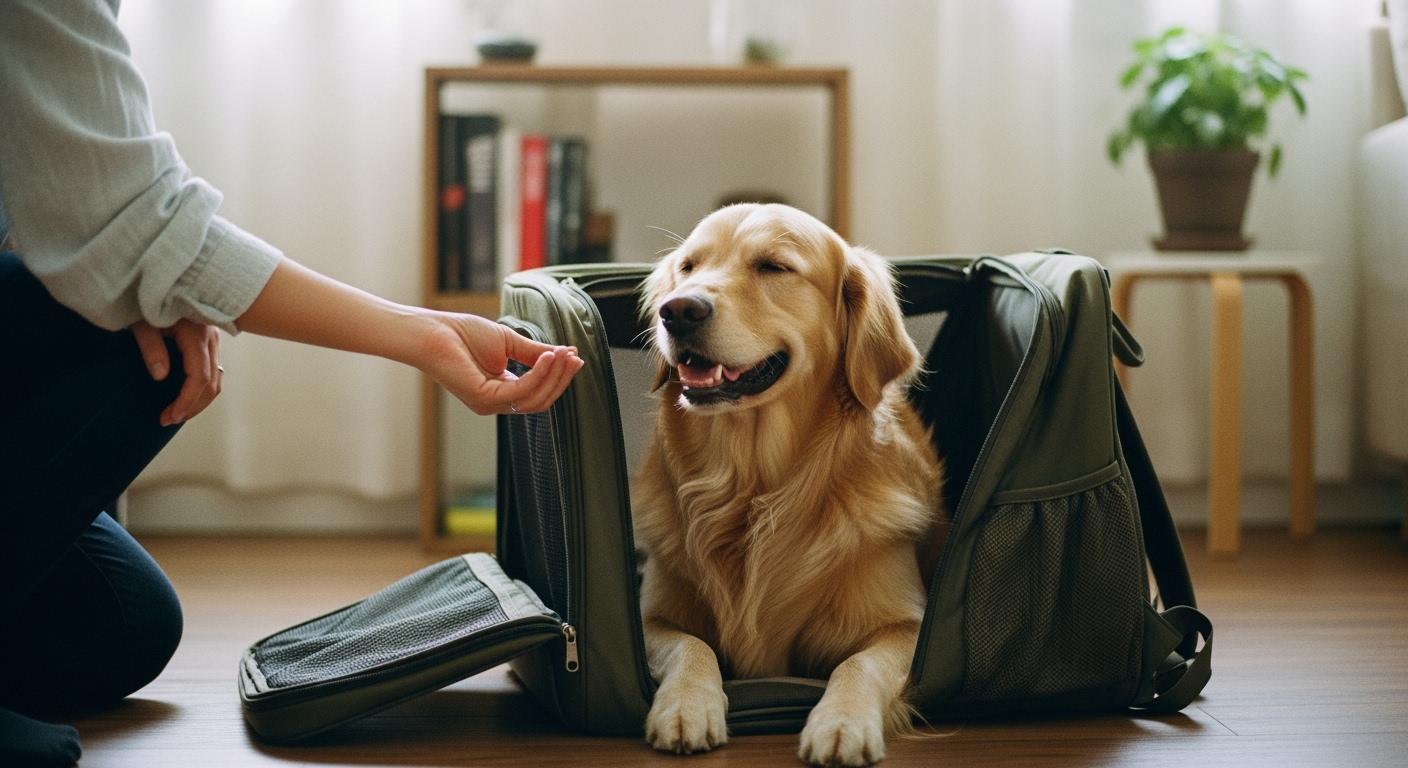
A dog backpack carrier with side entry changes one thing that shapes the entire loading experience: the direction the dog moves to get inside. Instead of being lifted and lowered through a top opening, the dog walks forward at ground level into a space it can see. That single design choice shifts how stress distributes through the dog’s body, how much room the handler has to guide legs and shoulders, and whether the carrier base stays planted or wobbles during entry.
Most top-loading carriers are not badly made. They are built around a loading path many dogs simply do not accept. When a dog braces, twists, or backs away, the problem is rarely the dog’s temperament. More often, the loading angle conflicts with how a dog’s front assembly moves naturally. Side entry removes that conflict.
Why Top-Loading Backpack Carriers Create Resistance
Dogs enter spaces head-first, leading with the forelegs. The shoulder joint is built for forward reach and weight absorption at a forward-downward angle. When a handler lifts a dog vertically and lowers it through a top opening, two things happen that the dog’s body is not structured to process calmly.
First, the vertical lift removes ground contact from all four paws at once. A dog suspended in air has no reference plane — no surface to push against or adjust posture from. The narrow top opening restricts any attempt to reposition. The dog twists to find footing that is not there. Second, the downward insertion concentrates pressure along the spine and ribcage while the dog’s head stays above the opening — a sequence that, in the dog’s perceptual world, resembles being forced into a trap. That is not anthropomorphism. It is the predictable outcome of an entry path that breaks the natural sequence: see the space, step into it, settle.
A handler can verify this directly. Set the empty carrier on the floor and watch whether the dog approaches voluntarily. A dog that sniffs a side opening and steps toward it but balks at being lifted toward a top opening is not being stubborn. The carrier’s entry design is filtering out a loading path the dog finds threatening.
| Loading problem | Carrier design cause | How side entry addresses it |
|---|---|---|
| Dog twists or braces | Narrow top opening forces vertical descent through a gap the dog cannot see | Wide side panel lets the dog see the interior and step forward on its own |
| Dog plants feet and refuses to be lifted | Vertical loading removes ground reference; dog has no stable surface to push against | Carrier sits on the floor; dog walks onto a planted base with paw contact throughout |
| Dog gets stuck mid-entry | Small top gap leaves no room to adjust shoulder position once partially inside | Side panel opens wide enough to guide both shoulders through before zipping closed |
How a Side Entry Panel Changes the Loading Equation
A side-entry carrier reverses the loading sequence: the dog moves horizontally into the space, then the carrier closes around it, rather than the dog being inserted vertically into an already-closed container. The entry angle matters more than the opening size.
When a dog steps forward into a carrier, the shoulder joint moves through its natural range — forward extension followed by weight transfer onto the leading leg. The base stays on the floor, so the dog’s paws have a planted surface to push against throughout the motion. There is no moment of suspension, no loss of ground reference. A wide side panel compounds this. The handler opens the carrier along its full length, guides the dog’s shoulders and hips through in one motion, and zips the panel closed after the dog is already settled. Compare this to feeding a dangling dog through a top gap — the difference is not subtle.
Visibility during entry changes cooperation. Mesh side panels let the dog see the interior before stepping in and maintain eye contact with the handler. A dog that can see the space it is entering and can see its handler nearby is far less likely to freeze or resist. Dark, enclosed top openings give the dog none of this.
After loading, check whether the dog settles within 30 seconds or keeps shifting. A dog that circles, paws at the floor, or refuses to lie down within the first minute is signaling that the interior dimensions or base stability are not working — regardless of what the size chart says. Fit checks that rely only on tape-measure numbers miss what a 60-second settle test catches immediately.
| Design feature | Structural purpose | What fails when it is missing |
|---|---|---|
| Wide side panel with full-length zipper | Opens the carrier body for walk-in access; closes after the dog is positioned | Handler must feed the dog through a small flap; twisting and bracing increase |
| Stable, non-slip base panel | Keeps the carrier planted during loading; no wobble as the dog steps onto it | Carrier shifts under the dog’s weight; dog hesitates or backs out mid-load |
| Mesh side panels with clear sight lines | Gives the dog visual access to surroundings and handler during entry and travel | Dog enters a dark enclosure blind; hesitation escalates to active resistance |
| Padded interior floor | Absorbs initial paw pressure on entry; softens the hard-stop sensation | Dog feels a hard surface underfoot and may refuse to step fully inside |
Structural Features That Make Side-Entry Carriers Reliable
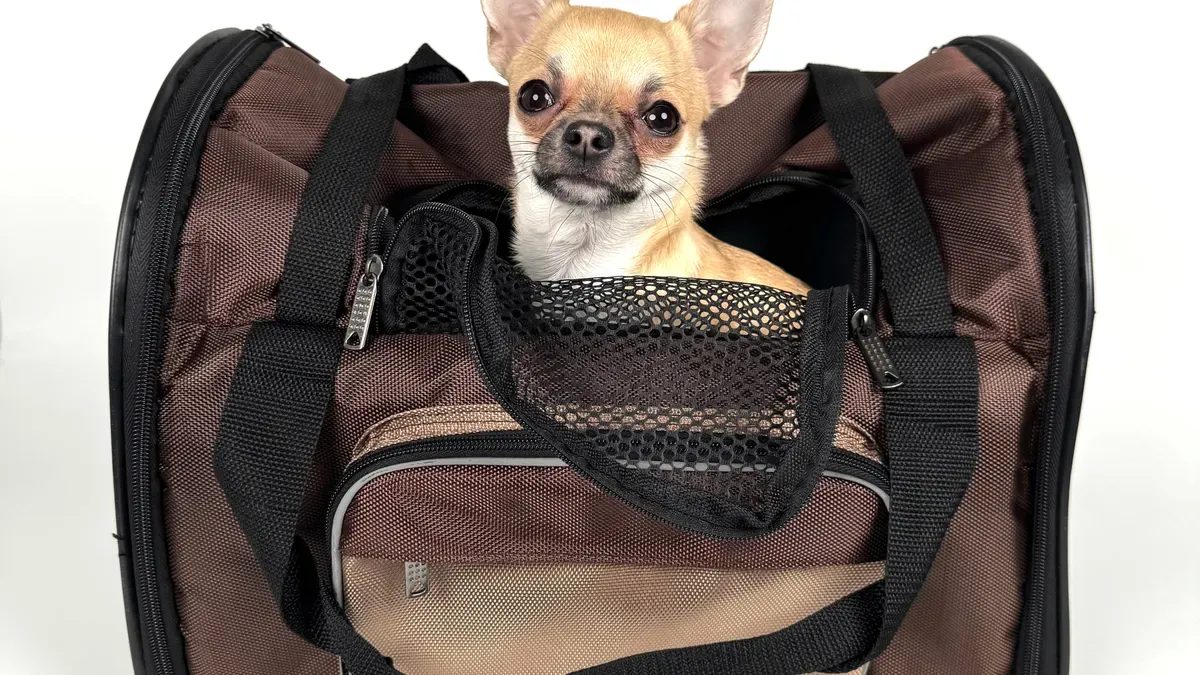
A side opening is only as useful as the structure around it. If the base collapses when the dog steps on it, or if the zipper path separates under tension, the entry design advantage disappears immediately.
The base panel is the foundation. When a dog steps in, the first paw contact transmits load through the base to the floor. A base built with a rigid or semi-rigid insert distributes that load across the full footprint rather than letting it concentrate under one paw. The dog feels a solid surface, not a trampoline. An edge-to-edge insert — rather than a floating pad that can shift — removes a failure point that is hard to catch in a visual inspection but obvious the moment a dog loads in.
The zipper path carries more structural responsibility on a side-entry carrier than on a top-loader. On a top-loader, the zipper closes over the dog like a lid. On a side-entry carrier, the zipper seals the entire side panel along a vertical or near-vertical seam under tension from the dog’s body leaning against it. A zipper that separates mid-seam under lateral pressure creates an instant escape path. Dual zippers with locking pulls and a cover flap over the pull tabs reduce this risk in a verifiable way: pull on the closed zipper from the inside and check whether the seam gaps. If it does, the zipper path is underbuilt for the load it carries.
Mesh ventilation is not only about comfort. On a hike or long travel day, airflow through opposing mesh panels determines whether the dog breathes steadily or overheats. Mesh on only one side traps heat; mesh on at least two opposing sides creates a convective path. The mesh weave also needs to be dense enough to resist tearing if the dog paws at it from inside. A torn mesh panel on a side-entry carrier is a structural failure, not a cosmetic one — it is the barrier between the dog and the outside.
| Safety element | What it resists | Failure signal to check |
|---|---|---|
| Double-stitched zipper path with locking pulls | Lateral pressure from dog leaning against the side panel | Zipper teeth separate when pushed from inside; visible gap at mid-seam |
| Internal tether with swivel clip | Dog pushing through a partially open panel | Tether tangles or clips to collar instead of harness, creating neck pressure |
| Reinforced side panel seams | Tension at stitch lines when dog’s weight shifts during carry | Thread breaks visible along side seam after repeated loading cycles |
| Edge-to-edge base insert | Base collapse under first paw contact | Carrier floor dips or folds when the dog steps in; dog refuses to load |
Interior fit is the dimension most often misjudged — not because size charts are inaccurate, but because they describe the carrier, not the dog’s ability to use the space. A dog needs enough interior height to stand without its head pressing against the top panel and enough length to turn around without compressing its spine into a C-shape. Sizing a backpack carrier correctly starts with the dog’s standing height and body length, not its weight. Load the dog, zip it closed, and check after two minutes whether the dog has found a resting position or is still shifting. A dog that cannot settle is in a carrier that does not fit.
Padded shoulder straps and a non-collapsing frame affect the handler’s side of the equation. Straps that distribute weight across the shoulder without digging in make a difference on walks longer than 15 minutes. An internal frame that prevents the carrier walls from bowing inward under the dog’s weight keeps the interior volume stable — the dog is not being gradually compressed as the carrier fabric relaxes. The right carrier for a short errand may be the wrong one for a two-hour trail walk, and the difference often comes down to whether the frame and strap system are built for sustained carry or occasional use.
When a Side-Entry Carrier Is Not the Right Answer
A side-entry carrier asks the dog to walk forward into a confined space at ground level. That sequence works for most dogs. It does not work for every dog, and the design itself introduces trade-offs worth understanding.
Dogs with severe confinement anxiety may react as poorly to a side-entry carrier as to a top-loader. The issue is not the entry direction but the enclosed space itself. In these cases, no entry design resolves the underlying problem — behavioral desensitization to the carrier as an object must come first.
The side zipper path is a structural vulnerability that top-loaders do not share to the same degree. A top-loader’s zipper runs along the top plane and is rarely under lateral body load. A side-entry zipper runs along a loaded seam. If the zipper hardware or stitching is underbuilt, the side-entry design creates a failure mode that does not exist on a top-loader. This is why seam reinforcement along the zipper line carries more weight on side-entry carriers than on any other carrier type. A backpack carrier built with double-stitched seams and locking zipper hardware addresses this failure point at the production level.
Weight distribution during carry also shifts. On a backpack-style side-entry carrier, the dog’s body sits closer to the wearer’s back when the side panel is the load-bearing wall. This can feel more stable than a top-loader where the dog’s weight hangs further from the carrier’s center of mass. But it means the side panel and its zipper bear a portion of the dog’s weight throughout the carry — not just during loading.
Disclaimer: The fit checks and loading observations described here assume a dog with typical body proportions for its breed group. Dogs with barrel chests, very deep keels, or pronounced swaybacks may distribute pressure differently inside a side-entry carrier. For these dogs, the standard stand-and-turn fit check may pass even when pressure points exist along the sternum or lumbar spine during actual carry. Hand-check pressure distribution along the dog’s sides after 10 minutes of carry — if the carrier walls press inward at the dog’s widest point, the interior width is inadequate regardless of what the size label states.
FAQ
Does a side-entry carrier reduce stress compared to a top-loader?
For dogs that resist vertical loading, yes — but the mechanism is biomechanical, not psychological. The dog is not being “calmed” by the design. It is being given an entry path that matches its forward-stepping gait, with paws on a planted surface and eyes on the space ahead. Remove the suspension and the blind insertion, and the stress response often disappears because the trigger has been removed, not managed.
Can a side-entry backpack carrier be used for airline travel?
Yes, provided the carrier meets the airline’s under-seat dimensions and has mesh ventilation on at least two sides. Some airlines require mesh on three sides. The side-entry design itself is not a barrier to cabin approval — the carrier’s external dimensions and ventilation configuration are what matter at the gate. Check the airline’s specific carrier size limits before purchasing; these vary by carrier and aircraft type.
Which breeds adapt fastest to side-entry carriers?
Small breeds with short legs — dachshunds, corgis, French bulldogs — tend to adapt fastest because the walk-in motion avoids the awkward vertical lift their body proportions make especially difficult. But the design advantage is not breed-locked. Any dog that resists being lifted and lowered benefits from a loading path that keeps paws on the ground and the entry visible.
How should the carrier be secured after loading?
Close the side zipper fully and verify both pulls are at the end of the track, not mid-seam. If the carrier has a zipper cover flap, secure it over the pulls. Clip the internal tether to a harness — not a collar — to avoid neck pressure if the dog shifts suddenly. Before lifting the carrier onto your back, push gently against the closed side panel from the outside to confirm the zipper seam holds under light pressure.






