
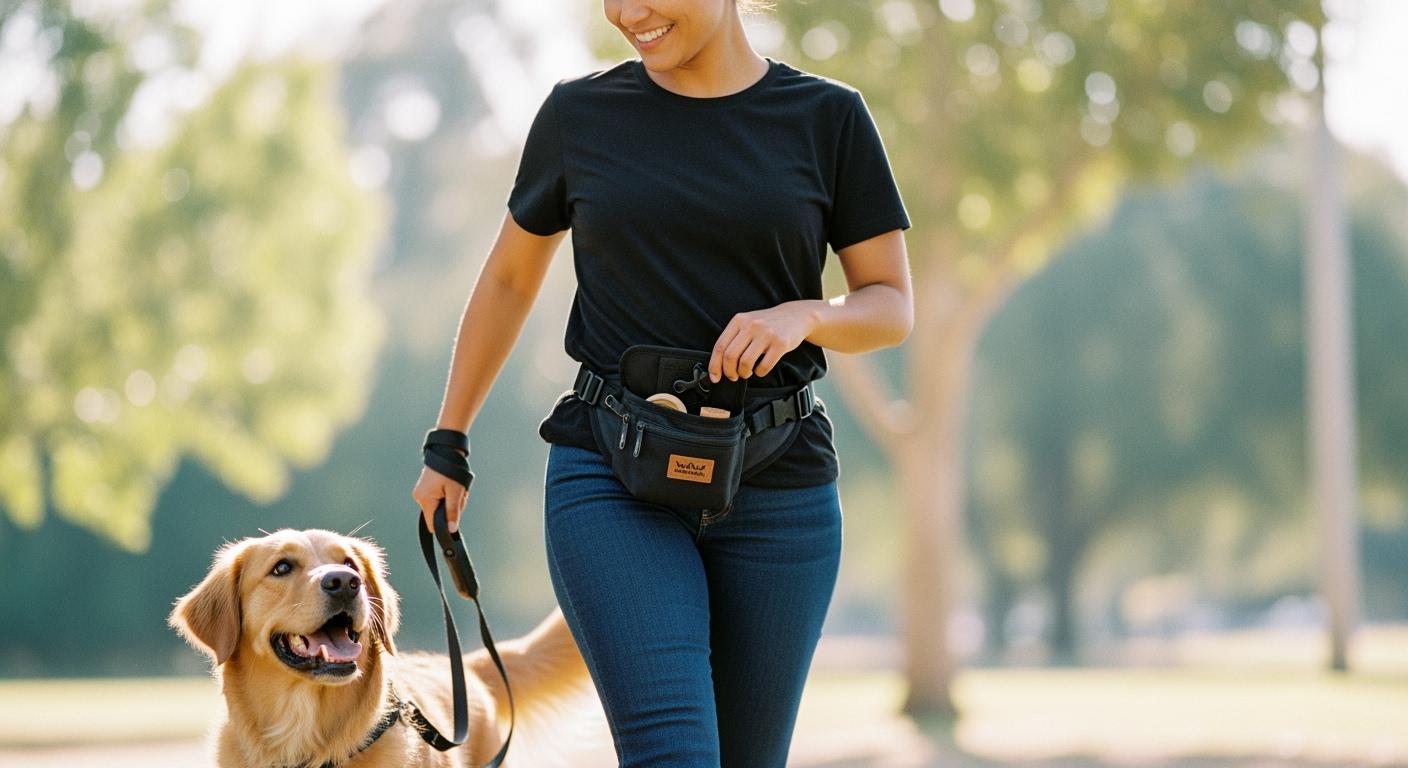
Most dog treat pouches spill for two reasons, and neither has much to do with how carefully you move. An open-top pouch with a wide mouth makes access easy. That same opening, tilted 45 degrees during a crouch, becomes an exit ramp. A magnetic closure that snaps shut after each reach changes that equation — and a deep structured body keeps treats from shifting toward the opening in the first place.
A pouch designed around these two points does not need a dozen extra features. It needs a closure that closes itself and a shape that does not collapse under motion. Pocket count, belt clip style, liner material — those matter only after the closure and body shape work.
| Real-use failure | Likely pouch design cause | Better design direction |
|---|---|---|
| Treats spill during a jog | Loose or open closure | Magnetic closure with drawstring or zipper backup |
| Crumbs escape when bending forward | Shallow pouch body that tilts open | Deep, structured body that holds shape under tilt |
| Pouch swings and dumps treats | Unstable waist or belt attachment | Secure belt clip with minimal lateral play |
When a Treat Pouch Spills — Closure and Body Shape Are the Root Cause
What Fast Movement Does to an Open Pouch
Bend forward. The pouch tilts. Gravity pulls every treat toward the opening. If nothing blocks the exit, treats fall out. That is the entire spill mechanism — and it happens in under a second.
The physics is straightforward. A pouch attached at the waist swings as a pendulum during walking or jogging. Each stride adds a forward-and-back arc. When you crouch, the pouch body tilts past horizontal. At that angle, any treat resting near the opening has a clear path out. The only things that stop it are a closure that seals the opening or a body deep enough that treats sit well below the rim even at full tilt.
This is why closure design and body depth are not separate preferences. They are the two physical barriers between a contained treat and one on the ground. A shallow pouch with a magnetic closure still dumps crumbs if the closure gap lets small pieces through. A deep pouch with no closure still spills when you bend far enough. The designs that work combine both.
In practice: Load a pouch with ten small treats, clip it to your waist, and walk briskly for two minutes while changing direction every fifteen seconds. Count what remains. A pouch that passes keeps nine or ten. One that loses three or more has a design problem, not a user problem.
Two Design Points That Matter More Than the Rest
Stroll the accessories aisle and pouches advertise storage pockets, waste-bag dispensers, reflective trim, carabiner clips. None of that stops a spill. The features that matter are the ones that counter the two failure modes: opening under motion and body collapse. A pouch built specifically for spill-free training in fast-paced conditions prioritizes those two points first. Extra pockets are irrelevant if the main compartment empties itself on the first jog.
Magnetic Auto-Close — Why Snap-Shut Works Where Fixed Openings Fail

The Physics of a Magnetic Closure During Movement
A fixed open top is a permanent exit. A zipper or drawstring seals completely but demands two hands to close — and the delay between reaching for a treat and resealing is when spills happen. A magnetic closure changes the sequence: hand enters, grabs treat, hand exits, magnets snap the opening shut. No second step. The magnets are positioned at the rim and drawn together by their own force the moment the hand clears the opening.
The seal is not airtight — small crumbs can escape through the gap if the pouch tilts sharply. But the bulk of the treats stay behind the magnetic barrier. The failure mode worth watching is weak magnets. A closure that snaps shut during slow walks but pops open at a jog is no better than an open top. If the pouch can be shaken open with a brisk hip motion, the magnets are undersized. This is the kind of detail that separates pouches that balance easy access with genuine spill control from those that only look secure on a store shelf.
The Backup Closure Most Pouches Skip
Magnets work best during active use — hand in, hand out, snap shut. Between sessions, during car rides, or when the pouch gets tossed into a bag, magnets alone are not enough. Pressure from other objects can push the opening apart. A drawstring or zipper backup covers that gap. Tighten it before stowing, and nothing escapes regardless of orientation. The combination — magnetic for speed during training, drawstring for security during transport — covers both use modes. A pouch with only one forces a trade-off no handler should have to make.
Pouch Depth and Body Structure — Why Shape Determines Spill Rate
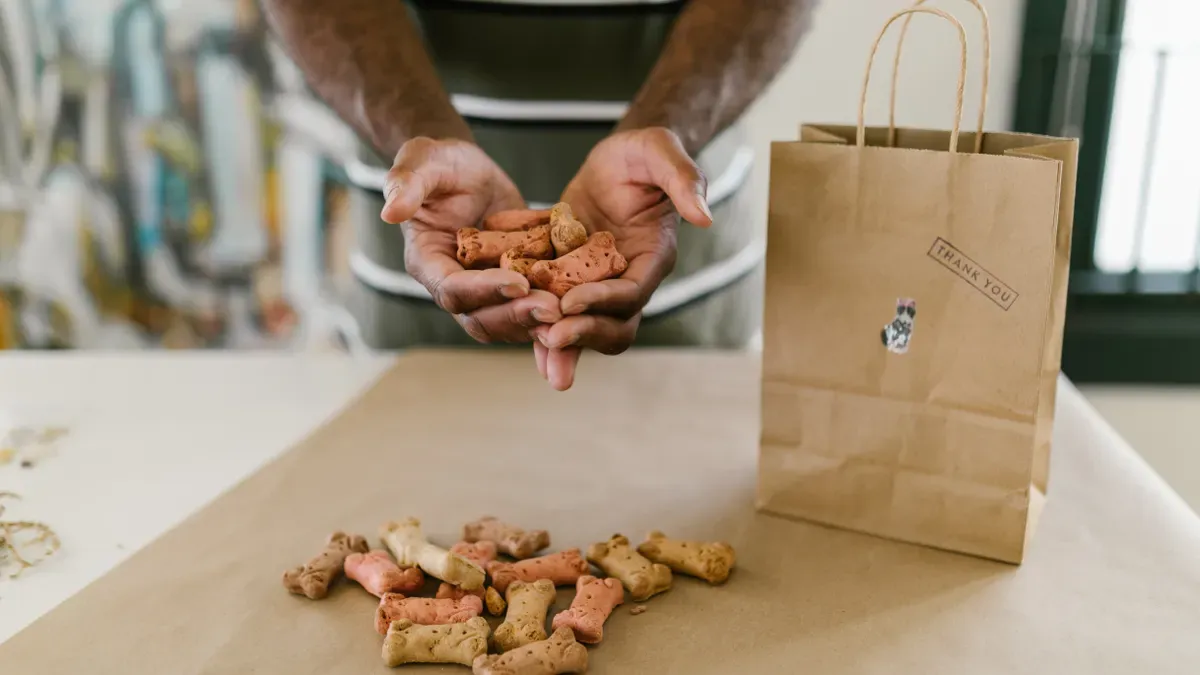
Shallow Pouches vs. Deep Structured Bodies
Take a shallow pouch — three inches deep, wide opening at the top. Fill it halfway. Tilt it forward 45 degrees: the treat level reaches the rim, and any additional jostle sends pieces over the edge. That is a shallow pouch during a normal bend to attach a leash. A pouch with six or more inches of depth keeps the treat level well below the rim at the same tilt. Treats have farther to travel before reaching the exit.
Add a structured body — one that holds its shape rather than collapsing inward — and the interior volume stays consistent. Treats do not get squeezed upward by collapsing walls. Comparing pouch designs across access speed and spill control shows the same pattern: depth plus structure beats shallow plus soft every time under real movement. A pouch that crumples when you lean against a counter becomes shallower in practice than its measurements suggest.
Disclaimer: This depth-versus-shallow comparison assumes treats of uniform kibble size, roughly pea-sized to thumbnail-sized. If you use soft, crumbly training treats that break apart during movement, even a deep structured pouch may accumulate fine debris near the opening — the closure becomes the primary defense in that case. For dogs on restricted diets where treat size and texture cannot be adjusted, prioritize closure seal quality over body depth alone.
Interior Design — Seams, Corners, and the Cleaning Penalty
A pouch body that keeps treats in during movement has a second job: letting crumbs out during cleaning. Stitched seams at the bottom corners trap debris. Rounded, seamless interiors let you wipe the surface in one pass. This is not cosmetic. Crumbs left in corners absorb moisture and transfer stale odors to fresh treats. A non-porous liner — typically coated polyester or wipe-clean nylon — resists oil absorption from soft treats. When sizing a pouch for session length and treat type, the interior finish is as relevant as the volume. A pouch big enough for an hour of training but impossible to clean after a session with moist treats becomes a one-use item in practice.
| Real-use failure | Likely pouch design cause | Better design direction |
|---|---|---|
| Treats spill when bending forward | Shallow or collapsing pouch body | Deep, structured body that holds shape under load |
| Crumbs pack into bottom corners | Stitched seams at base | Rounded, seamless interior bowl |
| Odor persists after cleaning | Absorbent lining material | Non-porous, wipe-clean liner |
When a Spill-Resistant Pouch Design Works Against You
A pouch built around closure security and body depth trades off some access speed — the magnetic seal adds a fraction of a second to each reach. For most training, that fraction does not matter. But in a few conditions, it does. Seated training sessions where the pouch rests on a table do not need spill resistance — gravity works in your favor. Rapid-fire treat delivery, dispensing a treat every two to three seconds for sustained shaping work, may be slowed by any closure at all. Handlers using larger, irregular treats — dehydrated liver chunks, training jerky strips — may find a magnetic opening sized for kibble does not fit their format.
In those cases, the design priority shifts. A simple open-top pouch or a more versatile pouch built for capacity over spill control may fit the workflow better. A spill-resistant pouch is built for handlers who move — stand, walk, crouch, jog. If the session never leaves a chair, the design advantage disappears.
Disclaimer: This analysis focuses on waist-worn pouches used during active dog training and walking. Pouch performance during high-impact activities like trail running or mountain biking introduces additional forces — rotational torque on the belt clip, sustained vibration, and impact shocks — that exceed the testing conditions described here. If the pouch is intended for those activities, verify that the belt attachment can lock or be secured against rotational slip, as even a perfectly designed closure and body will spill if the entire pouch rotates past 90 degrees on its mount.
FAQ
How do you test whether a pouch closure holds during a run?
Load the pouch with ten treats, clip it to your waist, and jog in place for thirty seconds with high knees. Stop and count. If the magnets popped open or treats escaped, the closure is not rated for running intensity. A pouch that passes this controlled test may still fail on uneven terrain — the side-to-side sway of real trail movement adds a lateral force that stationary jogging does not replicate.
Can a treat pouch stay attached during bent-over movements?
It depends almost entirely on the belt attachment, not the pouch body. A clip with a locking mechanism or a strap that threads through a belt loop resists rotation when the pouch tilts forward. A simple spring clip can rotate on the belt, especially with a narrow belt. Walk ten minutes with the pouch loaded, then check whether the attachment point has shifted more than an inch from its starting position — that shift signals an unstable mount.
What makes a pouch interior easy to clean after soft treats?
A non-porous liner with a rounded, seam-free bottom. Rough fabric interiors and stitched base seams trap oils and crumbs a wipe cannot reach. To verify: press a soft treat into the bottom corner, leave it for five minutes, then wipe with a dry paper towel. If residue remains, the interior will accumulate odor. A pouch with a washable, non-absorbent liner resets to clean in under a minute after even the messiest session. The training treat pack format with a smooth interior lining handles daily use without absorbing odors.
Does a magnetic closure work with all treat sizes?
A magnetic closure works best with treats smaller than the opening width — typically kibble-sized to thumbnail-sized pieces. Larger, irregular treats like jerky strips or full-size biscuits may catch on the rim and prevent the magnets from seating fully. If training relies on larger treats, a pouch with a drawstring-only closure or a wider magnetic opening is the better match.






