
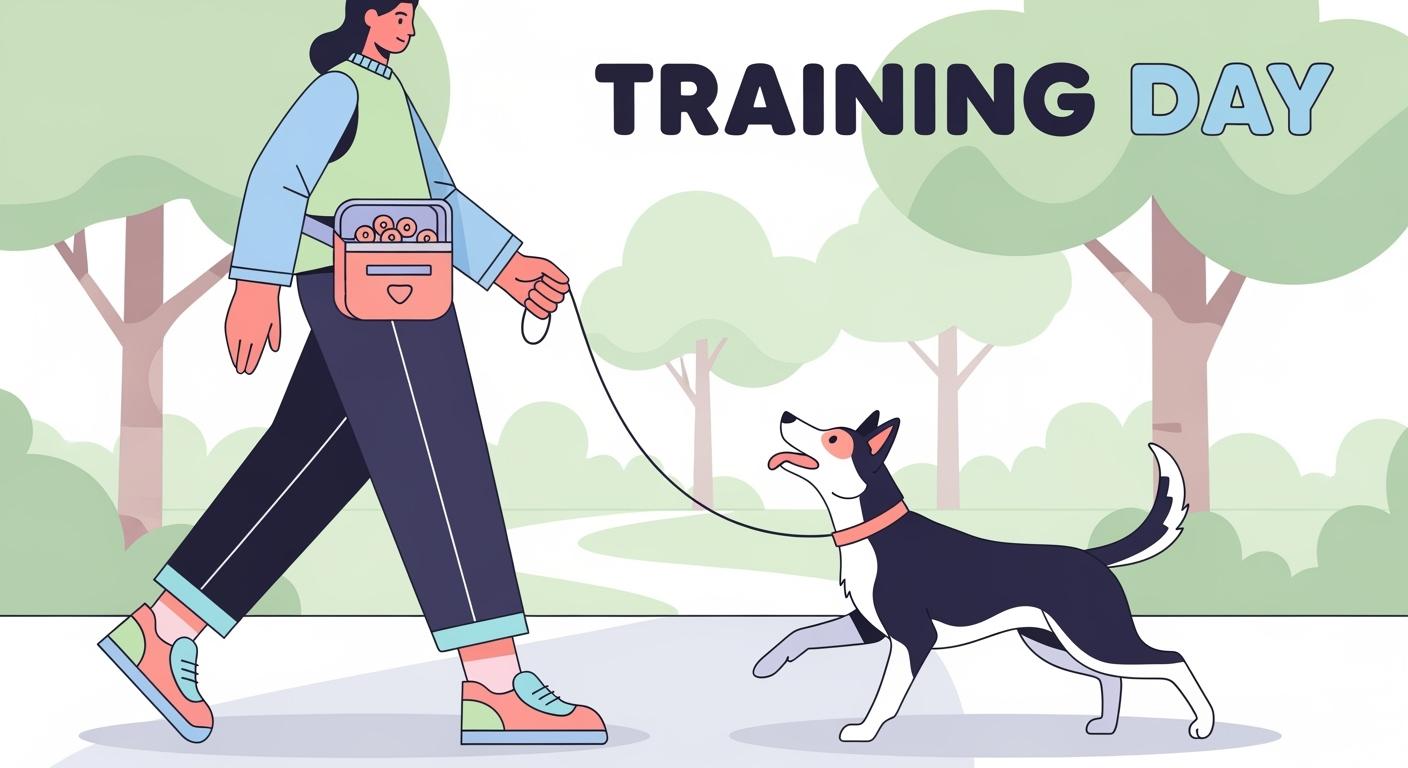
A treat pouch that flips mid-stride is not a storage problem. It is a timing problem. When the opening rotates away from your hand, the reinforcement window closes—the dog has already moved on to the next distraction, and the treat you finally fish out rewards whatever behavior came after the one you meant to mark.
Stability in a training pouch is not about how many pockets it has or whether it looks streamlined in a product photo. It comes down to two design details: how wide the attachment point spreads load across your waist, and how close the bag body rides to your hip. Everything else—pocket count, lining material, waste-bag dispenser loops—is secondary. Get the anchor wrong, and none of the extras matter because you cannot reach them fast enough.
A split-top waist-anchored pouch and a narrow clip-on bag look similar on a shelf. They stop looking similar about thirty seconds into a walk with a dog that pulls, lunges at squirrels, or changes pace without warning.
Why Clip-On Treat Pouches Flip Once Training Starts Moving
The Standing-Still Illusion
Stand in front of a mirror and clip a pouch to your waistband. It sits flat. The opening faces up. You slide two fingers in, grab a treat, and it feels natural. This is a static test, and static tests are misleading because they remove the single force that determines whether a pouch actually works during training: lateral acceleration.
When you walk, your hips oscillate side to side. A pouch attached by a single narrow clip—typically a plastic spring gate or a thin metal carabiner—acts like a pendulum. The clip forms a pivot point roughly half an inch wide. The pouch body, loaded with an ounce or two of treats, hangs below that pivot. Each hip swing inputs angular momentum at the attachment point. The pouch swings outward. On the return swing it twists. After two or three strides the opening faces your thigh instead of the ceiling.
Tip: The width of the attachment point sets the lever arm that resists rotation. A clip one inch wide resists twisting with roughly four times the rotational stability of a half-inch clip—not because the math is complicated, but because doubling the width squares the restoring torque.
Real Movement Exposes the Design Gap
Add a dog that pulls or changes direction, and the pendulum effect compounds. A sudden lateral tug rotates your torso. The pouch, already swinging from hip motion, gets an additional impulse. The narrow clip cannot counter-rotate fast enough. The bag flips, treats shift to the low corner, and the opening is now facing backward or down.
Common failure sequence with narrow-clip pouches:
- The bag tilts outward within the first ten strides on flat ground.
- A turn or leash correction rotates it further—often past 90 degrees.
- Treats migrate to the downhill side, unbalancing the load further.
- The opening is no longer where your hand expects it.
- You look down. You steady the bag with your other hand. The reward arrives late.
Late rewards do not reinforce the behavior you intended. A reward system built around split-second timing breaks down when the delivery tool adds a two-second fumble to every repetition.
| Failure Sign | Design Cause | Better Direction |
|---|---|---|
| Bag flips or tilts past 45° | Narrow single-point clip creates pendulum pivot | Wide belt loop or dual-anchor waist attachment |
| Reward arrives 2+ seconds late | Rotating opening, treat migration to low corner | Stiffened rim, split-top access, shallow main chamber |
| Handler looks down during delivery | Bag body swings away from hip on turn | Close-body contour, wide rear panel, tensioned belt pass-through |
One Hand Is All You Have
Active training means one hand holds the leash. The other hand reaches for the pouch. If the pouch has moved since the last reach, muscle memory fails. You have to locate the opening visually. That glance down breaks your attention at the exact moment the dog checks in with you—and the check-in goes unmarked.
To verify whether a pouch design supports one-handed access under movement: walk at normal pace for two minutes with the pouch loaded, then reach for a treat without looking. If your fingers find the opening on the first try, the design has enough rotational stability for real-world use. If you need a second attempt or a glance, the attachment system is undersized for dynamic training. This check works across pouch styles—split-top, drawstring, magnetic closure—because it tests the anchor, not the closure.
What Makes a Pouch Lose Stability—Attachment, Load, and Opening Design
Attachment Width Sets the Baseline
A nylon belt loop sewn across a four-inch rear panel distributes tension differently than a single carabiner clipped to a belt loop. The sewn panel creates a wide friction contact patch against the waistband. When the pouch tries to rotate, the entire panel must overcome static friction across its full width. A narrow clip has no such patch—it rotates freely around its single contact point the moment lateral force exceeds the clip’s rotational friction, which for most spring-gate designs is negligible.
This is why pouches with an integrated belt sleeve or a wide pass-through panel tend to hold orientation better. The belt itself becomes a structural rail. The pouch body cannot pivot independently of the belt, so hip oscillation transfers less rotation to the bag. The difference is most visible when the handler speeds up from a walk to a jog—narrow-clip pouches swing rhythmically with each footfall, while wide-panel pouches stay relatively still.
Load Balance and Chamber Shape
A deep cylindrical pouch holds more treats. It also concentrates weight further from the attachment point, which increases the pendulum moment. When treats shift to one side—which they will, because irregularly shaped rewards like freeze-dried liver or cheese chunks do not pack evenly—the offset mass creates a torque that rotates the pouch toward the heavy side.
A shallower, wider chamber keeps the center of mass closer to the waist. Treats spread laterally rather than stacking vertically. This lowers the effective pendulum length and reduces the torque generated by uneven fill. Even when treats settle to one side, the shorter lever arm means less rotation per ounce of offset weight.
In practice: A pouch with a depth-to-width ratio near 1:1 tends to stay upright through pace changes. Pouches deeper than they are wide—roughly 2:1 or more—start tilting noticeably once treat levels drop below half and the remaining pieces can shift freely.
Opening Stiffness and Reward Timing
A split-top opening with a stiffened rim stays accessible even when the pouch tilts slightly. The rim holds its shape, creating a consistent target for your fingers. A drawstring closure collapses when the pouch body flexes—the fabric bunches, the opening narrows, and accessing a treat becomes a two-handed operation.
The material choice at the opening matters in a way that is easy to overlook during a quick product-page browse. A polyester rim stiffener sewn into a double-folded hem holds its shape through dozens of wash cycles. A sewn-in plastic stay can warp in a hot dryer. Neither failure shows up in a showroom photo, but both become obvious the third time you reach for a treat and meet collapsed fabric instead of an open rim.
Check this by pressing the sides of an empty pouch inward with your thumb and forefinger, then releasing. A well-designed rim springs back to its original shape. A rim that stays pinched signals that after a few months of use and laundering—particularly when comparing pouches on access speed and spill control—the opening will progressively deform and slow down every reach.
| Design Difference | Why It Matters | Main Limitation |
|---|---|---|
| Split-top with stiffened rim vs. drawstring | One-hand access stays consistent; opening does not collapse under body movement | Stiffened rim can press into the hip if the pouch rides low on a short-waisted handler |
| Wide belt sleeve vs. narrow clip | Rotational stability across pace changes; pouch cannot pivot independently of the belt | Threading the belt takes a few extra seconds during setup; less convenient for quick on/off |
| Shallow wide chamber vs. deep cylinder | Lower center of mass reduces pendulum swing; treats spread laterally instead of stacking | Holds fewer treats per carry; may require refilling mid-session for long training walks |
What Stable Training-Pouch Design Works for Active Walkers

Close-Body Waist Fit Anchors Everything
A pouch that sits flush against the hip moves with your body rather than around it. When the rear panel contours to the natural curve of the waist, the contact patch extends across the full panel width rather than pinching at two clip points. Friction does the work that a mechanical lock would do—and it does it without transferring concentrated pressure to one spot on the waistband.
The belt tension that keeps the pouch stable is the same belt tension that keeps your pants up. No separate adjustment. No secondary strap to tighten or forget. This matters because every additional adjustment point is a failure mode: a strap that loosens over a mile, a buckle that catches on a door frame, a slider that drifts under repetitive motion. A simple wide pass-through eliminates those variables.
To check fit stability on any pouch: after a 10-minute walk with a loaded pouch, note whether the rear panel has shifted more than one inch from its starting position on the waistband. Rotation under one inch suggests the attachment system is adequate for the handler’s typical pace and the dog’s pulling style. More than that, and the design likely needs either a wider belt pass-through or a second anchor point—especially for setups where simplicity trades off against versatility in ways that affect real-session reliability.
Split-Top Access vs. Drawstring Delay
Drawstring closures solve one problem—they keep treats from spilling when the pouch tips over—but they create a bigger one: they make access slow enough to miss the reinforcement window. A one-handed drawstring open requires hooking a thumb under the cord, pulling against the pouch body, reaching in, and then re-tensioning. Four distinct motions per reward. With a dog that needs 15–20 reinforcements in a five-minute focused session, that is 60–80 extra hand movements. The handler either slows down the session to accommodate the pouch, or the pouch gets abandoned in favor of a pocket full of crumb dust.
A split-top design with a stiffened spring rim replaces those four motions with one: fingers slide between the split flaps, grab a treat, and withdraw. The flaps close on their own. No cord to pull, no bag mouth to re-open. This speed difference is not about convenience—it is about whether the treat arrives before the dog’s attention drifts. When setting up a treat bag system for consistent training, closure type determines whether the pouch helps or hinders the session rhythm.
A treat pouch built for training repetition earns its place on the belt when the handler can complete a full reach-and-reward cycle without adjusting grip, looking down, or steadying the pouch with the leash hand.
When a Stable Pouch Is Not the Right Tool
A waist-anchored training pouch assumes you are standing or walking and have one hand consistently free for treat delivery. That assumption breaks in several real-world scenarios.
If the handler runs with the dog on a waist belt, a hip-mounted pouch can bounce against the thigh at pace, creating a repetitive slap that distracts both handler and dog. A crossbody sling setup or a small pocket-sized pouch may work better here—the tradeoff is less capacity for fewer distractions at speed.
If the dog is in a long-line decompression walk where treats are delivered infrequently and the handler uses both hands for leash management, a zippered pocket or a small carabiner-mounted canister may be more practical than a dedicated training pouch. The split-top advantage disappears when treat delivery drops below once per minute, because access speed no longer drives session quality.
When spill control matters more than split-second access—such as on a trail with tall grass where dropped treats vanish instantly—a drawstring or magnetic closure that prioritizes containment over speed becomes the better choice, even though it slows down each individual reward.
Disclaimer: The stability checks described here assume a handler walking on paved or packed surfaces with a dog on a standard-length leash. Handlers on uneven terrain, those using trekking poles, or handlers managing reactive dogs may experience different pouch dynamics—the hip motion that keeps a pouch stable on flat ground can become irregular on a rocky incline, and a pouch that passes the 10-minute rotation check on pavement may shift more aggressively on a trail. For dogs that lunge suddenly or change direction at speed, a pouch with a secondary retention tether or a reinforced belt pass-through provides an extra margin that the standard checks may not demand but real-world surprises often do.
FAQ
Why does a narrow clip make a pouch flip during walks?
A narrow clip creates a single pivot point with negligible rotational friction. Each hip oscillation inputs angular momentum at that pivot—the pouch swings outward, then twists on the return. A wide belt sleeve or dual-anchor panel spreads the attachment across several inches, so the pouch body cannot rotate independently of the waistband.
Does pouch depth affect stability?
Yes. A deep pouch lowers the center of mass further from the attachment point, lengthening the effective pendulum and amplifying the swing from each hip movement. A shallower chamber keeps the weight closer to the belt, reducing the lever arm. The tradeoff is capacity—a shallower pouch needs refilling sooner on long sessions.
Are drawstring pouches always worse than split-top designs?
Not always—they are worse for speed but better for containment. On trails where dropped treats disappear into brush, a drawstring closure that keeps treats sealed during a stumble can be the more practical choice. The design question is whether the training session rewards frequency (split-top wins) or containment over uneven ground (drawstring can win).
How can I tell if my current pouch is stable enough?
Walk for 10 minutes at your normal training pace with the pouch loaded to its typical level. Mark its position on your waistband with a finger before you start. After 10 minutes, check whether the rear panel has rotated more than one inch from its starting position. Rotation under one inch is acceptable. More than that, and the attachment system is undersized for your movement pattern.
Does treat type affect pouch stability?
Irregularly shaped treats—freeze-dried chunks, cheese cubes, cut hot dog rounds—do not pack evenly and shift under movement, creating unbalanced loads that rotate the pouch toward the heavy side. Uniform cylindrical or pellet-shaped treats settle more predictably and produce less torque from internal shifting. The effect is subtle with a well-anchored pouch but becomes noticeable when the attachment is already marginal.






