
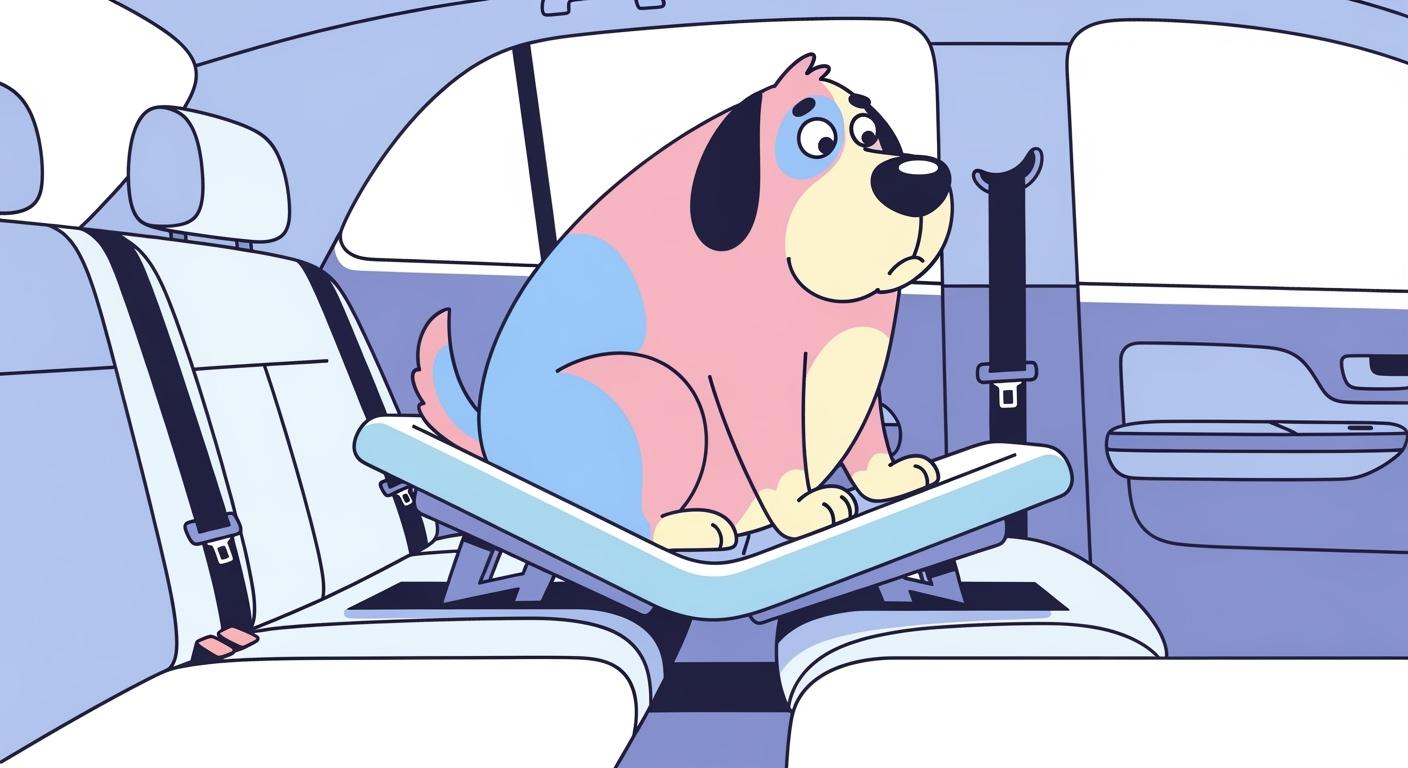
A large dog shifting weight on a split rear bench does more than move around — the dog becomes a live load testing the seat cover’s base design. When the base cannot make full contact with both seat sections, the result is predictable: tilt, rock, and a dog that cannot settle. The problem is not the dog. It is the gap between the seat halves and how the base handles it.
Why Large Dog Car Seat Bases Tilt on Split Rear Seats
How the Seat Seam Creates a Pivot Point
Split rear seats are mechanically two separate platforms, not one. The seam between them forms a discontinuity — a narrow trench that a soft or undersized base cannot bridge without deforming.
When a large dog’s weight lands on a cover spanning that seam, the fabric forms a shallow curve over the gap. The center section — the part with no vehicle seat underneath it — deflects downward under load. That downward deflection rotates the edges upward around the seam like a seesaw pivoting on its fulcrum. A rigid base resists this bending moment by spreading the load across its full footprint. A soft base follows the contour of the gap, turning every weight shift into a rocking motion.
The second variable is overhang. If the base extends past the front edge of the vehicle seat, the unsupported front section becomes a cantilever. The dog’s weight behind the seat edge acts as the load; the seat edge itself becomes the pivot. A base that overhangs changes from a stable platform into a lever. And levers tip. The relationship between seat depth and base depth is not about size labels. It is about where the load sits relative to the support. When a seat cover’s measurements match the bench dimensions, the base edges land on solid seat surface, not air.
Rigid Base vs. Soft Base — What the Dog Feels
Drop a 70-pound dog onto a car seat cover. On a rigid base, the platform stays flat. On a soft base, the middle bows into the seat gap and the corners lift. The dog feels the difference immediately — not as a design spec, but as a surface that shifts under its paws.
A rigid bottom panel works because it creates a single structural plane. When weight lands on one side — say the dog leans into a turn — the opposite edge does not lift. The entire base moves as one piece, or it does not move at all. This is the opposite of a foam or fabric-only base, where compression at the load point transfers motion diagonally across the cover. Load one corner; the opposite corner floats.
The material logic runs deeper than stiffness alone. A rigid panel in production is typically a laminated composite — a stiff core sandwiched between fabric layers. This construction keeps the panel thin enough to fold for storage but rigid enough under tensile loading from the seat anchors. A soft base skips the lamination step, relying on fabric tension alone. Tension works until the dog moves. Then the fabric relaxes on one side, slack forms, and the base deforms toward the gap.
| Check Area | Strong Design Signal | Weak Design Signal | Why It Matters |
|---|---|---|---|
| Center load | Base stays flat when dog weight is on it | Middle dips or bows toward the seat gap | Center sag turns a stable platform into a hammock over empty space |
| Corner contact | Edges stay in contact with the bench seat | Corners lift, curl, or float above the seat | Raised edges mean the base has lost its full footprint |
| Top surface grip | Dog can settle without constant repositioning | Surface feels slick once weight shifts | A hard base still fails if the dog slides across it |
In practice: After 10 minutes of driving, stop and check all four corners of the base. A corner that floats more than half an inch off the seat surface signals the base has lost contact. The dog may not vocalize or pace — but if the corners are up, the platform has been unstable the entire drive.
Padding cannot fix this. Extra foam compresses under weight and hides the underlying instability for the first few minutes — until the dog shifts. Then the foam bottoms out, the unsupported gap takes over, and the rocking returns. Padding changes what the dog feels at the top surface. It does nothing to the structural problem underneath. A booster-style seat that elevates a smaller dog works on a different principle entirely — the dog’s weight sits inside a contained bucket, so base tilt is constrained by side walls. A full-bench cover has no side walls to fall back on. The base must hold the line on its own.
Design Features That Stabilize a Large Dog on Split Seats
Three design details determine whether a large dog car seat stays put or becomes a sliding platform on split rear seats: the underside grip layer, the panel reinforcement pattern, and the buckle opening alignment.
Non-Slip Underside
A textured backing — typically silicone-dotted or rubberized mesh — creates mechanical friction against the vehicle upholstery. This friction resists the lateral forces that come from the dog climbing in, turning around, or bracing during braking. Without it, even a perfectly flat base slides as soon as the dog’s weight shifts direction. A back seat cover with a non-slip backing layer grips through turns and stops in a way that fabric-on-fabric simply does not.
Reinforced Panels
A base panel that flexes at the seat seam is a base panel that has already failed. Reinforcement — typically a rigid insert sewn into a fabric sleeve or a laminated stiffener bonded to the underside — prevents the panel from forming a hinge at the split-seat gap. The engineering target is not absolute rigidity but gap-bridging stiffness: stiff enough that the panel does not follow the contour of the seat seam under load.
Aligned Buckle Openings
The restraint path matters. If the cover’s buckle or tether slots do not line up with the vehicle’s anchor points, the owner must either leave the dog unsecured or wrestle the cover out of position to access the buckle. Neither outcome is acceptable. Split-fold covers with precision-cut openings solve this at the pattern stage — the slots are positioned to match common vehicle layouts, not placed as an afterthought.
Fit-For and Not-Fit-For Scenarios
A large dog car seat cover that matches the vehicle’s seat dimensions produces clear fit signals. The dog steps in, settles within a few seconds, and stays centered through turns and stops. The base corners stay in contact with the seat surface. The restraint openings line up without adjustment. The dog is not bracing, not turning in circles, not leaning against the door panel.
When the base does not match the seat shape, the signals are just as clear. The dog cannot find a stable position. It braces with its paws, shifts repeatedly, or presses against the side of the car. The base tilts on every weight shift. Corners float. The middle sags into the gap. The buckle slots do not line up with the anchor points.
Disclaimer: These fit checks assume the vehicle has a standard split rear bench with level seat cushions. Vehicles with deeply contoured sport seats or integrated child booster sections may not provide a flat enough mounting surface for any full-bench cover — the base design cannot compensate for a seat shape that was never intended to carry a flat load across its full width. If the vehicle seat itself has a pronounced dip at the split, a rigid base panel can bridge a shallow gap but will not level out a deep contour.
| Fit Signal | What the Dog Does | Root Design Cause |
|---|---|---|
| Good fit | Settles, stays centered | Flat rigid base, non-slip grip, aligned openings |
| Poor fit | Braces, turns, slides | Floating corners, soft base, poor underside grip |
A second observable check: after installing the cover, run your hand along the underside at the seat seam. Feel for the rigid panel dipping into the gap or fabric bunching into the split. If the panel does not bridge the seam flat at rest, it will not hold flat under the dog’s weight either. The base design and the vehicle seat shape either work together — or the in-car safety seating equation starts with a disadvantage that no amount of strap tightening can fix.
A large dog needs the base to do one job well: resist the bending moment at the seat gap. When it does, the dog rides in a stable position. When it does not, the tradeoff between support and access becomes a daily frustration instead of a one-time setup decision.
FAQ
Why does a large dog car seat tilt even when the straps are tight?
Tight straps pull the cover against the seat back, but they do not change what happens at the seat seam. If the base is soft or the panel flexes at the gap, strap tension cannot stop the middle from sagging or the corners from lifting under the dog’s weight. The structural problem is between the base and the seat surface — the straps only control fore-aft position.
Can padding level out a rocking dog car seat?
Padding compresses. Under a large dog’s weight, foam collapses into the seat gap and the instability returns — often within the first few minutes of driving. A rigid base panel bridges the gap; padding fills it temporarily and then gives way. These are different mechanisms with different outcomes.
What makes a base rigid enough for a large dog?
A laminated composite panel — a stiff core bonded between fabric layers — provides the gap-bridging stiffness that fabric tension alone cannot deliver. The core material resists bending across the seat seam; the fabric layers provide tear resistance and attachment points for the anchor straps. A base that flexes easily by hand will flex under a dog.
Does a non-slip underside actually make a difference during braking?
A silicone or rubberized backing creates static friction against the vehicle upholstery. Without it, lateral forces from the dog’s momentum overcome fabric-on-fabric grip almost immediately. The cover slides, the dog braces, and the base alignment shifts. After a few miles, the cover can migrate several inches from its original position — a shift that is visible the moment the door opens.






