
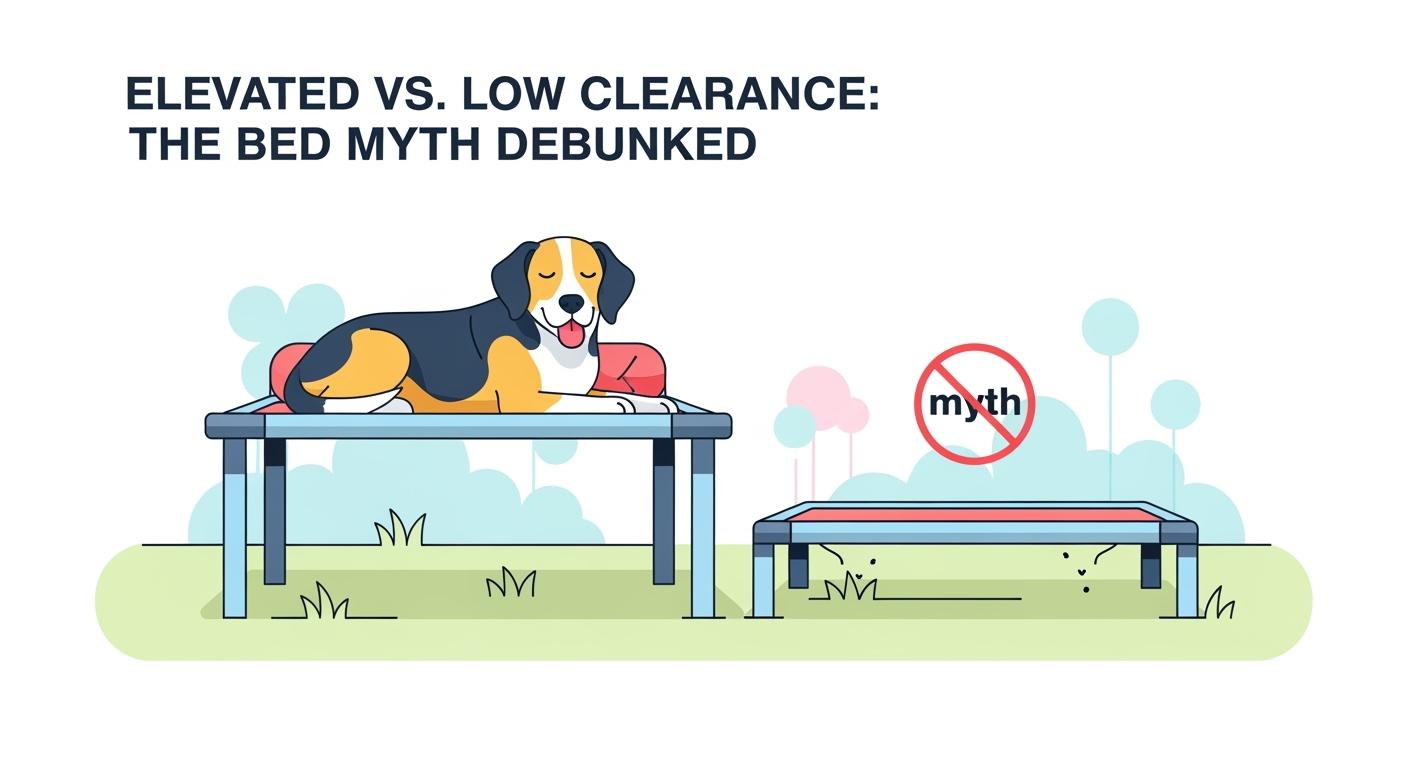
Lift a dog bed six inches off the ground and the top stays dry. That part works. The underside is where the design either succeeds or fails.
An outdoor dog bed elevated above the ground should make cleanup obvious: sweep underneath, rinse, done. But when the frame sits low with crossbars packed tight, mud, wet grass, and fur collect in pockets you cannot reach with a broom or hose. The top looks fine. Flip the bed over and the mess is still there.
Clearance is not a yes/no feature. It is a geometry problem. How much open space sits between the ground and the lowest frame part determines whether debris passes through or gets trapped. That gap — and the shapes that surround it — is what this article unpacks.
When Six Inches of Air Still Trap Mud
Elevation helps only when the space below is unobstructed. A bed frame with 4-inch legs and three crossbars running parallel underneath creates compartments. Dirt falls through the mesh, hits a crossbar, and settles. Rain pools on flat bar surfaces. Fur wraps around joints. The bed is technically elevated. It is also a collection tray.
Think through the physics for a moment. Debris falling from a dog’s coat has downward momentum. When it hits an open gap, it lands on the ground where you can sweep or rinse it away. When it hits a crossbar instead, two things happen. First, the impact scatters smaller particles sideways into corners the crossbar creates with the leg joints. Second, fur and grass blades — which have high surface area relative to mass — lose momentum on contact and cling rather than bouncing clear. Add moisture from wet paws or morning dew and those particles bond to the frame surface. Each use layers on more.
This is why clearance alone is not the answer. The arrangement of material below the sleeping surface matters as much as the distance to the ground. An open frame with a single perimeter bar and 7 inches of clearance sheds debris faster than a crowded frame at 9 inches.
In practice: After a wet afternoon outside, flip the bed and look at the crossbars, not the ground. If debris clings to the bars themselves, the frame layout — not the height — is the bottleneck.
A quick field check: after your dog has used the bed outdoors for a week, run your hand along the underside of each crossbar. A smooth pass means debris is falling through. Grit, fur, or damp patches mean the frame is catching what should be landing on the ground.
What the Numbers Actually Mean
The 6-to-9-inch clearance range often cited for elevated dog beds is a starting point, not a guarantee. Six inches works when the underside is a single open rectangle with legs at the corners and nothing else spanning the gap. The same six inches under a frame with two mid-span crossbars leaves divided channels that trap debris between them.
Nine inches is not automatically better, either. A taller bed with a crowded underside still blocks broom access. The extra height mainly helps airflow — useful for drying speed — but does not solve the geometry problem if crossbars remain in the path of falling debris. When evaluating an outdoor elevated dog bed, checking what sits between the legs matters more than the leg height alone.
Frame Layout, Foot Shape, and the Seams That Slow You Down
Three frame details determine whether cleanup takes 30 seconds or turns into a recurring chore: how the bars are arranged, what the feet look like, and where the fabric attaches.
Crossbar layout. A single perimeter frame — one continuous outer bar with legs at the corners — leaves the entire underside open. A broom passes through in one sweep. A hose sprays from any angle without deflecting off mid-span bars. Frames with parallel crossbars between the legs create divided zones. Debris collects along the bar edges where the gap narrows. Each bar adds two edges that catch falling material.
Here is how different frame choices play out in practice:
| Design Difference | Why It Matters | Main Limitation |
|---|---|---|
| Single perimeter frame | Full underside access for broom and hose | Requires thicker tubing for rigidity without cross-bracing |
| Cross-braced frame | Stiffer structure at lower material cost | Creates debris-catching channels between parallel bars |
| Smooth, rounded feet | Mud and fur wipe off in one pass | Smooth plastic feet can slide on slick patios unless rubber-tipped |
| Textured or angled feet | Better grip on decks and tiles | Texture traps fine dirt that requires scrubbing to remove |
| Welded or seamless corners | No gap for fur and grass to wedge into | Harder to repair if a joint fails compared to bolted connections |
| Fabric with edge binding | Prevents fraying at the mesh perimeter | Binding seam creates a ridge where fine debris collects |
Foot design. Feet are the dirtiest part of any outdoor elevated dog bed. They sit in mud, wet grass, and standing water. Smooth, dome-shaped feet shed debris when you spray them. Textured feet with ridges or recessed screw holes hold onto grit. The worst offenders are hollow tube ends left open — they fill with water and mud, then drip onto the patio when you move the bed.
Seam placement. Every seam on the sleeping surface is a catch point. Hair, grass blades, and fine sand work into the stitch holes or catch on the fabric edge. A bed with a single panel of mesh stretched across the frame has fewer catch points than one with multiple panels seamed together. Coated mesh — where the fabric edge is heat-sealed rather than folded and stitched — eliminates the stitch-line catch point entirely. The material choices in outdoor dog bed construction determine whether the surface resists embedding or invites it.
Tip: After hosing down the bed, check whether water beads on the mesh or soaks through stitching. Water that lingers in seam lines means the thread is holding moisture — and whatever dirt dissolved into it.
An observable test: rinse the bed, let it sit for 10 minutes on a dry patch of concrete, then press a paper towel against each foot and each seam intersection. Moisture transfer on the towel tells you exactly where the bed holds water — and where odor will develop if those spots never fully dry between uses.
Where Open-Frame Beds Excel — and Where They Do Not
Open-frame elevated dog beds solve a specific problem well: keeping the sleeping surface out of contact with wet, muddy, or debris-covered ground while allowing fast resets between uses. Outdoor rest setups for dogs that prioritize quick drying and easy rinsing benefit most from this design.
They work best on hard surfaces — patios, decks, packed dirt, concrete. A broom or hose reaches underneath without obstruction. On grass or gravel, the advantage shrinks. Uneven ground tilts the frame, reducing effective clearance on the low side. Long grass grows up through the gap and touches the mesh, transferring moisture.
They also work best with short-coated dogs that track in surface-level debris. A muddy Labrador leaves mud on the mesh that falls through quickly. A long-haired dog sheds fur that wraps around frame bars regardless of clearance — open geometry helps but does not eliminate the issue. For raised dog beds used outdoors, matching the bed to the dog’s coat type and the surface underneath produces better results than chasing a specific height number.
These beds do not provide shade, insulation from cold ground, or orthopedic support. The mesh surface offers no pressure redistribution for dogs with joint issues. In direct sun, a steel-frame elevated dog bed will heat up — a dog brushing against hot tubing can flinch away from the bed entirely. Outdoor dog bed durability also depends on how the frame coating handles repeated sun exposure and wet-dry cycles.
Disclaimer: This article addresses how frame design affects outdoor cleanup, not whether an elevated surface is appropriate for your dog’s physical condition. If your dog has hip dysplasia, arthritis, or a thin coat that offers little natural padding, a mesh-only elevated surface may not provide enough support or warmth — even if the frame design makes cleaning easy. Dogs with deep chests or barrel builds may also find the flat mesh surface uncomfortable for extended rest, as it does not contour to body shape the way a cushioned bed does.
FAQ
How do I know if my elevated dog bed has enough clearance?
Slide a broom under the bed from the side the dog usually enters. If the broom head passes through without hitting a crossbar, the clearance and layout work together. If you need to angle the broom or work around bars, the geometry is working against you — regardless of the height number.
Does a taller bed always stay cleaner?
No. Height helps airflow and drying speed, but debris trapping is a layout problem, not a height problem. A 10-inch-tall bed with multiple mid-span crossbars will still collect fur and mud between bars. A 6-inch bed with a single perimeter frame and open center cleans faster.
What material sheds dirt best on an outdoor elevated bed?
Tight-weave polyester mesh with a PVC or TPU coating outperforms uncoated fabric outdoors. The coating prevents dirt from embedding in the weave and stops water from wicking into the thread. Heat-sealed edges eliminate the stitch-line catch point that plagues folded-and-sewn hems.
Can I leave an elevated dog bed outside permanently?
You can, but the frame material determines how long it lasts. Powder-coated steel resists rust until the coating chips at joints or foot contact points. Aluminum does not rust but costs more and dents more easily. Check the frame at leg joints and weld points monthly — those are where coating fails first and rust starts.






