
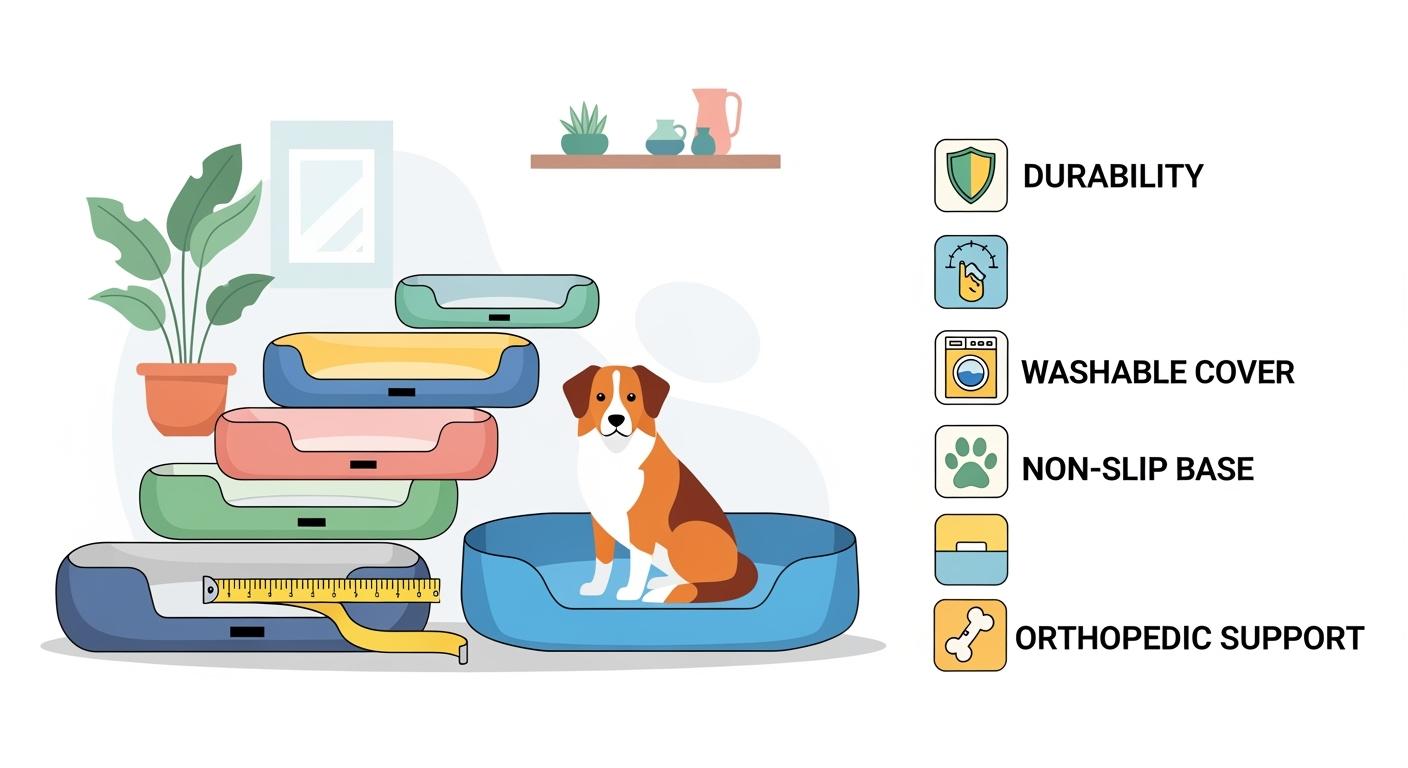
A durable dog bed should do more than resist wear. It should give your dog enough usable space to turn, settle, and rest without the fill shifting, the center flattening too quickly, or the base sliding around. This guide focuses on everyday fit, support feel, and cleanup checks so you can avoid common buying mistakes and choose a bed that works in real daily use.
If your dog already has pain, stiffness, or trouble getting in and out of bed, treat this as a product guide and ask your veterinarian what bed height and firmness make entry easier.
Key Takeaways
- Buy by usable sleep space, not by a size label alone. Your dog should be able to curl, stretch, and turn without hanging over the edge.
- Pick a bed made with good materials. Check seam finish, cover removal, fill stability, and how the base grips the floor.
- Durable does not mean right for every dog. A bed can look tough but still fail on fit, cleanup, entry height, or long-term shape retention.
What “Dog Bed Durable” Should Mean in Real Use
Start with usable sleep area, not marketing size names
The first check is not fabric strength. It is whether your dog can actually rest in the positions it uses at home. Some dogs curl tightly. Others stretch out, sleep on one side, or rotate before settling. A bed that looks large on the label can still feel small once bolsters, raised edges, or thick sidewalls reduce the interior area.
Use this simple check before you buy:
- Watch your dog when it is already relaxed, not standing alert.
- Note its longest sleeping posture and its usual curled posture.
- Mark a rectangle on the floor with a blanket or towels to match the bed’s usable interior area, not just the outside dimensions.
- See whether your dog can turn, settle, and rest without paws, hips, or shoulders hanging over the edge.
- Check entry height. Your dog should be able to step in and out without hesitation or repeated pawing at the edge.
Quick check: If your dog circles twice, steps off, or keeps readjusting before lying down, the bed may be too small, too tall, or too unstable for easy daily use.
Durable does not fix a bad fit
Tough fabric alone does not make a bed a good buy. A bed can look sturdy and still disappoint if the center sags, the edge support collapses, or the base slides every time your dog steps on it. That is why fit and construction should be checked together.
Before buying, ask these questions:
- Can your dog lie flat without part of the body hanging off the bed?
- Does the surface stay even, or does your dog sink into one low spot right away?
- Can your dog get in and out without catching claws or dragging the bed across the floor?
- Will the bed still be practical after hair, damp paws, and routine washing?
Materials and Construction to Check Before You Buy

Surface, fill, seams, and base grip
You want your dog bed to last and support your dog’s health. In practice, that means checking how the surface feels, how the fill holds its shape, whether seams stay smooth, and whether the base stays planted during entry and exit.
- Surface feel: Choose a top fabric that feels comfortable against the coat and does not get noisy or slick when your dog turns.
- Fill stability: Press down in the center and along the edges. The surface should recover evenly, without obvious lumps or hollow spots.
- Seam finish: Look for tidy stitching and edges that do not feel rough against paws, elbows, or belly fur.
- Base grip: Push the bed lightly across the floor. If it skates too easily before the dog even uses it, everyday entry can become annoying or unstable.
Look for construction that stays practical after repeated use: easy cover removal, low-friction zippers, smooth edges, and fill that does not shift into corners.
Cleaning matters as much as toughness
Many returns happen because a bed is harder to clean than expected. Hair sticks to the surface, the cover is hard to remove, or dampness lingers after washing. A bed does not feel durable for long if routine cleanup becomes frustrating.
These checks are usually more useful than marketing claims:
- Can you remove the cover without wrestling with tight corners?
- Does the surface release hair easily with a quick brush or vacuum pass?
- After a spill or wipe-down, does the bed dry reasonably, or does moisture stay trapped?
- After washing, does the bed return to shape, or does it stay twisted, flat, or uneven?
If you want longer service life, buy a good quality bed that is easy to clean and easy to reset after use. That combination usually matters more than a long list of broad durability claims.
Common Buying Mistakes and Quick Checks
Common mistakes that lead to poor fit or fast disappointment
- Buying by size label alone instead of checking the usable interior space.
- Assuming a thicker bed always gives better support.
- Choosing by tough outer fabric without checking fill stability and base grip.
- Ignoring entry height for smaller, older, or hesitant dogs.
- Forgetting to test how easily the cover removes and goes back on after washing.
- Using “durable” as if it means chew-proof, scratch-proof, or right for every dog and every home setup.
Pass/fail checklist before you buy
| Check item | Pass signal | Fail signal | What to do |
|---|---|---|---|
| Usable sleep area | Dog can curl, turn, and stretch without hanging off | Hips, paws, or shoulders spill past the edge | Move up in usable interior size or choose a shape with less bulky sidewall space loss |
| Entry and exit | Dog steps in and out smoothly | Dog hesitates, paws at the edge, or drags the bed | Choose a lower entry height or a more stable base |
| Fill recovery | Surface springs back evenly after pressure | Center stays flat, lumpy, or uneven | Choose a bed with better shape retention and more even support |
| Cover cleanup | Cover removes, washes, and goes back on without fuss | Zipper is awkward, cover twists, or dampness lingers | Prioritize easier cover removal and faster everyday cleanup |
| Base grip | Bed stays put during a step-in test | Bed slides or rotates on the floor | Choose a grippier base or plan to place it on a more stable surface |
When to replace or rethink the bed
A durable bed still needs replacement or a setup change if you notice any of these signs:
- The center stays compressed after normal use.
- The bed keeps a damp smell after cleaning and drying.
- Your dog avoids the bed or keeps stepping off to rest on the floor.
- Seams open, rough edges appear, or fill begins shifting into corners.
- The base slides enough to make entry and exit awkward every day.
This guide is for general product selection. If your dog has ongoing pain, limping, or major mobility changes, use those signs as a reason to get veterinary advice rather than relying on bed choice alone.
FAQ
How do I know if a durable bed is actually the right size?
Check the usable interior area, not just the outside dimensions. Your dog should be able to turn, settle, and rest in its usual sleep posture without hanging over the edge.
Does thicker always mean more supportive?
No. A thick bed can still feel unstable or flatten quickly. Focus on even support, shape recovery, and whether the surface stays comfortable after repeated use.
What is the fastest way to compare two beds before buying?
Compare four things first: usable sleep area, entry height, fill recovery, and cover cleanup. Those checks usually tell you more than a long feature list.






