You want less mistakes in listings and less returns. Clear categories and safe words help your team pick the right collars for dogs. They also match each product to what shoppers want. When you sort collars by group and use true claims, you make your catalog less confusing. This way also helps you follow US and EU rules. These rules keep your business and your customers safe.
Key Takeaways
Learn about the four main dog collar types: Everyday, Reflective, Martingale, and Breakaway. Each one has its own use.
Use simple and safe words in your catalog. Do not use words like ‘escape-proof’ so people do not get confused.
Give clear size guides and pictures to help buyers pick the right collar. This helps stop returns and makes people happier.
Sort your catalog by collar type and the main problem it solves. This helps workers and buyers find things faster.
Check your stock and catalog often to follow safety rules. Keep records for each item so you can track them.
Collars for Dogs: Four Main Types
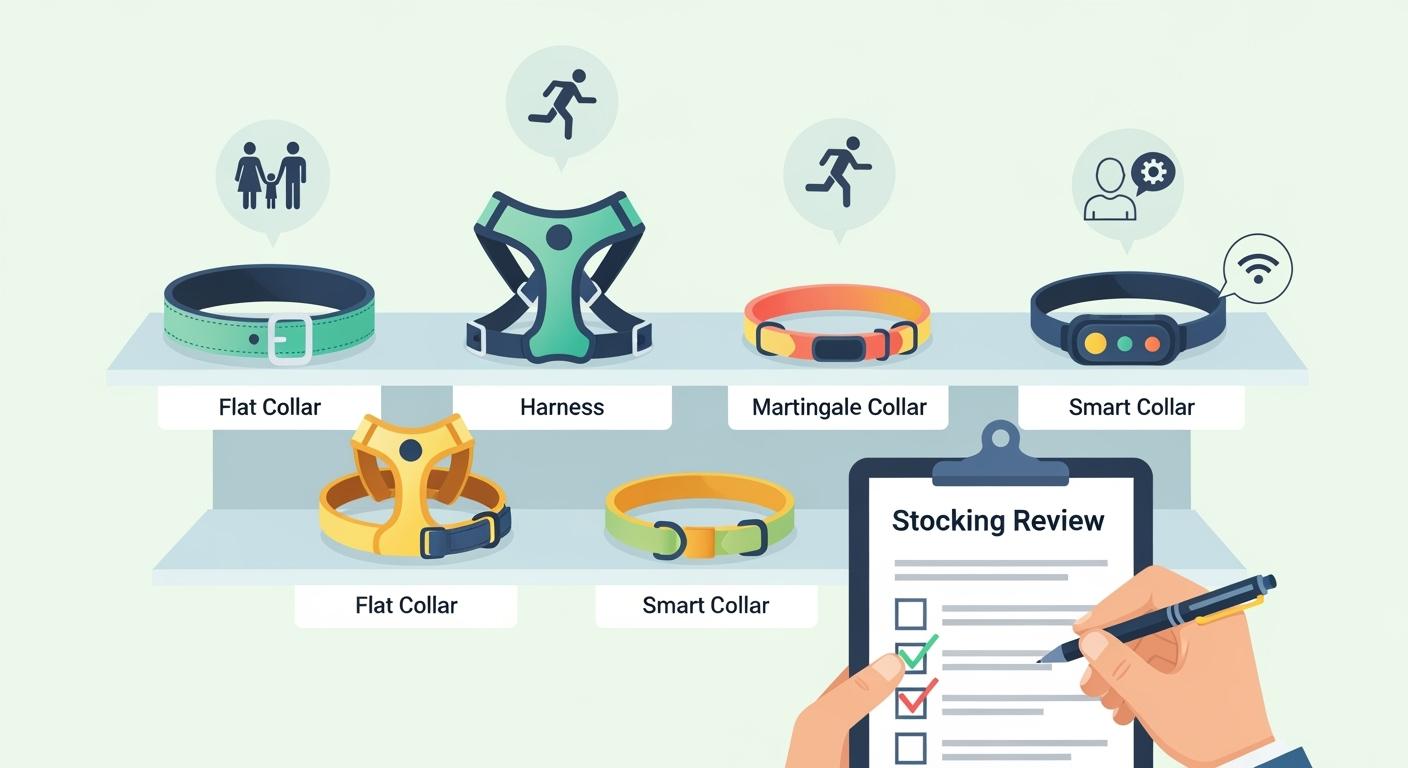
To pick the right collars for dogs, you need to know the four main types. Each type helps with a different problem for your customers. Here is a short look at each one:
Everyday Collars: Good for daily use, ID tags, and easy walks.
Reflective Collars: Make dogs easier to see when it is dark and light shines on them.
Martingale Collars: Lower the chance of a dog slipping out because they tighten a little.
Breakaway Collars: Open if pulled hard to help stop choking if the collar gets stuck.
These meanings can help your team sort, name, and suggest collars for dogs. Next, we will talk more about each type.
Everyday Collars
Most people use everyday collars for normal days. They come in many colors, materials, and sizes. Shoppers want collars that feel good, are simple to put on, and hold ID tags well.
Tip: Always check the size and how the collar closes before you add it to your catalog. Picking the right size and strong buckles means fewer returns.
Key Features:
Purpose: For daily use, ID tags, and walking on a leash.
Shopper intent: Simple, comfy, and looks nice.
Closure types: Side-release or quick-release buckles.
Materials: Strong webbing like nylon or biothane.
Material and Safety Comparison Table:
Feature | Buckle Collar (Everyday) | Chain Collar |
|---|---|---|
Intended Use | Everyday wear, ID attachment | Training, short-term walks |
Fault Tolerance | High – webbing and clasp tested | Low – single link failure breaks |
Neck Injury Risk | Low – even pressure distribution | High – risk of tracheal damage |
Durability | High – UV/moisture resistant | Moderate – corrosion-prone |
Failure Rate | ~1.5% over 12 months | ~7% over 12 months |
Buckle collars are best for daily use. Chain collars are not good for all-day wear because they can hurt dogs and break more often.
Claim Boundaries:
Do not say the collar is “escape-proof” or will never fail.
Remind your team and shoppers that the right size and fit are important for safety.
Reflective Collars
Reflective collars help dogs be seen at night or when it is dark. These collars use special stuff that sends light back to where it came from, like car headlights.
Note: Reflective means the collar needs light from outside to work. It does not make its own light or glow.
Key Features:
Purpose: Help dogs be seen at night.
Shopper intent: More safety for walks after dark.
Reflective element: Trim, weave, or coating that bounces light.
Reflective vs Illuminated Table:
Factor | Reflective Collar | LED Collar |
|---|---|---|
Visibility Range (Headlights) | 150–300 meters | 30–60 meters |
Visibility in Fog/Rain | Severely reduced | Moderately maintained |
Battery Dependency | None | Yes |
Behavioral Acceptance | High | Variable |
Claim Boundaries:
Say things like “Improves nighttime visibility when light hits it.”
Do not say the collar glows or works in all weather.
How well it works depends on the light and angle.
Martingale Collars
Martingale collars, also called limited-slip collars, get tighter when a dog pulls but stop at a certain point. This helps keep dogs from backing out of their collars during walks.
Tip: The fit is important. A martingale collar must be set right for comfort and control.
Key Features:
Purpose: Make it harder for dogs to slip out.
Shopper intent: More control for dogs with narrow heads or those who try to escape.
Closure type: Martingale slider (no buckle or with buckle).
Not a training tool or “escape-proof” answer.
Claim Boundaries:
Do not say it stops escapes for sure.
Always give fitting instructions in your catalog or on the package.
Breakaway Collars
Breakaway collars have a special buckle that opens if pulled hard. This helps stop choking if the collar gets caught on something.
Safety Note: Breakaway collars are not for leash walking unless the label says so.
Key Features:
Purpose: Lower the chance of getting stuck and choking.
Shopper intent: Safety for dogs who are outside or alone.
Closure type: Quick-release or breakaway buckle.
Breakaway Collar Safety Table:
Feature | Description |
|---|---|
Quick-release clasp | Opens under medium pressure to stop choking and getting stuck |
Force threshold | Opens if pulled with about 5–7 pounds of force |
Safety recommendation | Vets and animal groups say these are good for stopping strangling |
Claim Boundaries:
Do not say the collar will never open by mistake.
Say: “Designed to release under force in snag situations.”
If you know these four main types, you can help customers find the right collars for dogs and make your catalog less confusing.
Retail Segmentation Map

Picking the right collars for dogs starts with a simple map. This map helps you match each collar type to what customers need. It also helps you reach your store goals. You can use this plan to help your team. It makes your catalog less confusing and helps people buy better.
Segment Problems Solved
Each collar type fixes a different problem for shoppers. When you label collars by the main problem, staff and shoppers find what they need faster.
Segment | Main Problem Solved | Secondary Use Cases | Claim-Safe Labeling Example |
|---|---|---|---|
Everyday | Daily wear, ID tag holding | Basic leash walking | “For daily use and ID tags” |
Reflective | Nighttime visibility when light is present | Adds safety to walks after dark | “Improves nighttime visibility when light hits it” |
Martingale | Reduces backing out of collar | Gentle control for narrow heads | “Limited-slip design; fit matters for comfort” |
Breakaway | Reduces snag/choke risk | Safe for unsupervised wear | “Designed to release under force in snag situations” |
Tip: Always use claim-safe words. Never say a collar is escape-proof or promise it will always work.
You can pick a main segment by the biggest problem the collar solves. If a collar has more features, you can add a second segment. For example, a reflective martingale collar would have “Martingale” as the main segment and “Reflective” as the second.
Dual Segment Collars
Some collars fit in more than one group. You might see a collar that is both reflective and martingale. Some everyday collars have a breakaway buckle. In these cases, you should name the collar by its main job first.
Primary segment: The main problem the collar solves.
Secondary segment: Any extra feature that helps.
Example Table: Dual Segment Labeling
Product Example | Primary Segment | Secondary Segment |
|---|---|---|
Reflective Martingale Collar | Martingale | Reflective |
Everyday Collar with Breakaway | Everyday | Breakaway |
Reflective Everyday Collar | Everyday | Reflective |
Note: Always put the main segment first in your catalog. This helps staff and buyers sort products fast.
Staff Decision Tree
A simple decision tree can help your team pick which collars to stock. It also helps you sort them into groups. This tool helps new staff learn faster and makes fewer mistakes in the catalog.
Start
│
├── Is the main use daily wear and ID?
│     └─ Yes: Everyday Collar
│     └─ No:
│
├── Is nighttime visibility a key concern?
│     └─ Yes: Reflective Collar (add as secondary if combined)
│     └─ No:
│
├── Does the customer need to reduce backing out?
│     └─ Yes: Martingale Collar
│     └─ No:
│
├── Is snag or choking risk a top concern?
│     └─ Yes: Breakaway Collar
│     └─ No: Review for specialty or custom needs
Staff Tip: Use this decision tree when you pick products and update the catalog.
OEM means you buy products made for your brand by another company. ODM means you buy products designed and made by another company, but with your brand on them. When you work with OEM or ODM partners, always share your map and claim-safe words. This keeps your catalog clear and follows the rules.
You can use this map to train your team, help buyers, and work with suppliers. It helps you avoid mistakes and plan your inventory better.
Request a quote
Ask for samples / get a catalog
Naming and Catalog Rules
You want your catalog to be easy to understand and safe. This part gives you rules for naming and listing collars for dogs. You will learn how to use the right words for each group. You will also see how to avoid mistakes, like mixing up reflective and illuminated or martingale and slip lead. These rules help your team, train new workers, and work with suppliers.
Shelf Naming Standards
Use the same group names everywhere: Everyday, Reflective, Martingale, and Breakaway. This makes shelf tags, online listings, and order forms easy to read. Always start with the main group. Only add a second group if the collar really has another feature.
Tip: Use claim-safe words. For example, say “Improves nighttime visibility when light hits it” for reflective collars.
Fill out these catalog fields for each collar:
Segment (main and secondary)
Closure type (side-release buckle, martingale slider, breakaway buckle)
Width (list the size in inches or centimeters)
Size method (neck range and how to measure)
Hardware (type and location of rings)
Reflective element (trim, weave, or coating)
Care (wash and dry instructions)
Safety notes (plain warnings, no guarantees)
Reflective vs Illuminated Terms
Many shoppers and staff mix up reflective and illuminated collars. Reflective means the collar sends back light from outside, like car headlights. Illuminated means the collar has its own light built in.
Term | What It Means | Claim-Safe Example |
|---|---|---|
Reflective | Bounces light back to the source | “Improves nighttime visibility when light hits it” |
Illuminated | Has a built-in light source (like LEDs) | “Built-in light source; check battery life” |
Never say “glow” for reflective collars. Only use “illuminated” if the collar has its own light.
Martingale vs Slip Lead
Martingale collars and slip leads look alike but work in different ways. A martingale collar is a limited-slip collar. It gets tighter to a certain point and then stops. A slip lead is a leash and collar together, with no stop point.
Note: Always call martingale collars “limited-slip design.” Never say they are “escape-proof” or “training” collars.
You can use this part to teach your team and update your catalog. Share these rules with your OEM or ODM partners to keep your product data safe and clear.
Request a quote
Ask for samples / get a catalog
Shopper Misunderstandings and Returns
You want fewer returns and complaints. To do this, you need to know why shoppers and staff get mixed up. Most returns happen because of sizing mistakes, hardware mix-ups, or wrong ideas about the collar. You can stop these problems with clear words and good pictures.
Sizing Issues
Sizing is a big reason for returns. Many shoppers pick the wrong size because they do not know how to measure a dog’s neck. Some collars use different size charts, which makes it harder. You should always show a simple measuring guide with every collar. Use a picture or drawing that shows where to measure. Add a note like, “Measure around the base of the neck and leave space for two fingers.” This helps buyers get the right fit.
Common sizing mistakes:
Using breed as a size guide instead of neck measurement.
Not checking the width of the collar.
Ignoring the closure type, which can change the fit.
Tip: Always put both neck range and width in your catalog fields.
Hardware Confusion
Hardware can be tricky for buyers and staff. Some shoppers cannot tell a martingale slider from a side-release buckle. Others mix up breakaway buckles with regular ones. You should use close-up pictures of each hardware type. Add short labels like “Breakaway buckle opens under force” or “Martingale slider tightens to a limit.” This helps stop mistakes and returns.
Prevent confusion by:
Showing hardware from more than one angle.
Using claim-safe labels, not promises.
Expectation Gaps
Expectation gaps cause many complaints. Shoppers may think a reflective collar glows or that a martingale collar stops all escapes. You can fix these gaps with clear product descriptions and real photos.
Here are the top three expectation gaps:
Expectation Gap | Description |
|---|---|
Unclear Product Images | Buyers cannot see collar width or buckle features clearly. |
Confusion about Sizing and Fit | Customers feel the collar does not match their expectations for size or fit. |
Misalignment of Features | Product description does not match the actual collar features. |
Five common misunderstanding drivers and how to prevent them:
Reflective vs Illuminated vs Glow:
Use the phrase “Improves nighttime visibility when light hits it.” Show a photo with a flashlight beam.Martingale vs Slip Lead:
Label martingale collars as “Limited-slip design.” Use a diagram to show the stop point.Breakaway vs Walking Collar:
Add “Designed to release under force in snag situations.” Show the breakaway buckle in action.Size and Fit:
Always provide a measuring guide and show the collar on a dog.Hardware Type:
Use close-up images and clear labels for each buckle or slider.
Note: Never promise “escape-proof” or “guaranteed” results. Always use claim-safe language.
Request a quote
Ask for samples / get a catalog
Segment Tables for Collars for Dogs
You need easy-to-read tables to help your team choose collars for dogs quickly and safely. These tables show which collar works best for each use. They also help you fill out catalog fields without making mistakes. You can look at this section when you train new staff, update product listings, or talk with OEM or ODM partners. The first table is a segment matrix. The second table shows catalog field rules and common mistakes.
Segment Matrix Table
This table helps you sort each collar by its main use. It shows what to focus on and what not to say.
Segment | Best use case | Key attributes to show | What not to promise |
|---|---|---|---|
Everyday | Daily wear, ID tag holding | Size range, buckle type, material, color | Escape-proof, medical benefit |
Reflective | Nighttime visibility with light | Reflective trim, location, care instructions | Glow, works in all conditions |
Martingale | Reduces backing out, gentle control | Limited-slip design, fit guide, hardware | Escape-proof, training guarantee |
Breakaway | Reduces snag/choke risk | Breakaway buckle, force threshold, warnings | Never opens by mistake, leash use |
Use this matrix to help set up your catalog and train your team.
Listing Field Table
This table shows the main fields for listing collars. It also lists common mistakes and how to fix them.
Field name | Plain-English definition | Common mistake | Fix |
|---|---|---|---|
Segment | Main collar group (e.g., Everyday, Reflective) | Mixing up primary and secondary | List main segment first |
Closure type | How the collar opens and closes | Wrong buckle named | Use close-up photos and clear terms |
Width | Strap width in inches or centimeters | Missing or unclear size | Always list width |
Size method | How to measure for fit | No measuring guide | Add simple instructions |
Hardware | Type and location of rings | Not shown in images | Show hardware from two angles |
Reflective element | Where reflective material appears | Calling reflective “glow” | Use “reflective” only |
Care | How to wash and dry the collar | No care info | Add care instructions |
Safety notes | Warnings for misuse scenarios | Overpromising safety | Use claim-safe language |
OEM means you buy products made for your brand from another company. ODM means you buy products designed and made by another company, but with your brand name.
You can use these tables to make fewer catalog mistakes. They help you train your team and follow the rules. They also keep your listings clear and help lower returns.
Request a quote
Ask for samples / get a catalog
Merchandising Basics
Entry Assortment and Add-ons
You want your collar choices to fit what shoppers need. This also helps stop confusion. Start with the four main segments: Everyday, Reflective, Martingale, and Breakaway. Make sure you have many sizes and closure types for each one. Add-ons can help you sell more and keep dogs safer. Offer leashes that match the collar’s color and hardware. Give ID tags that can be engraved clearly. Suggest reflective clip-ons for people who want more nighttime safety.
Entry Assortment Checklist:
Everyday collars in many sizes and colors
Reflective collars with trim or coating you can see
Martingale collars with guides for fit
Breakaway collars with safety notes
Leashes, ID tags, and reflective add-ons
Tip: Use your OEM or ODM partner catalog to fill any missing items.
Signage Copy Blocks
Clear signs help staff and shoppers pick the right collar. Use short, claim-safe copy blocks for each segment. Put these near shelf tags or on online listings.
Segment | Signage Copy Block Example |
|---|---|
Everyday | For daily wear and ID tags. Check size and buckle type. |
Reflective | Improves nighttime visibility when light hits it. Visibility depends on lighting and angle. |
Martingale | Limited-slip design. Fit matters for comfort and control. |
Breakaway | Designed to release under force in snag situations. Not for leash walking unless specified. |
Note: Never promise escape-proof or guaranteed results.
Cross-Sell Logic
You can get shoppers to buy more by showing related products. Put leashes next to collars with matching hardware. Offer ID tags at checkout or in collar listings. Place reflective clip-ons near reflective collars. Use shelf talkers or online tips to help buyers.
Cross-Sell Opportunities:
Leashes with closures and colors that match
Engraved ID tags for every collar type
Reflective clip-ons for extra safety
Staff Tip: Use catalog filters to link collars with add-ons that work together.
Request a quote
Ask for samples / get a catalog
Compliance and Safety
You need to make sure your collar catalog is safe and follows the rules. The US and EU have strict rules for product safety and information. The EU General Product Safety Regulation (EU) 2023/988 says you must track products, give clear warnings, and use careful words. You have to help your team and buyers know what each collar does and what it cannot do.
Traceability and Product ID
You must keep track of every collar you sell. Give each style, size, and color a special product ID. Write down where you get each collar and which batch it is from. This helps you act fast if there is a safety problem or recall. In the EU, you must show where the collar came from all the way to the shelf. In the US, you should keep records as long as your warranty or return policy lasts.
Tip: Put clear product IDs on packages, shelf tags, and in your catalog. This makes it easy to find and report any collar.
Safety Language
You must use claim-safe words in all your listings and signs. Never say a collar is “escape-proof” or “guaranteed” to stop injury. Instead, tell what the collar is made to do and where it might not work. The table below shows safe and risky words for different collars:
Type of Collar | Allowed Wording | Risky Wording |
|---|---|---|
Reflective Collars | Retroreflective trim helps dogs be seen when light hits it at night. | Guaranteed visibility |
Visibility gets better with direct light, like headlights or a flashlight. | Always visible | |
Made to help dogs be seen at night, but not a promise for all situations. | Daytime glow | |
Illuminated Collars | Active light for dark places. | Guaranteed visibility |
Light changes with battery and where you use it. | Always visible | |
Failsafe safety | ||
Accident-proof |
Note: Always use words that match what the collar can really do. Do not use words that make promises you cannot keep.
Professional Advice
You should remind buyers and staff that collars are not medical or training tools. Always tell customers to check the fit and use the collar the right way. If someone asks about special needs, tell them to talk to a pet expert or veterinarian. This keeps your catalog safe and your business following the rules.
Give clear care and use steps.
Add safety notes for each collar type.
Never promise medical or training results.
Request a quote
Ask for samples / get a catalog
B2B Wrap-Up and Catalog Clarity
A clear way to sort collars helps you keep your catalog neat. When you group collars by type and use safe words, you stop confusion. This also means fewer returns. Your team finds collars faster. Shoppers get better help. You also follow US and EU safety rules.
Category Manager Checklist
You can use this checklist to check your collar section. It helps you find missing things and fix problems before they get big.
Make sure every collar has a main type: Everyday, Reflective, Martingale, or Breakaway.
Check that each listing uses safe words. Do not use words like “escape-proof” or “guaranteed.”
Make sure all catalog fields are filled in: type, closure, width, size, hardware, reflective part, care, and safety notes.
Look at product pictures. Show hardware, closure, and reflective parts clearly.
Use the decision tree to help pick new products.
Teach staff to use the same names and sorting rules.
Keep records for each product and batch.
Tip: Check your catalog often to catch mistakes early and follow the rules.
Supplier Standardization
You need to work with your OEM or ODM partners to keep your catalog safe and clear. Share your sorting map and naming rules with suppliers. Ask for photos that show all important parts. Request data in your usual format.
Standardization Area | What to Ask Suppliers For |
|---|---|
Photos | Clear pictures of hardware and closure |
Naming | Use your type and closure words |
Data Fields | Fill all catalog fields as you ask |
Safety Notes | Add safe warnings |
When you set these rules, you add new products faster. You also lower the chance of mix-ups and safety problems.
Request a quote
Ask for samples / get a catalog
You can use this way of sorting to set up your collar catalog. It helps you have fewer returns. Clear groups and safe words help your team pick the right collars for shoppers. This also helps you follow US and EU safety rules. Check your stock often and update your catalog with these rules.
Always work to keep things safe and easy to understand.
Request a quote
Ask for samples / get a catalog
FAQ
What is the main difference between reflective and illuminated collars?
Reflective collars send light back to where it came from, like car headlights. Illuminated collars have their own lights built in. Only call a collar “reflective” if it does not make its own light.
How do I choose the right collar segment for my store?
Think about what your customers need most. Use the segmentation map to help. Pick Everyday for daily use. Choose Reflective for better visibility. Use Martingale for collars that tighten a bit. Pick Breakaway for extra safety. Always match the collar to the main problem it solves.
Why do most returns happen with dog collars?
Most returns happen because of wrong sizing, hardware mix-ups, or unclear product details. You can lower returns by using clear catalog fields, good photos, and safe wording.
Can I list a collar as “escape-proof” or “guaranteed safe”?
No, you should not use words like “escape-proof” or “guaranteed” in your catalog. Use safe phrases like “limited-slip design” or “designed to release under force in snag situations.”
What catalog fields are most important for compliance?
You must include segment, closure type, width, size method, hardware, reflective element, care, and safety notes. Clear product IDs and tracking help you follow US and EU safety rules.
Need help with your collar choices?
Request a quote
Ask for samples / get a catalog