When you pick dog life jackets for customers, you need a size guide that helps every pet get the right fit. Good sizing helps dogs stay comfortable, float well, and be easy to see. The harness should fit well at the chest. It should let pets move but still be snug. A pup float life jacket with a good harness fit stops sizing problems. It also keeps the product strong and lasting. Girth is the main measurement. Weight is a second check. Clear instructions help with reliable features, quality control, and rules. When you suggest a hiking dog harness, soft mesh dog harness, or car safety dog harness, you know fit matters for every pet and customer. This guide helps you suggest dog harnesses and makes each product better.
Key Takeaways
Use girth as the primary measurement for selecting dog life jackets. This ensures a better fit for your pet.
Always measure girth at the widest part of the ribcage, just behind the front legs, using a soft tape for accuracy.
If a dog’s girth falls between two sizes, choose the size with more adjustment range to ensure comfort and safety.
Check the fit of the harness using the two-finger rule. Straps should be snug but not tight for optimal comfort.
Supervise your pet while using a life jacket. It provides buoyancy support but does not guarantee safety.
Dog Life Jackets Sizing Standard
Girth-First Sizing Rule
You need to use girth as the main measurement when you select a harness for a pet. Girth means the chest size at the widest part of the ribcage, just behind the front legs. This method gives you a better fit because dogs have different shapes even if they have the same weight. You can trust girth measurements because studies show they are reliable and consistent. When you measure girth, you help the harness fit well and keep the product features working as designed. Most industry guides do not set rules for pet flotation devices, but many makers use girth as the main way to size dog life jackets. For example, a medium harness may fit a pet with a girth between 27 and 32 inches. You should always start with girth when you use a size guide for dog harness recommendations.
Girth is the main measurement for harness fit.
Measure at the widest part of the ribcage.
Use a soft tape and keep it snug, not tight.
Girth-first sizing helps you match the product to the pet.
Weight as Guidance
You should use weight as a second check after you measure girth. Weight helps you confirm the harness size, but it does not replace girth. Dogs with the same weight can have different body shapes. Makers list weight ranges to help you check your choice. You can see how weight and girth work together in the table below.
SIZE | WEIGHT (lb/kg) | GIRTH (in/cm) | LENGTH (in/cm) |
|---|---|---|---|
XXS | 3-6 / 1.4-2.7 | 7-12 / 18-30 | 7 / 18 |
XS | 6-15 / 2.7-6.8 | 13-20 / 33-51 | 12 / 30 |
S | 15-30 / 6.8-13.6 | 18-25 / 46-64 | 16 / 41 |
M | 30-60 / 13.6-27.2 | 24-30 / 61-76 | 21 / 53 |
L | 60-80 / 27.2-36.3 | 29-36 / 74-91 | 25 / 64 |
XL | 80+ / 36.3+ | 30-42 / 76-107 | 26 / 66 |
You should pick the harness size by girth first. Use weight to check your choice. This helps you follow the guide and keep product compliance.
Between-Sizes Policy
Sometimes a pet’s girth falls between two sizes. You need a clear rule for these cases. Choose the harness size that covers the girth with more adjustment range. After you pick the size, check the fit using the handle lift and twist test. This policy helps you reduce returns and improve product fit.
Tip: If the pet’s girth is between sizes, pick the size with more adjustment range. Confirm the fit with a handle lift and twist check.
Safety Disclaimer
You must use a claim-safe boundary line for all dog life jackets. This keeps your product page clear and helps you avoid safety guarantees. You should remind users that the harness is designed to help provide buoyancy support when fitted and used with supervision. The harness does not guarantee safety.
Note: Dog life jackets are designed to help provide buoyancy support when properly fitted and used with supervision. They do not guarantee safety.
Measurement Definitions for Dog Life Jackets
How to Measure Girth
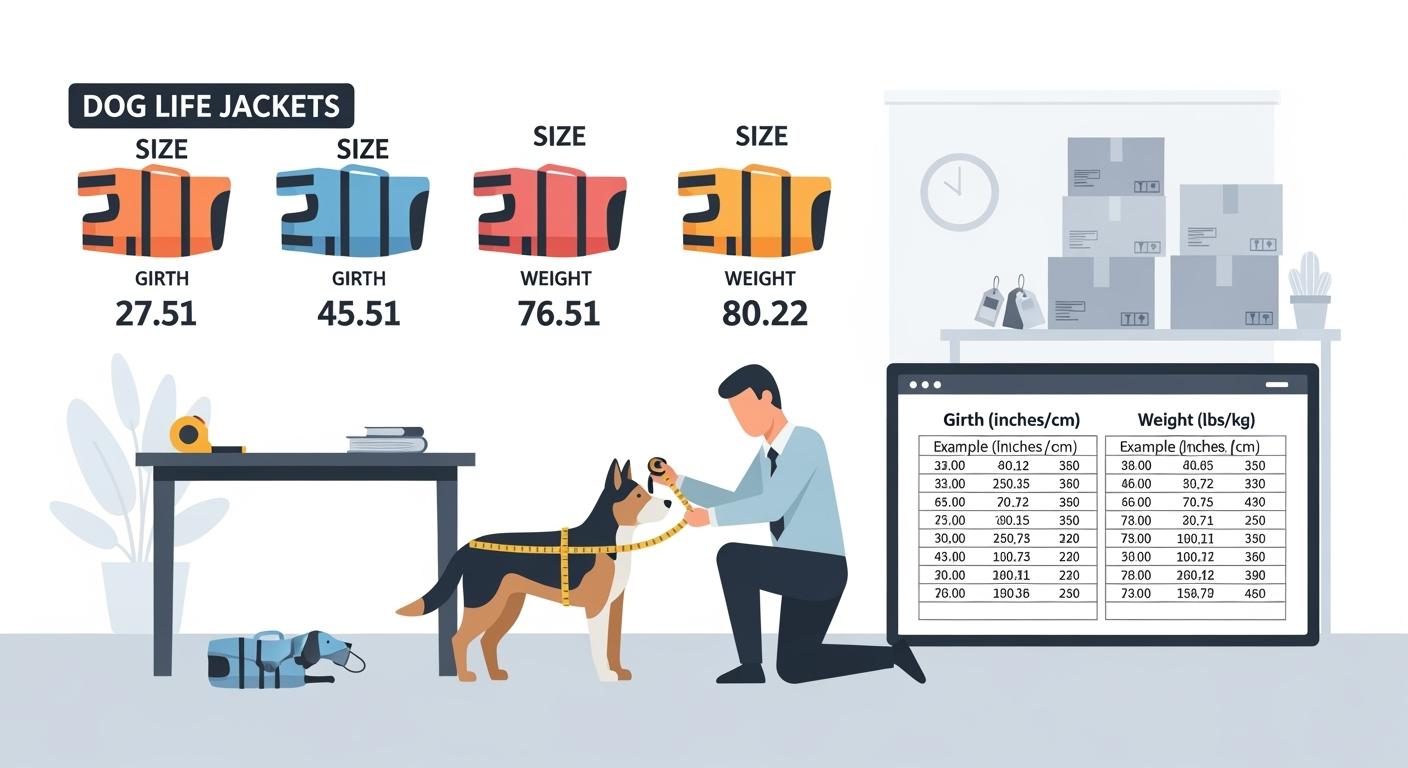
You need to measure your pet’s chest at the widest part of the ribcage. This spot sits just behind the front legs. Use a soft measuring tape and wrap it around the chest. Keep the tape snug but not tight. Measuring the girth this way helps you find the right size life jacket for your dog. A correct girth measurement gives the best fit and helps the jacket work as designed.
Use a soft measuring tape for accuracy.
Measure the widest part of your pet’s ribcage, just behind the front legs.
Keep the tape snug, not tight.
Check the product sizing chart after you measure.
How to Measure Weight
Weigh your dog using a pet scale or a regular scale. Hold your pet if needed and subtract your own weight. Use the current weight to check your size choice on the chart. Weight acts as a guide to confirm your girth-based selection. Dogs with the same weight can have different shapes, so always start with girth.
Optional Measures (Neck, Back Length)
Some pets have unique body shapes. If your dog has a long back, deep chest, or thick neck, you may need extra measurements. These help you check for a secure and comfortable fit. Use the table below to see how to measure neck and back length.
Measurement Type | Description |
|---|---|
Back Length | Measure from just below where the collar sits to the base of the tail. |
Neck | Measure around your pet’s neck where the collar naturally sits. |
Note: OEM means a supplier manufactures products to your specifications and branding, while ODM means the supplier provides a ready design that you can customize and brand.
Dog Life Jackets Size Guide Chart
Required Columns and Dual Units
You need a clear chart when you help a customer choose dog life jackets. The chart must show all the important details for each product. You should include these columns:
Size code
Girth minimum and maximum (inches and centimeters)
Weight minimum and maximum (pounds and kilograms)
Notes for fit or special features
Fit risk flag for extra guidance
Dual units help every customer understand the measurements. You make it easier for pet owners and B2B teams to check quality and compliance. This chart supports quality control and helps you match the right product to each dog.
Rounding and Precision
You should round girth measurements to the nearest quarter inch or centimeter. For example, if a dog measures 33 and 1/4 inches, you record 33.25. If the girth is 33 and 3/4 inches, you write 33.75. This method keeps the chart clear and helps you avoid confusion. Weight should also use simple rounding, so customers can check the product fit quickly. Accurate rounding supports quality and durability.
Overlap and Gaps Handling
You want every pet to get a safe and comfortable fit. If a dog’s girth falls between two sizes, you pick the larger size for more adjustment. This rule helps you prevent tight spots and lets the product features work well. You should check for gaps or overlaps in the chart. Clear boundaries help you reduce fit risks and support quality control.
Tip: Use a soft tape to measure girth, neck, and back length. Accurate measurements help you avoid chafing and keep the product working as designed.
Table Template
Here is a sample chart you can use for dog life jackets:
Size Code | Girth Min (in/cm) | Girth Max (in/cm) | Weight Min (lb/kg) | Weight Max (lb/kg) | Notes | Fit Risk Flag |
|---|---|---|---|---|---|---|
XXS | 7 / 18 | 12 / 30 | 3 / 1.4 | 6 / 2.7 | For very small pets | Low |
XS | 13 / 33 | 20 / 51 | 6 / 2.7 | 15 / 6.8 | Small breeds | Low |
S | 18 / 46 | 25 / 64 | 15 / 6.8 | 30 / 13.6 | Young dogs | Medium |
M | 24 / 61 | 30 / 76 | 30 / 13.6 | 60 / 27.2 | Adult pets | Medium |
L | 29 / 74 | 36 / 91 | 60 / 27.2 | 80 / 36.3 | Large breeds | High |
XL | 30 / 76 | 42 / 107 | 80 / 36.3 | 100 / 45.4 | Extra large dogs | High |
This chart helps you support quality, durability, and compliance for every customer and pet.
Fit Verification and Safety Checks
You need to check the fit of dog life jackets before you let your pet use them. A good harness fit helps your pet stay comfortable and safe in the water. You can follow three key steps to verify the fit and safety of each harness.
Strap Snugness (Two-Finger Rule)
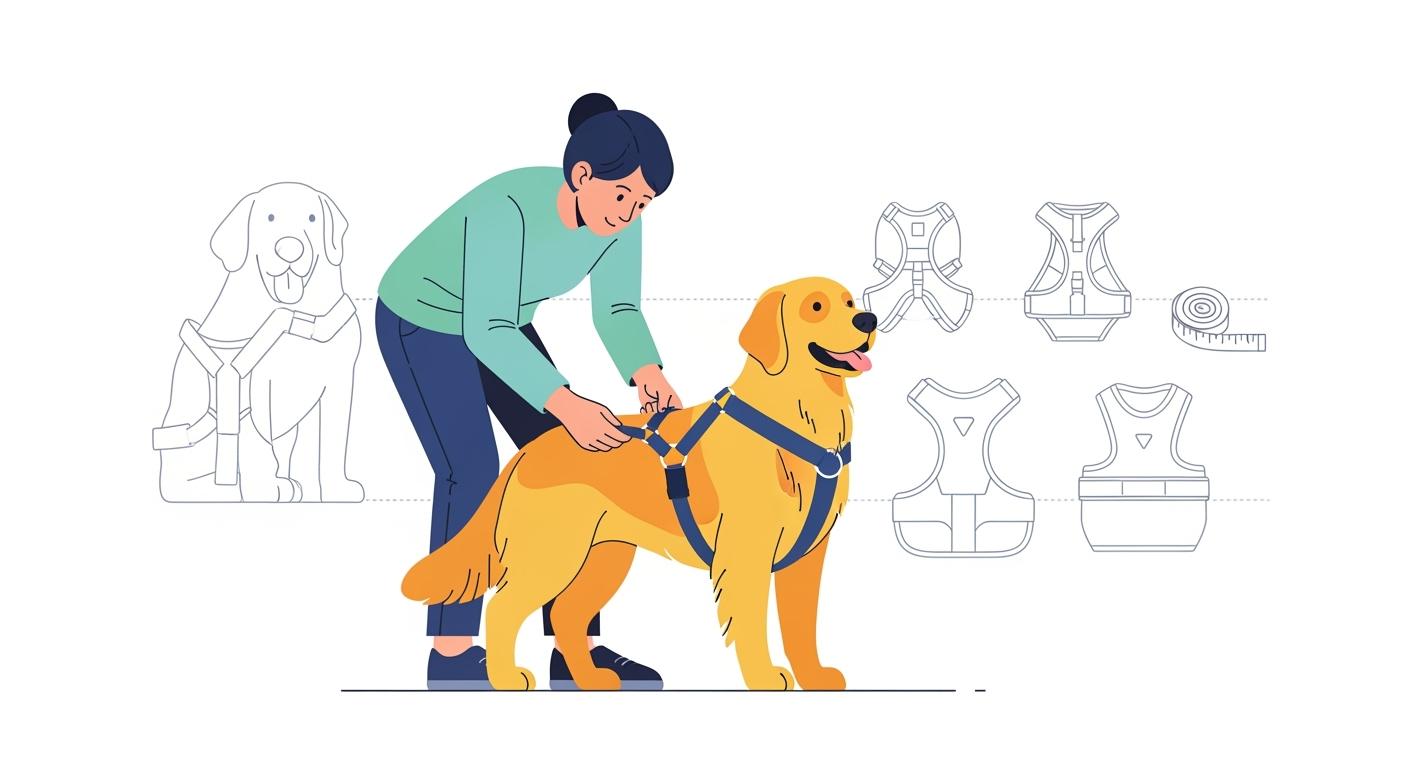
You should adjust the straps on the harness so they fit your pet securely. Use the two-finger rule to check snugness. Place two fingers under each strap. The straps should feel snug but not tight. If you cannot fit two fingers, the harness is too tight. If you can fit more than two fingers, the harness is too loose. This rule helps you keep your pet comfortable and prevents rubbing.
Adjust straps for a secure fit.
Use the two-finger rule for proper snugness.
Handle Lift and Twist Test
You need to test the harness by lifting your pet gently using the top handle. The harness should stay in place and not twist or slide toward the neck. This test checks if the harness features work well and if the size is correct. If the harness moves or twists, you may need to adjust the straps or try a different size. A sturdy rescue handle is important for lifting your dog in emergencies.
Lift your pet gently by the handle.
Watch for twisting or sliding.
Adjust the harness if needed.
Movement and Rub Points
Your pet should move freely when wearing the harness. Check that the harness does not rub at the underarm, neck, or belly. Look for wide, padded straps and high-cut leg openings. These features help prevent discomfort and allow your dog to swim, run, and play naturally. Make sure the harness sizing lets your pet move without chafing.
Researchers say strap layout, handles, and fit are important for buoyancy and comfort.
Safety Statement for Dog Life Jackets
Dog life jackets are designed to help provide buoyancy support when fitted and used with supervision. They do not guarantee safety. You should watch your pet at all times when using a harness in or near water.
Safety Features | Description |
|---|---|
Proper flotation | Helps keep your dog’s head above water |
High-visibility colors | Makes your pet easy to see |
Sturdy rescue handle | Lets you lift your dog quickly |
Adjustable fit system | Supports a secure and comfortable fit |
Freedom of movement | Allows natural swimming motion |
Quick-release buckles | Makes removal fast in emergencies |
You can use these steps and features to check the fit and safety of every harness. This process helps you choose the right size and reduce risks for your pet.
Above-the-Fold Sizing Communication
One-Line Sizing Instruction
You need to measure your pet’s chest girth at the widest part of the ribcage. Use this measurement first to select the right dog life jacket. Check your pet’s weight as a second step to confirm your choice. This girth-first method helps you match the jacket to your pet’s body shape and supports product features.
Chest (in/cm) | Weight (lb/kg) | Dog Size |
|---|---|---|
7-12 / 18-30 | <10 / <4.5 | 3XS |
11-17 / 28-43 | <12 / <5.4 | 2XS |
16-23 / 41-58 | 10-15 / 4.5-6.8 | XS |
22-27 / 56-69 | 15-30 / 6.8-13.6 | S |
26-32 / 66-81 | 30-60 / 13.6-27.2 | M |
30-37 / 76-94 | 50-90 / 22.7-40.8 | L |
36-44 / 91-112 | >90 / >40.8 | XL |
Supervision Reminder
Supervision helps keep your pet safe when using a dog life jacket. These jackets help your dog float and give you a way to assist your pet in the water. They do not remove all risks. Experts say life jackets are flotation aids, not life-saving devices. You must watch your pet at all times.
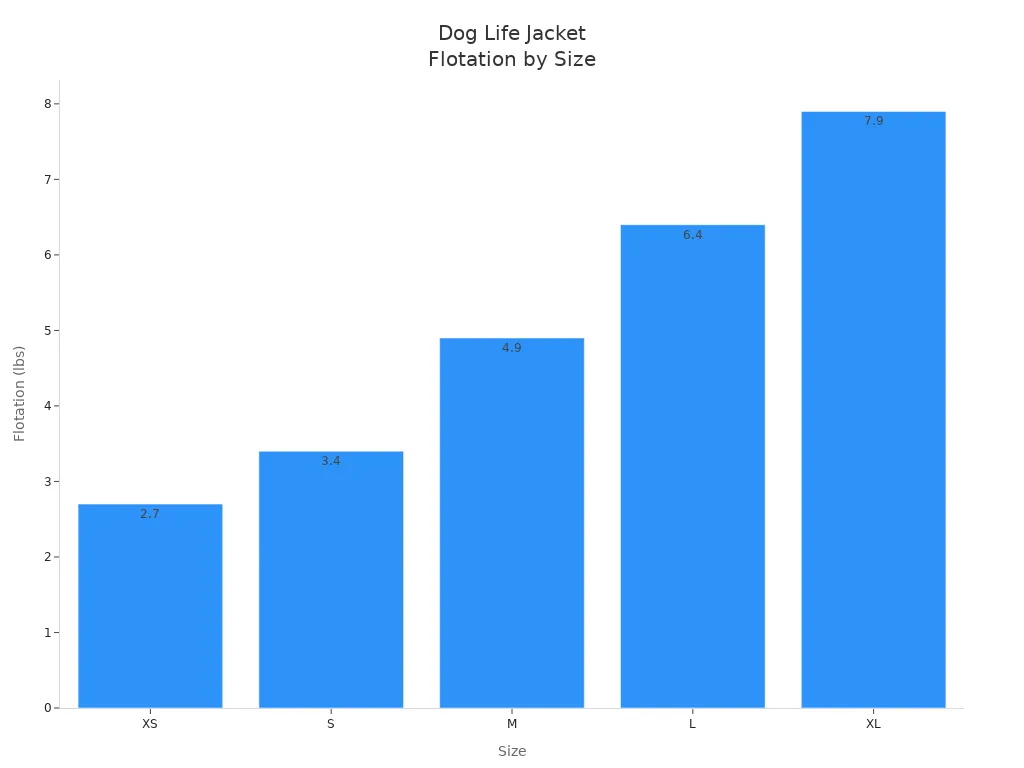
Quick Links to Size Guide and Measurement Graphic
You can find the full size guide, measurement instructions, and fit graphics at the top of the product page. These quick links help you check your pet’s girth and weight, see fit illustrations, and review all sizing features before you choose a dog life jacket.
Resource | What You Find |
|---|---|
Size Guide | Girth and weight chart, fit notes |
Measurement Graphic | How to measure your pet’s girth |
Fit Illustration | Shows jacket features on a dog |
Copy Blocks for B2B Pages
Measurement Instructions Block
Measure your pet before you choose a harness.
Wrap a soft tape around your dog’s chest at the widest part of the ribcage, just behind the front legs.
Write down this girth measurement.
Weigh your pet using a scale.
Measure from the base of your dog’s neck to the base of the tail to check back length if needed.
Adjust the harness straps around the neck and chest. Make sure you can fit two fingers under each strap.
Check that your pet can walk, sit, and lie down with the harness on.
Between-Sizes Decision Block
If your dog’s girth falls between two sizes, pick the harness that covers the girth with more adjustment range. After you choose the size, check the fit using the handle lift and twist test. This helps you find the best fit for your pet and supports the features of the life jacket.
Fit Check Block
Adjust the harness straps so they are snug but not tight.
Use the two-finger rule: you should fit two fingers under each strap.
Lift your pet gently by the top handle. The harness should not twist or slide toward the neck.
Watch your dog move. The harness should not rub at the underarm, neck, or belly. Your pet should move freely.
Safety Boundary Block
Dog life jackets help provide buoyancy support when fitted and used with supervision. They do not guarantee safety. You must watch your pet at all times when using a harness in or near water.
Images and Scale Cues for Dog Life Jackets
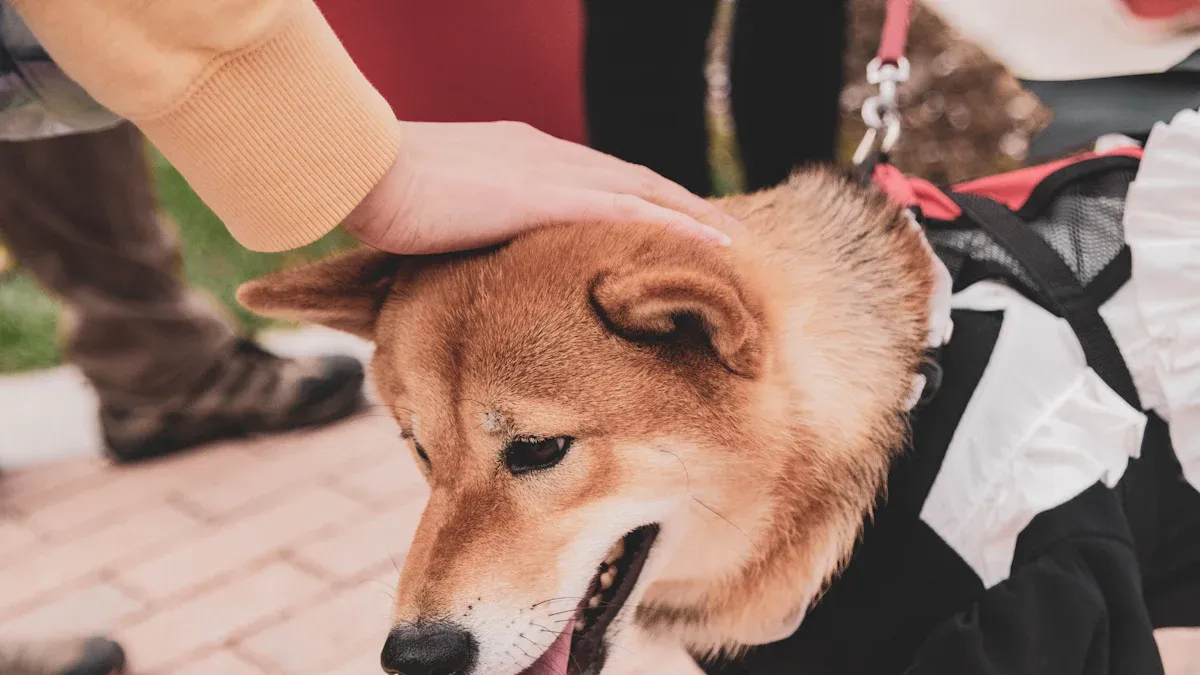
Clear images help you choose the right harness for your pet. You need to see how each harness fits on a dog. Good visuals show you where to measure, how straps adjust, and how rescue handles work. These images help you understand the features and sizing rules. You can use them to check fit and reduce mistakes when you select a harness for your pet.
Measurement Graphic
A measurement graphic shows you where to measure your pet. You see the neck, chest, and back points. This helps you get the right girth for your dog. The chart below shows common measurement spots for each harness size.
Size | Neck (A) | Chest (B) | Back (C) |
|---|---|---|---|
X-Small | 23-33 cm (9-13 in) | 35-50 cm (14-20 in) | 23.5 cm (9.25 in) |
Small | 30-51 cm (12-20 in) | 46-63 cm (18-25 in) | 31.1 cm (12.25 in) |
Medium | 41-64 cm (16-25 in) | 61-81 cm (24-32 in) | 43.2 cm (17 in) |
Large | 46-76 cm (18-30 in) | 76-94 cm (30-37 in) | 47 cm (18.5 in) |
X-Large | 61-89 cm (24-35 in) | 89-114 cm (35-45 in) | 52 cm (20.5 in) |
Tip: Use a soft tape to measure your pet’s chest at the widest part. This helps you follow the girth-first sizing rule.
On-Dog Fit Photos
You need to see photos of a harness on a dog. These images show you how the harness sits on the pet’s body. You can check if the straps fit well and if the harness covers the chest. On-dog fit photos help you spot tight spots or loose areas. You see how the harness supports movement and comfort for your pet.
Strap and Buckle Closeups
Closeup images of straps and buckles help you check adjustment points. You see how to tighten or loosen the harness for your dog. These photos show you the design and how the harness fits different pet sizes. You can look for wide straps, padded areas, and easy-release buckles. This helps you make sure the harness fits your pet and supports safety features.
Handle and Lift Point Photo
A clear photo of the rescue handle and lift point helps you understand how to lift your dog. You see where to grip the harness and how the handle sits on the pet’s back. This image helps you check if the harness supports your pet’s weight and keeps the fit secure. You can use this photo to test the handle lift and twist check.
Feature | Description |
|---|---|
Adjustable Straps | Secure fit for different dog sizes |
Bright Colors | Easy to see your pet in water |
Reflective Accents | Better visibility in low light |
Multiple Sizes | Fit options for many dog breeds |
Rescue Handles | Lift your pet out of water if needed |
Note: Use these images and scale cues to help you select the right harness for your pet. Good visuals support fit checks and sizing rules.
Item Master and PIM Fields
When you manage dog life jackets for your B2B catalog, you need clear and complete product information. Good data helps you support quality, reduce errors, and meet customer needs. You can use a Product Information Management (PIM) system to organize these details. The right fields help you track each product, show the right size, and explain the features to every customer.
Size Band Fields
You should include size band fields for every dog life jacket. These fields help you match the product to the pet and support quality checks. Here are the key size band fields you need:
Size code (such as XS, S, M, L, XL)
Girth minimum and maximum (inches and centimeters)
Weight minimum and maximum (pounds and kilograms)
Fit notes for special body shapes or breeds
Between-sizes rule reference
A table in your PIM can look like this:
Size Code | Girth Min (in/cm) | Girth Max (in/cm) | Weight Min (lb/kg) | Weight Max (lb/kg) | Fit Notes |
|---|---|---|---|---|---|
S | 18 / 46 | 25 / 64 | 15 / 6.8 | 30 / 13.6 | Young pet |
Construction Fields
You need to record construction fields to show the quality and features of each product. These fields help you answer customer questions and support product claims. Important construction fields include:
Material type (such as nylon, mesh, foam)
Stitching method
Buckle and strap type
Handle design and placement
Reflective accents or high-visibility colors
These details help you show the quality of the dog life jacket and explain how the product supports the pet.
Packaging Fields
Packaging fields help you track how each product reaches the customer. You should include:
Package dimensions (length, width, height)
Package weight
Barcode or SKU
Packaging type (such as polybag, box, hangtag)
Care instructions included
Good packaging data helps you support quality, reduce shipping errors, and meet customer needs. You can use these fields to keep your catalog clear and easy to use for every pet and customer.
QA and Governance for Size Guide
Quality control helps you keep your dog life jacket size guide clear and correct. You need to check every detail before you share the guide with your team or customers. Good QA steps help you support pet safety, improve quality, and reduce mistakes. You can use these checks to make sure your size guide works for every pet and supports product durability.
Overlap and Gap Checks
You should look for overlaps and gaps in your size chart. Overlap means two sizes cover the same girth for a dog. Gaps mean a pet might not fit any size. You can use a table to check for these problems. Write down the girth range for each size. Check that every pet has a size that fits. This step helps you keep quality high and supports compliance.
Tip: Review your chart with your team. Make sure every pet can find a size. Fix any overlap or gap before you publish.
Dual-Unit Math Checks
You need to check that all numbers match in both inches and centimeters, and in pounds and kilograms. Use a calculator to check your math. Write both units for girth and weight for every dog size. This step helps you support quality control and makes the guide easy for every pet owner to use.
Check every number in the chart.
Make sure the math is correct for both units.
Fix any mistake before you share the guide.
Copy Risk Checks
You must read every word in your size guide. Look for words that promise safety or make claims you cannot support. Remove any words that sound like a guarantee. Use clear language that helps pet owners understand the features and limits of the product. This step helps you follow risk discipline and keeps your guide claim-safe.
Change Control Triggers
You need a rule for when to update your size guide. If you change the design, add new features, or get feedback about fit, review the guide. Write down the reason for the change. Share the update with your team. This helps you keep quality and compliance strong for every dog and pet product.
QA Step | What to Check |
|---|---|
Overlap and Gap Check | Girth ranges cover all pets |
Dual-Unit Math Check | Numbers match in both units |
Copy Risk Check | No unsupported claims or guarantees |
Change Control | Update guide after any product change |
You can use these steps to keep your dog life jacket size guide clear, accurate, and safe for every pet. Good QA supports quality, durability, and compliance for your product.
Sizing Clarity Checklist for Dog Life Jackets
30-Second Clarity Test
You want every pet owner and B2B team to understand the size guide quickly. Use this test to check if your page is clear. Read the sizing section for thirty seconds. Ask yourself these questions:
Can you find the girth-first rule for choosing a dog life jacket?
Do you see where to measure your pet’s chest?
Is the fit check easy to follow?
Are the features of each size easy to spot?
Can you find the safety boundary statement?
If you answer yes to all, your page passes the clarity test.
Consistency of Chart and Graphic
Check that your size chart matches your measurement graphic. Look for the same girth ranges and units in both places. Make sure the chart and graphic use the same terms for dog sizes. You want pet owners to see the same information in every part of the page. Consistency helps you avoid confusion and supports correct fit for every pet.
Tip: Compare the chart and graphic side by side. Fix any mismatch before you publish.
Item | Chart | Graphic |
|---|---|---|
Girth Range | Yes | Yes |
Weight Range | Yes | Yes |
Dog Size Name | Yes | Yes |
Measurement Points | Yes | Yes |
No Safety Guarantees
You must use clear language about safety. Do not promise that a dog life jacket will prevent accidents or guarantee protection. Remind pet owners that supervision is needed. The product helps with buoyancy and fit, but it does not remove all risks. Use a claim-safe boundary line in every section.
Note: Dog life jackets help provide buoyancy support when fitted and used with supervision. They do not guarantee safety for your pet.
This checklist helps you keep your sizing guide clear, consistent, and claim-safe. You support pet comfort and product features while following best practices for risk discipline.
You help every pet get a better fit when you use a girth-first size guide for dog life jackets. Clear measurement instructions let you match each dog to the right product. Fit checks and safety notes support pet comfort and reduce mistakes. You see how features like adjustable straps and rescue handles work for every pet. You can audit your current pages and update them to follow these standards for each dog and pet.
FAQ
How do you measure your dog for a life jacket?
You wrap a soft tape around your dog’s chest at the widest part of the ribcage, just behind the front legs. Write down this girth measurement. This helps you pick the right size for your pet.
Why is girth more important than weight when choosing a dog life jacket?
Girth shows your dog’s body shape better than weight. Two pets with the same weight can have different chest sizes. You use girth first to match the jacket to your dog’s body.
What should you do if your pet’s girth falls between two sizes?
Pick the size that covers your pet’s girth with more adjustment range. Check the fit using the handle lift and twist test. This helps your dog stay comfortable and lets the jacket features work well.
How do you check if a dog life jacket fits your pet?
You adjust the straps so they are snug. Use the two-finger rule. Lift your pet gently by the handle. Watch for twisting or sliding. Make sure your dog can move freely without rubbing at the underarm or neck.
What safety tips should you follow when your pet wears a dog life jacket?
Watch your pet at all times near water. The jacket helps with buoyancy but does not guarantee safety. Make sure the fit is correct and check all features before your dog goes into the water.