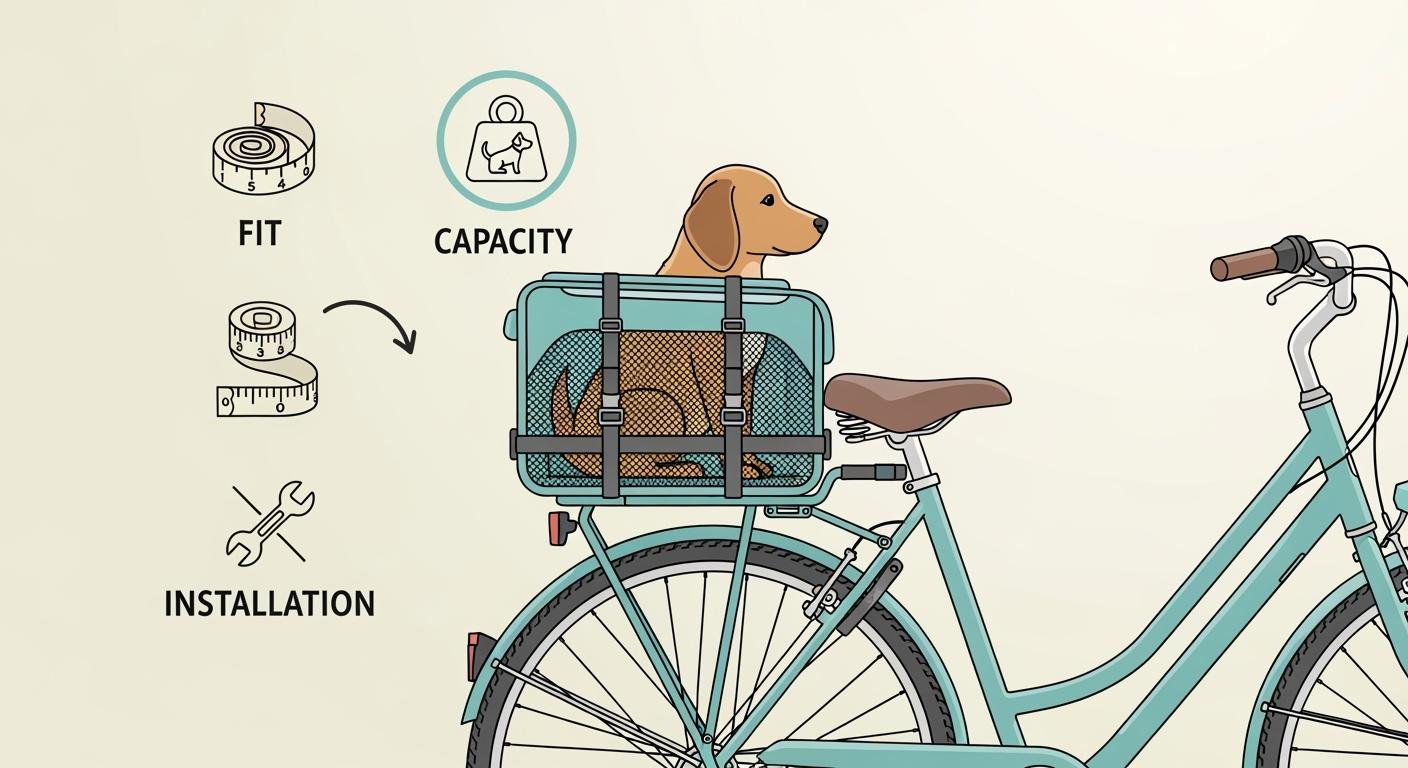
You can pick a dog carrier for bike by looking at three main things: fit, capacity, and install. Check the size of your handlebars, how much weight it can hold, and the inside space. Use inches or centimeters for size, and pounds or kilograms for weight. This helps you find the right match for your bike and your dog. It also helps you follow the install steps. Using this data-focused approach helps you avoid mistakes with sizing or putting on the dog carrier for bike. You will find easy checklists, simple rules, and real product examples for every step.
Key Takeaways
Make sure your bike fits the dog carrier. Measure the handlebar and rack to see if they match.
Know how big and heavy your dog is. Measure your dog’s chest and back to pick the right carrier.
Follow each install step with care. Make sure the carrier is flat and tight so your dog stays safe.
Use a harness tether for more safety. This stops your dog from jumping out when you ride.
Check the carrier before every ride. Look at the fasteners and attachments to stop accidents.
Decision Panel
Choosing the right dog carrier for your bike starts with three key checks: bike fit, dog fit, and install. This panel gives you a quick way to see if a carrier matches your needs. You can use the data fields below to confirm each step and avoid common mistakes.
Bike fit summary
Mount type: Check if the carrier attaches to handlebars, racks, or frames.
Handlebar diameter range: Most carriers fit handlebars between 0.9–1.25 inches (23–32 mm).
Rack width: Some carriers need racks between 4–7 inches (10–18 cm).
Required data fields: Mount type, handlebar diameter, rack width, bike geometry notes.
Tip: Measure your bike before you buy. This helps you avoid wrong fit and wasted time.
Dog fit summary
Weight limit: Each carrier lists a max dog weight, such as 15 lbs (7 kg).
Interior dimensions: Look for usable space, like 14 x 10 x 10 inches (36 x 25 x 25 cm).
Dog size cues: Check your dog’s chest girth and back length.
Required data fields: Weight limit, interior dimensions, chest girth range, back length range.
Note: If your dog is between sizes, pick the carrier with more space. This reduces squeeze risk.
Install summary
Install steps: Most carriers need you to attach brackets, tighten straps, and anchor the base.
Secure install definition: Fasteners tightened, carrier level, straps anchored, shake test passed.
Re-check schedule: Inspect install before each ride.
Required data fields: Install steps, fastener type, tether setup, shake test rule.
Reminder: Always use the harness tether. This helps keep your dog contained during the ride.
By checking these data points, you lower the chance of wrong fit, wrong size, or install errors. Each summary uses clear fields that map to product info systems, making it easy for you and support teams to confirm details.
Dog Carrier for Bike Fit
Bike compatibility
You need to check if your bike works with the dog carrier for bike you want. Start by looking at the mount type. Most carriers use one of these:
Front-mounted baskets and seats: Good for small dogs under 20 pounds (9 kg).
Rear-mounted carriers and seats: Hold small to medium dogs, up to 40–50 pounds (18–23 kg).
Dog backpack carriers: Fit very small dogs for short rides.
Dog bike trailers: Carry medium to large dogs or more than one small dog.
The table below shows which carrier types fit different bikes and dogs:
Carrier Type | Best For | Compatibility Considerations |
|---|---|---|
Front-Mounted | Small to medium dogs | Attaches to handlebars, gives good view |
Rear-Mounted | Larger dogs | Attaches to rear rack, adds stability |
Bike Dog Trailers | Larger or multiple dogs | Attaches to back, has more space |
Check your bike’s handlebar diameter or rack width. Most front baskets fit handlebars between 0.9–1.25 inches (23–32 mm). Rear racks should be 4–6 inches (10–15 cm) wide and 12–18 inches (30–46 cm) long. Make sure your bike frame is sturdy and has a low center of gravity for balance. Reliable brakes and wide tires help keep the ride smooth and safe.
Required data fields:
Mount type
Handlebar diameter range
Rack width and length
Frame strength notes
Brake and tire suitability
Rider clearance
You need enough space to ride safely with a bike dog carrier. Check that the carrier does not block your knees, feet, or steering. For front-mounted baskets, make sure the basket does not hit cables, shifters, or brake levers. Test your steering lock both ways before you ride. For rear-mounted carriers, check that you can get on and off your bike without trouble. Make sure the carrier does not touch the wheel or brakes.
Tip: Stand over your bike and move the handlebars side to side. Make sure nothing blocks your movement.
Required data fields:
Clearance from handlebars or rack
Interference with cables or controls
Rider mounting and dismounting space
Steering lock test result
Dog compatibility
You want your dog to fit comfortably in the dog bike basket or carrier. Measure your dog’s weight, chest girth, and back length. The best bicycle basket for dogs lists a weight limit, such as 15 pounds (7 kg). Look for usable interior space, like 14 x 10 x 10 inches (36 x 25 x 25 cm). Your dog should sit and turn around without pushing against the sides. If your dog is between sizes, pick the dog basket for bikes with more space.
Required data fields:
Weight limit (pounds/kg)
Usable interior dimensions (inches/cm)
Chest girth range (inches/cm)
Back length range (inches/cm)
Fit checklist
Use this checklist to confirm a safe fit for your dog bike carrier:
Checklist Item | Description |
|---|---|
Inspect the mounting system | Make sure it fits tightly on your bike |
Confirm trailer hitch fit | Match the hitch to your bike’s axle if using a trailer |
Add padding for comfort | Place padding so your dog feels good during the ride |
Attach leash to carabiner | Use a carabiner, not the bike frame, for the leash |
Allow easy entry and exit | Make it easy for your dog to get in and out |
Use a harness | Always secure your dog with a harness, not a collar |
Check all measurements before you buy.
Test the fit with your dog before your first ride.
If you use top front-mounted dog baskets or best rear-mounted dog baskets, always follow the install steps for your model.
Required data fields:
Mounting system fit
Trailer hitch compatibility
Padding presence
Leash attachment method
Entry and exit access
Harness use confirmation
Note: These steps help you avoid wrong fit and keep your dog safe. Always use claim-safe fit guidance and check all data fields before you ride.
Bike Dog Carrier Capacity
Choosing the right bike dog carrier means checking how much weight it can hold, the size inside, and how your dog fits. You also need to know the difference between storage space and the area for your dog. This helps you avoid returns and keeps your dog comfortable.
Weight limit
Every dog carrier for bike has a weight limit. You must check this before you buy. The weight limit tells you the maximum weight the carrier can safely hold. If your dog is close to the limit, pick a carrier with a higher capacity. Here is a table that shows common weight limits for different types of carriers:
Type of Carrier | Weight Limit |
|---|---|
Front Baskets | Under 20 pounds (9 kg) |
Rear Carriers | 40–50 pounds (18–23 kg) |
Dog Bike Trailers | Over 100 pounds (45 kg) |
Note: Always use the weight limit for the dog compartment, not the total load or packaging weight.
Required data fields:
Weight limit (pounds/kg)
Carrier type
Dog compartment load rating
Interior dimensions
You need to look at the usable interior dimensions, not just the outside size. The best bicycle basket for dogs always lists the inside length, width, and height. This tells you if your dog can sit, turn, and lie down. For example, a dog bike basket might have an interior space of 14 x 10 x 10 inches (36 x 25 x 25 cm). Measure your dog and compare these numbers.
Tip: If your dog is between sizes, choose the carrier with more usable space. This helps prevent your dog from feeling squeezed.
Required data fields:
Usable interior length (inches/cm)
Usable interior width (inches/cm)
Usable interior height (inches/cm)
Entry opening size (inches/cm)
Dog size cues
To find the best fit, measure your dog’s chest girth, back length, and sitting height. Use a soft measuring tape for the most accurate results. Here is how you can measure your dog:
Use a soft measuring tape for accurate measurements.
To measure length, have your dog stand and measure from the front of their chest (or collar area) to the base of their tail.
For height, measure from the top of their shoulders down to the floor while the dog is sitting.
The best bicycle basket for dogs will list a chest girth and back length range. Always compare your dog’s measurements to these ranges. If your dog is between sizes, pick the larger carrier.
Required data fields:
Chest girth range (inches/cm)
Back length range (inches/cm)
Sitting height (inches/cm)
Dog weight (pounds/kg)
Storage space
Storage space means how much room the carrier takes up when you are not using it. Dog compartment capacity means the space your dog uses inside the carrier. These are not the same. Some carriers fold up to save space. Others need more room for storage. Here is a table to help you see the difference:
Carrier Type | Storage Space | Dog Compartment Capacity |
|---|---|---|
Front-Mounted | Smaller, compact | Ideal for smaller breeds |
Rear-Mounted | Larger, takes more room | Suitable for larger dogs |
Front-mounted carriers are usually smaller and easy to store indoors.
Rear-mounted carriers often need more storage space and can be harder to remove.
Foldable carriers collapse when not in use, which saves space in small homes.
Note: Always check both the storage size and the dog compartment size before you buy.
Required data fields:
Folded storage dimensions (inches/cm)
Unfolded storage dimensions (inches/cm)
Dog compartment interior dimensions (inches/cm)
Carrier type
By checking these capacity details, you can find the best bicycle basket for dogs that fits your pet and your space. This helps you avoid common mistakes and keeps your dog safe and comfortable.
Install Checklist
Tools and parts
You need the right tools and parts to install your bike dog carrier. Gather these before you start:
Screwdriver or Allen key (for mounting brackets)
Mounting holder with correct adaptor for your bike’s stem diameter
Seat bars and release button
Safety straps and adjustable harness
Triple-point attachment system or reinforced mounting brackets
Non-slip flooring for inside the carrier
Required data fields:
Tool type
Mounting adaptor size (inches/cm)
Attachment system type
Safety strap presence
Harness type
Install steps
Follow these steps to install your carrier and help your dog feel safe:
Place the carrier on the floor. Let your dog sniff and explore it. Toss treats inside.
Feed your dog inside the carrier (while it is off the bike) to build comfort.
Put your dog’s harness on. Clip them to the internal safety tether for short periods indoors.
Attach the carrier to your stationary bike. Encourage your dog to get in. Reward with praise and treats.
Gently rock the bike to simulate movement.
Take a short first ride, such as down the block. End with praise. Increase ride time slowly.
Required data fields:
Step-by-step install procedure
Carrier introduction method
Harness and tether setup
First ride duration
Level and tighten
Check that the carrier sits level and all fasteners are tight. Inspect the mounting hardware and straps before each ride. Confirm that the carrier does not tilt or wobble.
Make sure all straps are tight.
Confirm mounting hardware is secure.
Check tire pressure and brakes.
Required data fields:
Level install confirmation
Fastener type and tightness
Strap tension
Mounting hardware security
Shake test
After you install the carrier, perform a shake test. Hold the carrier and gently shake it side to side. The carrier should stay in place and not move more than 0.5 inch (1.3 cm). If it moves, re-tighten the fasteners and straps.
Tip: Repeat the shake test before every ride to check for looseness.
Required data fields:
Shake test result
Movement allowance (inches/cm)
Re-check schedule
Harness tether setup
Always use the harness tether to keep your dog safe. Attach the tether to your dog’s harness, not their collar. Adjust the tether length so your dog can sit and turn but cannot jump out. The recommended tether length is 8–12 inches (20–30 cm).
Setup Step | Description |
|---|---|
Attach to harness | Clip tether to harness, not collar |
Adjust length | Set tether to 8–12 inches (20–30 cm) |
Check security | Tug gently to confirm tether holds |
Required data fields:
Tether attachment point
Tether length (inches/cm)
Harness use confirmation
Security check result
Note: These steps help you avoid common install errors like loose mounts, tilted carriers, or unsecured dogs. Always follow the checklist for a secure install.
Safety and Limits
Intended use
A bike dog carrier is for short rides and safe trips. Each carrier type works best for certain dogs. The table below shows what each carrier is good for.
Type | Best For | Pros | Cons |
|---|---|---|---|
Front-mounted baskets | Medium dogs, several small dogs | Holds more weight, protects well | Hard to store, less time with dog |
Rear-mounted trailers | Dogs over 25 lbs (11 kg) | More space, easy to ride | Not good on narrow paths, big size |
Wearable backpack carriers | Very small dogs under 15 lbs (7 kg) | Keeps dog close, easy to carry | Can make you tired, may get hot |
Required data fields:
Carrier type
Intended dog size (pounds/kg)
Use case notes
Boundary rules
You need to follow rules to keep your dog safe. Stay at least 20% under the weight limit. For example, if the carrier holds 25 pounds (11 kg), use only up to 20 pounds (9 kg). This helps with bumps and stops.
Check your dog’s weight before every ride.
Never put too much weight in the carrier.
Only use with dogs that fit the size and weight rules.
Required data fields:
Manufacturer weight limit (pounds/kg)
Recommended max dog weight (pounds/kg)
Size range (inches/cm)
Road and speed tips
You can keep your dog safe by following these tips:
Start and stop slowly so your dog feels calm.
Turn wide and slow to keep balance.
Talk to your dog in a gentle voice.
Stop often for water and stretching.
Watch out for other bikes and cars.
Begin with short rides while not moving. Then try slow rides before going faster. Electric bikes need more care because they go fast quickly. Always change your speed for the road and your dog’s comfort.
Required data fields:
Recommended speed range (mph/kph)
Road condition notes
Break schedule
Communication method
Wear and inspection
Check your bike dog carrier before every ride. Look for these things:
Mounting system: Make sure it does not move or shake.
Leash or harness clip: Check it holds your dog safely.
Strong frame and fabric: Look for tough materials.
Bright colors or reflectors: Help others see you.
Check often to find problems and keep your dog safe. Change old or broken parts when needed.
Required data fields:
Mounting system security
Leash/harness clip presence
Frame and fabric condition
Visibility features
Tip: Always watch your dog during rides. Start with short rides of 5–10 minutes in quiet places. See how your dog acts and use treats for good behavior. Let your dog look at the bike while it is still. Walk the bike slowly to help your dog get used to it.
Spec Sheet
A spec sheet shows all the key details in one spot. You can use it to see if the carrier fits your bike and dog. Each field comes from the product manual or info system. This makes it easy to compare products and answer questions fast.
Spec fields
The table below lists main features and sizes. These fields help you check fit, comfort, and safety.
Feature | Description and Range |
|---|---|
Mount type | Handlebar, rear rack, trailer hitch |
Usable interior dimensions | Length x width x height (inches/cm) |
Weight limit | Maximum dog weight (pounds/kg) |
Materials | Frame and fabric type, weather resistance |
Tether and closures | Internal harness clip, closure type |
Visibility | Bright colors, reflective strips |
Ventilation | Mesh panels or windows |
Padding and support | Removable pad, firm base |
Weather protection | Rain cover, sunshade |
Secure mounting system | Brackets, clamps, or hitch system |
Note: Always use the weight limit for the dog compartment. Make sure there is good ventilation and visibility for safe rides.
Required data fields:
Mount type
Interior dimensions (inches/cm)
Weight limit (pounds/kg)
Materials
Tether and closure type
Visibility features
Ventilation
Padding
Weather protection
Mounting system type
Compatibility fields
Check if the carrier works with your bike before buying. Look at these things first:
Handlebar baskets: Measure handlebar diameter (inches/cm). Make sure cables do not block the mount.
Trailers: See if you need a quick-release skewer or an adapter for your axle.
E-bikes: Make sure the carrier does not touch the motor or battery.
Required data fields:
Handlebar diameter range (inches/cm)
Rack width and length (inches/cm)
Trailer hitch type
Adapter needs
E-bike compatibility notes
Tip: Always measure your bike and check these fields. This helps you avoid fit problems.
Packaging info
Find packaging details here. This helps you plan for storage, shipping, or selling.
Packaging Field | Description and Range |
|---|---|
Folded size | Dimensions when folded (inches/cm) |
Unfolded size | Dimensions when open (inches/cm) |
Gross weight | Total package weight (pounds/kg) |
Box contents | List of included parts and tools |
Carton quantity | Number of units per carton |
Required data fields:
Folded size (inches/cm)
Unfolded size (inches/cm)
Gross weight (pounds/kg)
Box contents
Carton quantity
Note: These fields help you with shipping, storage, and planning.
OEM means a company makes products for other brands. ODM means a company designs and makes products for others to sell. These terms show who makes and designs the products.
Customer Support Macros
Wobble fixes
If your bike dog carrier shakes, try these steps to fix it:
Check your dog’s weight. Make sure it is not too heavy for the carrier.
Tighten all straps and clamps. Loose parts can make the carrier move.
Use the safety tether. This keeps your dog safe and helps stop sudden moves.
Put padding inside the carrier. Padding helps your dog feel good and keeps the basket steady.
Line up the basket with the center of the handlebars. This helps balance the carrier.
Make sure all mounting hardware is tight. Do not make it too tight.
Test if the basket is steady before you ride. Shake the carrier gently to see if it moves.
Take a short ride without your dog. Change the basket if steering feels strange.
Always use the built-in tethers to keep your dog inside.
Check the basket’s steadiness before every ride.
Tip: If the carrier still wobbles, look at the mounting system. You may need a different attachment type.
Required data fields:
Dog weight (pounds/kg)
Strap and clamp tightness
Tether use confirmation
Padding presence
Basket alignment
Mounting hardware security
Shake test result
Dog fit issues
If your dog does not fit well or looks uncomfortable, try these ideas:
Pick a carrier with strong harnessing choices.
Check the weight limit. Make sure your dog is not too heavy.
Use a harness, not a collar, to keep your dog safe.
Take short rides to help your dog get used to the carrier.
Watch what is around you so your dog does not get scared.
Ride slowly to help your dog stay calm.
Plan stops so your dog can rest.
Make sure the carrier fits your dog’s size and weight.
Look for tough, weather-proof materials.
Choose carriers with good airflow and strong fastenings.
Soft straps and soft insides help your dog feel better.
Find carriers with storage pockets if you need extra space.
Note: If your dog still does not fit, measure chest girth, back length, and weight. Get a bigger carrier if needed.
Required data fields:
Harnessing option
Weight limit (pounds/kg)
Carrier size range (inches/cm)
Ventilation features
Padding and comfort features
Storage pocket presence
Bike incompatibility
If the carrier does not fit your bike, check these things:
Measure your handlebar diameter and rack width.
Make sure the mounting system matches your bike’s shape.
See if cables or brakes get in the way.
Check if you need an adapter for your axle or rack.
Read the carrier’s notes about e-bike compatibility.
If the carrier still does not fit, pick one with a mount type that works for your bike.
Tip: Always measure your bike before you buy a carrier. This helps you avoid problems and returns.
Required data fields:
Handlebar diameter (inches/cm)
Rack width and length (inches/cm)
Mounting system type
Adapter needs
Compatibility notes
Data Table
Product info table
A product info table helps you see if a bike dog carrier works for you. The table shows which data fields are most important. Each row explains how the section connects to real product details. It also shows how to display the data, where the information comes from, how to check it, and what return risk you can avoid.
Page Section | Required Data Fields | Display Format | Source of Truth | QA Rule | Common Return Risk Prevented |
|---|---|---|---|---|---|
Fit | Mount type, handlebar diameter (inches/cm), rack width (inches/cm), bike type/model | Table, checklist | Product manual, PIM | Match bike specs | Wrong bike fit |
Dog Compatibility | Dog weight (pounds/kg), dog size (L x H in inches/cm), chest girth, temperament | Table, range | Product info, PIM | Compare dog measurements | Wrong dog size, comfort issues |
Capacity | Weight limit (pounds/kg), usable interior dimensions (inches/cm), planned trip type | Table, range | Product manual, PIM | Confirm weight and size limits | Overload, squeeze risk |
Install | Install steps, tool type, fastener type, secure-install definition, re-check schedule | Step-by-step list | Product manual | Follow install checklist | Incomplete install, loose carrier |
Safety and Limits | Intended use, boundary rules, recommended speed (mph/kph), comfort concerns | Table, note | Product info, PIM | Check use case and limits | Unsafe use, over-speed |
Spec Sheet | All above fields, materials, tether type, visibility, ventilation, packaging info | Export-ready table | Product manual, PIM | Confirm all fields present | Missing info, support delays |
Support Macros | Wobble fixes, fit issues, compatibility notes, storage tips | List, troubleshooting | Support scripts, PIM | Use macro for each issue | Repeat returns, unresolved problems |
Tip: Always check your dog’s weight, size, and temperament before you buy. Measure your bike and compare all the fields in the table. This helps you avoid mistakes and makes support faster.
This table gives you an easy way to match your bike, your dog, and your trips. You can use it to check fit, comfort, and safety. Each field comes from a trusted source, and every QA rule helps stop returns.
You can choose better if you check fit, capacity, and install data for your bike dog carrier.
Using checklists and safe tips helps you avoid returns and keeps your dog safe.
Measure your bike and your dog. Compare all sizes in inches or centimeters and pounds or kilograms. Check everything before you buy.
The spec sheet and support macros help you feel sure about your choice. This makes a bike dog carrier great for long rides.
Tip: Always look at each data field and test the install before every ride.
FAQ
How do you measure your dog for a bike carrier?
Use a soft tape. Measure chest girth, back length, and sitting height. Record weight in pounds and kilograms. Compare these to the carrier’s interior dimensions and weight limit.
Required data fields: Chest girth (in/cm), back length (in/cm), sitting height (in/cm), dog weight (lb/kg)
What bikes work with most dog carriers?
Check your bike’s handlebar diameter and rack width. Most carriers fit handlebars between 0.9–1.25 inches (23–32 mm) and racks between 4–7 inches (10–18 cm).
Required data fields: Handlebar diameter (in/cm), rack width (in/cm), mount type
How do you know if the carrier is installed securely?
Test the carrier by tightening all fasteners, checking level, and performing a shake test. The carrier should not move more than 0.5 inch (1.3 cm).
Required data fields: Fastener type, level check, shake test result, movement allowance (in/cm)
What is the weight limit for a bike dog carrier?
Each carrier lists a maximum dog weight. Common limits are 15 pounds (7 kg) for baskets and up to 50 pounds (23 kg) for rear carriers.
Required data fields: Weight limit (lb/kg), carrier type, dog compartment load rating
How do you keep your dog safe during rides?
Always use a harness tether. Adjust the tether length so your dog can sit and turn but cannot jump out. Supervise your dog and start with short rides.
Required data fields | Tether attachment point | Tether length (in/cm) | Harness use confirmation |
|---|