
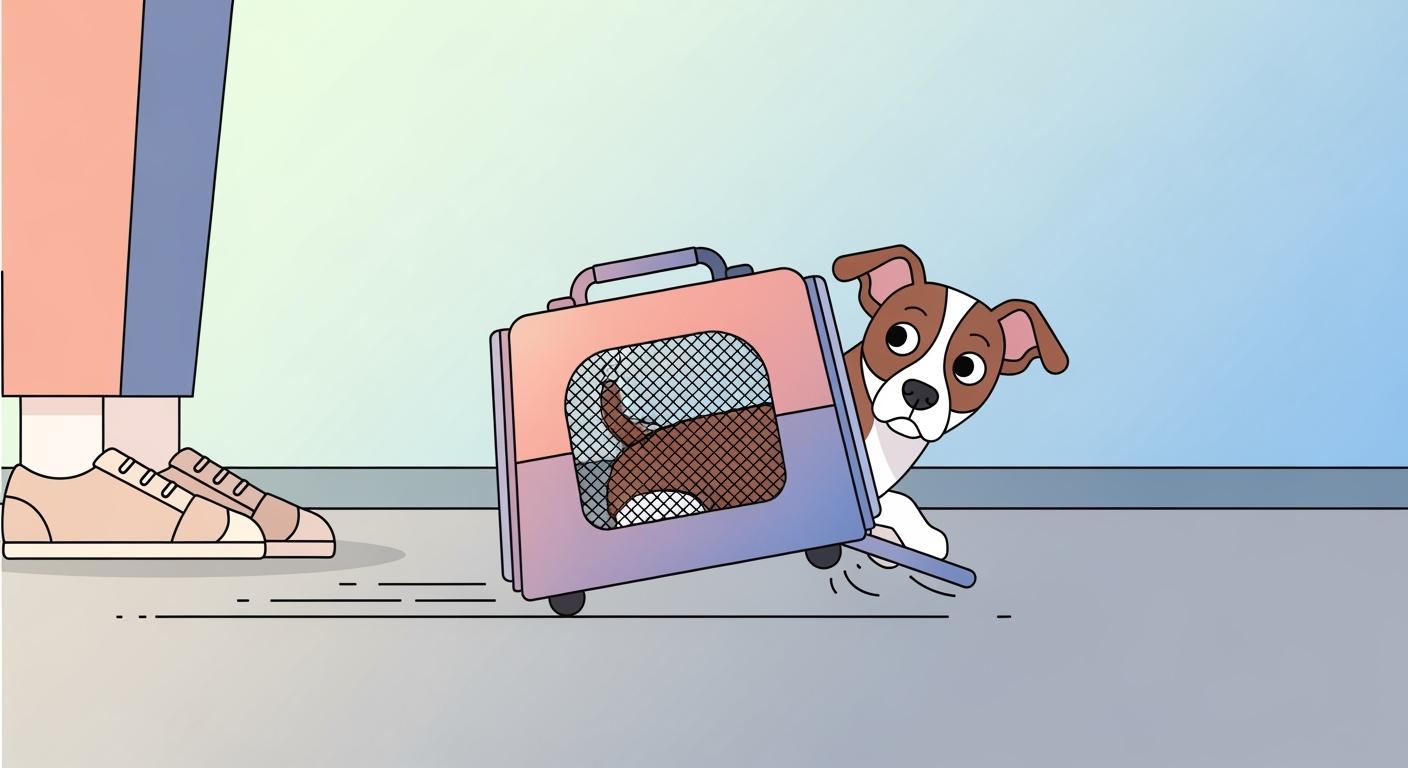
A small dog carrier tips because the base bends. That is the root cause. Everything else — the shoulder pull, the dog sliding to one end, the constant readjustment — follows from a single structural decision made during design: whether the floor panel resists flex or gives way under load. When you pick up the carrier and the bottom sags, the dog slides toward the sag point. The center of gravity shifts. A lever arm forms between where the dog now sits and where your hand holds the handle. That lever arm is what you feel as lean. On short trips through city lobbies, waiting in lines, or moving from car to store, this instability turns a quick errand into a constant correction loop.
Why a Soft Carrier Tips — It Starts with the Base
The Mechanics of a Sagging Floor Panel
Picture the carrier as a suspended platform supported at the handle points. When the base is flexible, the dog’s weight concentrates at the geometric low point — the center of an unsupported panel, or the rear edge if the handle anchors are set forward. The dog slides to that low point. The combined center of gravity of dog-plus-carrier shifts away from the vertical line running through the handle grip.
That horizontal offset is a moment arm. The weight of the dog multiplied by that offset distance produces a rotational torque around the handle. Your hand and shoulder fight that torque to keep the bag upright. The wider the offset, the more torque. A reinforced flat base shortens the arm by keeping the dog’s weight centered directly under the handle line. No sag. No slide. No torque.
You can verify this before buying. Set the empty carrier on a table and press down on the center of the base panel with your palm. Use the approximate force of your dog’s weight — for a ten-pound dog, press as if compressing a firm cushion. If the panel bends visibly, it will bend more when the dog shifts during a walk. If it holds flat, the first structural test passes. The same kind of base-flex problem shows up across small dog tote carriers that lean outward during a carry, and the underlying cause is almost always the same: an unsupported floor panel.
Signs the Structure Is Failing Mid-Carry
You do not need to wait until the bag tips to know the structure is losing. Early signals appear within the first block of walking. The carrier leans toward one hip and stays there. The opening mouth spreads or folds inward. Your dog braces a paw against one side wall. The handle pressure shifts unevenly across your palm — more weight on the index finger side, less on the pinky side. These are not comfort complaints. They are structural failure signals. Each one points to a specific design weakness: a flexing base, collapsing sidewalls, or off-center handle anchors.
After a five-minute walk, set the carrier down and look at the base panel edge. If the edge has curled upward anywhere, the panel deflected under load and stayed deformed. That deformation grows with repeated use — the material fatigues at the crease line, and the panel sags faster on the next trip.
Three Design Decisions That Steady the Carry
Base Reinforcement: Flat Versus Flexible
A flat base is not about comfort. It is about load-path predictability. When the base stays flat, the dog’s weight distributes across the full panel area. The reaction force from your shoulder travels straight down through the handle, through the sidewalls, into the base, and into the dog — a clean vertical stack. When the base flexes, that vertical stack angles. The dog slides. The force path goes diagonal, and the carrier rotates.
The reinforcement approach matters too. A thin plastic board sewn into a fabric sleeve adds stiffness but can crack at the corners after repeated folding. A high-density foam sheet resists cracking but gains thickness that reduces interior space. Removable stiffening panels let the user trade setup time for packability — the panel slides out for flat storage, back in for use. The design decision here is not “stiff or soft” but “how much stiffness at what weight and bulk penalty.” For daily errand use, dog carrier tote bags built for daily routines typically favor a fixed foam base over a removable insert — fewer steps between grabbing the bag and walking out the door.
Sidewall Structure and the Deflection Feedback Loop
A sidewall that collapses inward under pressure does more than look sloppy. It starts a feedback loop. The dog shifts weight toward one wall. The wall deflects. The dog’s weight moves farther off-center. The bending moment on the wall increases. The wall deflects more. The cycle runs until the dog hits the opposite wall or you counterbalance hard enough to arrest it.
Structured sidewalls — panels with a stiffening layer, whether foam-backed fabric, a plastic frame, or dense webbing — stop this loop at the first deflection. The wall resists the initial lean. The dog’s weight stays centered. No feedback loop forms. You can test sidewall stiffness in-store by pressing inward on the side panel at mid-height with two fingers. A wall that gives more than about half an inch under moderate pressure will give more under a shifting dog.
This dynamic also determines whether the ventilation mesh stays open. Mesh panels without a structured frame collapse when the dog leans, blocking the airflow they are supposed to provide. A framed mesh panel — where the mesh is set into a rigid or semi-rigid border — holds its shape and keeps air moving even when the dog presses against it. For carriers used on warm days, the materials and structural choices in sling and tote carriers separate designs that breathe under load from designs that only breathe when empty.
Handle Placement and the Center-of-Gravity Problem
Handles that attach forward of the carrier’s midpoint create an immediate lever arm. The dog sits behind the handle line. The bag tilts backward the moment you lift it. Handles set too wide apart let the bag rotate side to side with every step — each handle strap becomes its own pivot point, and the dog’s weight swings between them like a pendulum.
Centered handles aligned with the bag’s midpoint — or a single shoulder strap anchored at the front and rear edges — keep the lift point directly above the expected center of mass. The carrier hangs vertically. The weight splits evenly between the two handle straps or runs straight down the line of a single strap. You can test this in seconds: load the carrier with weight, lift it by the handles, and check whether the bag hangs level or tilts. A tilt of more than a few degrees means the handle anchors are positioned for a different load distribution than the one your dog creates. The balance problem that shows up here is the same one pet carrier tote bags with poor support and balance exhibit — one-handed access is useful, but only if the bag is not already fighting your grip.
| Design Difference | Why It Matters | Where It Falls Short |
|---|---|---|
| Reinforced flat base vs. flexible fabric floor | Keeps dog centered under the handle line; prevents the sag-and-slide chain that creates rotational torque | Adds weight; a non-removable stiff base makes the carrier harder to fold for storage |
| Structured sidewalls vs. soft fabric sides | Breaks the deflection feedback loop that amplifies dog movement into carrier sway | Increases bulk; structured panels do not collapse flat when empty |
| Centered handle anchors vs. forward-set handles | Eliminates the static tilt that starts before the dog even shifts position | Centered handles can interfere with top-opening access if not designed with a wide enough mouth |
When a Flat-Base Tote Works — and When It Does Not
Short Errands with a Calm Dog
The flat-base tote is optimized for short-duration carries — ten to thirty minutes — with a dog that sits or lies still. City lobbies, vet waiting rooms, walking from a parked car to a store. The carrier holds its shape. The dog stays put. The handle stays balanced. You do not adjust anything mid-walk.
Calm small dogs that settle into the carrier and watch the world go by are the best fit for this design. The carrier provides a defined space. The firm base gives the dog a predictable surface underfoot — no sinking, no sliding, no need to brace. For urban routes where stairs, elevators, and narrow doorways are unavoidable, urban-carrying solutions built around a structured tote tend to hold up with less mid-errand adjustment than soft-sided alternatives.
Where the Design Falls Short
A reinforced flat base and structured sidewalls solve the stability problem, but they do not solve every carrying problem. The design trades packability for structure. It folds less compactly. It weighs more than an unstructured soft tote. These trade-offs are acceptable for short errands. They become liabilities in other scenarios.
Dogs that push hard against the carrier walls — whether from excitement, anxiety, or a tendency to stand and turn repeatedly — can overwhelm even a structured compartment. The sidewalls resist deflection, but a determined dog creates forces that shift the entire bag against your body. The harness system on a tote — typically just handle straps — has fewer anchor points than a backpack carrier, so it cannot fully constrain internal movement. For these dogs, a small dog handheld carrier with a closer body fit or a crossbody sling that wraps the dog more snugly may reduce the internal shifting that a tote’s open compartment allows.
Long walks, hot weather, and dogs that need ventilation above all else also push against this design direction. Structured compartments retain more heat. Mesh windows help, but framed mesh still restricts airflow more than an open-top carrier. For a ten-minute lobby crossing this is irrelevant. For a forty-minute walk on a humid afternoon it is not.
Disclaimer: The base-panel press test described here assumes a smooth-coated dog of typical proportions for its breed. Double-coated breeds may compress the base differently — the coat itself acts as a distributed padding layer that can mask a mild panel flex during static testing, only for the flex to appear during motion when the dog shifts and the coat compresses. If the dog has an unusually deep or narrow chest relative to its breed norm, the weight distribution inside the carrier may concentrate at a point the base panel was not reinforced for, creating a flex zone this article’s general checks will not catch. In those cases, load the carrier with weight equal to your dog and carry it for five minutes indoors before committing to outdoor use.
FAQ
Why does my small dog carrier lean to one side even when I hold it level?
The dog’s weight has shifted off-center inside a compartment with a flexible base. The base sags at the heavy point. The sag creates a slope. The dog slides farther. The center of gravity moves laterally away from the handle line, forming a lever arm that pulls the carrier toward the heavier side. A reinforced flat base stops this by refusing to sag — no slope forms, so the dog cannot slide, so the center of gravity stays under the handle.
Can I fix a carrier that tips by adding a stiff insert?
Sometimes. A rigid insert cut to the base dimensions can restore a flat floor and improve stability, provided the sidewalls have enough structure to contain the dog once the base is flat. If the sidewalls are also soft, the base insert fixes only half the problem — the dog may still lean against a collapsing wall and shift the bag’s balance. An insert works best as a retrofit for carriers whose primary weakness is the base panel alone.
Does a structured tote carrier work for a dog that moves around a lot?
Less well than for a calm dog. A structured compartment resists deformation, but it does not immobilize the dog. An active dog that stands, turns, and shifts repeatedly creates a moving load that a tote’s two-point handle system cannot fully constrain. A crossbody sling or a backpack carrier with a three-point harness system — waist belt, sternum strap, and load-lifting straps — handles internal movement with less transmitted sway.






